
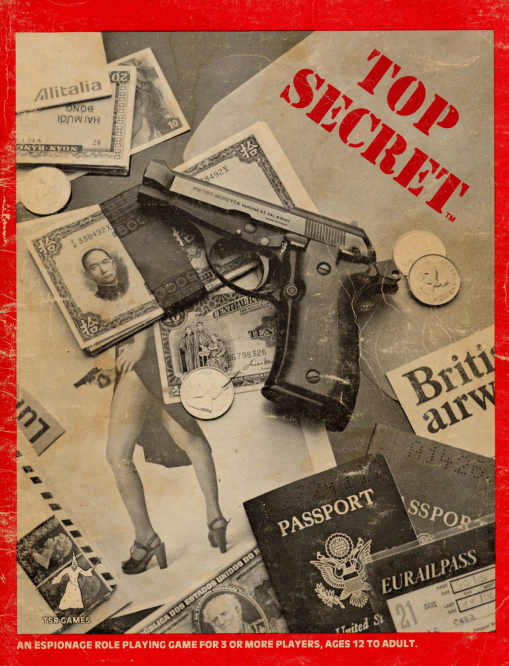
This isn’t a long one. Dunder Moose got me thinking again about the Top Secret RPG. I’m not addressing his question here, but I pretty much already addressed it here. Going back to look at the Top Secret rules reminded me of something, I wanted to document here.
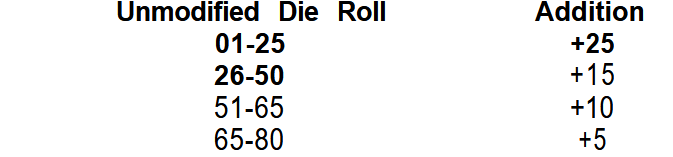
If you take a look at the Top Secret character generation rules you run into this table used for generating what they call traits but generally RPG jargon would call attributes.
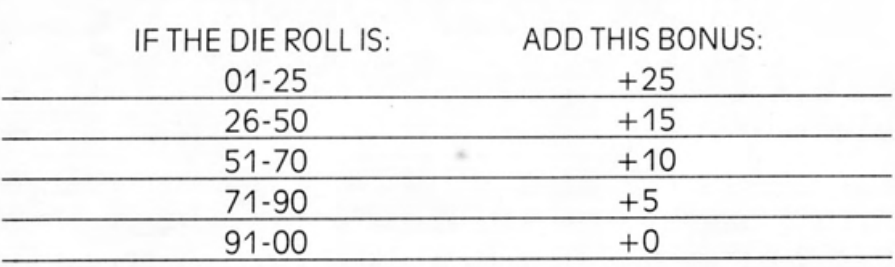
It made me think, “I’ve seen this before”. Of course I did, because I’ve played the game. But I’d seen it before in other places. Most recently in the other TSR RPG Gang Busters which features this table for “Abilites”.
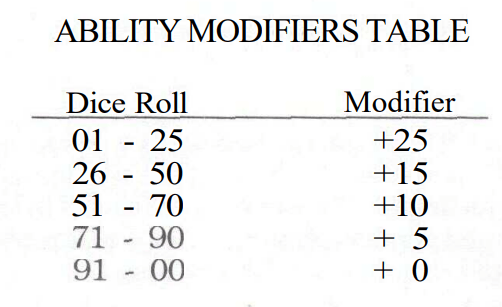
And, also in this table from second edition Boot Hill.
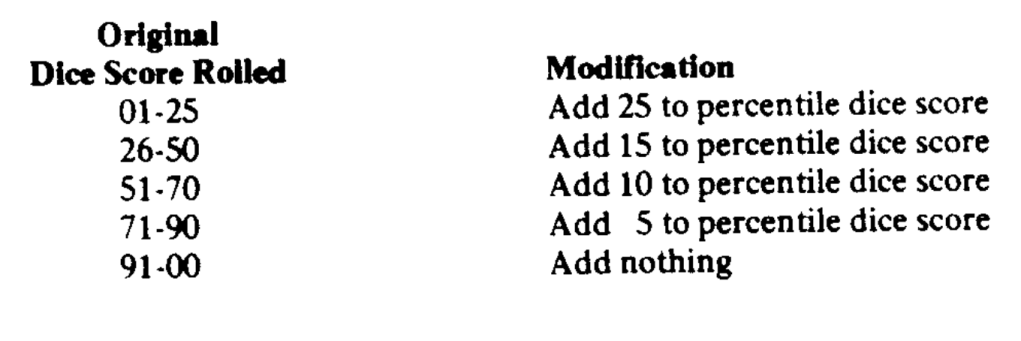
First edition Boot Hill features a similar table but someone different, though the overall approach is the same.

Dragon Magazine #47 (1981) features a new TSR RPG called Crimefighters which has this table which while not identical to those in Top Secret, Gang Busters, & Boot Hill is close enough to think there is a lineage here.
Now, everyone knows, that Dungeons and Dragons uses a 3d6 system (or variants) to generate attributes. And, Dungeons and Dragons spawned many variants of the game within TSR. I’m not going to go into each one but there were several versions of “Basic” D&D, Expert Sets, Advanced D&D, etc. But it looks to me that in 1975, the year after D&D was published, TSR, with Boot Hill, spawned a separate system for RPGs which they used as a starting point in applying the RPG concept to various fictive genres. Which led me to compiling a table of my own.
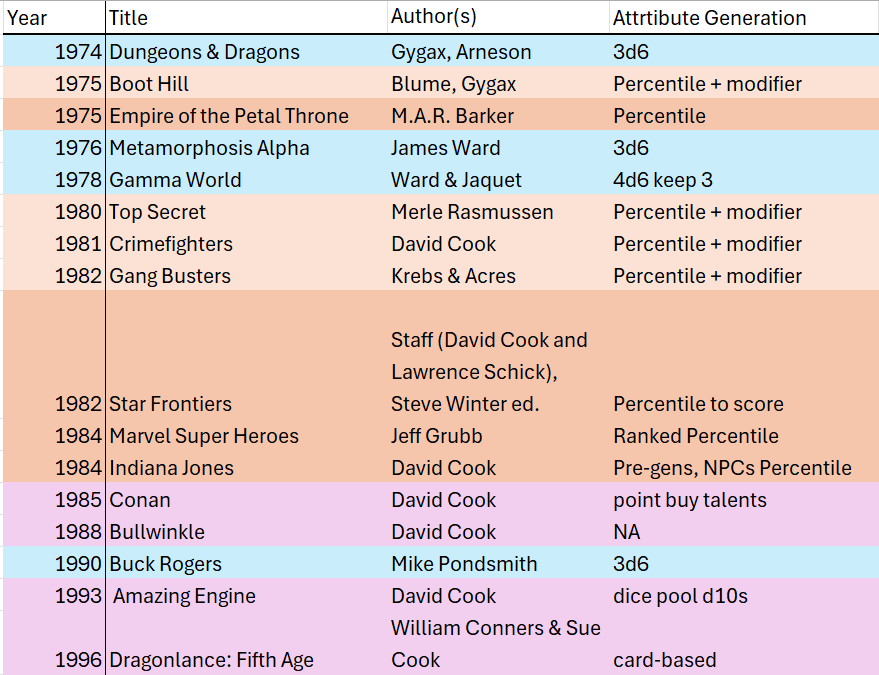
Now, this table does not include all the various versions of D&D and D&D setting books. While there are differences in the rules between various versions, they are close enough to say they are all genetic varients of the same thing. And, TSR published other RPGs that relied on the 3d6 approach: Metamorphosis Alpha, Gamma World, & Buck Rogers. Meanwhile Boot Hill spawned: Top Secret, Crime Fighters, andf Gang Busters. Plus, if you look are systems that use a percentile system either straight or ranked in some manner, then you also have Empire of the Petal Throne, Star Frontiers, Marvel Super Heroes, and Indiana Jones. These last, I can’t truly say are descendants of the Blume/Gygax system of Boot Hill, though I suspect Star Frontiers may be.
Yet, at face value, it looks like Boot Hill Spawn as many clear descendants within TSR as D&D did. And, Boot Hill may have a bastard or two in the closet as well. Now, I would argue that within D&D, the various games use more consistent mechanics than the Boot Hill offshoots. For the Boot Hill offshoots there is a pretty wide variation in rules for things like combat and character development.
To be clear, I am not saying Boot Hill was as influential as D&D outside of TSR. The ’70s and early ’80s spawned many games by other companies that also chose the 3d6 mechanic or something close to it. And, yes, many other companies also created percentile based attributes and mechanics that clearly have nothing to do with being inspired by Boot Hill. Percentiles aren’t exactly a unique idea and, really, seem like an obvious approach.
Also, it seems clear that post 1983 (the TSR split and Gygax sent to Hollywood) on, other than D&D products, TSR was choosing to produce products mostly divorced from anything specific that Gygax had a hand in. Mike Pondsmith’s Buck Rogers being the only non-D&D game produced using 3d6.
Now in 1979, with the publication of the Dungeons Masters Guide (DMG), Gygax included rules for converting characters to and from Gamma World and Boot Hill. Because Top Secret, Crime Fighters, and Gang Busters all use an approach either exactly or similar to Boot Hill, it seems like it would not take much effort to produce conversion rules for these games as well.
Upshot, it looks like Gygax (with collaborators) produced two approaches to generating character attributes, which he then chose to loosely unify with the DMG. Nonetheless, post 1979 the later games produced retained the modified percentile system rather than use a 3d6 approach. It’s not clear to me why that was, except to speculate that Brian Blume who was heavily involved in running the company at that time may have favored projects descended from prior things he’d worked on himself. Of course, post Gygax’s ousting in 1985, the company had a lot of interest in no longer creating works based on his prior art, even if Blume had also contributed. And, that is what we see with the history.
But, within TSR, for roughly the period Gygax was involved, Boot Hill seems to have had an influence in game design at least as influential as D&D.


Leave a Reply