
Disclaimer, for the purpose of this post, I’m using Druid spells as the examples, but the same lessons can also be had for Clerical and Magic-User spells.
In AD&D (and I guess most forms of D&D) there are essentially two kinds of spells. First, spells useful in the moment. Second spells useful over periods of time, or that bring benefits of a more lasting nature. Most spells are of the first category. But some of the more interesting spells are the second category.
Within these two groupings spells can be scaled roughly in terms of how powerful are their effects. That is, they are large spells or small spells. Now, of course, all these things are continuums and subjective. There are mediums. But thinking in these terms is useful I think.
Now, the shorthand is that spells are able to be used (after memorization) once per day. But it isn’t strictly true. The Dungeon Master’s Guide (DMG) page 40 clarifies the time upon which spells can be recovered.

This is important. So, for example, a first level druid can memorize two first level spells while a first-level magic user can memorize but a single first level spell. But, also, clerics (and druids) of high wisdom may get extra first level spells.
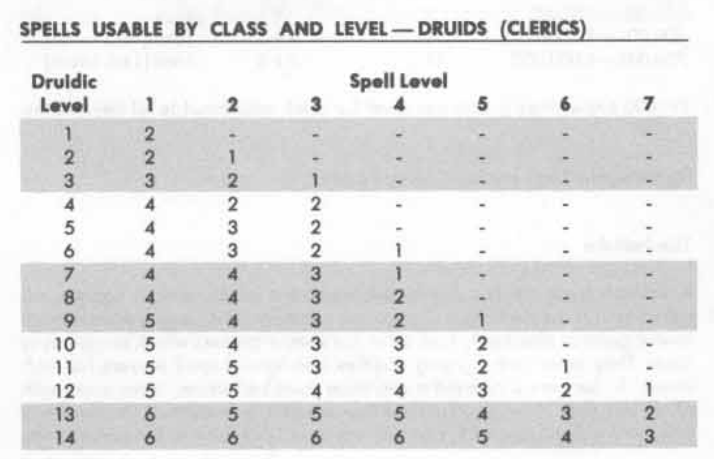
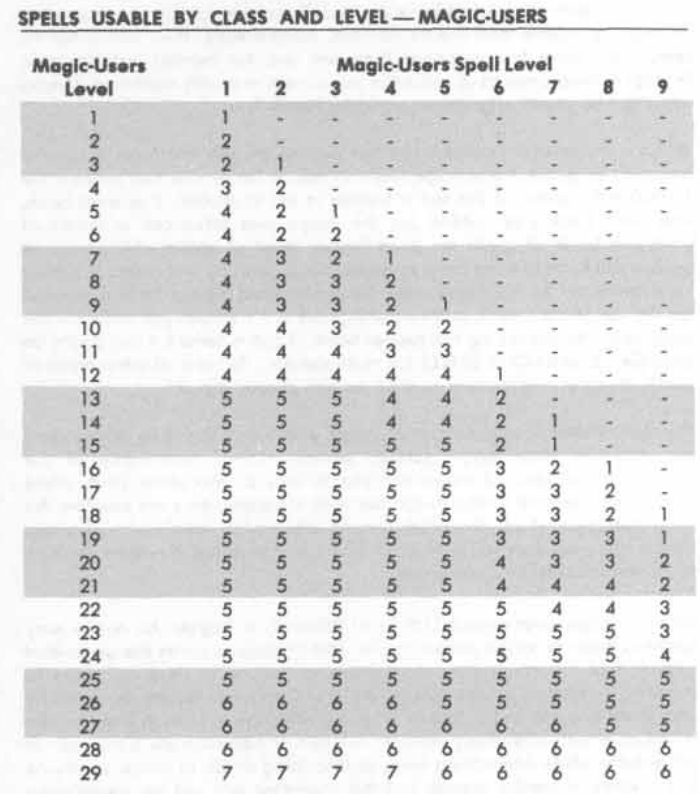
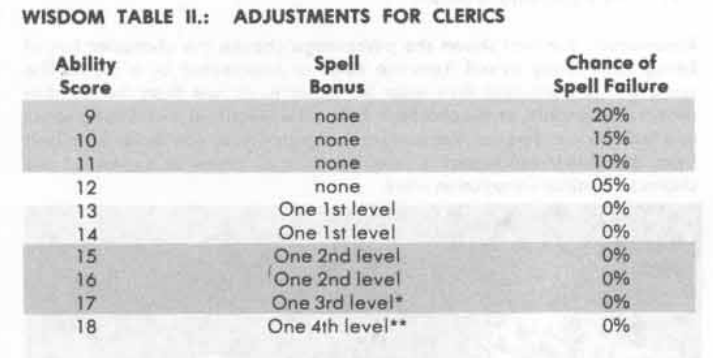
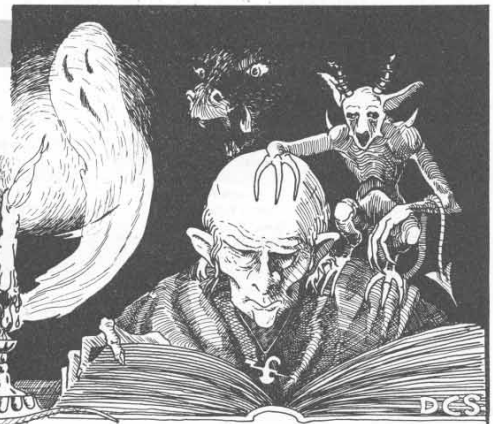
So, a magic user gets one spell at first level. While a high wisdom druid might get, at first level, four spells. On top of this, taking into account spell recovery, a magic user could maximize about six castings in a 24-hr day, while this high wisdom druid can maximize at 24 castings per 24-hr period. This is a big difference. But what can be done with these castings?
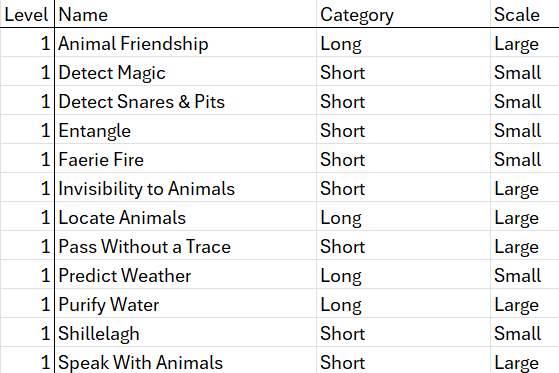
Here I’ve categorized the first level druid spells into the groupings. Most of the short term spells it’s hard to imagine needing to cast them twenty-four times per day. How often would one need to Pass Without a Trace per day? So, let’s take a look at the long term effects, these are Animal Friendship, Locate Animals, Predict Weather, and Purify Water.
Animal Friendship is limited to two hit dice of animals per level. So a first level druid is naturally limited such that one is unlikely to need to cast it so many times per day.
Locate Animals, lasts but a single round at first level and affects a 2″ wide path that is 2″ long per level. Now, assuming that during that single round the druid can walk a full 12″ that means an are 2″ wide and 14″ long. Outside this is 60 feet wide by 420 feet or 25,200 square feet. This is 0.57 acres. Thus, at 24 castings, a druid can search 13.9 acres per 24-hrs for a specific animal. While that’s a fair amount of acres, if one is looking for a herd of deer or something, that’s a small meadow. The druid really is going to need all those castings to really zero into something. Best get cracking.
Predict Weather also has some built in limitations. At first level, predict weather allows the prediction of the next two hours of weather. With four memorized, a first level druid can essentially predict eight hours of weather assuming he does nothing else. But then he must rest for four hours during which nothing is known about the weather. Then, for the first level druid, assuming all time is devoted to it, a druid can predict the weather for 16 hours per day with a four hour break between rests. And, of course, the predictions are in two hour chunks. This could be useful to parties (or armies) on the march. A two-hour warning may well be enough time to seek shelter or dig in.
Purify Water has some abiguities in its area of effect. It says 1 cubic foot/1″ square area are affected. I suppose the area listed assumed a shallow puddle with the volume listed as the maximum limit. For our purposes let us just look at volume. So our wise first level druid could purify up to 24 cubic feet of water per 24-hr period. Depending on the assumption of water needs, that’s enough water for a couple hundred people per day. Similarly, the reverse of the spell Contaminate Water, might be sufficient to wreck a small villages well.
Now, for second level spells, I’m only going to look at a single spell, Charm Person or Mammal.
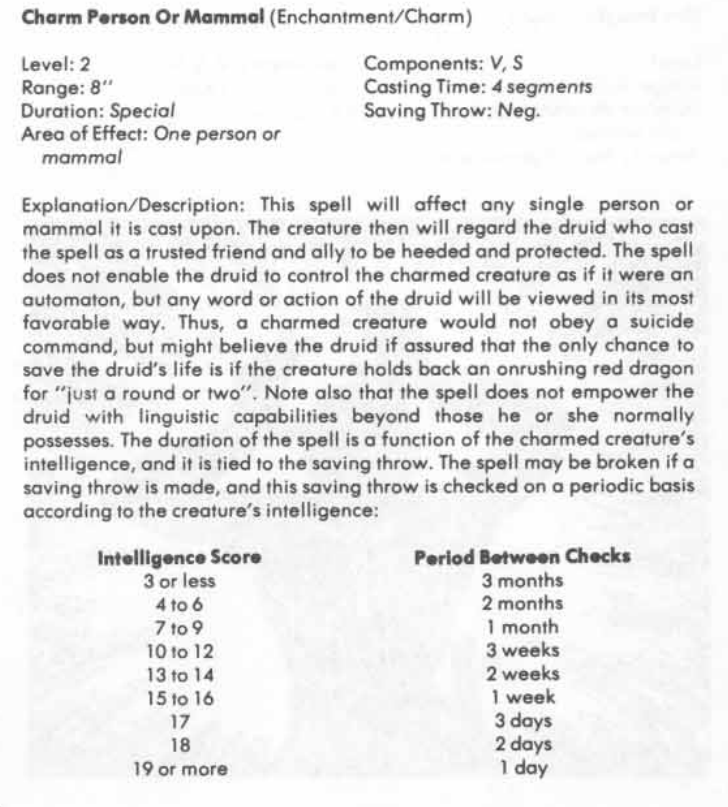
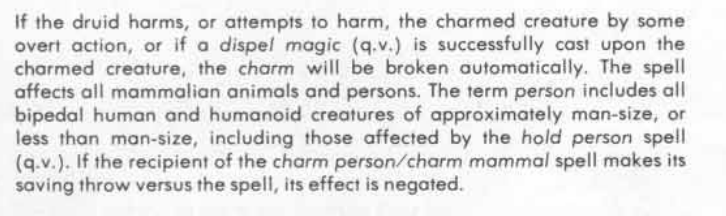
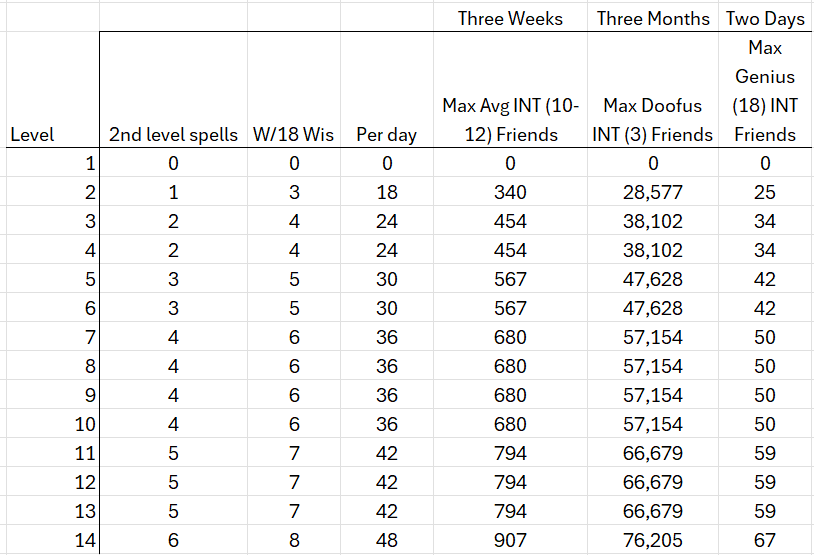
At second level an 18 WISDOM druid who sets his mind about it can use Charm Person or Mammal, eighteen times per day. For zero level NPCs, the saving throw is 19 and 20, so a ten percent chance of saving. This means, over a three week period (the length of effect on average intelligence) a second level druid can have 340 “friends. The 14th level Great Druid can have 907. Similarly, if the druid seeks out the semi-intelligent, INT 3 types, even a low level druid can befriend (over three months) thousands of doofuses. The doofuses automatically fail their saving throws. Or, if he seeks out the 18 intelligence geniuses (who have thirty percent chance to save), a second level druid can still make friends with 25 of them, and the Great Druid 67.
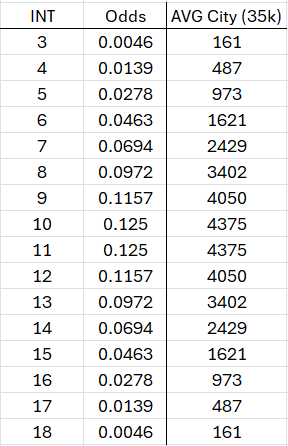
Now, these maximums. There are no doubt shortages of true doofuses just as there are shortages of true geniuses. In a average AD&D city of 35,000 there should be only 161 of pure doofus heart and the same amount of true genius.
I think it pretty obvious that a druid who sets his mind to it, can dominate a typical village. And, a high level druid should has a real ability to influence the politics of a decent sized city.
But what about the mammal part of Charm Person or Mammal? The Monster Manual (MM) gives this explanation of the intelligence groupings.
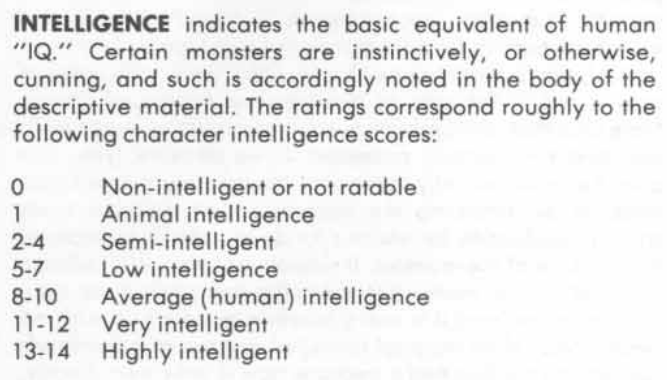

Those of semi-intelligence automaticaly fail their saving throws. Most animals will be charmed. Dogs and Bears are of semi-intelligence. Giant Beavers, are low to average intelligence — so they get a saving throw. The generic Herd Animal is of animal intelligence. Upshot, every druid who sets their mind to it, should be able to essentially have near every mammal animal within his region friendly to him. This is a thing he should be doing during downtime.
Again, there are natural limitations to this, and finding the animals is one of them. These charmed animals are friendly but they are still animals, they aren’t doing tricks for the druid. The spell Animal Friendship is for that. But, imagine every bear in the forest is your friend? Or, every buffalo in the herd is your friend, this still has great utility. Druid downtime should be spent finding animals (locate animals spell) and charming them. They will love him for months on end.
Magic users may also have charm person too. And, at first level. Now, magic users are much more limited on the spells-per-day allowed than druids. Nonetheless, magic users during downtime should be out there making friends and influencing people.
Now, I already can see the criticisms. This breaks the game. A good referee will not allow it. Blah, blah, blah. A referee would not hinder a fighter in recruiting as many men-at-arms as he could, would he? Or, force fighters to not wear armor. Spell casters like druids take limitations in armor and weapons they can use in exchange for magic power. Spell casters should be allowed to maximize the use of this power because they constantly suffer the limitations thereof. It does not break the game, it is the game. Let the spell casters play it.
So, the methodology of looking at whether a spell is long or short in duration and large or small in effect is usefull in identifying where downtime can be used to maximize a spell caster’s affect on the world. Look for long duration and large effect spells for this purpose. An example of long duration and small effect is the fire trap spell. The damage is modest (1d4+1 point per level of the caster), but the effect is permanent until triggered. I really need to be casting fire trap more often.
There are short term large effect spells (e.g the classic fire ball) that often have obvious uses. Some though, have limitations on when they can be used. For druids, Call Lightning is an example. Call Lightning is a third level spell and becomes available to a druid upon reaching third level. But, the limitation on the use of the spell is that it can only be used during an existing storm. So, without being able to rely on regular storms, it often is ignored. However, arduous use of predict weather can help.
Sort of. Predict weather only works for two hours into the future and it takes 6 hours to memorize Call Lightning. But, if a storm is predicted, that does not mean the storm ends after two hours. But the period between third level and ninth level can be pretty uncertain whether devoting a spell slot to Call Lightning will be of us. But at 9th level 5th level spells become available including Control Winds. Control winds at first doesn’t look like much, but, it can be used to kick that breeze up a few notches into a storm, and that storm into a hurricane. Then, you will start to see more frequent use of Call Lightning.
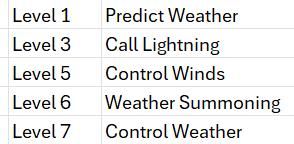
Then at eleventh level, level 6 spells come available. Weather Summoning, can now make using that Call Lightning much more reliable. And, at level 12 (if one is wise enough) the seventh level Control Weather comes around. Control Weather then can be used to send that storm away or redirect it elsewhere, so one does not become the target of Call Lightning oneself. The lesson here is to look for spells that work in conjunction with one another.
Speaking of which, Animal Summoning I, II, and III may come in pretty handy at deploying those charms onto the mammals.
In any case, hopefully, this discussion is useful in providing a methodology in thinking about spells, their use during downtime, and how they can reinforce one another when properly used.


Leave a Reply