
What the heck are Hit Dice in AD&D? Well, the Dungeon Masters Guide (DMG) gives a definition.

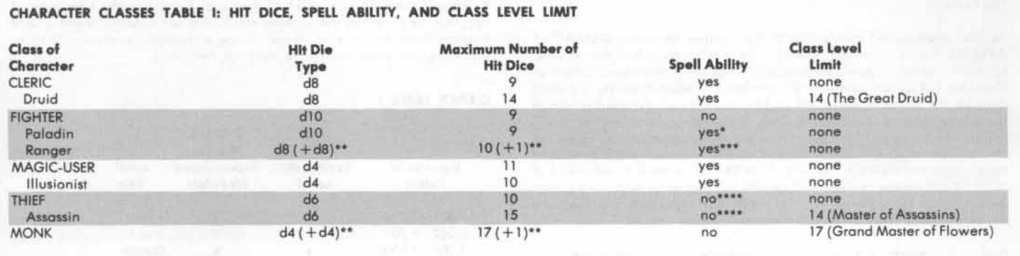
The Players Handbook (PHB) has the same definition essentially though it also explains how to determine hit points for multi class characters. PHB provides a summary table for each class.
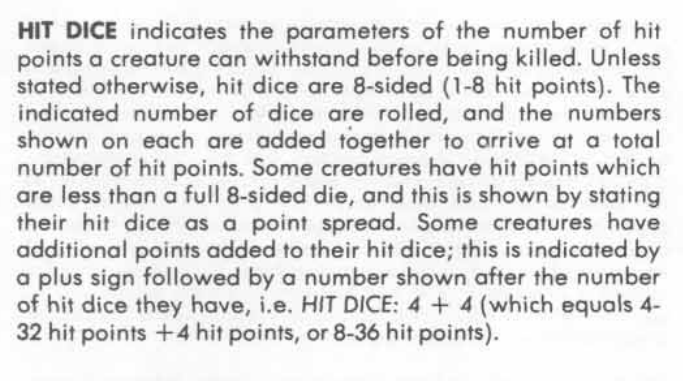
The Monster Manual (MM) also defines hit dice. The MM uses the same definition plus also defines the die used (d8) for monsters. Plus is allows that some “monsters” may use other dice as specified and also their may be hit point additions or substractions from the standard hit die.
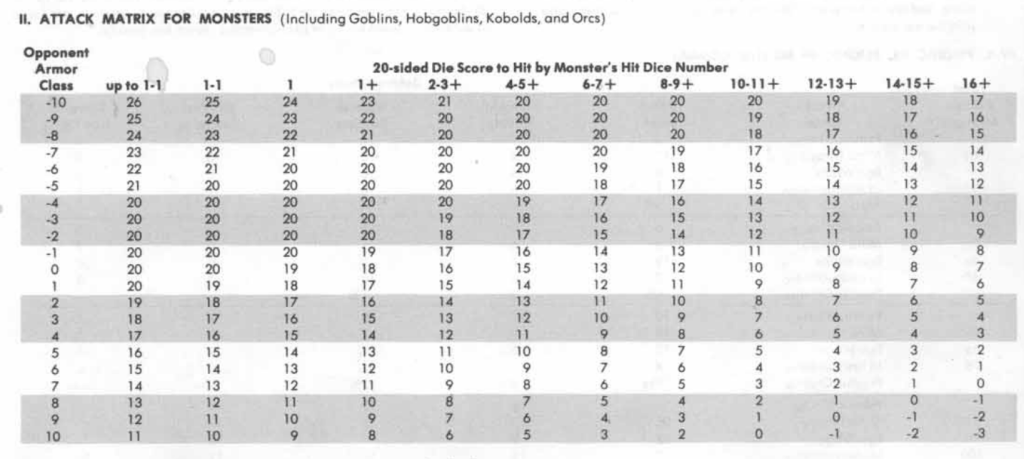
For monsters the hit die also determines the odds of hitting in combat (mostly). One can see from the table that the additions or substractions from hit dice have an affect on the the odds of a monster hitting in combat.
While hit dice for characters do not determine the odds of hitting in combat. For characters, the odds of hitting are determined by level. And, for humans there is such a thing as a zero level.
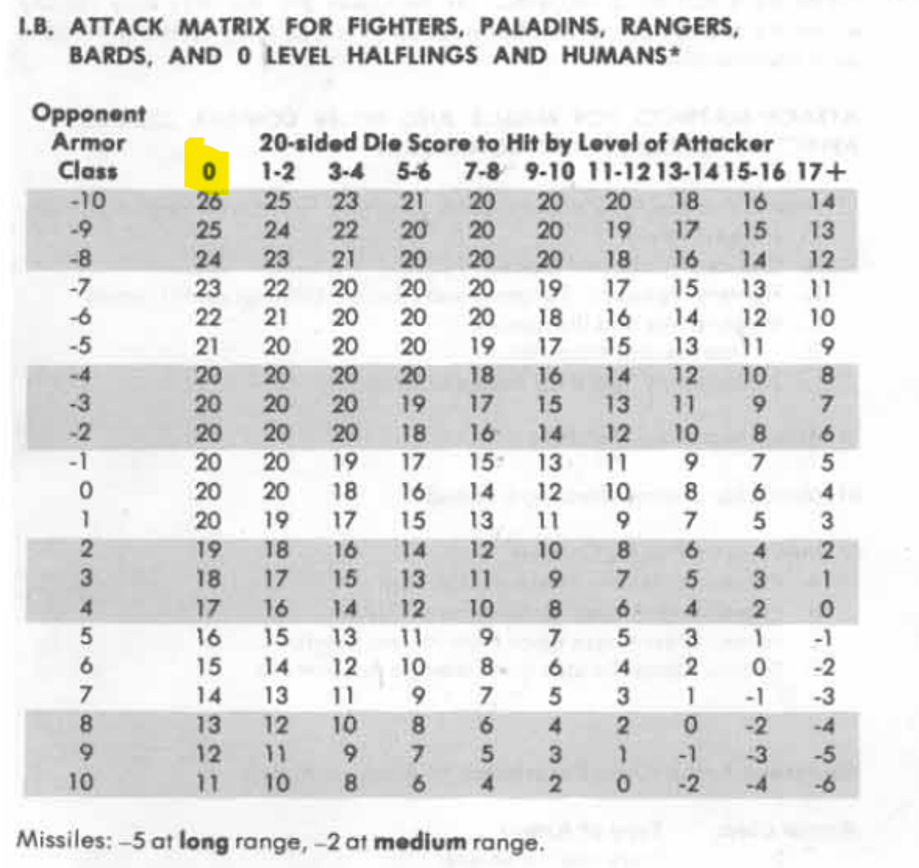
But what is the normal hit dice for normal humans? There, sort of isn’t one. Humans attack as level zero. But what about their hit points. Aren’t hit points determine by hit die as defined? Well, the monster manual has the section category of “Men” within which, no surprise, are given the details for several categories of men: bandits/brigands, berserkers, buccaneers/pirates, cavemen/tribesmen, dervishes/nomads, merchants, and pilgrims.
Most of the categories of “men” are listed under hit dice as having 1-6 hit points. So, men is one of the exceptions to general MM rule of a hit die of d8. Men attack as level zero and predominantly have a d6 for hit points. Or, do they?
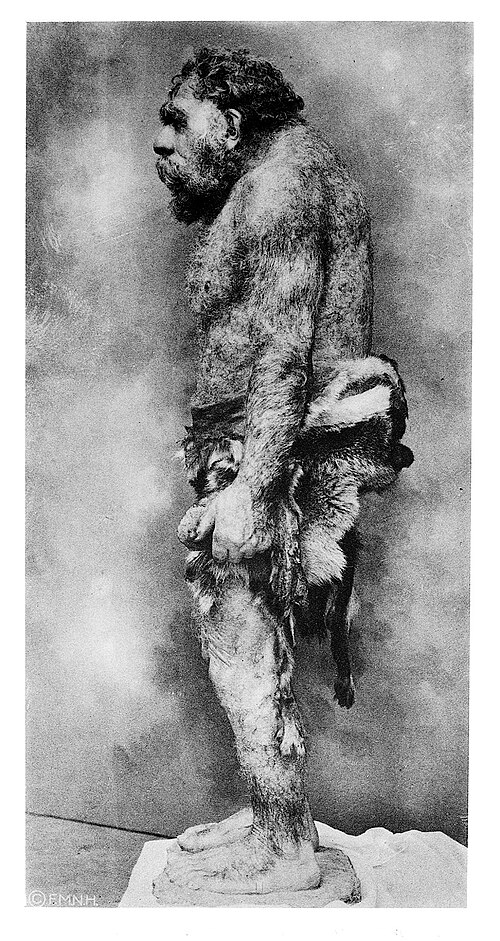
The first exception to the d6 rule is berserkers who have 2-7 hit points (d6+1), yet still attack as zero level. The second exception are cavemen and tribesmen. Cavemen are listed as having two hit dice and tribesmen are listed as having one hit die. Those are standard d8 hit dice. The implication here seems to be that berserkers are human but of a tougher stock while cavemen and tribesmen are something other than men. Cavemen might be considered as soemthing like neanderthals, pre-human ancestors of men. Tribesmen on the other hand are men, yet living such a different and hard existence that they fall into the non-man grouping. Take that as one will.
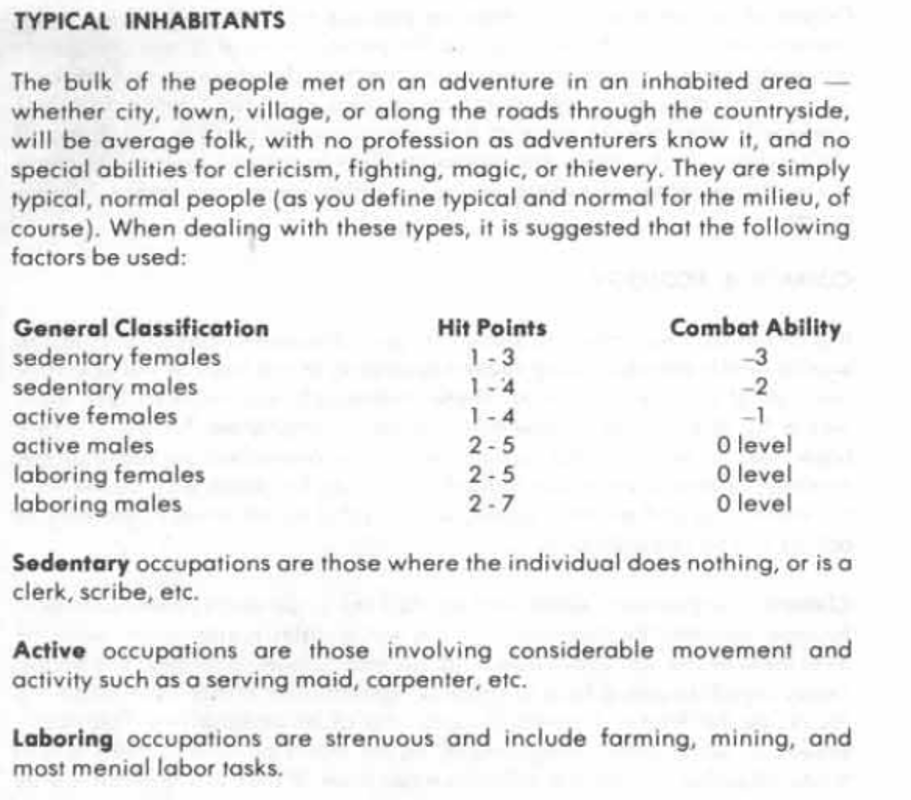
The DMG also defines several groupings of men (humans). What is referred to as “typical inhabitants”. These are the human peoples of the towns and villages a character might pass through.
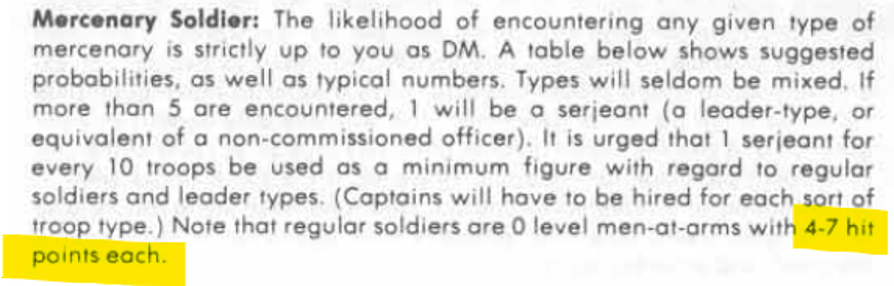
Also defined in the DMG are mercenary soldiers.
Putting all these side by side there are some conclusions to make.
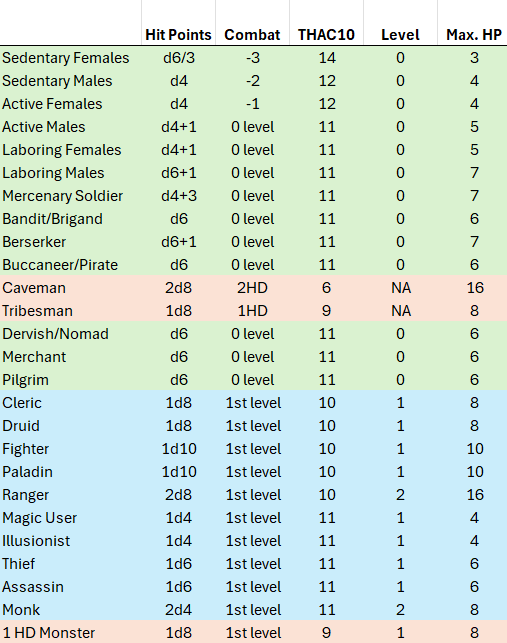
First. For the MM “men” the d6 is the norm. While for “typical inhabitants” the d4 is not the rule but the most common (with modifiers) die. For “typical inhabitants” only the laboring male gets a d6 and he gets a +1 which might imply a consitution modifier of CON 15 or greater. This is tougher than your typical man in the “men” category, really equivelent to berzerkers. Apparantly, the other types bandits, bucaneers, dervishes, merchants, and pilgrims don’t work as hard as laborers.
What does this imply about the classes? Well, magic users and illusionists get a d4 hit dies which is equivelent to the more sedentary types (nerds). While the thief and assassin classes are more akin to the active men from the MM or the laboring men of the DMG. Fit people, who nonetheless aren’t necessarily active combat types but who aren’t going to avoid a scrap if pushed in that direction. The cleric and the druid, with their d8 hit die, are the first deviation above those of normal men. These classes clearly have some training in combat that puts them a step above the typical man. The fighter and paladin have similar training in combat but also physical conditioning beyon that of “men”. The fighter types push themselves to excel phyically. This is also reflected in the greater constitution bonuses these classes also earn.
Finally there are the exception classes of ranger and monst. Both of these classes start with two hit dice. Unlike the other fighter classes the ranger only uses the d8 for hit points, but at first level he gets two of them. The d8 mirrors that of the cleric and druid. I divided the cleric and fighter as combat training versus combat training and physical conditioning. The d8 would imply a combat training level much like a cleric/druid but not the punishing physical conditioning of the fighter. So, where does the extra hit die come from? Well, were do hit in the classes normally come from? Experience. So, while the first level ranger may only fight as level one, his hit points reflect additional experience with avoiding physical dangers. The ranger has spent a lot of time in the wilderness even at first level. A similar argument can be made for the monk. The monk’s hit die reflects that of an ordinary sedentary human. The first level monk has likely already spend a lot of time meditating. But the monk’s extra hit die reflects he also has some unique experience the other classes do not have, presumably time spend learning the basics of unarmed martial arts techniques.
The last to look at is the mercenary soldier. The mercenary soldier starts with a heavily modified d4 hit die (d4+3). So, in this regard, the mercenary soldier is basically a sedentary human that has undergone abnormal conditions. Abnormal being something like the rigors of bootcamp. Now, one might look at that +3 and think it might be a constitution bonus. But, only fighter types get a +3 bonus from CON. Mercenary soldiers are not fighters. Mercenary soldiers are regular guys who ended up joining the military. It’s a rationalization but I reckon that +3 comes from a combo of training and, frankly, forced marches every day. The moment they leave the military, they’ll drop right back to their d4.
Now, what about a 1 hit dice monster. They get hit points like a cleric and druid (d8), which is well beyond that of normal people. Even the toughest normies, laboring males and mercenary soldiers, can never achieve eight hit points. In addition, a one hit dice monster hits AC10 with a roll of eight or better on a d20. While a zero level nomies hits AC10 with an eleven or better. So, one hit die monsters attack as third or fourth level fighters. All, first level character should be wary of one hit die monsters.
How wary? One can ratio the average hit points of the category to that of the average of a d8 (4.5) to get an idea of relative toughness. And, one can create the ratio of to-hit odd for a category to that of a one hit die monster to get an idea of relative combat effectiveness. Then these can be multiplied by each other to get a relative overall effectiveness value.
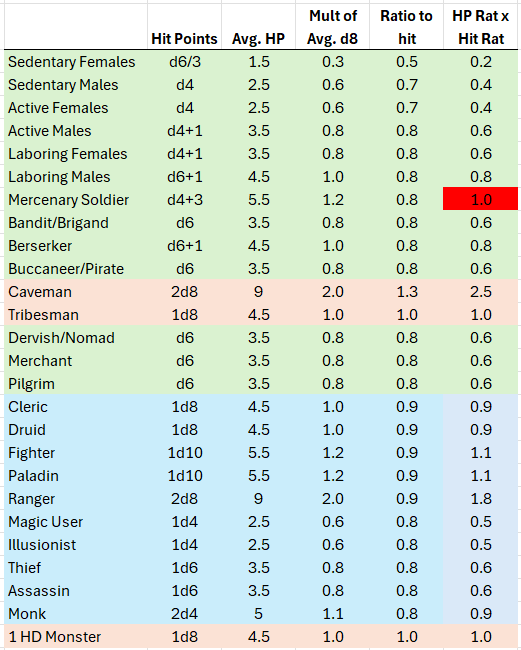
Just looking at hit points only the fighter classes and the monk have an advantage over the typical 1 hit die monster. The ranger especially so. Fighting though, no class has an advantage over the one hit die monster. All classes at first level, just aren’t as skilled and fierce as monsters. Then, taken together, the fierceness of the monster also mitigates some class’s hit point advantages. The ranger still has a real advantage. The fighter and paladin only a marginal advantage. At first level, all other classes fall significantly short of the one hit die monster.
But what about the mercenary soldier? The average hit point advantage of the mercenary soldier is exactly mitigated by his fighting disadvantage. This puts the mercenary soldier as exactly equal to the one hit die monster. Can this exactness be an accident? I don’t think so. Gygax finely calibrating things so that the typical soldier placed on the battlefield would exactly match the typical monster placed on the battlefield. This would be the categories most often present in a massed battle.
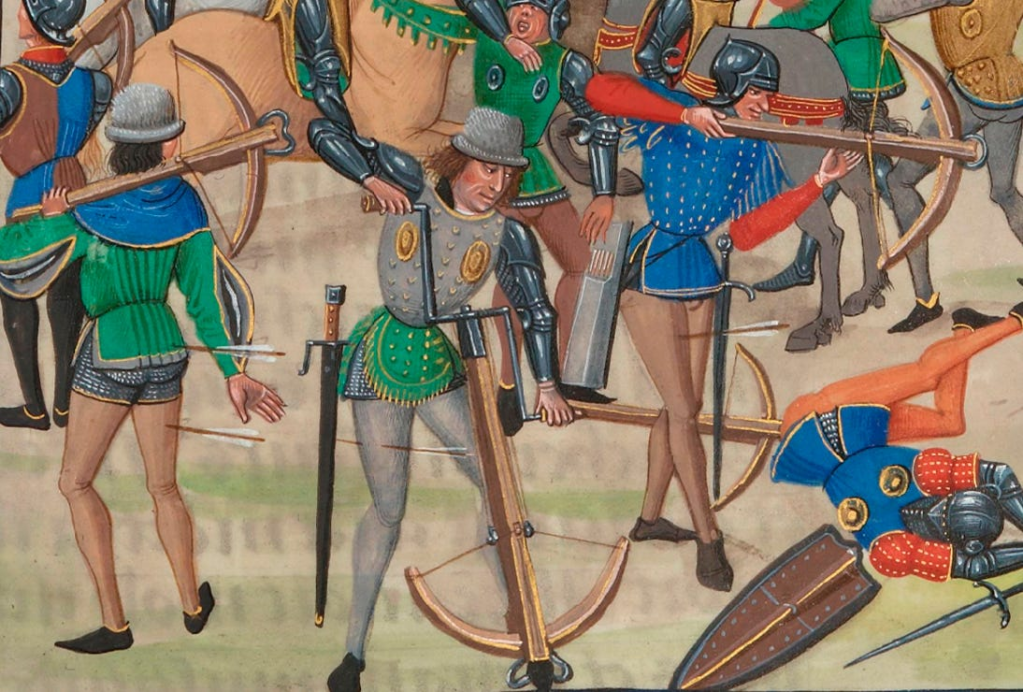
Thus, AD&D shows it’s wargaming roots. But also, makes it easy to carry out the most common types of massed battle with armies comprised of essentially equivelent individuals. The wargaming roots are also shown by the tribesman statistics. Tribesmen versus soldiers being a very common matchup of 19th century colonial era wargaming. The tribemen and the soldiers are equivelent. How very convenient. And, all other types are defined as rather modest deviations from these common battlefield units. From here it is weapon and armor types that vary the outcome of battles.
Yet again, despite what looks to incurious as arbitrary variations, AD&D turns out to be a well thought out system that makes the most common pairings essentially equivelent for ease of play. The elegance of AD&D remains a marvel and vastly underappreciated.


Leave a Reply