
GangBusters is a game focused on the 1920s and 1930s. The main body of the rules are for combat: shootouts, fistfights, and car chases. But the cars were the cars of the era. What happens is we try to bring the game into the 1970s?
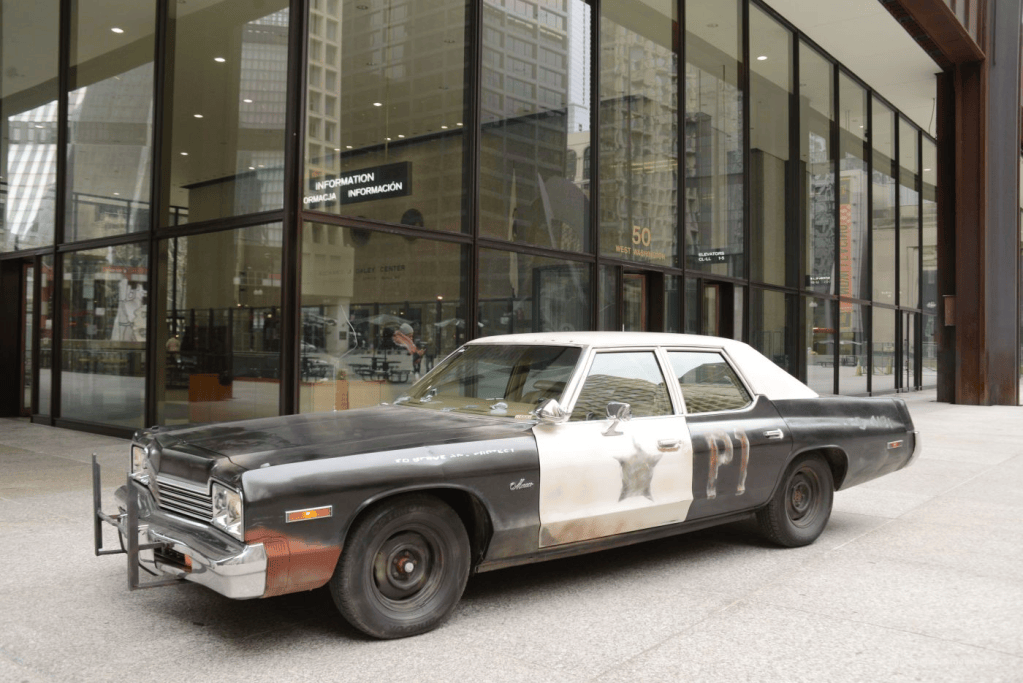
1974 Dodge Monaco
So, what are the current rules? Turns are one second long. HP are hit points, not horsepower. Each car has an acceleration (A) and braking (B) value. The A & B values are the number of turns it takes to change the speed by 10 mph. So, for a car with A?B of 5/2 and a top speed of 50 mph, it takes 25 turns to reach top speed and 10 to stop.
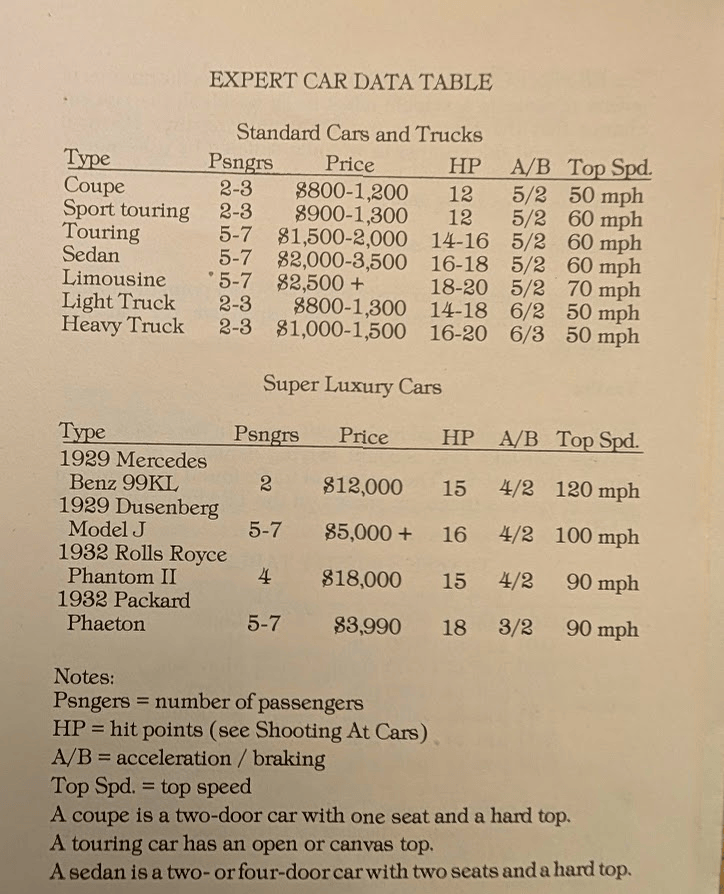
But, these cars are chosen to be representative of 1920s & 1930s vehicles. So what would the statistics for a more modern car look like? Well, let’s take the 1974 Dodge Monaco as an example. This car famously was used for the Bluesmobile in the movie The Blues Brothers.
Accoridng to this site a Dodge Monaco 4-Door hardtop with 200 hp and four barrel carburator will have a top speed of 118 mph and hits 60 mph in 10.9 seconds. So, for acceleration that would be 1.82 seconds per 10 mph accelleration. Round it it 2 for acceleration then. We can see this acceleration is significantly faster than any of the cars listed in GangBusters. I suppose this should come as no surprise given fifty years of progress.
The Ferrari Dino 246 GTS and 246 GT both accelerated from 0–62 mph in 5.0 seconds, making them the quickest production cars of 1974. This produces an A value of 0.8 seconds per 10 miles per hour. It could be rounded to 1 for game purposes.
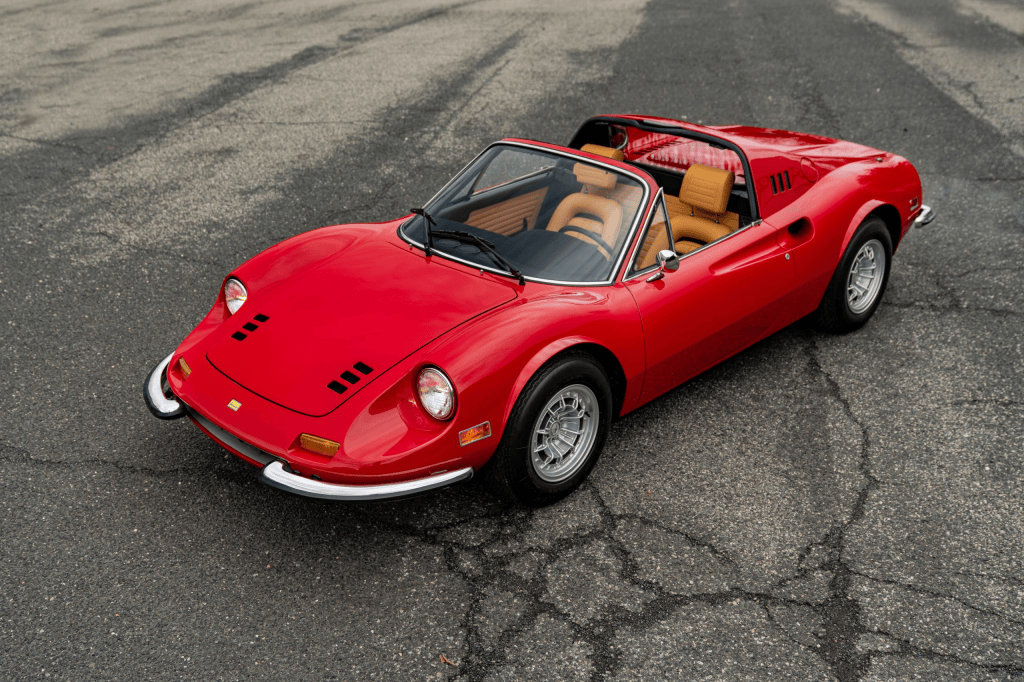
1974 Ferrari Dino 246 GTS
Similarly, a 1971 VW Super Beetle hits 60 mph in 16.1 seconds. 2.6 turns per 10 mph. Which could be rounded to 3. This is slow compared to the Dodge Monaco and the Ferrari. But still faster (or the same when rounded) than the 1932 Packard Phaeton which is the hottest car listed in the GangBusters rules. Upshot, rounding misses a lot of the nuances between vehicle capabilites.
We see this effect for the stock game cars too. All the non-luxury cars have the same A/B. Which does simplify things. Most of the luxury cars also have the same A/B. Performance-wise there is little difference then between vehicles. Maybe that was the case back then? I kind of doubt it. But trying to play the Expert rules as written does raise the question as to what happens when starting from a stopped position. For that car that takes five turns to reach 10 mph and all movement is in increments of 10 mph, does it just sit for four turns, and then leap into action the fifth turn? How is the speed tracked? The game seems to assume one does these things but the details are left to the reader.
Let me suggest some changes. Under standard Expert Rules on page 59, speed is tracked in increments of 10 mph and each 10 mph equates to 15 feet of movement per 1-second turn. There is nothing special about 10 mph or 15 feet per turn, in fact, 15 feet per second is merely presenting 10 mph in different units. So, an acceleration of 5 in the game amounts to an acceleration of 3 feet per second per second. Or, one might think of it as 3 feet per second per turn. So, one could just present the A value as an increase of 3 feet per second per turn, and indeed after five turns, the car would be traveling at 15 feet per turn.
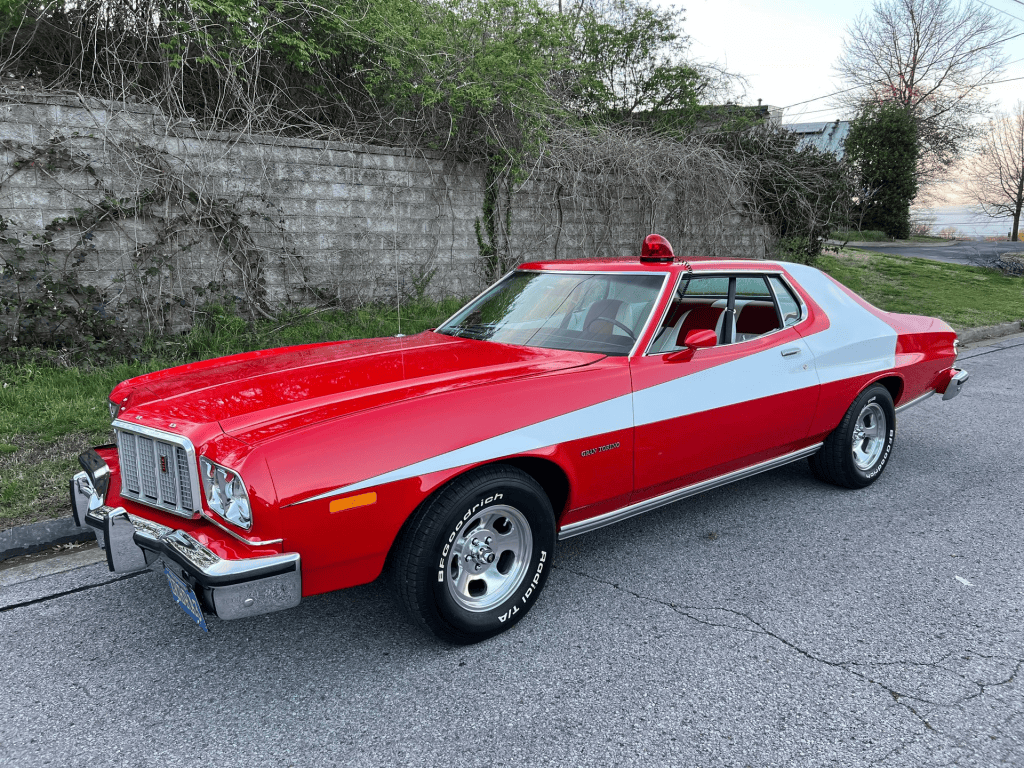
1976 Ford Grand Torino
Let’s look at an example. The car starts stationary, and accelerates a 3 fps. There is no movement the first turn. The second turn it moves 3 feet and continues accelerating to 6 fps. The third turn it moves six feet (total 9) and accelerating to 9 fps. The fourth turn it travels 9 feet (total 18) and continues accelerating to 12 fps. The fifth turn it travels 12 feet (total 30 feet) and finishes the turn having reached 15 fps (or 10 mph).
Now let us suppose, the car in this example then decides to brake to a stop. The D value is 2. This equates to a decceleration of 7.3 (let’s round to 7) feet per turn. To continue the example, on turn six the driver brakes. Starting speed for turn 6 is 15 sps so the car travels 15 feet, and ends the turn moving 8 fps. The seventh turn, the car travels 8 feet (total 23 feet), and deccelerates to 1 fps. The eighth turn, the car travels 1 foot (total 24 feet) and at the end of the turn stops.
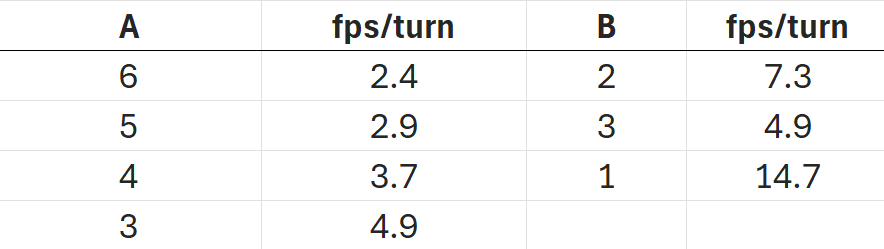
This seems like a pretty straight forward process, and if one wanted to use rulers to measure distance, rather than squares on the map, one would not need to round the feet per second values. Below is a table that shows all the standard 1920s Accelerations and Braking in terms of fps per turn.
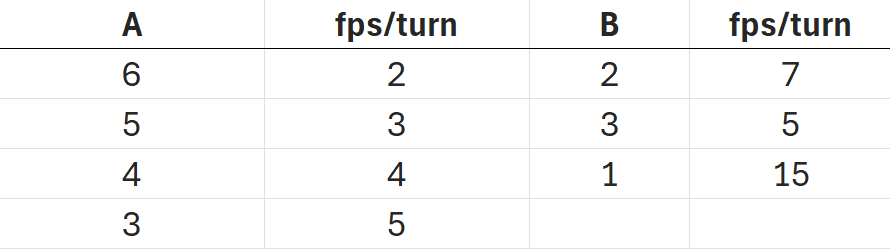
Or, if two digits is too much, here is the same conversion rounded to the nearest integer.
To convert from fps to mph use the table below. I’ve done 5 mph increments. You could interpolate between them, but probably the closest 5 mph is good enough for gaming purposes.

Braking is tricky. Frankly, the GangBusters 2 to 3 seconds per 10 mph is pretty long. In a 1902 Ransom E. Olds won a braking contest by stopping from 14 mph (20.5 fps) in 21.5 feet — so, nearly one second to stop from 14 mph. The GangBusters 2 seconds from 10 mph is 7.3 fps/turn, 3s is 4.9 fps/turn. But there is a bigger problem. 60 mph is 88 fps. Under the 7.3 fps decelleration, it will take something like thirteen seconds and 575 feet to stop. That’s a lot. Even Mr. Olds early brake drum would do something like 6.5 seconds. So, my recommendation for the early cars is to half the Braking value to 1 or 14.7 fps/turn (round to 15).
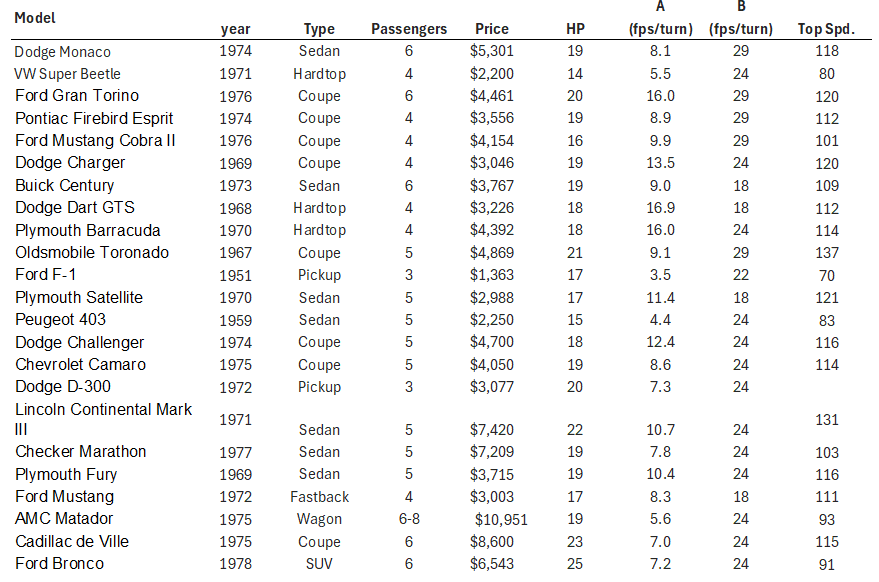
The reality is modern cars stop from 60 mph in about 3 to 5 seconds, or 150 to 175 feet. That gives of range of 18 to 29 fps/turn. Finding data for this is difficult. Manufacturers (and others) make accellerations of zero to sixty pretty available. But stopping times are much less popular. I’m using 24 fps/turn as typical, 29 as performance, and 18 as poor. Note that the modern legal standard isn’t a set value but depends on speed of the vehicle (and other factors), but generally is around 1 g (32.2 fpsps) or 32.2 fps/turn. These values would be around a B value of 0.5.
In any case, here are my stats for cars you might find in 1970s era detective TV shows.
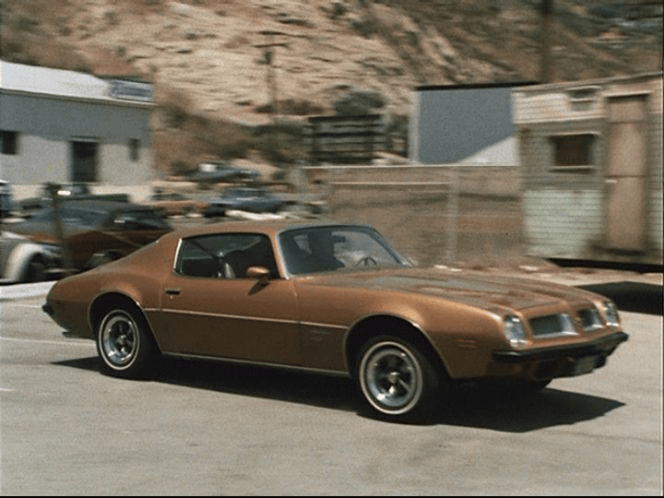
1974 Pontiac Firebird Esprit
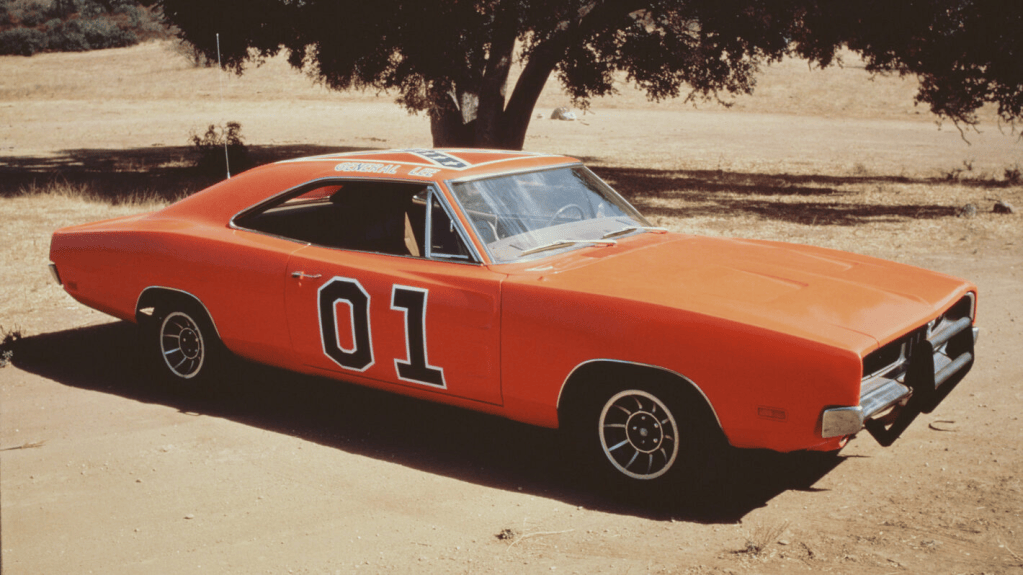
1969 Dodge Charger
One thing to note about GangBusters car stats is there is no fuel efficiency (MPG) value or tank size (gallons). It’s not a game about roadtrips or even long chases. The game is not Car Wars. Mostly, one runs from the bank to the car and gets out of the neighborhood as fast as possible. So, this is all a bit of overkill. Yet, if you want to move the game into the future some updates need to be made. If you want another model of 1970s detective show car, let me know and I’ll make an addendum.


Leave a Reply