
Monks in AD&D are something of an odd man out. While the rest of the game is based on primarily European sources, the monk is based on Asian sources. Or, really, a European or American interpretation of Asian sources and culture. Much like the TV show Kung Fu — invented by a Chinese man melding both West and East, but then taken one step removed by having a western man portray the Eastern. And, like in Kung Fu, AD&D monks move through the European-like milieu while being the exception to many of the rules and ways of playing the game.
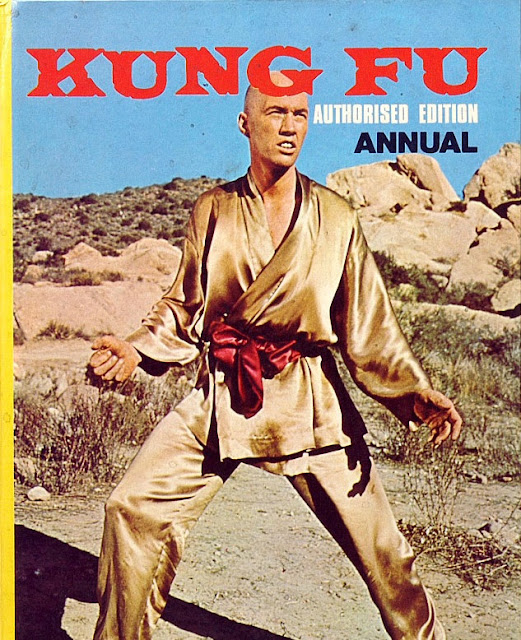
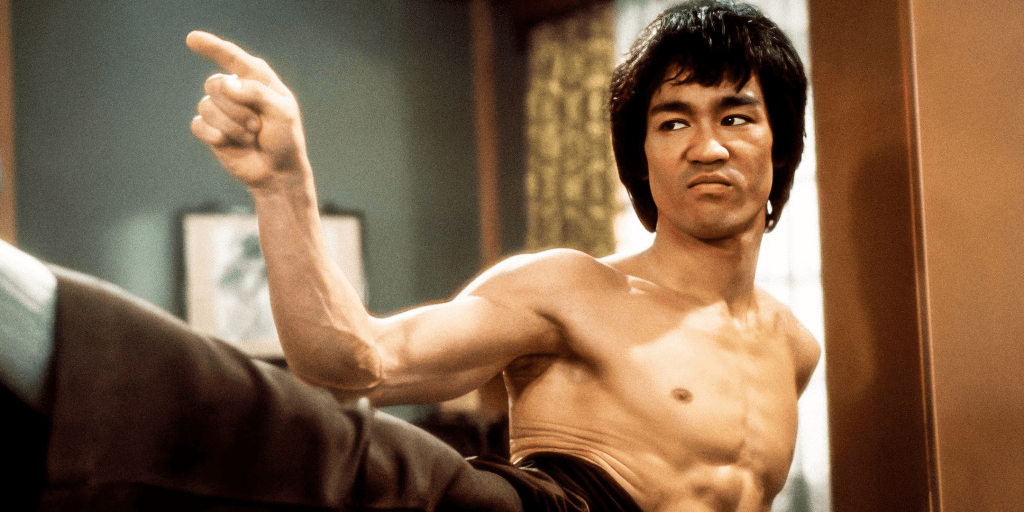
While monks, like all character classes, can use a subset of weapons, the key characteristic is their unarmed attacks or, rather, open-hand attacks. When we think of Shaolin monks, we think of punches, throws, locks, flips, and kicks.
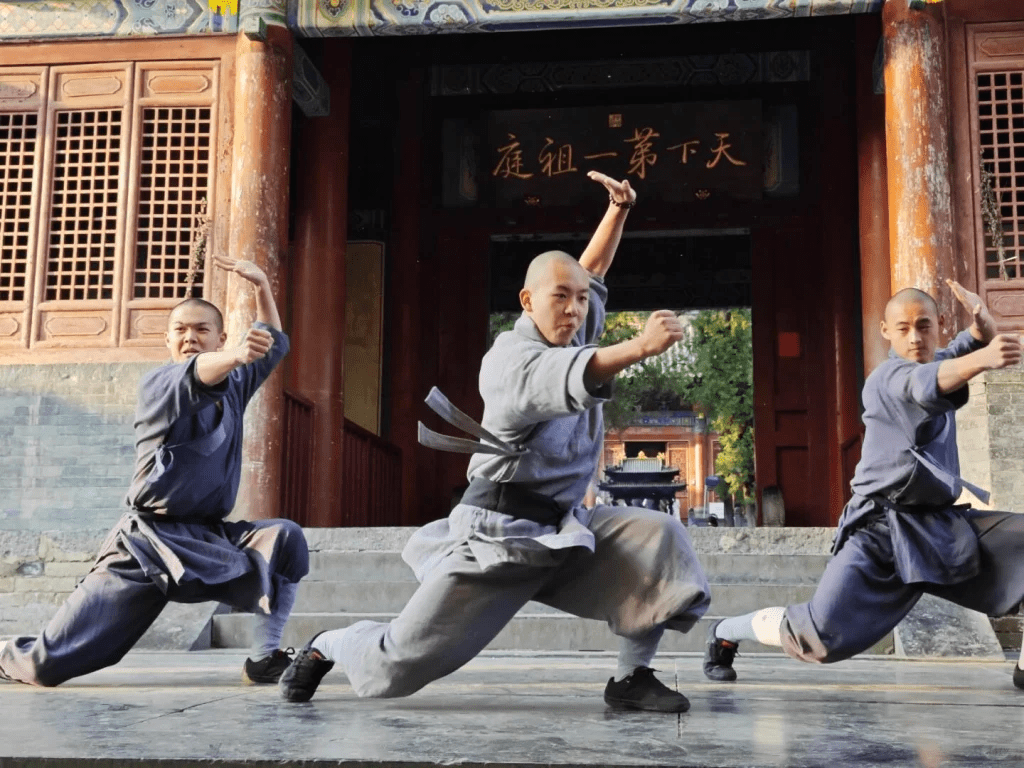
Now, one look at the Dungeon Master’s Guide (DMG) p. 72 shows there is a heading “Non-lethal and Weaponless Combat Procedures”. This section is available to all characters and includes three categories of attacks: pummeling, grappling, and overbearing. In short, “pummeling” is fighting with one’s fists, “grappling” is wrestling, and “overbearing” is knocking people or creatures off their feet. But, monks have an open-hand attack. Is pummeling the monk’s open-hand attack. No, while a monk might fight without a weapon, the monk’s open-hand attack in not using the “Non-lethal and Weaponless Combat Procedures”. The monk is the exception to the rule.
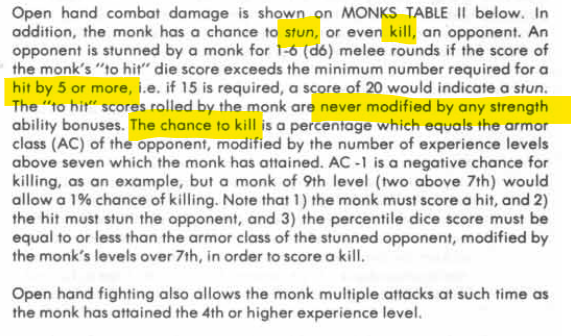
The monk’s open-hand attack is neither “non-lethal” nor “weaponless”. With open-hand attacks, a monk has a chance to stun or even kill opponents outright, in addition to any damage inflicted (see rule below). For example, a 9th-level monk attacking an AC10 opponent has a 10% chance of killing the opponent outright provided they hit and stun first. What are the overall odds here? A 9th-level monk attacks as a cleric and needs a 6+ on a d20 to hit AC10. But this is an open-hand attack, and thus (per PHB, p. 38) gets a +4 versus AC 10, so only a 2+ is needed to hit and a 7+ to stun the opponent. That equates to a 95 percent chance to hit and a 70 percent chance to hit and stun. The 9th level is two levels above the 7th level and thus gains a +2, so the 10 percent chance to kill is modified to 12%. Overall odds of killing outright are (0.7 x 0.12) 8.4 percent.
Extending this method to all the armor produces some interesting results.
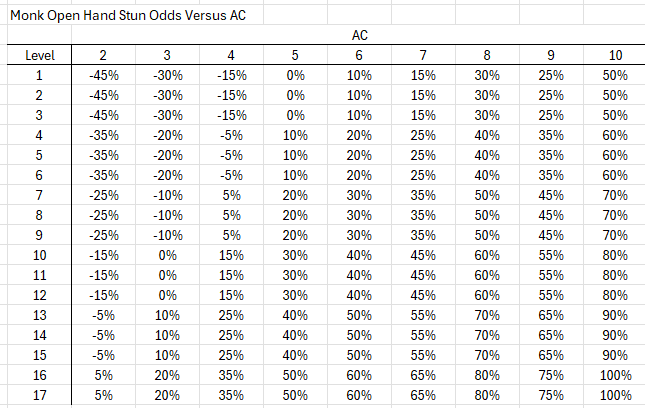
First, the odds of stunning, even at first level, for scale mail (AC6) and worse armors are fairly decent. And, with stunning lasting for 1d6 rounds (average 3.5), that stun may be the equivalent of a kill in numerous instances. Because the stunned character is easier to hit, those follow-up shots are even easier to land, which in themselves may lead to additional rounds of being stunned.

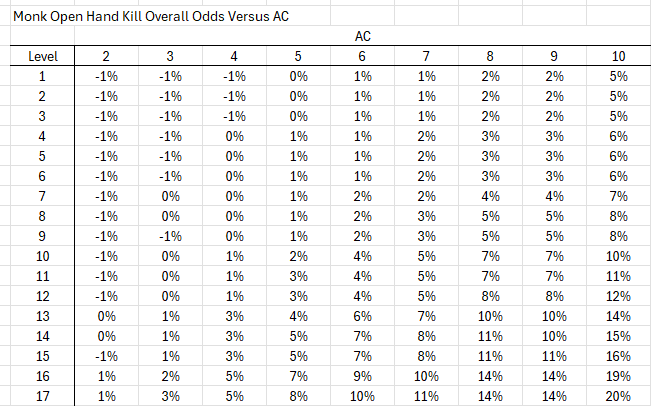
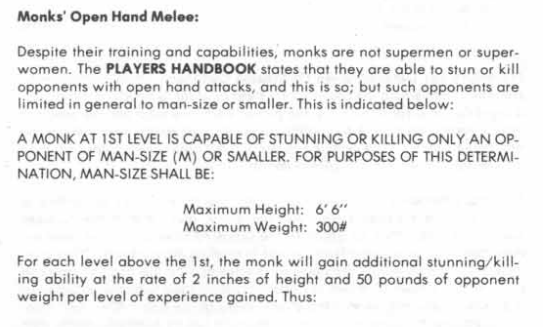
The second observation is that armor makes a big difference. Even the Grand Master of Flowers (17th level) has only a tiny chance to instantly kill an opponent equipped with plate armor and a shield. Even stunning such an opponent is only 5 percent. Yet, let’s not forget that monks past third level get multiple attacks per round with the open hand (though not with weapons), so those odds to stun and kill may well be cumulative.
Stun and kill results are independent of the level of the opponent and bypass hit points and saving throws entirely. This is huge and allows monks to challenge characters with significant hit points and level advantages. Players of monks should be asking questions about armor types and making sure stun and kill checks are made.
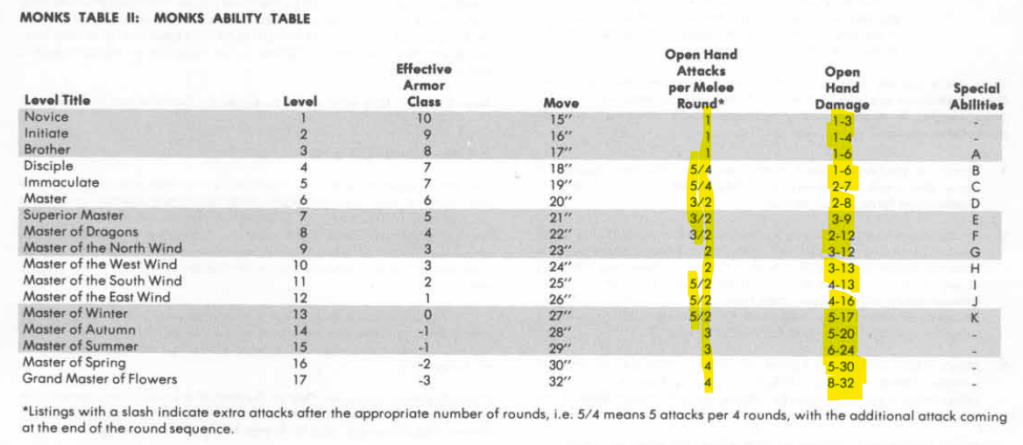
But there are limits. Monks aren’t superhuman. The DMG clarifies that the stun and kill effects only apply to human-sized creatures. A monk will not be stunning and killing a giant. Even exceptionally tall or heavy characters may be immune to these effects, at least from lower-level monks.
What about those “Non-lethal and Weaponless Combat Procedures”? Can monks pummel, grapple, and overbear? You bet they can. There is nothing in the PHB or DMG that says open-hand attacks replace these rules. In fact, the open-hand attacks are in addition to any pummeling, grappling, and overbearing that might be going on.

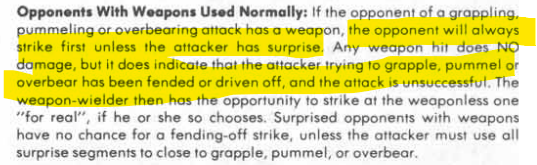
While I could find no explicit statement that the monk’s open-hand attacks count as being weapons, it should be noted that “Fist or Open Hand” is listed on PHB p.38 in the table “Weapon Types, General Data, and ‘to hit’ adjustments”. But also, “Fist or Open Hand” is not listed on the previous page’s table “Weight and Damage by Weapon”. From this, one can surmise other classes may only use the Weaponless Combat Procedures rather than treat weaponless punches as weapons. And, one can assume that a monk may choose to use his fists as weapons (i.e., open hand attacks) or not (i.e., use the Weaponless Combat Procedures). And, it then follows that a monk’s open-hands may be used as weapons for the purposes of fending off pummeling, grappling, and overbearing. An unarmed monk has a good chance of avoiding having the weaponless combat procedures used against him.
But what about all those fancy martial arts throws and holds? Don’t we need to add special rules for them? Well, I know the Oriental Adventures book did, but I think this was a misguided idea and approach. You see, the “Non-lethal and Weaponless Combat Procedures” already include all that. Surely not. Yes.

Take a look at the weaponless results tables. Throws, kicks, flips, crushing blows, and strangleholds are all built into the results.
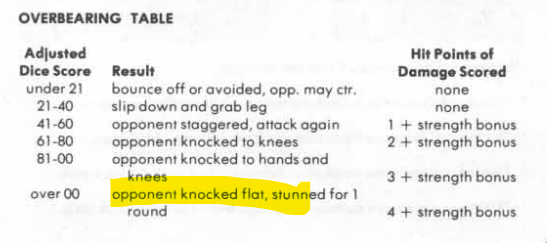
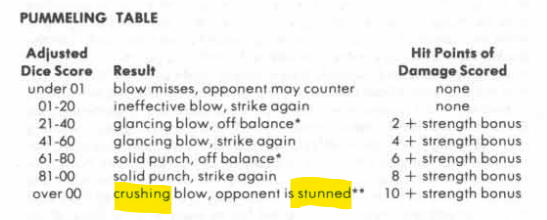
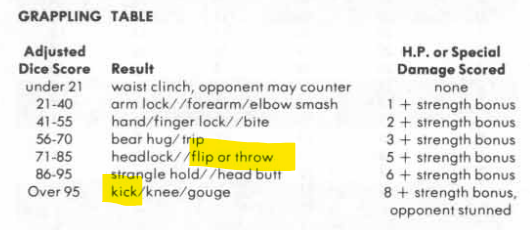
The stuff of martial arts is all already built into the weaponless combat procedures. A monk can do them too. How, and with what style, one chooses to interpret the results is up to every player.
A flip can be this:
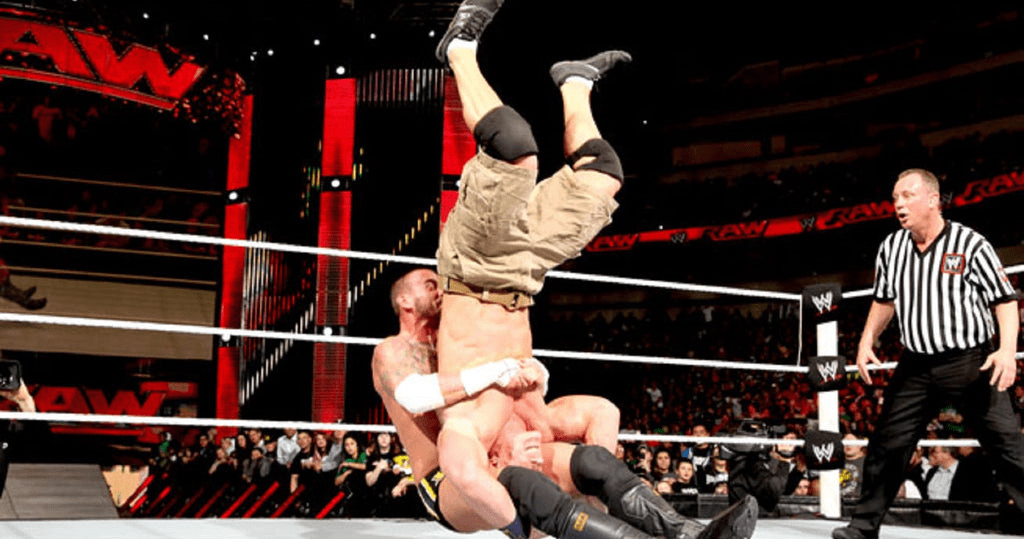
Or, the flip can be interpreted as this:
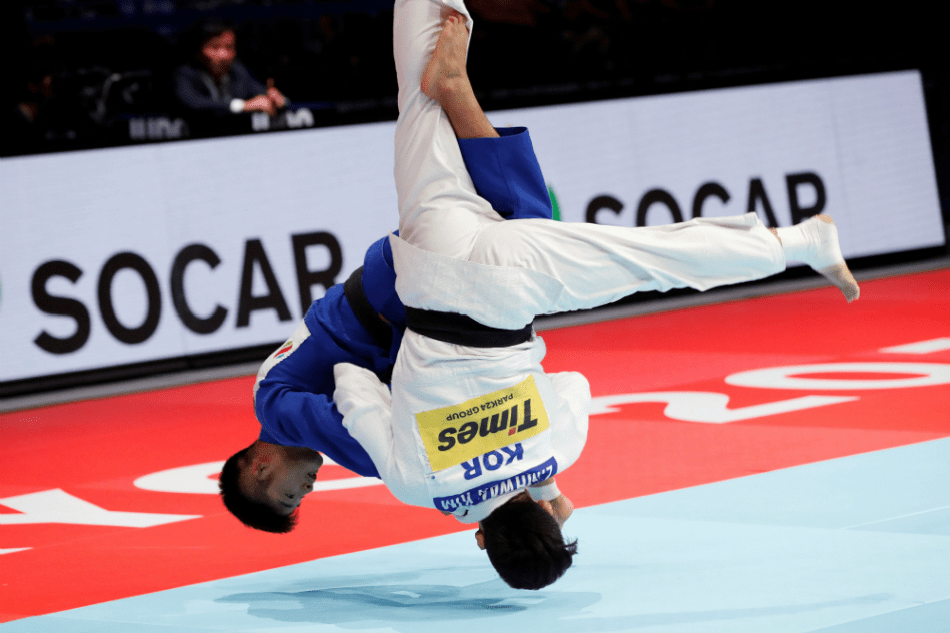
It’s your imagination. Use it.
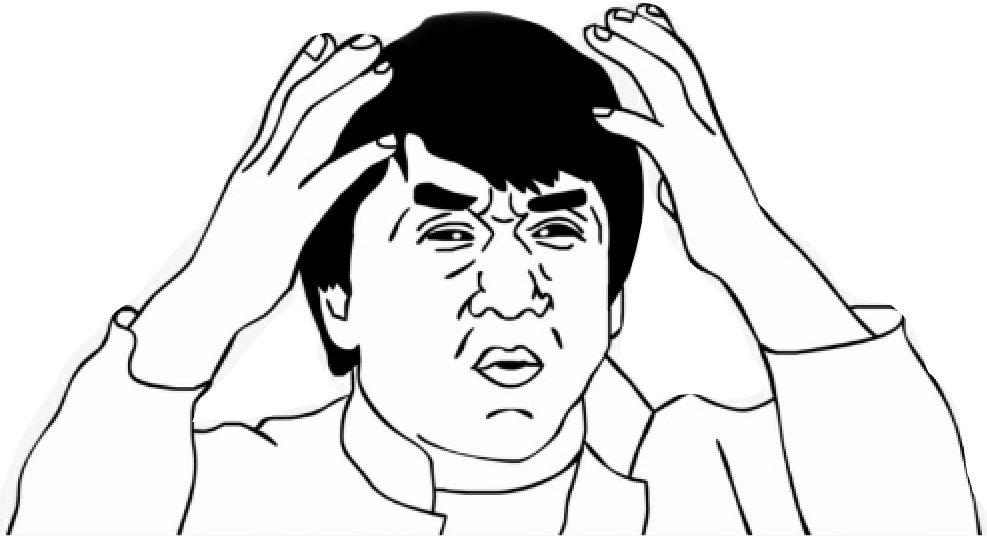
But the other reason a detailed system of “moves” isn’t needed is because a round of combat lasts one minute. A round isn’t a single use of a technique. A round is the result of a full minute of conflict. Many techniques are tried; only some are successful.
A round is not this:
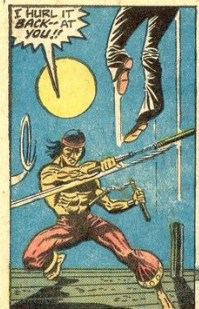
It is this:
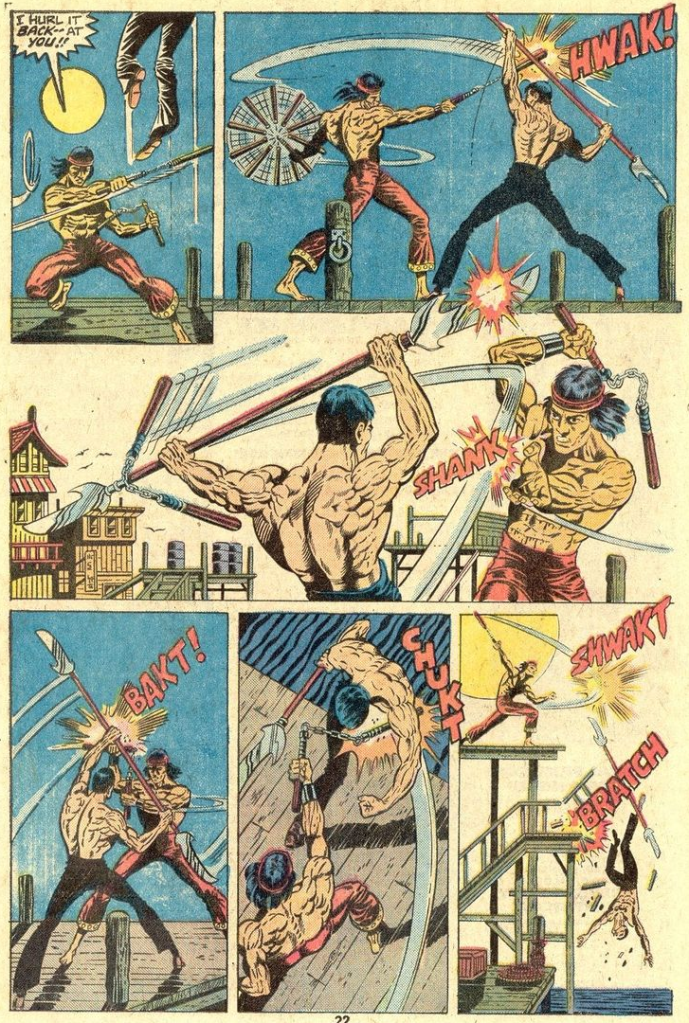
So let’s take a look at some of the weaponless combat details as they apply to monks. Monks may not wear armor. When grappling, monks always are treated as AC 10 when determining their chances of success. Yes, per the class description, a monk’s armor class lowers as they gain levels, but this is not what is used in the grappling rules. In this case the AC is based on the type of armor worn, and unarmored is AC10 for this purpose. Note the grappling success method is also used for overbearing, so the monk starts out (literally required) well-positioned to use grappling and overbearing.
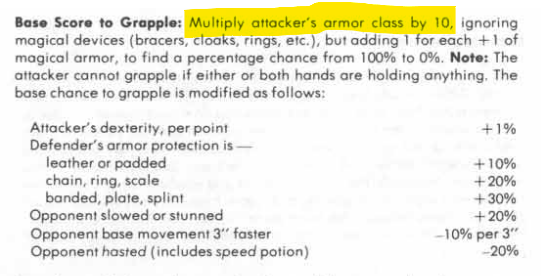
Pummeling is the same; AC x 10 sets the monk up for success in pummeling should he choose to do so.
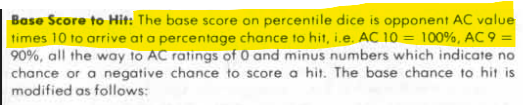
Let’s not forget that for grappling, a grapple always includes an attempt to counter the grapple. So, let’s present a quick example.
An opponent attempts to grapple the monk. Immediately, the monk can fend with his open hands. If he succeeds, he can immediately counterattack (often with a corresponding stun or kill chance). If the fend fails, carry out the grapple as normal. However, the monk does still get a chance to counter the grapple. Then, even if the grapple succeeds, the monk is still allowed to use his open-hand attacks as normal while being grappled.
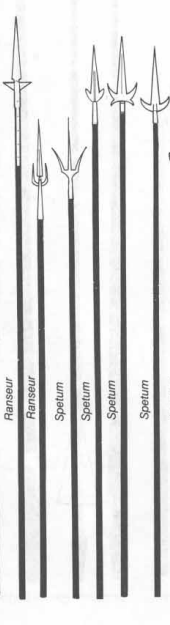
One tactic that could be useful for a monk, is to take the proficiency of polearm. This allows the use of the whole class of polearms. The ranseur and the spetum then become available for use by the monk. Both of these weapons are capable of disarming opponents as if their armor were AC8.
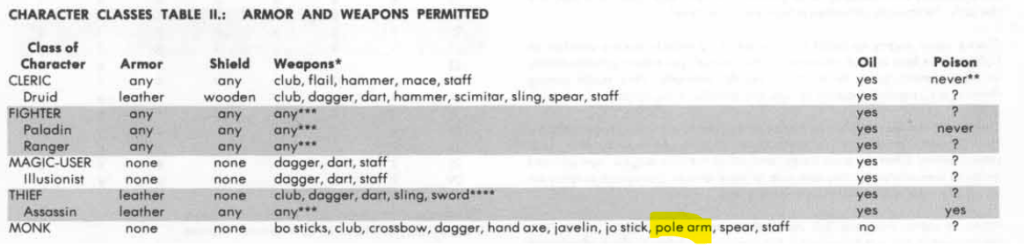

When that plate-armored knight approaches with his two-handed sword, a monk has the right to be concerned. His open-hand attacks are at a distinct disadvantage. But if he’s got a spetum or ranseur, his best bet is charge the sucker. With the longer weapon, the monk will attack first in the charge. That AC3 is now AC8 for disarming. Once disarmed, the knight is now forced into the position to use weaponless combat. And that knight will start with a 30 percent chance of success versus the monks 100 percent chance of success. Yes, there are modifiers to these, but generally they likely will help the monk more often than the knight. And, the weaponless combat procedures, totally bypass level in determining success. Not a bad position to be in for the monk.
Ultimately, the monk needs to make use of all the rules that he can. But if he does, he has some true advantages that no other character class has. And, once again, the beauty of the AD&D combat rules (and weaponless combat rules especially) successfully allows for unique class effects without pages of special rules or having to track loads of special techniques to produce genre-correct results. Now, this isn’t to imply that monks don’t have some special rules that apply to them. They do. But, not really much more than any other class.


Leave a Reply