
Deities and Demigods is probably the least used of the four original AD&D books. The book is mostly full of stat blocks for gods which the text of the book will tell you is mostly for comparative purposes rather than for player characters to go up against. In fact, I’ve long held the opinion that Appendix 3 is the most important part of the book and critical for playing cleric characters appropriately. The book really could have used the space better by detailing the nature and organization of each god’s worldly cult. But, that said, given the book’s dedication to presenting stat blocks, let’s make a use for them. And, let’s make use of them in a way that influences the lives of the player characters in your AD&D Campaign.
Let me be clear. This is a board game approach that feeds into miniature war gaming. It’s NOT some grimy Wesely-ite Braunstein with diplomacy and wheedling alliances. The motivations of the gods are inscrutable. No point in trying to understand their contrivances. Each God strives in conflict with the other gods in the forelorn hope to achieve primacy. Beyond that it is not the place of mere mortals (or players) to understand why. The gods are in conflict — they want to contend with each other, betray each other, and make use of each other for their selfish ends. Here is how it works. This game assumes you have access to the four main books of AD&D (PHB, DMG, MM, & DD) and cannot be played without those.
Time
While the gods are beyond space and time and not bound by worldly concerns, their worshipers are not. Thus, the game proceeds in month long turns. The Balance of the Cosmos at the end of each month sets the state of play for the AD&D campaign world for the next month.
The Game Board
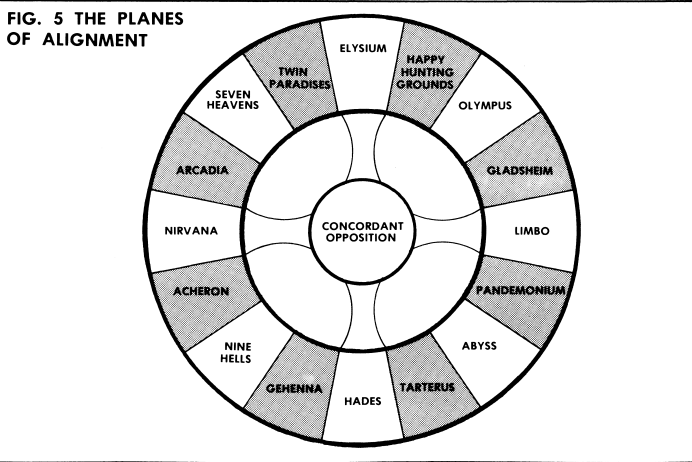
The Main Board:
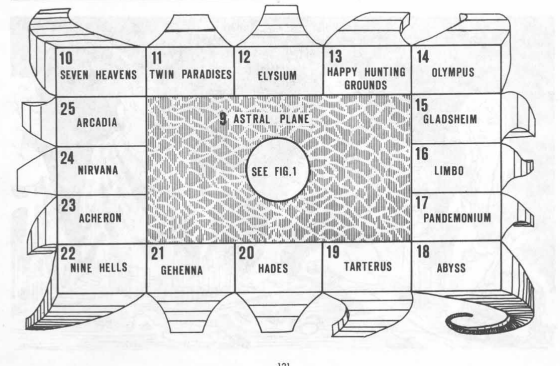
The Secondary Board:
The Tertiary Board:
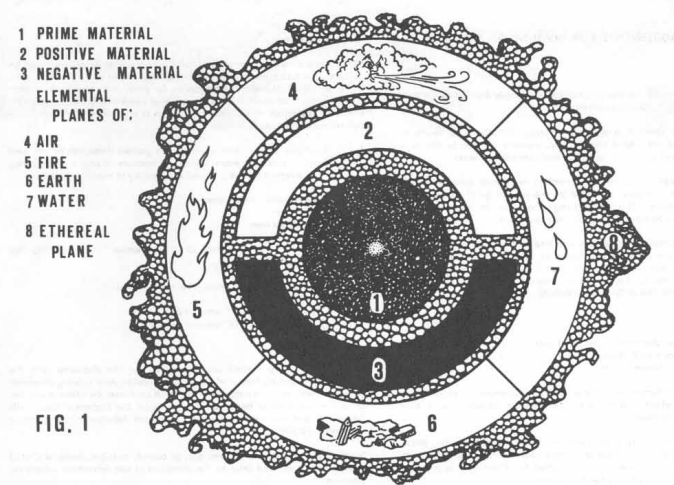
The Quaternary Board:
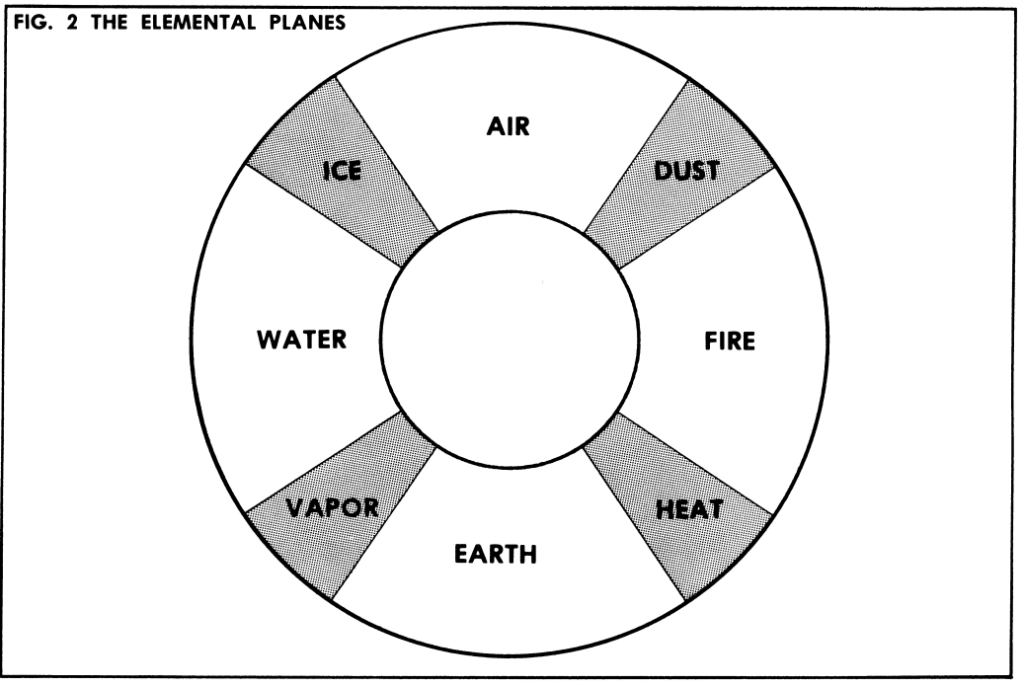
The Primary Board is the planes of alignment as described in Deities and Demigods. The Secondary Board is really mostly the same as the primary except it also shows the levels with a space on the primary board. For example, the Seven Heavens have their seven levels represented on the Secondary Board. The Secondary Board also shows location of the elemental, prime material plane, and the positive and negative material planes in respect to the others. The Quaternary Board shows the elemental planes, paraelemental planes and their relations.
The basic process:
- Initial Setup
- Play a month
- Gather Resources
- Gather Allies
- Movement
- Battle
- Turn End
- Retreats
- Loot enemies
- Assess Status
- Advance to the next Month (2 above)
Initial Setup
The initial setup will vary greatly depending on the pantheons and player character clerics in your AD&D campaign.
- Place on the Primary Board in the god’s appropriate plane, a marker for the location of that god for each patron deity of each player character.
- Check the alignment of each deity so placed, and if there is no deity of opposing alignment, players (as a group) choose an appropriate opposition deity. Each deity on the board must have at least on oppositional deity.
- Each deity on the board places one troop marker on the prime material plane.
- Once the deities have been placed, roll 1d12 to determine the starting month of the game.
Play a Month
Who plays in a month? The priority list for who gets to play a deity during a month is as follows:
- The player of the highest level player character cleric for that deity.
- If no player character cleric is available, the player of the highest level character of that deity’s alignment.
- If multiple characters meet the requirement for a deity, then they dice off to determine who plays this month.
- Any player who the group agrees has no conflicts of interest in playing a deity (players should be lenient in these determinations).
- The Referee.
Note: except for the largest campaigns, it is likely the referee will be playing many of the oppositional deities. But, ideally, unassigned players should volunteer for oppositional deities.
Gather Resources
Each deity can have maximum resource points based on the level of their greatest class ranking. For example, Zeus’s greatest class ranking is as a 25th level cleric. Zeus thus can have at the end of gathering resources a maximum of 25 resource points.
During the gather resources phase, each deity gets resource points based on their location in the multiverse. The first turn of the game, each deity starts at their maximum resources. Otherwise they collect the following numbers of resource points. Note, if a deity can trace a path back to his own plane where he has left troops and no opposing forces occupy those planes, then he can treat resource collection as if he were in his own plane.
| Within Own Plane | Adjacent to Own Plane | Astral/Ethereal | Inner Versus Outer | Opposition Alignment |
| Three Quarters | Half | Tenth | None | None |
Note that when an outer plane deity is occupying a space on the inner planes, and vice versa, they receive no resources. Similarly, a deity that is occupying a space where either of the associated alignments are not his own, then they receive no resources. For example, an elemental deity who has traveled to Nirvana would receive no resources that turn. Or, a Lawful Good deity that is occupying a space that is either chaotic or evil would receive no resources. Note: true Neutral deities occupying any aligned space flip a coin, if they win then they get half resource points.
Resource Points can be saved from turn to turn, but a deity may never hold more than their maximum resource points. For example is Zeus starts will 25 points, spends twenty, and later gains 4 loot, he has nine resource points at the end of the turn. At the start of the next turn he is in a plane adjacent to his own so he gets half of his 25 available (12.5 rounds to 13). 13+9 means he has 22 points. If he then retreats back to his home plane with his 22 points, the next turn he only gets 3 points to top him up to the maximum of 25.
Note that ressurected deities (see below) can gather resources and allies as normal during a month).
Gather Allies
Allies are gathered according to this order:
- Lawful deities
- Chaotic deities
- Good Deities
- Evil Deities
- Neutral Deities
Note, that for deities with two alignments, (e.g. Lawful & Good), those deities have two opportunities to gather resources. True Neutral deities have but a single chance to gather resources, but at least they can base it on observation of their opponents choices. Within alignment’s phase, the order is determined by allowance between players, or if a dispute arises, by rock, paper, scissors.
There are several types of allies. These include other deities, neighboring deities, demigods, heroes, and troops. Troops can be bought outright by spending resource points. Other deities, demigods, and heroes, one spends the points and then rolls to determine whether the ally is actually gained.
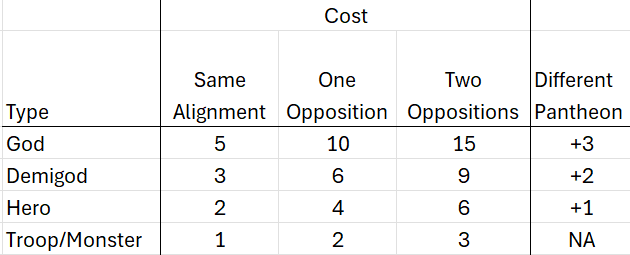
When gathering resources, a deity can call upon other deities, demigods, and heroes that reside on the plane he currently inhabits. For example, when Zeus is in Olympus he can call upon any of the deities within that plane that aren’t otherwise placed on the board in another plane. But the god may or may not actually heed the call. The points are spent to buy a chance, life is uncertain even for the gods. The player attempting to recruit an ally,
Once the points have been spent, the test to gain the ally is the loyalty roll as set out on pages 36 & 37 in the Dungeon Master’s Guide. The allies so gained will stay allied from month to month provided a loyalty roll is successfully made during the Gather Allies phase. These later loyalty tests do not cost resource points to make after the initial recruitment has been made.
Opponent deities in the same plane, can spend resource points to reduce the recruitment odds. A maximum of five resource points may be spent. Each point spent subtracts 5 percent from the loyalty rolls. During their recruitment turns opponent deities in the same plane are allowed to attempt recruitment (spending resource points as required) of entities already allied with other players.
Recruitment is generally from within a deities own pantheon. However, as shown on the table, one may recruit from other pantheons for additional expenditure of resources.
As a matter of practice, the players have ready access to the Deities and Demigods book to reference in order to select for recruitment.
When spending resource points to purchase troops, no loyalty test is required to obtain the troops that is guaranteed. Each troop purchased buys one roll on the Mercenary Soldier table on page 30 of the DMG. Roll first for the troop type, then roll again for the number encountered. The number of soldiers obtained in this manner is the number of companies of that troop type that are obtained. It is assumed that these companies come with all the requisite officers and equipment necessary for their purpose. Note that unit leaders may be equipped with magic weapons. If a unit leader has a magic weapon, that weapon effect is assumed to apply to the unit he leads.
Once a specific type of troop has been recruited, each resource point spent can be used to recruit more of that type. Once ten companies of a type are achieved, they are all grouped into regiments.
It should be noted that the troops so raised here, while treated as men as detailed in the DMG, are not men per se, but divine hosts. It is assumed they have heavenly (or diabolic or whatever) weapons sufficient to do damage to divine beings. The normal magic weapons to hit rules do not apply to these beings. They are, in essence, servitors of the gods. On the Prime Material Plane they might take any number of powerful forms, but for this games purposes of divine conflict, they perfectly match the abilites of common soldiers. While these troops are capable of hitting divine beings they get the damage they do reduced by each +1 of magic needed against the opponent. For example, if a +5 weapon is required to normally hit a deity, and the troop only has a +2 weapon, then the damage done is reduced by -3.
Unlike for other gods, demigods, and heroes, no loyalty test is required to maintain the presence of these troops. However, loses in battle may cause troops to dissipate. This will be covered in the Turn End phase.
Deities & Demigods contains some monsters and/or various animal companions. Entities associated with the deity mentioned in the deities stat block do not need to be purchased, they are available to the deity from the start. Other creatures/entities are must be purchased, but the numbers that appear are rolled according to the listed stat block.
Movement
A deity may choose to move about the planes. And, he may choose to bring allies and troops with him. When he does so, all troops and allies move at the speed of the liege deity.
Deities move among the planes at the maximum listed movement rate in their stat block, divided by ten rounded to the nearest integer using standard rounding rules. Zeus, for example can walk at 18″ or fly at 24″, to determine his movement rate about the planes, one dives 24 by 10 to get 2.4. This rounds to two movement points per month. As another example, Ares has a walking speed of 26″ which would round to three movement points per month.
Deities may also send allies or companion animals to other planes for him for a variety of reasons. When travelling separate from their liege deity, these entities travel using their own listed movement rates. Let’s say Zeus decided to send the White Eagle of Zeus on an errand, then the eagle (which has a movement rate of 48″) can travel at a speed of five movement points.
Generally moving from one plane (or level within a plane) one can only move into adjacent planes for the cost of a single movement point. If one moves into either the astral or ethereal plane, all movement stops for that turn even if the entity has more movement points they are able to spend. They may resume movement the following turn.
When a deity moves, he may choose to leave troops in his wake.
Battle
When more than one entity occupies a plane (or level within a plane), they may do battle. Any deity has the option to withdraw and take their associates with them. Any withdrawal is to an adjacent empty space, the astral or ethereal realms, or to a deities home plane if it is adjacent. But, like your fist time at fight club, if you stay in the plane you must fight.
Non-diety entities unaccompanied by a deity, may also retreat if faced by only non-diety entities. But, if faced by a diety, they can not retreat and must fight (likely forlornly). Non-deity troops, located on the prime material plane are not required to fight, unless their deity is present. However, if any one player chooses to fight on the prime material plane then a battle occurs — all other entities that do not choose to fight on the prime material plane must retreat to the ethereal realm when the fight occurs.
Battles are fought on the tabletop using AD&D rules. The goal here is to use those Deities & Demigods stat blocks, so seems like AD&D will be the best. But, should you choose another rule set, you will need to adapt as needed.
It is beyond the scope of this post to determine the battlefield terrain. However, I likely will come up with and post, ramdom terrain generators for the various planes. But, use your judgement to match the terrain to the location. The Seven Heavens aren’t the Happy Hunting Grounds aren’t the Nine Hells, etc. The terrain should be appropriate to the location.
Fighting a battle.
- Set up the decided upon terrain.
- Each Player rolls randomly to determine what side of the board they set up on (but they do not set up yet). If the same side is rolled, roll again until an empty side is identified. If all sides of the board have been chosen then it is permissible that more than one Player be associated with a side (this does not necessarily make them allies).
- Roll 1d10-1 to determine the number of objectives. If zero results, then the goal is to destroy the opposing force. Otherwise, the goal is to capture objectives.
- Players take turns placing objective markers onto the playing field in the same order as set out for gathering allies. Each side has objective markers identified as theirs (often by color). Players do not place their own objective markers but choose a marker from an opponent and place it. Placing continues until the requisite number of markers have been placed. There is no gurantee that any of your objectives will be placed.
- Players set up their forces according to the order used in Gathering Allies. To set up ones force first roll a 1d10. On a roll greater than 7, the force starts off of the board. Otherwise the force may set up on the side of their board edge within one quarter of the board width. Forces that start off of the board, roll a 1d10. On a roll of greater than 5, the army begins in column formation and must enter the board in column. If in column subsequent units must enter at the location the first unit entered the board.
- Play out the battle. The battle ends when:
- All objectives have been held for at least three turns.
- Enough sides withdraw from the board so no further fighting can occur.
- Surrenders occur to the point no further fighting can occur.
Addendum:
Under this approach, this will likely generate more battles than many will want to fight. Especially since the entities in Deities & Demigods are complicated with complex abilities. If it takes a month to run all the battles then you aren’t then affecting your campaign world. So, here is an optional battle rule.
Optional: Instead of fighting all the potential battles at the beginning of the month, only fight the largest battle in the month. Identify the the plane with the greatest number of deities in it. If there are ties, then includes allies, then troops. Fight that battle to conclusion and leave the other planes in stasis — this might indicate the deities maneauving for advantage within a plane.
Turn End
Once all battles for the turn have been fought, the turn ends.
Retreats
For every troop unit that retreated off the board, roll a 1d10. On a roll of ten, that unit dissipates and is removed from the game.
Every allied deity, demigod, and hero must make a loyalty test. Failure removes those from the game. Note: they may be recruited again later.
Loot
There are several types of loot.
For each captured opponent objective marker roll once on the table. For each of a deity’s own objective markers captured, roll twice on the table.
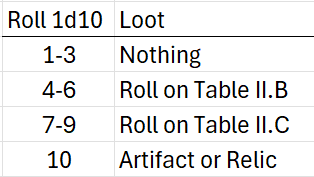
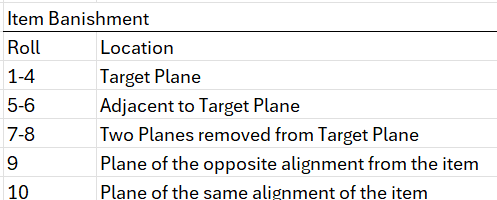
Captured or killed opponents may also be looted. This loot is any magic items or artifacts possessed by the defeated forces. This is up to and including Deity specific magic items. Note alignment difficulties may arise in handling certain items or artifacts that are of incompatible alignment. In those cases, if a deity is present they may choose to use their divine power to banish the item to another plane. If no deity is present then the item is left in place on the plane where it was dropped. Defeated deities will make considerable efforts to regain lost personal items.
To banish an item, the deity chooses a location anywhere within the multiverse (including the prime material plane) then rolls 1d10.
Assess Status
This is the last step of the monthly turn. Several types of status need to be assessed. The status of each deity, the status of allies and troops, and the effect on the prime material plane for the coming monthly period.
Defeated Deities. Deities that have been slain in battle must make a saving throw versus Spells to ressurect in their home plane. If their home plane is occupied by enemy forces then, they may not make a ressurection roll until their plane have been purged of enemy forces. If a ressurection roll is failed, then they roll 1d4 to determine the number of months before they may roll again.
If a deity has been defeated, any troops that managed to retreat off of a battlefield must make, on a unit by unit basis, the unit leader must make a morale test. If that morale test (DMG p37) results in a failure the unit dissipates and is lost. Note this is in addition to the previous dissipation check for retreating. Other allies are lost automatically upon deity death. They may be recruited again later.
Material Plane Status Effects
- If a deity was killed or remains dead, whether or not he ressurects the following month, the clerics for whom he is a patron have no access to six or seventh level spells for the month (DMG P38)
- If the deity does not have at least one troop located on the prime material plane, then the clerics for whom he is a patrom have no access to third, fourth, and fifth level spells for that month (DMG P38). The deities must have servitors on the prime material plane to disseminate these mid-level spells.
- If the deity is personally on the prime material plane then all spells are available to his clerics.
- If a deity has died all characters of his alignment suffer a -1 to all saving throw and to-hit rolls for the following month. Clerics of that deity suffers -2 to all saving throws and to-hit rolls for that month.
- If a deity retreats or is forced to retreat, then all clerics of that deity suffer a -1 to all saving throw and to-hit rolls for the following month.
- If an elemental deity is killed, then all magic user spells that make use of that element have saving throws at +2 for the next month.
- If an elemental deity is forced to retreat, then all magic user spells that make use of that element have saving throws at +1 for the next month.
- If a plane associated with a particular alignment has been occupied by a deity of another alignment, then all people of that alignment suffer a -1 to all rolls for the following month. Note for planes of multiple levels, all levels must be occupied for this effect to occur.
- If all player character clerics of a deity fail to carry out all their required rituals for a month (see Appendix 3 of Deities & Demigods), then the Deity suffers -2 to all rolls for the following month.
- Deities with the alignment or elemental nature of the month get a +1 on all rolls for the following month.

This ends the monthly cycle. Start at gathering resources for the next month.


Leave a Reply