
Jeffro is back and in fine form on Substack. He’s got a beaut of a post here. And, as typical he’s right. Everyone go read it now. It’s more important to read that one, than this one. Jeffro discusses M.A.R. Barker’s 1,500 NPC Index Cards, and Tony Bath’s playing card based NPC personality generation and how they can be used to create a living campaign that exists outside of player input (and, or least, can exist outside player input).
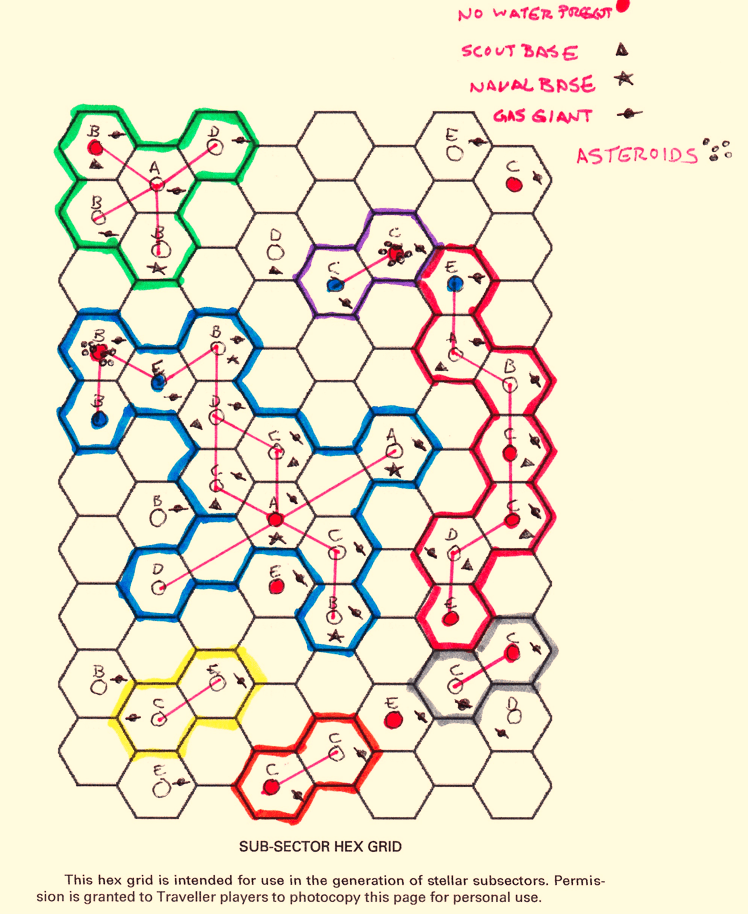
In his article, Jeffro discusses how he might create a Traveller campaign using Barker’s and Bath’s methods. Let’s go back to 2017. At that time Jeffro encouraged me to run a classic Traveller campaign (title The Empire of Reason) using just the first edition three LBBS. Which did. I made the subsector. I used apophenia to flesh out the relations between planets in the subsector. Then in play I used the encounter tables and the patrons book to create situations for the players to react to. Well, I did run the classic Shadows adventure. These adventures got cataloged on the Castalia House blog, which, sadly, is now defunct and lost.
But, under the hood, what Jeffro did not see, is I also created NPCs for the leadership of the main factions. And, periodically rolled to see what happened. This led to the psionicist coup and the founding of the Empire of Reason, leading to an immediate civil war within that fledgling empire. That is within the blue outlined systems on the subsector map. This civil war led to most of the events the player’s interacted with. Similarly, these random rolled factional events also led to the destruction of the amazonian system that came to be known as Planet Playtex, and Jeffro’s character being chased and nearly ganked by an amazonian princess. But the game and the Castalia House blog kind of tanked when Jeffro pulled out for personal real-life reasons (things beyond his control). Perhaps, had the game continued we would have made faster progress, but there you are.
Now, was this exactly like what Jeffro described in his column? No. Not at all. But, it was in the direction of independent NPCs driven by random rolls. And, it is illustrative how long it’s taken to get from A to B here. Nearly, 2017 to 2026. But, it’s a bit longer than that.
In 2016, I ran a short-lived AD&D Oriental Adventures campaign for an in-person group. This also was at Jeffro’s urging. But, he’d moved away so could not play in live sessions. These were also documented on the Castalia House blog, and are also now lost.
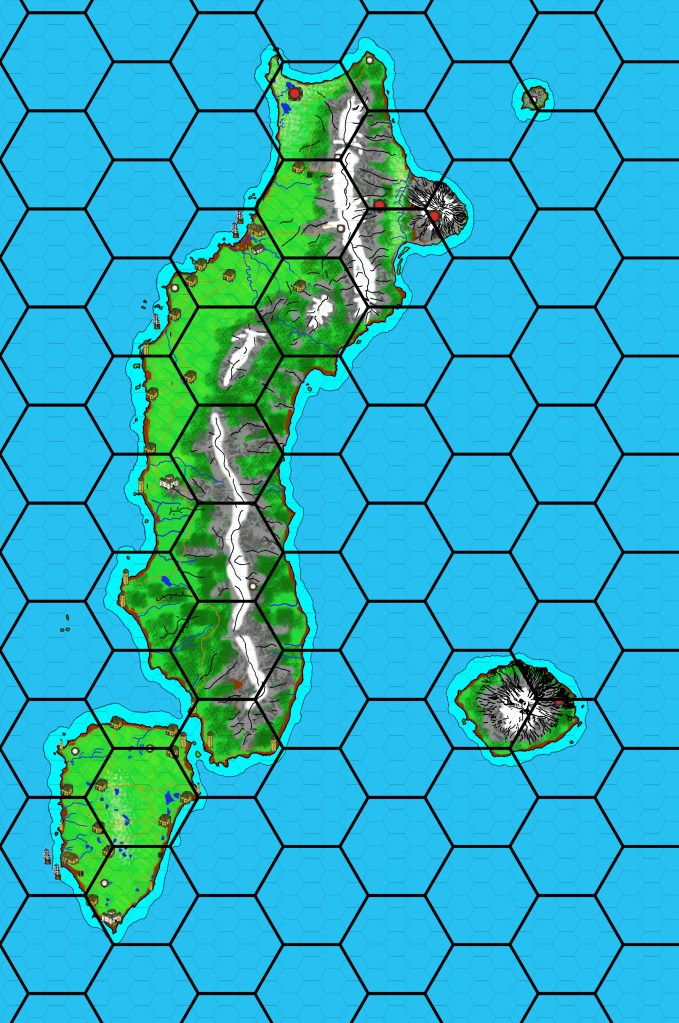
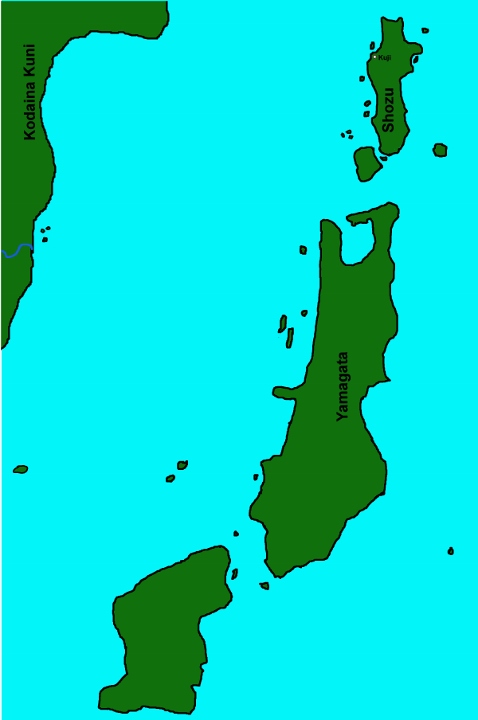
For that one, I had no interest in running adventures in the official Oriental Adventures setting. So, I made my own. At first just the island of Shozu, but then later the mainland of Kodaina Kuni and its capital of Okina Ringo as the players went pirating.
While, I had some fun with these sessions, it was overall, a failure. The players I had available were not that interested in AD&D and really wanted to play superhero games, which I had no interest in running.
We never got to it, but what interested me the most about the Oriental Adventures rules was the detailed family trees, the birth ranks, honor. These seemed to me to be ready-made factions which, if played properly could generate game events without ready-made set-piece modules.
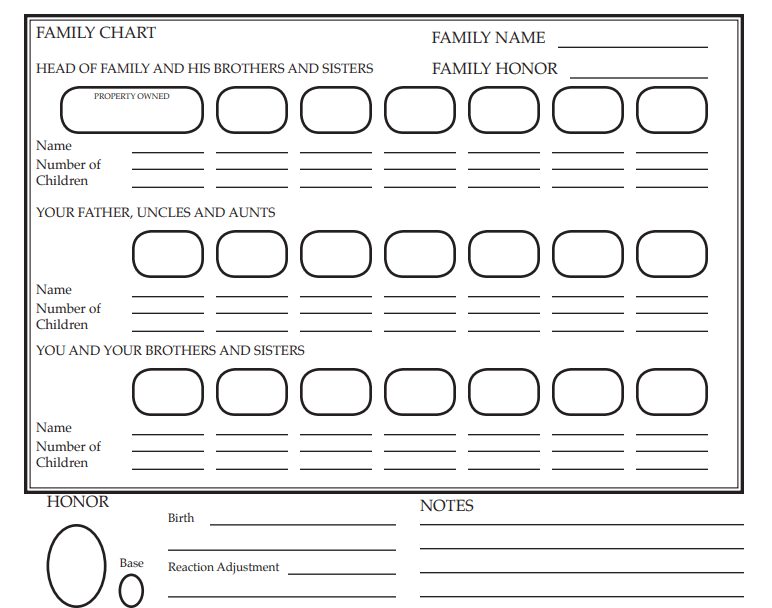
The Oriental Adventures character sheet has twenty-one places for potential family members within a character’s clan. And, it provides a modicum of ancestral information to place that family into society.
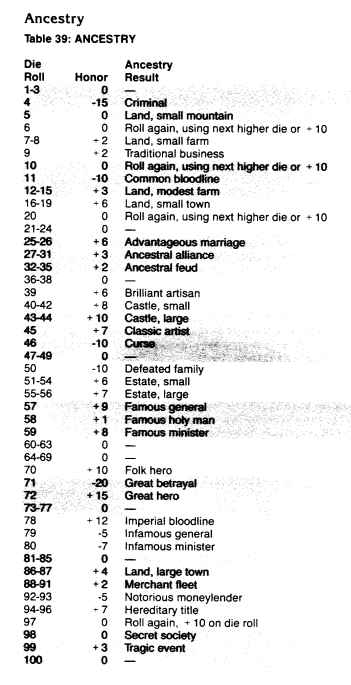
Now, when rolling a player character’s family, one might generate a dozen relatives. So, for a typical number of player’s, six for examples, there are now already something of the order of 72 NPCs introduced to the game and placed about the board. It’s not 1,500 NPC cards. But it does seem like a good start and something that might occupy a game for quite a while. It certainly is well about what I’d consider the Braunstein minimum.
Oriental Adventures takes a somewhat different approach to random encounters than straight AD&D. In AD&D you roll periodically within the dungeon, and when the party is travelling overland. It’s not that Oriental Adventures doesn’t do this, but it also adds Yearly, monthly, and daily events. And, these events aren’t just encounters with people or monsters. They are everything between wars, natural disasters, and things in between like marriages. Similar to how Appendices A, B, and C are the main game mechanic of AD&D, these annual and monthly rolls are the main game mechanic for the Oriental Adventures campaign.
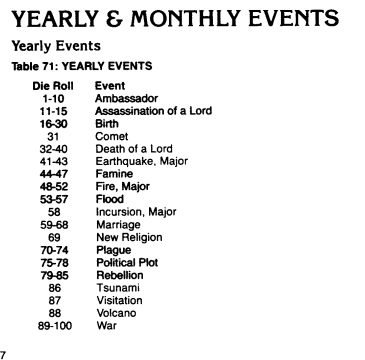
Jeffro’s proposal of rolling, perhaps, annually for his NPC cards reminds me of this sort of approach. Similar, Jeffro’s discussion of Bath’s card-driven NPC personality generation reminds me of another AD&D feature. The DMG on pages 100/101 presents a method of generating NPC personalities. It’s random tables rather than card driven, but the effect is on the same track as Bath. And, I wouldn’t be surprised to learn there may be connections to Gygax being inspired by Bath in this regard.
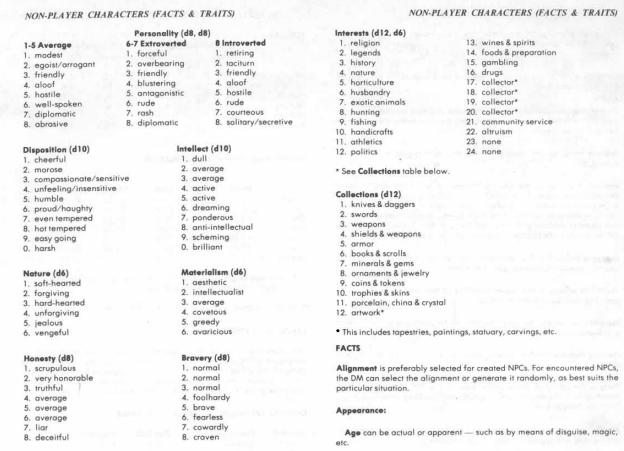
So, this is another example of Jeffro synthesizing information and approaches that were within AD&D all along. It’s also worth noting, years ago now, Jeffro was annoyed by me when he began pushing Braunstein, that I was pointing out things like the NPC personality tables and suggesting we hadn’t fully explored the AD&D rules yet. It’s nice for him to catch up. Jeffro’s a leaper and I’m a plodder. It’s in our nature. But, when you leap ahead, sometime it is necessary to take a step back and put things back in. Elon Musk presented in an interview that when simplifying a process, you need to eliminate steps, but if you never have to put steps back in, you never eliminated enough steps in the first place. This is Jeffro’s method, and he’s not wrong to do so here. Eliminating steps is very much a means of focusing on one part of a system at a time. I am glad Jeffro eventually got to this one.
This is also why, when I ran my Gang Buster’s Braunstein, I felt that going zero prep was wrongheaded and that I needed to generate a detailed context for the Braunstein. Wesely’s Braunstein reportedly has some excruciating detail, and Gygax’s AD&D, taken as a whole, gives you a lot of the basic tools to set that detail and keep it moving. It is a sad thing, that TSR, under Gygax, never really published any AD&D modules that really used the rules of AD&D and Gygax never really got to present examples of how the NPC traits were to be used. But, read Jeffro’s column, it’s well worth it. And, a better explication than I could do. It took ten years to get from A to B, but some things can’t be rushed. Good for him.


Leave a Reply