
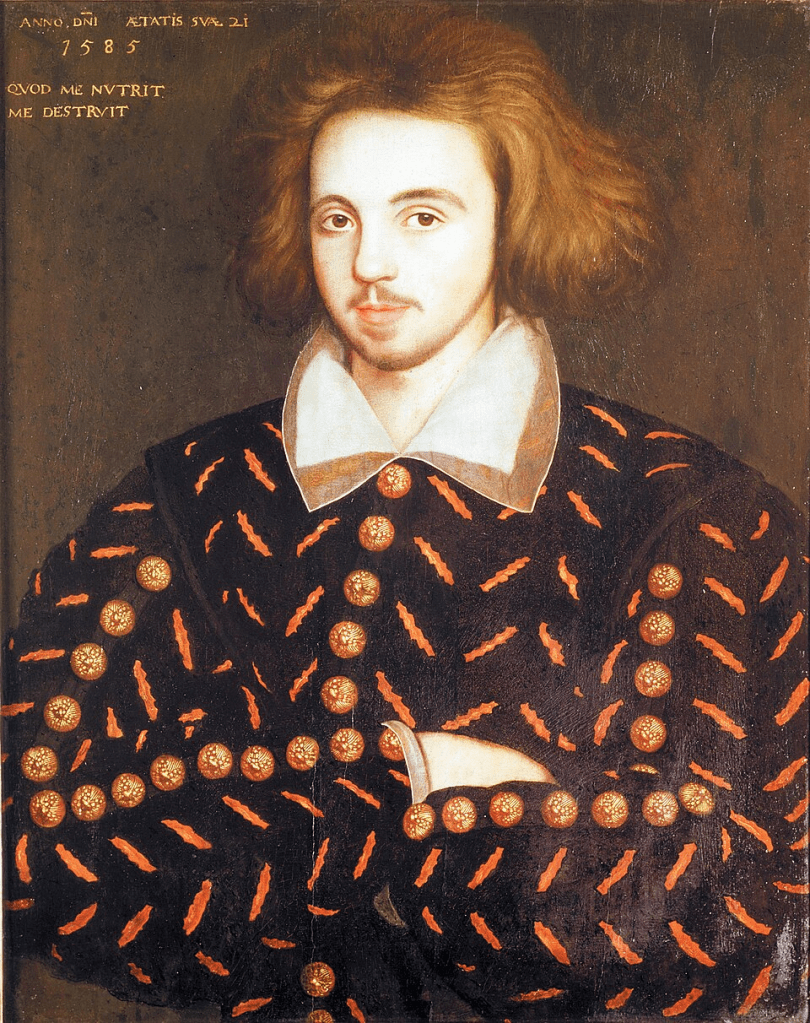
Marlowe
The playwright and poet Christopher Marlowe died at age 29 on May 30, 1593, ostensibly in an argument over who should pay the bill of a bar tab or food bill. To say the least the story is suspicious. Marlowe was a suspected spy working for Sir Francis Walsingham (who died in 1590, prior to the killing). All the other men in the room had also worked for Walsingham (or a relative). Marlowe was under indictment for blasphemy and may well have had soon to reveal his connections under oath (and/or torture). So, Marlowe may well have been murdered by men sent by the Privy Council or other parts of the British State to avoid revealing his intelligence connections (or possibly blackmail information he had on members of the Privy Council).
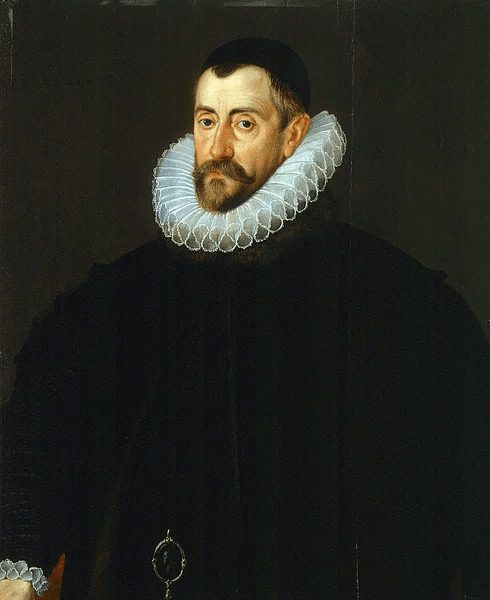
Walsingham
For this exercise let’s look at a couple of scenarios. First, take the story of his death at face value. It was an argument over a bill that got out of hand and initiated by Marlowe. Second, it was an assassination. The three men were sent to kill Marlowe and they did. How might these scenarios be represented in AD&D? Why do this exercise at all? Because it illustrates some points about the AD&D combat system. And, part of it is in answer to this post.
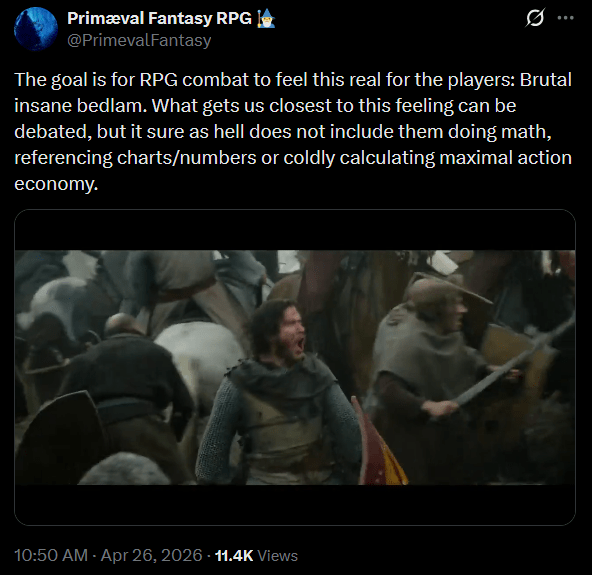
I think this guy may have confused Role Playing Games with sports. While I may agree with him to a degree regarding the idea of “action economy”, some minimal amount of math and/or charts and a knowledge/sense for statistics is part of playing dice-based games. Perhaps he might prefer joining a rugby team? Or Society for Creative Anachronism or a Historical European Martial Arts club? But, this example may not be of the “insane bedlam” category so much, it does get to the brutal pretty well.
It all took place at a boarding house run by the widow, Eleanor Wood. Marlowe had eaten lunch with three men Ingram Frizer, Robert Poley, and Nicholas Skeres, they had gone for an after lunch walk together, then returned for supper. Apparently all had gone well until, at 6 PM, after supper, the question of who should pay the bill was raised.
According to Frizer, they argued. Frizer was sitting at a table between the other two and Marlowe was lying behind him on a couch, and then, out of the blue, Marlowe seized a dagger from Frizer’s belt and attacked Frizer causing “two wounds on his head of the length of two inches, and of the depth of a quarter inch”. Frizer then wrestled the weapon free from Marlowe and stabbed Marlowe over his right eye, killing him “instantly”. Though modern speculation suggests Marlowe may have lived for several minutes after the wound.
How might this be represented in AD&D? First, we must determine the nature of the combatants stats and attributes. According to wikipedia, “Marlowe has been described as a spy, a brawler, and a heretic, as well as a ‘magician’, ‘duelist’, ‘tobacco-user’, ‘counterfeiter’ and ‘rakehell’”. For our purposes, I think the key terms are “spy” and “brawler”. He certainly wasn’t a magic user in AD&D terms. And, while, he was known for getting into more than one physical fight, “duelist” also seems somewhat overblown. And, while use of tobacco, holding heretical beliefs, and being a rakehell may be of some interest, probably not relevant to combat abilities.
Spying is a key skill to but one class, the assassin. Marlowe, while known for getting into fights, is not known for murdering anyone. So, that sets a maximum level of three. A waghalter implies someone likely to be hanged. He may have been that, but Rutterkin means a crafty fox or beguiler which he certainly was. He may have been under indictment, but he may well have slipped that noose. I’m setting Marlow as a second level assassin.
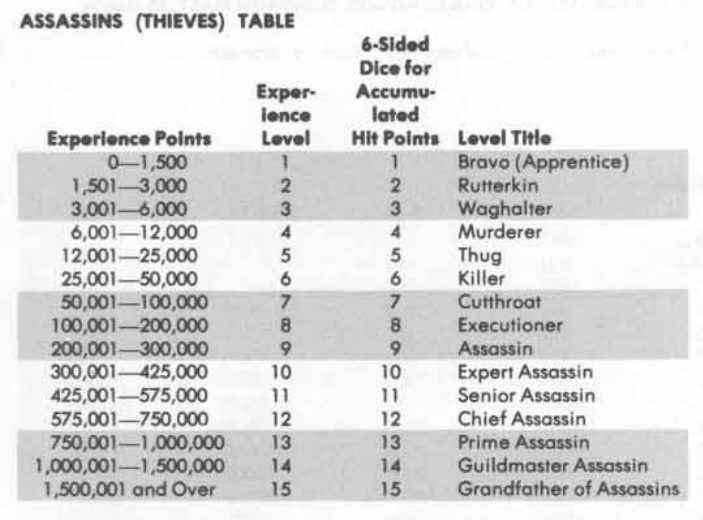
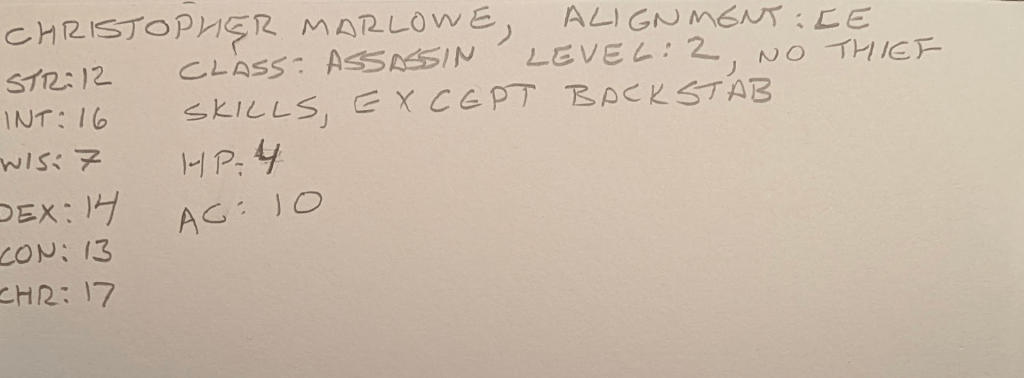
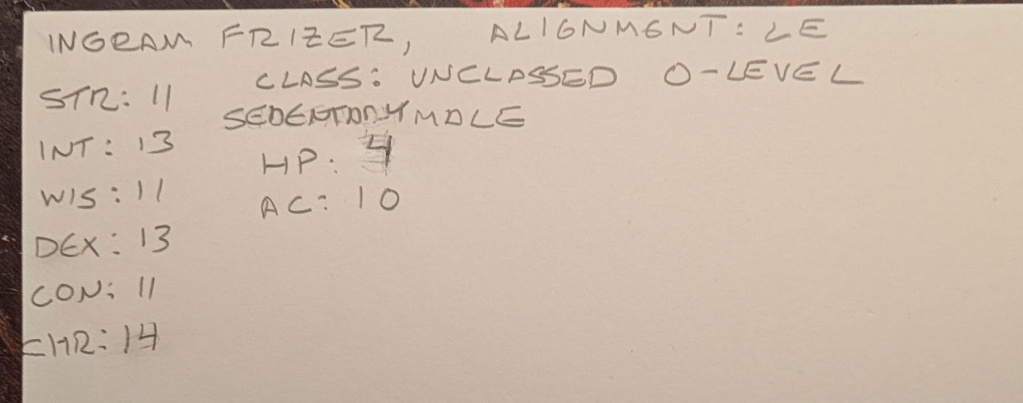
The two main details of Marlowe’s nature from history are his intelligence and his personal charisma, both needed to become a successful playwright. Otherwise, I’ve assumed fairly humdrum physical attributes, somewhat above average but not to the extent of getting any significant bonuses from them. What about the other guys. Less is known about the other three but here we go.
Ingram Frizer, at the time of Marlowe’s death, worked as a servant for Thomas Walsingham (first cousin once removed of Sir Francis Walsingham) and a pretty high level servant too, acting as his business agent. But, according to Wikipedia, “He has been described as “a property speculator, a commodity broker, a fixer for gentlemen of good worship” and a confidence trickster gulling “young fools” out of their money.” He apparently did okay in property sales and also, after Marlowe’s death, seems to have been rewarded through his connections to Walsingham. But, nothing otherwise in the history makes Frizer out as a man of action. He may not have been a classed character at all. While he died in 1627, his age at the time of the killing, is unknown.
Robert Poley is quite another matter when compared to Frizer. Poley was older than Marlowe and around the age of 42 at the time of the killing. But he had quite a career both before and after the killing. Around 1583 he’d come to work for Sir Francis Walsingham as a Catholic informer. By 1585 he was being sent to Paris carrying messages to Thomas Morgan (who was working for Mary, Queen of Scots). By 1586, he’d infiltrated to some degree Mary’s household and was able to reveal a plot to kill the Earl of Leicester (Robert Dudley). And, later in 1586 was instrumental in exposing the Babington Plot to assassinate Queen Elizabeth, leading directly to Mary, Queen of Scots execution.
Then Poley seemed to get a promotion and began to work as a case officer for Walsingham, as well as creating and deciphering codes. From 1588 to 1601 has was acting as a courier carrying messages to Denmark, Netherlands, Scotland, and France for the Privy Council. It was apparently on one of these excursions that he met with Marlowe.
After Marlowe’s death, he continued his work with the Privy Council, up to being sent to jail to spy of Ben Johnson regarding his play The Isle of Dogs. The last heard from Poley was a letter from Poley to Sir Robert Cecil, July 18, 1602, saying, “How, half offended, you said to me I never made you good intelligence, nor did you service worth reckoning, is the cause I have not since presented myself with offer of my duty, although I much desire my endeavours might please you, my necessities needing your favour.” There seems to have been a falling out. At around 51 years of age, no doubt Poley was slowing down, well known as an intelligence agent. His value as an agent no doubt was running quite thin. He wasn’t heard from again. Even the place and date of his death is unknown. It may be that Cecil’s part of the 1601 Essex Rebellion played some part of this falling out, but that is unknown.
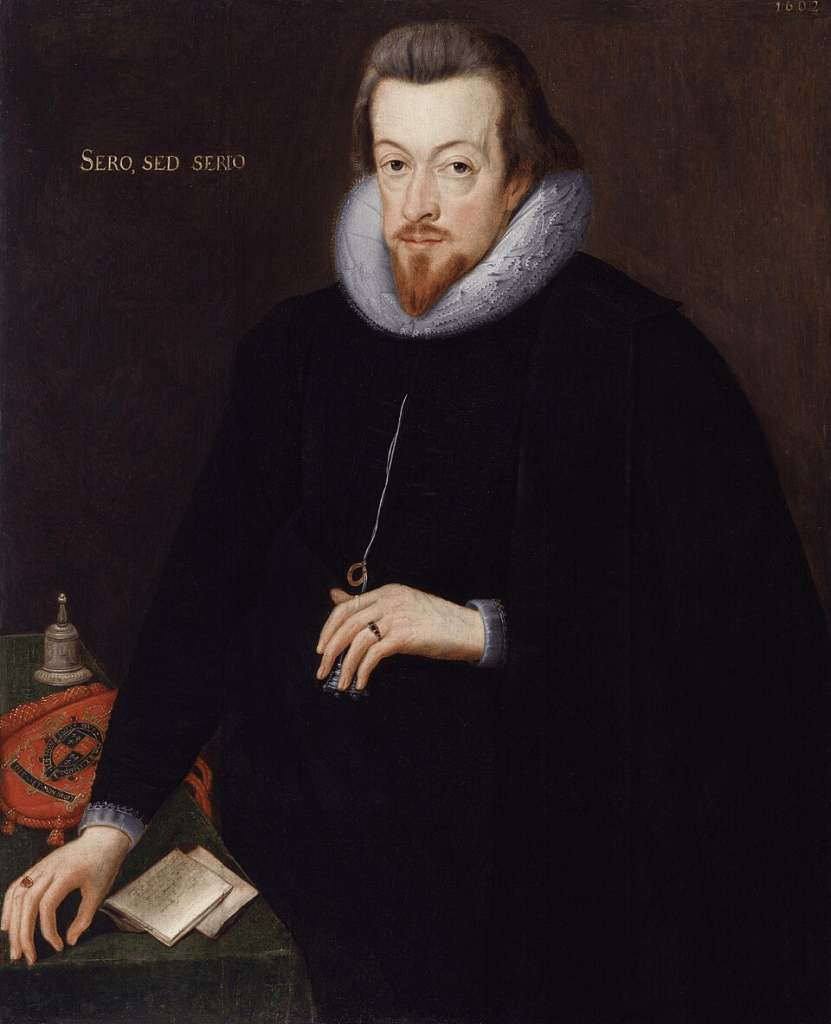
Robert Cecil, 1st Earl of Salisbury
Poley was, in every sense, a spy. Definitely Assassin class. But, what level? He does not seem to have ever risen to be guild master, but there does seem to be a period where he was acting as a caseworker, running agents for Walsingham.
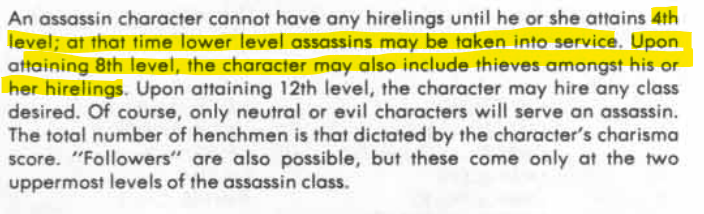
I’m going with 8th Level Assassin for Poley. At the time of Marlowe’s death it seems clear he’d worked with other assassins and thieves. He’d been involved in major and successful spying operations.
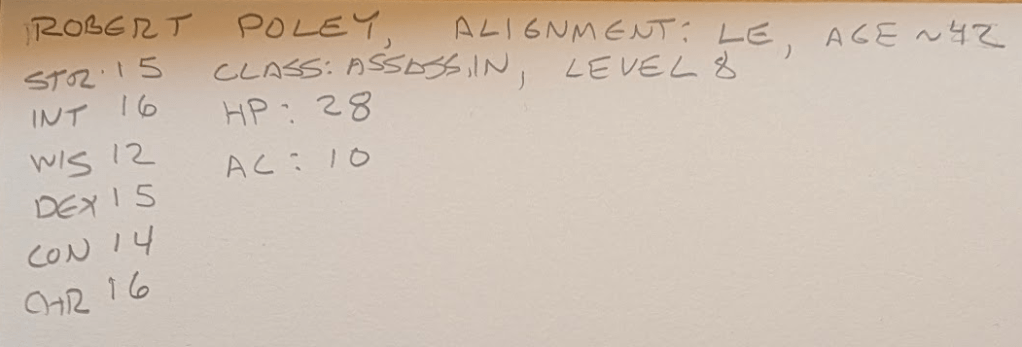
Nicholas Skeres was right around Marlowe’s age, a year older. The second son of a tailor (who died when Skeres was three), Skeres seems not to have been a man of any particular station or importance. He did gain some level of education in the law, though he doesn’t seem to have earned a degree. But he did come some attention. “On 7 July 1585, writing to Lord Burghley, William Fleetwood mentioned a “Nicholas Skeeres” among a number of “maisterles men & cut-purses, whose practice is to robbe Gentlemen’s chambers and Artificers’ shoppes in and about London””.
In 1593 Skeres was called before the Star Chamber to testify on his part in a confidence trickster scam, in which he admitted he had carried out many times over the previous ten or twelve years (essentially his entire adult life). He apparently began working in some capacity with loan sharks in his early teens. He seems to have made specialty of bilking writers and playwrights. Just the sort of fellow that would be targeting Marlowe.
Sometime around 1581 he seemed to pal around with Thomas Walsingham. And, in 1586 his name comes up as some sort of government plant within the Babington Plot. So, that connects him to Poley. He also entered the Earl of Essex’s service in 1589 and was still in his service in 1591/92. And, in the 1593-Star Chamber testimony referred to Essex as his “Lord and Master”. It doesn’t seem to be a stretch to think him still working for Essex on the night of Marlowe’s death.
In 1594/5 he was arrested along with others running an illegal brokery. But, they were released as the “brokery” seems to have been a cover related to political surveillance. He was arrested again in 1601 as part of the Essex Rebellion, sent to prison, and never heard from again. Notably, Sir Robert Cecil, Poley’s intelligence connection, was also part of the Essex Rebellion.
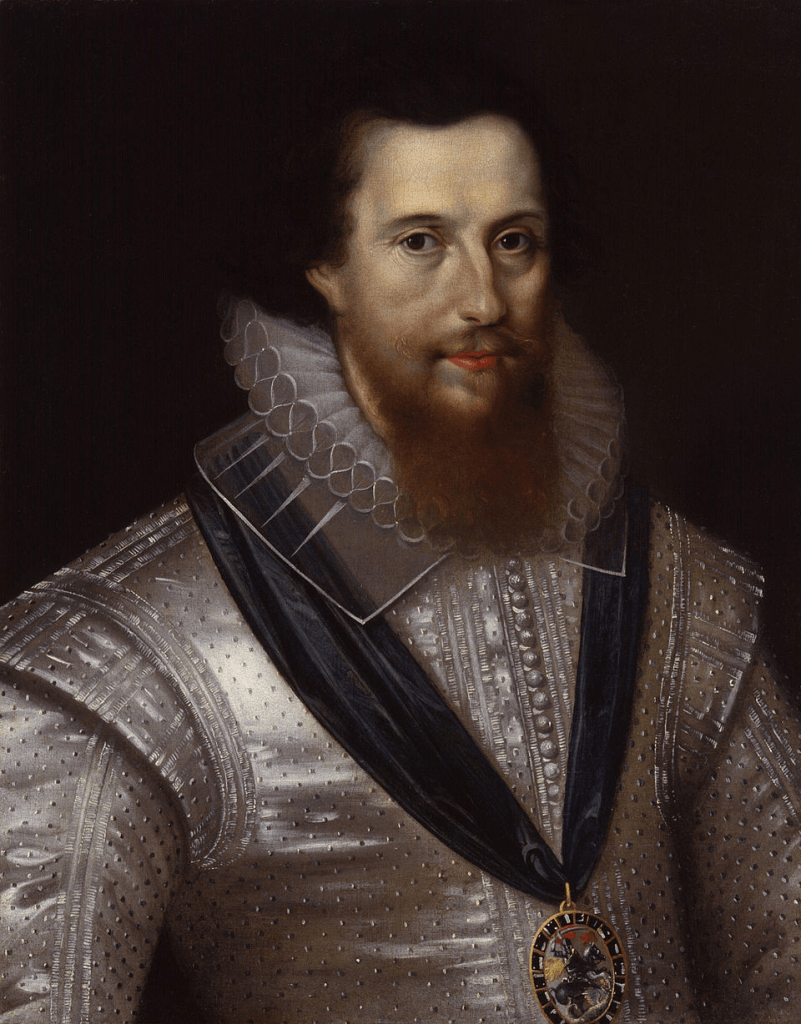
Robert Devereux, 2nd Earl of Essex
How to depict Skeres? Confidence trickster, loan-shark thug, robber, spy? Minimum age for a thief in AD&D is 19 and for an assassin is 21.
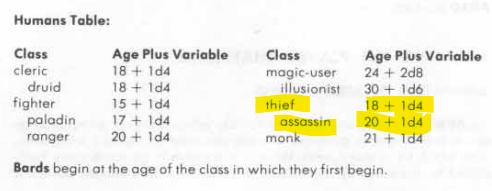
Skeres begins working for Walsingham at age 18 in 1581. He’s a known robber by 1585, age 22. At 23, he’s deep in infiltrating the Babington Plot. I’m tempted to make him duel-classed thief and assassin. But, I think it simpler just to start as assassin at age 21, by 1593 he’s got nine years in the profession. Not as entrenched at Poley, call it level 6.
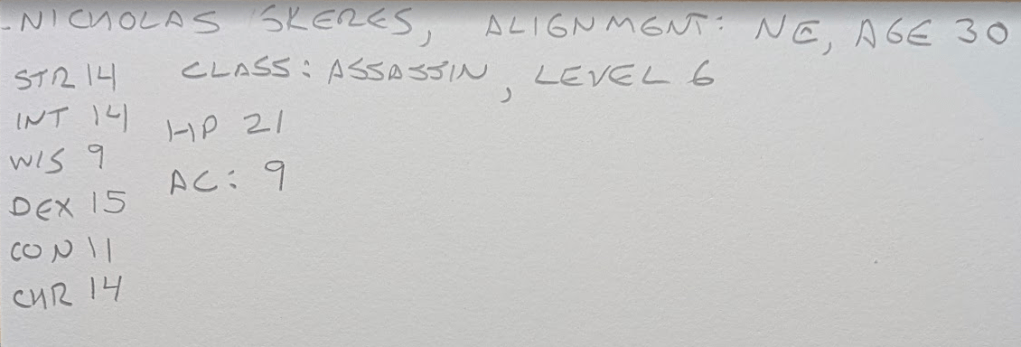
We now have our four men. All connected to the Elizabethan underworld of spies. Four men enter, three men leave.
Scenario 1 — The Official Story
Initial conditions. Marlowe is on a couch directly behind Frizer, who is sitting at a table flanked by Poley and Skeres.
Round 1:
Roll surprise: note, how surprise works is here.
We know Marlowe achieved surprise because he was able to grab Frizer’s dagger from his belt. Frizer may have worn his dagger at the back, which was common at the time.
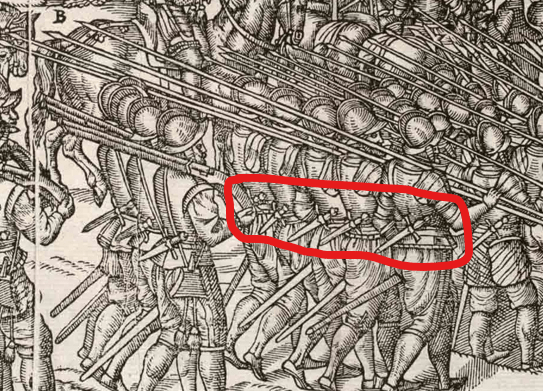
Frizer’s group then rolled either a 1 or a 2 giving Marlowe either 1 or two segments of surprise. Whereas Marlow either rolls a 2-6, or the referee ruled he needn’t roll for surprise because this wasn’t a chance encounter but a decision on his part to attack.
So, at the very least Marlowe gets one segment of surprise allowing him to snatch Frizer’s dagger. If Marlowe had a second segment of surprise he could potentially get a backstab on Frizer. What are the odds of a hit? A second level assassin needs an 11+ to hit AC10. It’s a rear attack so it’s +2 to hit. Marlower must roll a 9+ to hit, a 60 percent chance of success. If it’s during a second surprise segment, possibly another +2 might be granted, resulting in a 70 percent chance to hit. Not bad.
Actually, if Marlowe achieved that second segment of surprise, he could have had a chance use the assassination table. The odds for Marlowe on the assassination table are 55 percent for an immediate kill.
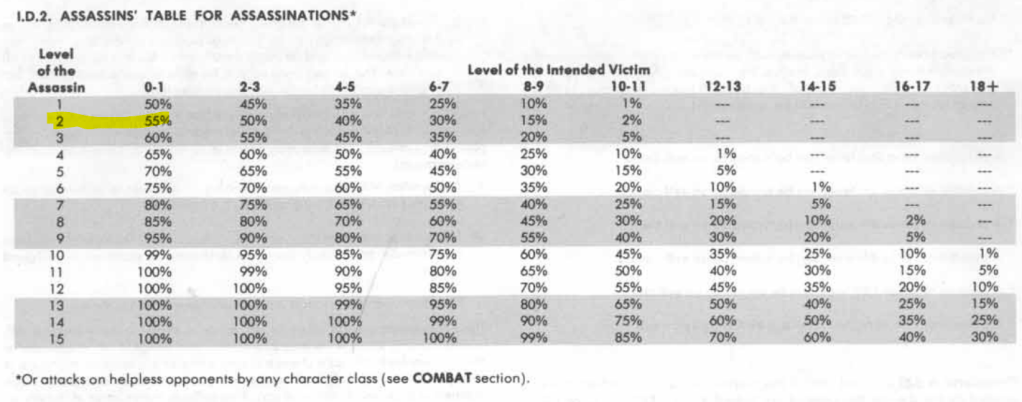
We know Marlowe did not kill Frizer, so he either did not get to use the table, or he failed on the assassination roll. What are the odds of getting both the second segment of surprise and succeeding on the assasination roll. To get the second segment of surprise Marlowe needed to roll a 3 or better and Frizer a 2, that (4/6) x (1/6) = 0.111. Eleven percent chance. Then he has a 55 percent chance of success if he got the second segment, that’s 0.111 x 0.55 =0.061. Six point one percent change of achieving the instant kill. Not goods odds. And, he didn’t make it.
Now, if he achieved the second segment but failed the assassination roll, Marlowe would still get to roll damage as a hit. A dagger does 1d4 damage. So, even if he failed the assassination roll, he still has a chance to kill Frizer. Frizer has four hit points, he’d need to roll a four for a kill, 25 percent chance. There his odds of success are 0.111 x 0.45 (odds of failing the assassination roll) x 0.25 = 0.0125. One point five percent chance of succeeding when the assassination roll fails. Overall odds of Frizer being killed on the second segment is then 7.35 percent. Not great odds.
If Marlowe failed at getting the second segment, he still gets a normal attack at 60 percent chance of a hit, and if so a 25 percent chance of a kill. The odds there are (1-0.111) x 0.6 x 0.25= 0.133. Thirteen poin three percent chance of a kill.
Overall Marlowe has a 7.35+13.3 = 20.6 percent chance of killing Frizer. Not great odds. Not the worst, but not great.
But we know he fails. At best he does one or two hit points points damage to Frizer. Given the superficiality of Frizer’s wounds, I’m going with a single hit point.
So what then are the three opponent’s responses? The story is that Frizer manages to wrest the dagger back from Marlowe, with which he then delivers the fatal blow.
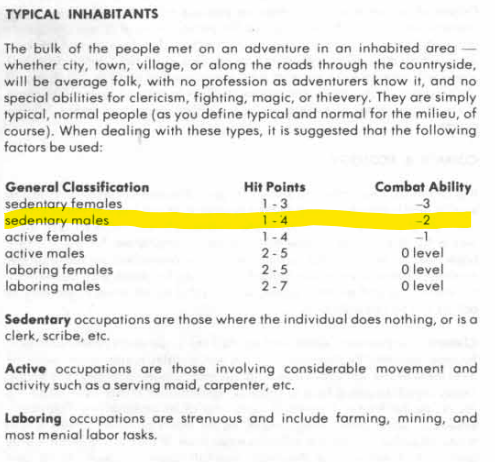
Getting that dagger back sounds like disarming. Now, AD&D does not have a lot of rules for disarming opponents. There are specific weapons (like the spetum) which can disarm. Frizer does not have any weapon, much less a disarming weapon. The grappling rules state that the attacker cannot grapple if either or both hands are holding anything. But that’s the attacker,

A number of questions get raised here. The grappling rules that in each round of grappling there will be an attack and a counter.

It says nothing about whether the counter of the grapple must drop a held item.
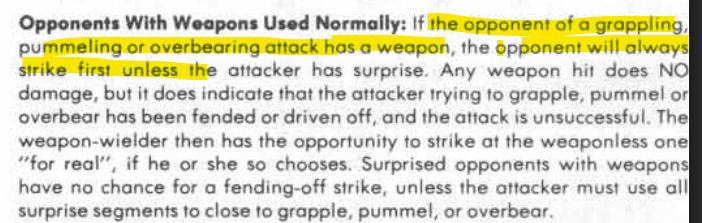
Additionally, it says that if an opponent of a grappling attack has a weapon, they will always strike first. And, if successful, no damage is done but the grappler has been fended off.
So the qeustions are:
- Is the counter to a grappling attack required to drop what’s in their hands?
- If the character who is grappled has already attacked in the round, does he get a counter?
- If the characters who is grappled, has a weapon and has already attacked in the round, do they get a fend attempt? Does that prior attack count as the fend?
I dont’t have true answers here, and I don’t think any has them (Gygax is dead), but here’s what I have done. The unarmed combat rules are mostly written as a seperate system from normal melee. It may be that’s not the case, but that’s how it reads to me (mostly). So, as I result, I have generally allowed fending for all grapple attacks even if the grapple comes at the end of the turn from the side that lost initiative. That is, having carried out your normal melee attacks does not lose you your chance to fend. I can see arguments otherwise, but that’s how I’ve done it. Similarly, I’ve assumed that a grapple always gets a counter even if a character has already attacked in the round. If someone grabs you, you will instinctively pull away. I have also required that counters, like attacking grapples, also require free hands. Again, I can see arguments otherwise, but that’s been my practice.
Back to the first round, Marlowe has seized the dagger and mananged to do superficial damage to Frizer. Frizer then grapples. Under my prior practice, Marlowe may fend. Frizer has turned to face Marlowe, the back of his head streaming blood, so the odds to fend AC 10 or 11+, or 50%. To be consistent with the story, Marlowe fails to fend. Frizer grapples. Frizer’s base chance is 10 x 10 ( AC10 x 10) + 13 (attacker’s dex) = 113%, he can’t fail. Now for the effect, roll is 1d100 modified by 13 (attacker’s dex) + 11 (attacker’s str) = 1d100+24. Minimum roll here then is 25, maximum 124. I’m assuming no weight and height differences. Anything might happen (except for a waist clinch). But the story does not imply a huge amount of wrestling, just that Frizer managed to get the dagger back from Marlowe. I’m assuming Frizer rolled low (15+24=39) and managed to get an arm lock. Heck, that’s what they’ll tell you if wrestling a man with a knife, control the arm with the knife. Marlow takes 1 hp of subdual damage. Marlowe has three remaining hit points.
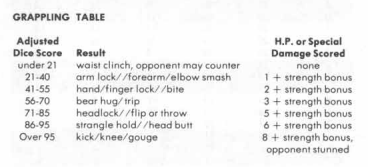
Marlowe now gets his counter. He is already grappled so, there is no need to roll the base chance to grapple. Opinions may differ here but if he did have to roll the base chance, he’d still be in the automatic range 10×10 +14 = 114%. So, now Marlow drops his dagger and rolls his counter, 1d100+14 (his dex) + 11 (his str) = 1d100 +25. Marlowe and Frizer are pretty well matched here. Marlowe rolls better (25+24=49) than Frizer, but not much better. He bites Frizer’s grip on his hand doing 2 points of subdual damage. Frizer but one hit point left.
But, hold on, what about Poley and Skeres. What do they do? The story doesn’t say they did anything. If they had though, they also could grapple Marlowe. Given, their base chances to grapple are both over 100%, well, if they had intervened together they could have subdued Marlowe.
That’s the end of round 1.
Round 2:
Frizer wins intiative (41.66% chance), picks up the dagger and stabs Marlowe. Marlow has AC 10, Frizer has zero hit dice so needs 11+2 (sedentary male) = 13 to hit (40%), succeeds and rolls at least 4 hp damage. Rolling three hit points would have reduced Marlowe to zero hit points but one of those was recoverable subdual damage. But four hit points reduces Marlowe to -1 hp, even recovering, the one hit point of subdual damage is zero hp. So, at best, Marlowe dies instantly, at worst, he spends several rounds unconscious and bleeding out.
Frizer has a ten percent chance of killing Marlowe (0.25 x 0.40 = 0.1), and he did so. Well, no. Really, including winning initiative it’s 0.25 x 0.4 x 0.4166 = 0.042. Four point two percent chance.
Had Marlowe won intiative, Frizer has but a single hit point left. So, any hit reduces him to zero and out of the fight. And, a roll of two or better would be unrecoverable. The odds of killing Frizer are 0.4166 x 0.5 x 1 = 0.208 (20.8%).
Sum up:
Overall, Marlowe has 25 percent chance of killing Frizer over the two rounds (assuming Marlowe is himself not killed or otherwise subdued.
Frizer, on the other hand, needed to roll at least a 47 on his grappling score to completely subdue Marlowe (with a 5hp head lock). To do that Marlowe needed to also fail to fend (50%). Total odds 0.5 x 0.53 = 27% chance. Total odds (more or less) of Frizer winning over the two rounds are then 20.8%+27% = 47.8%
Overall, the odds were not in Marlowe’s favor and even if taking Frizer out of the action, he then had two more opponents to contend with. So, his choice, even with surprise, of grabbbing Frizer’s dagger was a mistake. Given the surprise his better chance would have been to run for the door.
Scenario 2 — the more likely story
Marlowe is in a private room with three hostile intelligence agents, one of which is likely an experienced assassin. Assume that Frizer never had the dagger. Poley has the dagger. Poley, as I’ve represented here is an 8th level assassin. With surprise, Poley has an 80 percent chance of killing Marlowe outright.
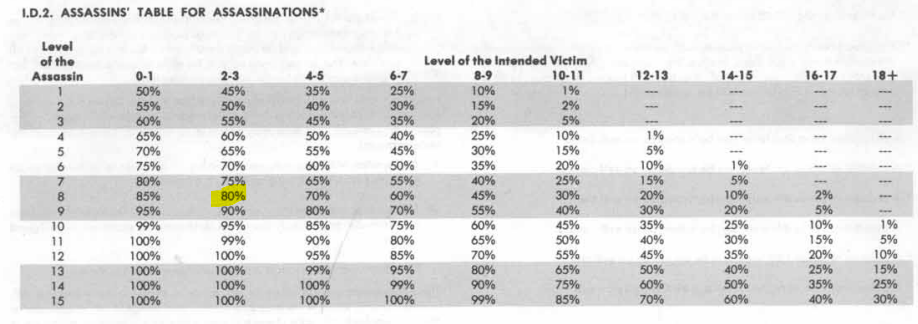
Total odds then are, 0.4166 x 0.8 = 0.333. Thirty-three percent chance. But actually if the assassination attempt fails, the dagger stills does damage. Thus Marlowe (with 4 hp) still then has a 25 percent chance of being killed. Fifty-eight percent chance of success of killing Marlowe overall.
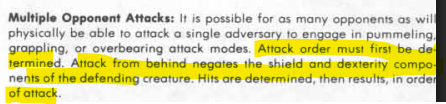
But, it’s even worse for Marlowe. Assume no dagger is drawn. Everyone is unarmored and therefore have very good chances to successfully grapple (>100%). Unless, Marlowe wins intiative and runs for the door, then he will be successfully grappled and with three opponents of similar capability, it’s overwhelming that he will be subdued. And, once subdued, dispatched. And, really, the three could reasonably block the door from being reached.
Let’s face the facts. The wound Marlowe received, a stab into the eyesocket, above the eyeball and into the brain, looks a lot less like the sort of knife wound one takes in a brawl, than the kind one takes when two guys are holding you down and the third picks the least messy way to finish you off. Oh, I dunno, the sort of wound a professional intelligence agent might practice.
Scenario 3 — badass Marlowe
Let’s look at one last scenario.
Assume Marlowe isn’t a normal man. Assume he is instead, a 10th level fighter with 18/00 strength and 18 dexterity with 70 hit points. As before, all are unarmored. Poley has the dagger.
Fighter Marlowe trusts his three companions. They enter the room. You first my good man. The door closes. The three jump the Fighter Marlowe.
There is a 25 percent chance the three get at least one segment of surprise. And, a 11.1 percent chance of getting two segments of surprise. Poley has a 30% chance of successful assassination of a 10th level character. Overall, that’s 0.138*0.3+0.111*0.3 = 0.75. 7.5 percent chance of successful assination in the first two segments.
Assuming no surprise (47.2% chance), then it goes to initiative. The three have a 41.66 percent chance of winning initiative. If they win, then all three can choose to grapple Fighter Marlowe.
Base chance to grapple:
- Poley 100+15=115
- Frizer 100+13 = 113
- Skeres 100+15 = 115
All three will successfully grapple:
Now the result modifiers
- Poley 15+15-8-16=+6
- Frizer 13+11-8-16=+0
- Skeres 15+14-8-16=+5
Assume an average roll for each (55).
Poley and Skeres get bear hugs and Frizer grabs a hand.
Fighter Marlowe nows gets to counter.
- Fighter Marlowe on Poley 18+18+10-2-3 = 41
- Fighter Marlowe on Frizer 18+18+10=46
- FM on Skeres 18+18+10-2–2=42
If Fighter Marlowe rolls average (55) then all three will have their holds broken and end up stunned. Presumably past that point, Fighter Marlowe cleans their clocks.
But what if they don’t roll average. To get a good chance of a win, they really need to stun Fighter Marlowe. Poley would need to roll a 90, Skeres a 91, and Frizer a 96. Overall odd of at least one hitting that mark is 24 percent. Because the rules states that any hold remains in effect unless a successful higher percentage counter is rolled, a stun in grappling really results in a win. Once stunned, the stunned character keeps getting stunned the following rounds until out.
So, generally speaking overall odds of reducing Fighter Marlowe in the first round include the chance of assassination plus the chance of successful stunning grapple. So, 7.5+24 = 31.5%.
Now, if the don’t get surprise and lose initiative their odds drop rapidly. Because Frizer is 0-level, Fighter Marlowe would get a free attack on Frizer. The first thing I’d do is punch Frizer in the face. Given his 18/00 strength, he has a great chance to knock him out immediately, that leaves Poley and Skeres. And, odds are Fighter Marlowe can at least stun one of them with a pummel. Then the following round, the remaining dude better roll lucky on a grapple and hope to stun, because otherwise he’s getting knocked out too.
But, what if Fighter Marlowe did not have extraordinary attributes (thought I doubt he’d make tenth level without them). The grapple odds go to 95 percent chance of at least one stunning grapple occuring.
The upshot here is to realize, that three to one odds can be significantly dangerous, if unarmed and unarmored regardless of levels. Plus, extreme attributes can also bring real advantages. I suppose that isn’t too surprising. Yet, even so, I reckon a player who has raised his fighter to tenth level would prefer not his opponenents ever have a nearly 1/3 chance of taking him out in a single round.
Conclusions
I did a lot of math here, more or less accurately, thought I admit not taking all permutations into account. But to play the game, you do not have to.
What it shows here is that even high level characters face significant risks if unarmed and trapped in a room with three dudes who want to kill him. In one or two rounds, normal guy Marlowe will be taken out by the three easily. Even extraordinary fighters are at a real risk. AD&D combat can be short and deadly. And, yes, brutal. Like three guys holding you down and driving a knife above your eye socket into your brain.
AD&D provides the requested brutal insane bedlam. But you will have to do some modest math, consult some charts, and roll some dice. But, that’s what playing a game is.


Leave a Reply