
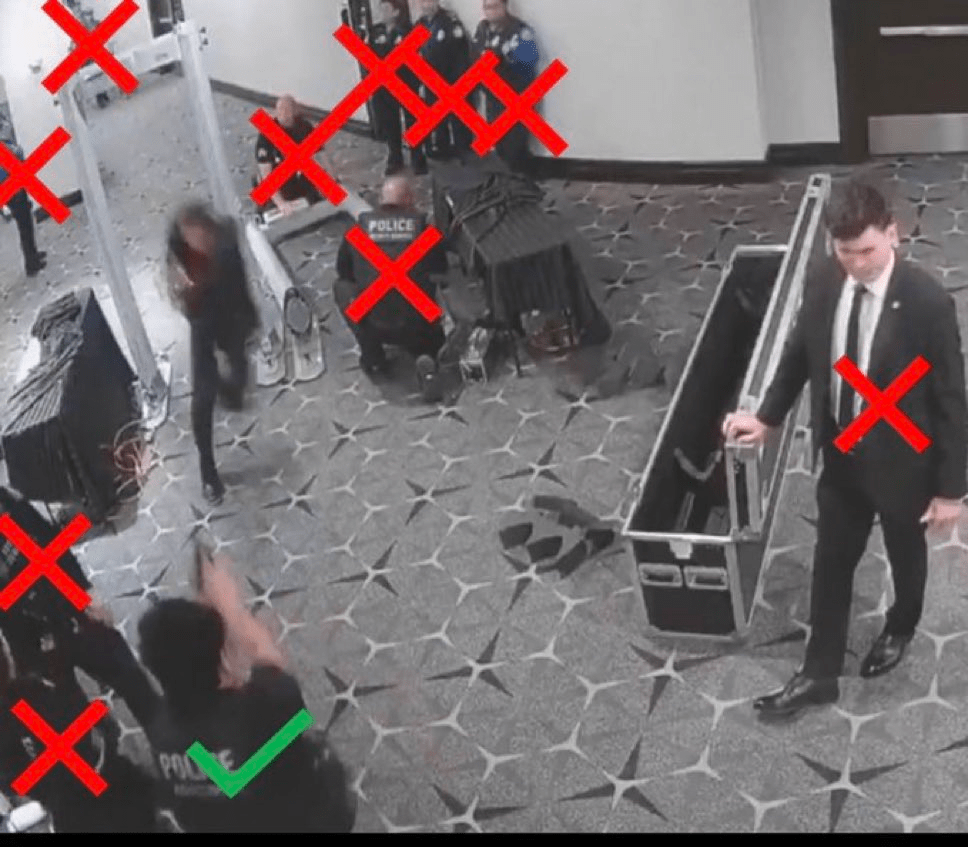
This one isn’t political. I’m taking a look here as an example of how game mechanics might represent real life circumstances.
What seems to have happened is a man attempted to attack the White House Correspondents Dinner with the aim of assassinating President Trump and/or other high members of the government. Luckily, he failed and was apprehended.
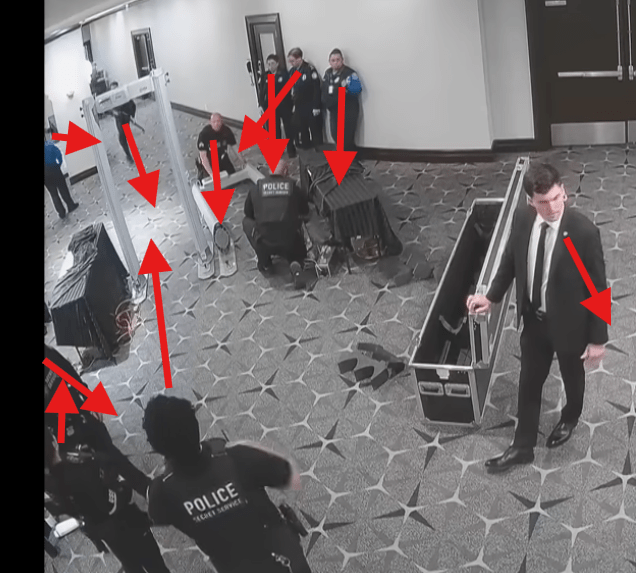
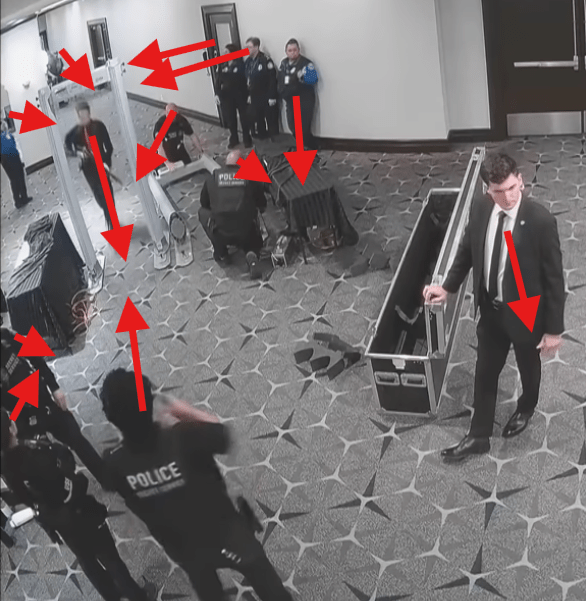
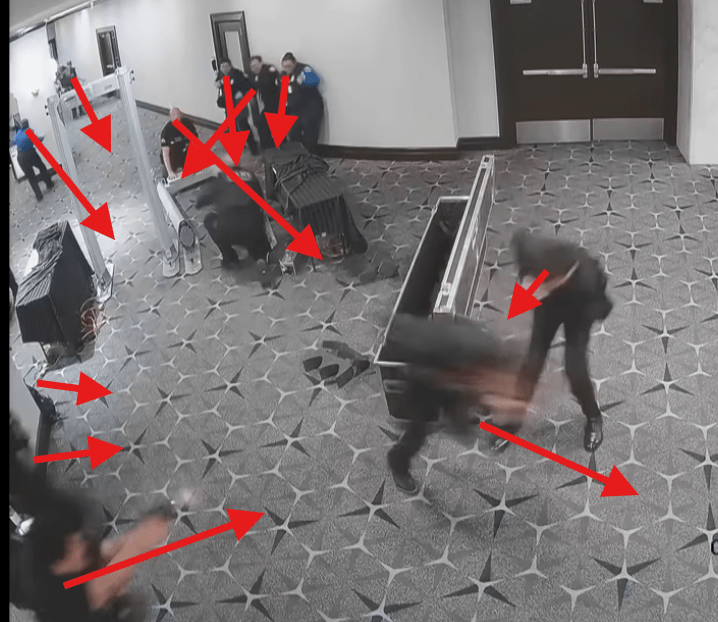
The diagram here is approximate and based on the photo above. Each square being about five feet. The various guards are shown in red with the arrows being the apparent direction of their facing or gaze. The attacker exits the side and within three seconds is going through the standing metal detector. Then two seconds later leaves the frame of the video. So, what we are covering here last about five seconds. This video seems to cover it.
During these five seconds, it seems the attacker fired his shotgun once, missing. Or, possibly hitting one Secret Service officer in their vest. While five rounds were fired by one Secret Service officer, also all missing. The officer who fired is circled in green.
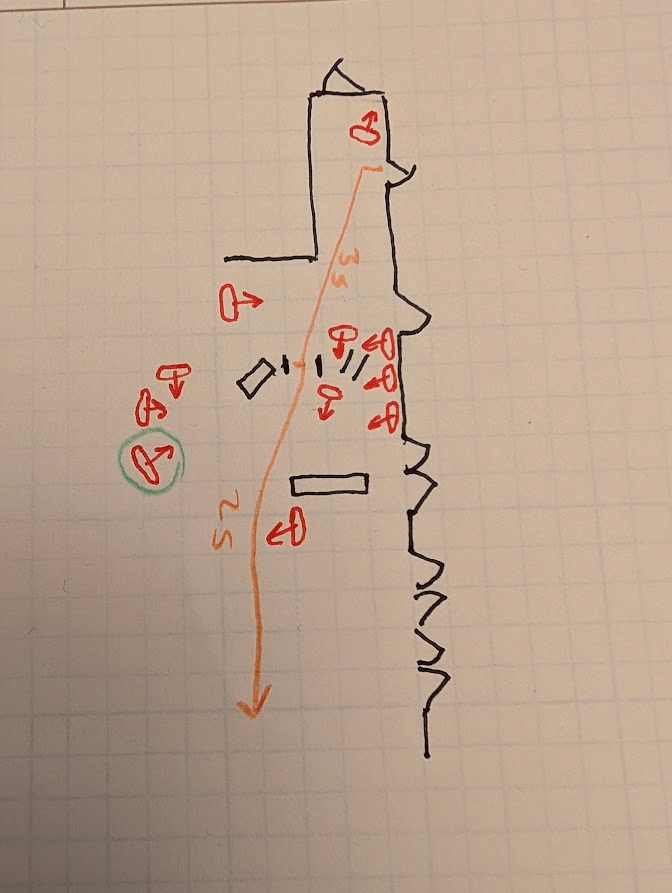
From my crude diagram, it’s clear the officer that managed to draw and fire at the attacker, was the only person present looking the right way, who had the longest time available to both notice the runner, process what was happening and make a decision to react. Most of those present were either facing away from the door, or looking perpendicular to the path of the runner, meaning they only had a chance to react until after he had passed them. It has been noted that the runner was moving at approximately 9 miles per hour.
For our exercise we will be using the rules for Gang Busters. This rule set is for running games of cops and robber in the 1920s & 1930s. But, really, this is pistols and shotguns. Nothing much has changed.
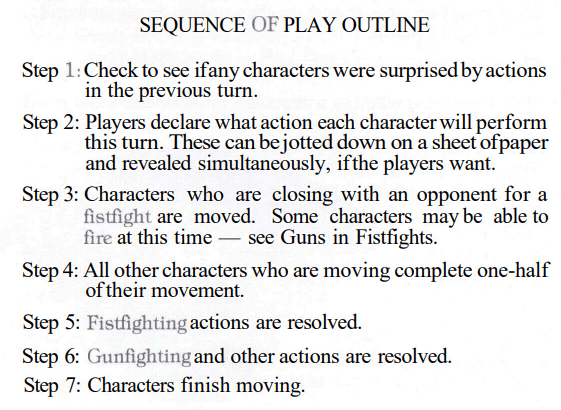
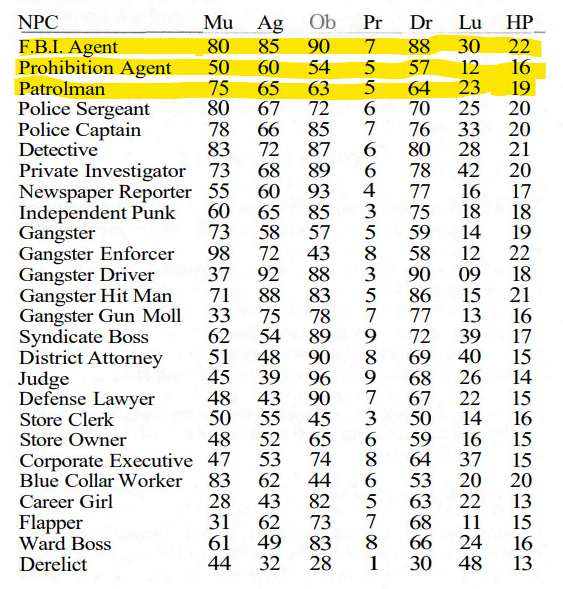
The first step is to check whether characters are surprised. First off, I’m ruling anyone with their back turned is automatically surprised, and the rest must check to see if they are surprised. That makes five out of the eleven automatically surprised. According to the surprise rules one must make an Observation check to determine whether a person is surprised. What’s their observation?
The rules don’t give a statistics for Secret Service Agents. But, I’m going with the FBI stats for them. I see only one guy in the classic suit and tie so, I’m treating him as Secret Service and thus Observation 90. All the others I’m using the Patrolman stats, Observation 63.
Turn 1 (Second 1)
When the attacker exits the doorway, there are two potential guards that might react. The guard leaning against the wall nearest to the exit door, might have caught something in their peripheral vision, and the guard looking in the direction of the door. As luck would have it, they both failed their rolls as they took no action in that first second. The odds of this happening are 0.37 x 0.37 or 13.7%. The rule for length of surprise is the roll minus the character’s observation roll. The guard with the best view rolls a 64, so he can react the next turn. The guy along the wall rolls a 66, so can’t react until turn three. But note, surprise can be brutal in Gang Busters, if they’d rolled 100, they couldn’t act for 37 turns, over half a minute.
The attacker chooses to run. According to the rules, they can run 15 feet in a turn, that turns out to be ten miles per hour, so pretty close to the estimates made in the video. After one second he’s now at the corner where the room opens up. Only one officer has noticed.
Turn 2
Six more officers get to roll for surprise. All either fail, (0.26% chance), or it’s a mix, some seem to start to notice the runner. Our one officer has drawn his pistol. The runner keeps going another 15 feet at the run, he’s nearly at the metal detector.
Turn 3
A lot happens this turn. The runner keeps going another 15 feet. He apparently fires a shot from his shotgun, at the officer drawing on him. The officer fires four or five times (I counted four muzzle flashes during that second, but there might be another near the end). I’ll use four for this example. Pretty much all the other officers (except the two packing the metal detector ) start drawing their own weapons.
First the runner’s shot. It’s a pump action shotgun. Per the Gang Buster’s rules, rate of fire is one per turn, so that works. What are the odds of hitting? Per the rules shooting is an Agility modified by situational modifiers. What’s his Agility? Well, we know he’s no tough guy. Fellow on the white collar career path. back to the NPC table. I put him somewhere between Career Girl, Store Clerk, and District Attorney. Let’s do Store Clerk, Agility 55. But he’s running.
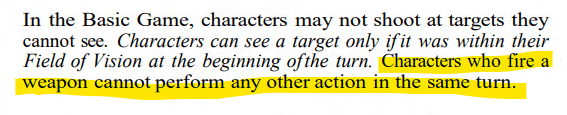
Rules say if you shoot you can’t perform any other action. But he did shoot. Yet he was running. Automatic miss.
Now the officer. In Gang Busters, the rate of fire for an automatic pistol is one per turn. But we know he got four or five rounds off. Well, the game falls down there in my opinion. Let’s do the one round.
Patrolman agility is 65, target is running -20, also turning and firing as he runs by -10. So the odds at 65-30 = 35%. Not great odds and we know he missed. Now, there is a rule that could be stretched to allow the other shots. The rules for the Browning Automatic Rifle used in semiautomatic mode, allow for up to three rounds to be fired per turn. The first without modifier. The second at -10, and the third at -20. So, if we applied this also to semiautomatic pistols, then the first shot is at 35%, the second 25%, and the third at 15%. If we extended the same approach to a four round, then that would be at 5%. Under this approach, the odds of all four rounds missing are 0.65×0.75×0.85×0.95=39.37%. Meaning the odds of at least one hitting were 60.63%. So, better than even odds for a hit. Bad luck for that officer.
But, someone was hit. I know I wouldn’t want to be standing where those officers opposite were standing.
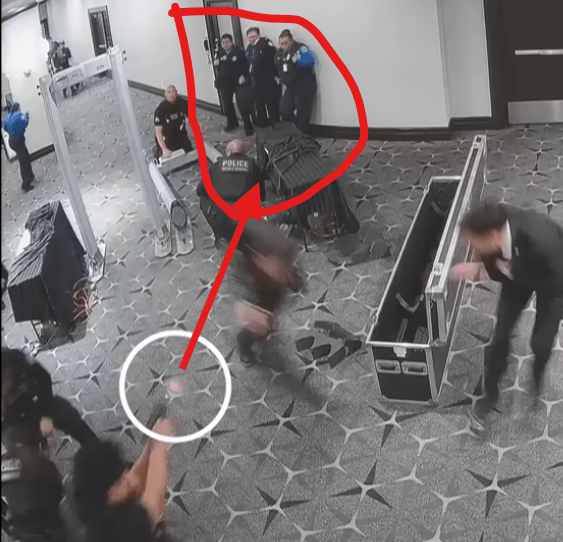
Still, at the end of the turn, the runner is nearly off the screen, and most of the officers have not yet substantially reacted.
Turn 4
The runner continues running. The officer finishes his shooting and missing (with no better odds than last turn). All the other officers have now either drawn their weapons and/or moving to follow the runner. Or, some seem to be running away. Though let’s be charitable. They might have been going to cover exits from which more attackers might be emerging from. It’s a reasonable assumption that where there is one attacker, there might be others. Also, pretty standard to want to cover the exits. Plus, one of those retreating might have been shot and moving away to assess the damage.
Turn 5
I’m calling it here. The attacker is off-screen. Apparently, he trips and falls and is then subdued.
Conclusion
Overall, Gang Busters does a decent job of representing what happened here. Given the random rolls, it’d be unlikely to get exactly the same result if played out. But that’s randomness for you. It seems like a plausible scenario which the game system was designed to address.
Also, from my perspective, outside the game system, it seems like the officers involved reacted pretty quickly to an unexpected situation. Especially the one fellow who opened fire. He had the best view of what was happening. One observation I have is he might have done better not drawing and firing, but just tackling the guy. One step into his path, and it would have been all over. It’s a pretty good example of how when it gets tight, people respond to what they have trained. No doubt they’d trained drawing and firing a lot more than intercepting and tackling.
The other unanswered question is why are they packing up the security point when the even is not over? Seems pretty lax, despite the relatively fast reaction times of the officers. If the checkpoint had been up and the officers looking outward, rather than inward, he’d have had much less of a chance.
But let’s make another thought experiment. How would this same thing be represented in AD&D? Well, instead of one second turns, AD&D uses 1-minute rounds. Meaning this whole thing was one one-minute round. There is no surprise in AD&D terms because the guy would have made it into the room in that case. Initiative is by side, so the attacker wins initiative runs, firing once while missing. Then one officer returns fire (missing) while the remaining use the unarmed combat rules to dogpile him. Perhaps the DM rules he must make a saving throw to avoid tripping while charging through an area scattered with equipment (he fails that saving throw).
In both systems it’d be the same event. But how the details play out feel somewhat different.
Addendum 1: Let’s take a look at the tackling scenario. Instead of drawing on turn 2, the officer moves to grapple with the runner. Both can move up to 15 feet. So the officer, gets to him right around the metal detector. The attacker is going to try to shoot while the officer tries a hold.
The attacker has an Agility of 55 but is considered to be “in a fistfight” so gets a -40 modifiers. Only 15% chance of hitting. Meanwhile, the officer has an Agility of 65 and Muscle of 75 (giving him a punching score of 4). The officer has better odds (65%) than hitting with at least one bullet. Plus, if he’s successful, the attacker takes 2 damage per round until he breaks free. And, of course, very soon all eleven of the officers in the room will be available for further piling on. So, it’s a risky move, but, at least in Gang Busters, closing to melee had better chances of success than trying to draw and shoot.


Leave a Reply