
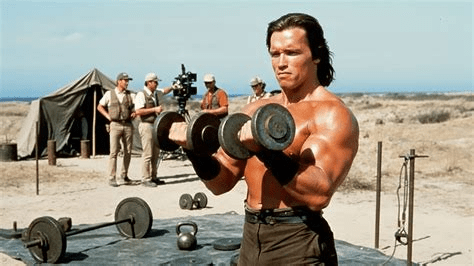
I’ve previously written about Conan as represented in AD&D here. And, I’ve recently talked about strength in AD&D here. This post is to discuss a contradiction I’ve made. And to make a controversial assertion. Arnold Swarzennegger was not strong enough to play Conan. It’s a hard pill to swallow but let’s take a look.
Rob Kuntz in God’s, Demigods, and Heroes puts Conan’s strength at 18/00.
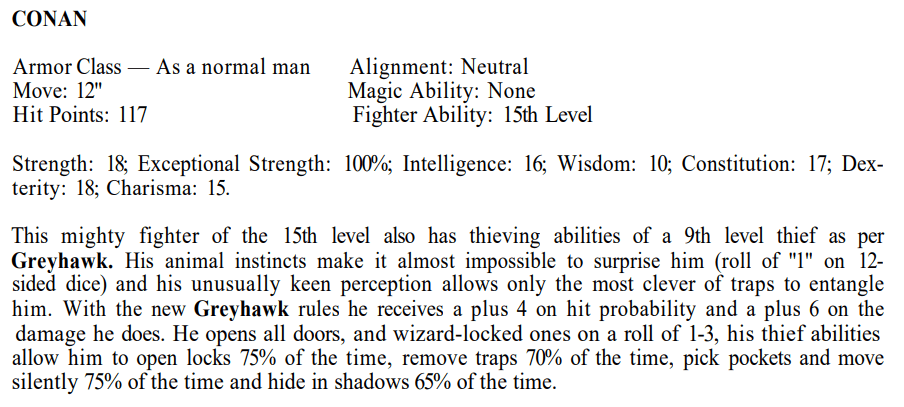
Gygax, depending on age, put Conan’s strength varying between 18/01 and 19. Nineteen! C’mon now. Conan is only human.
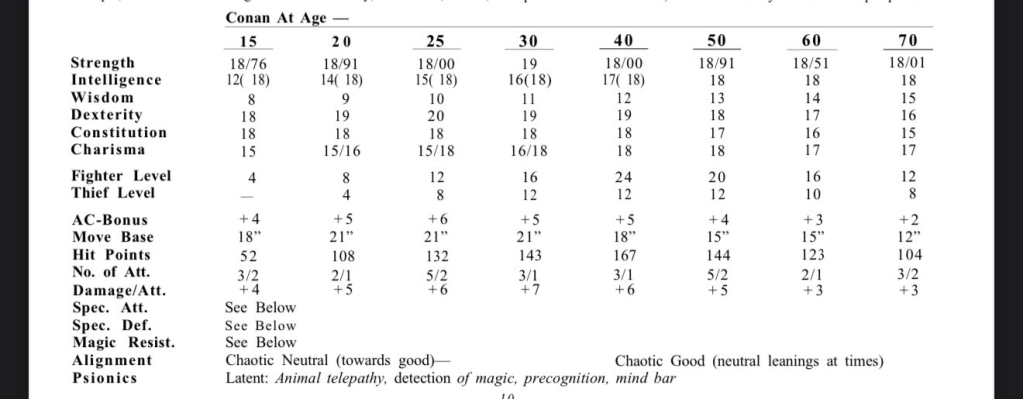
The TSR published modules set Conan at 18/90.
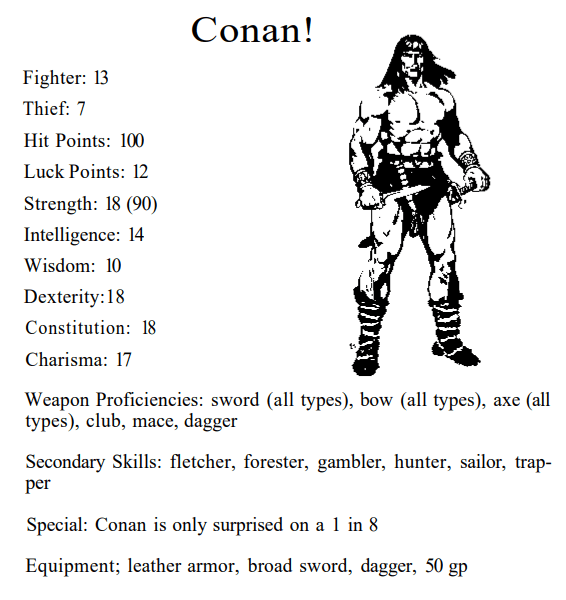
Myself, I equivocated and chose tradition.
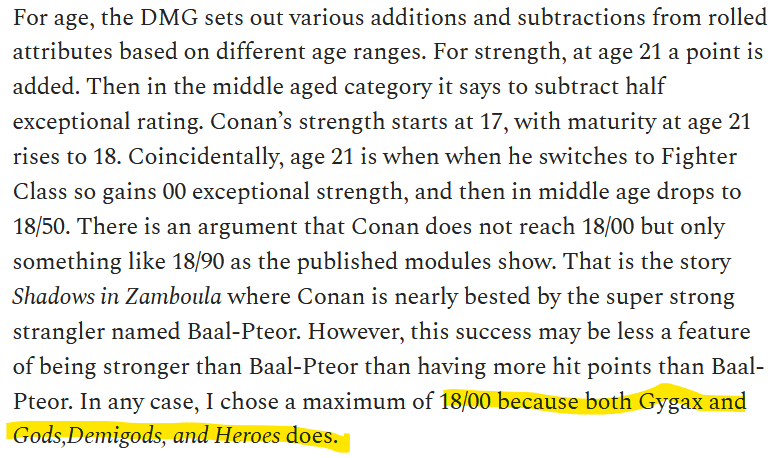
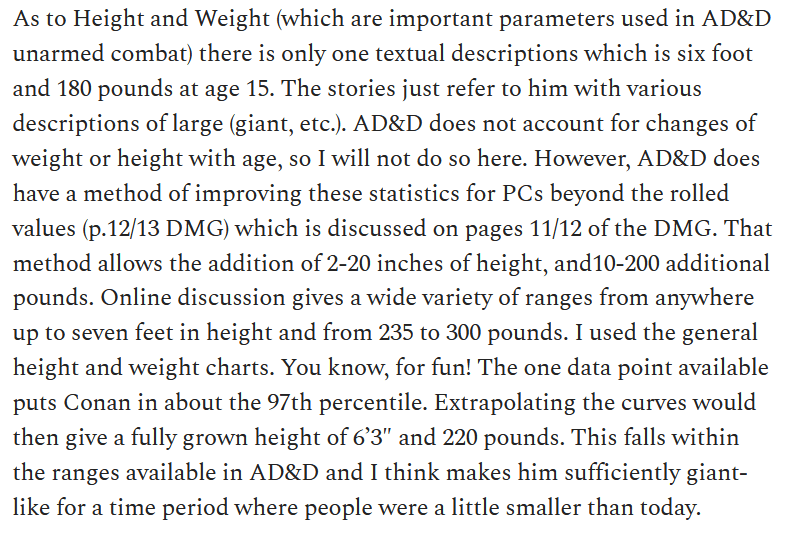
I also choose a height and weight of 6’3″ and 220 pounds. Which, if the internet is correct, is not so dissimilar to Swartsenegger’s own 6’2″ and (at his peak) between 230–250 lbs.
Using the method I previously described, using his body weight range of 220-250 lbs, puts strength around 18-18/75.
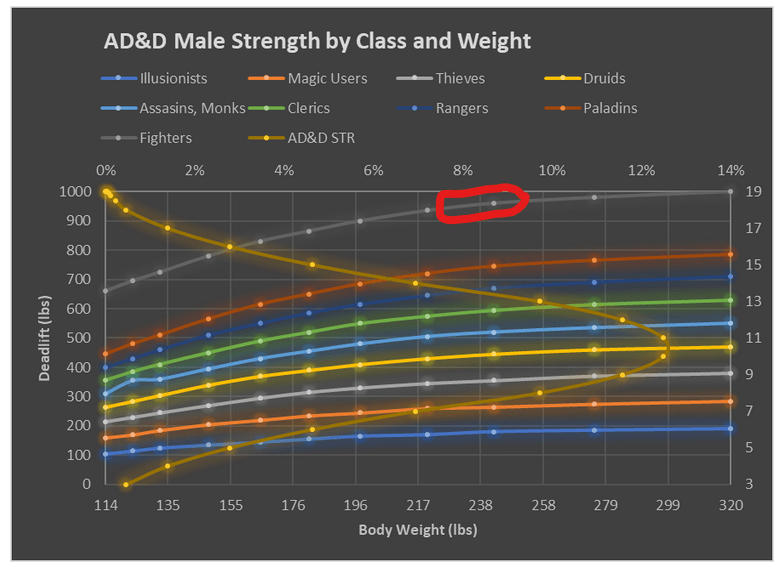
But that would put his deadlift between 900 and 960 pounds. Arnold, according to the internet max his deadlift at 710 pounds. Of course, I choose the top of the scale range for demigod scale. If Arnold is merely world-class then his maximum strength at his weight drops to around 15, Fifteen! This illustrates a weakness in the approach I took. Spreading the entire range of strengths along the deadlift training goal probably doesn’t represent the low end of abilities, even for those untrained.
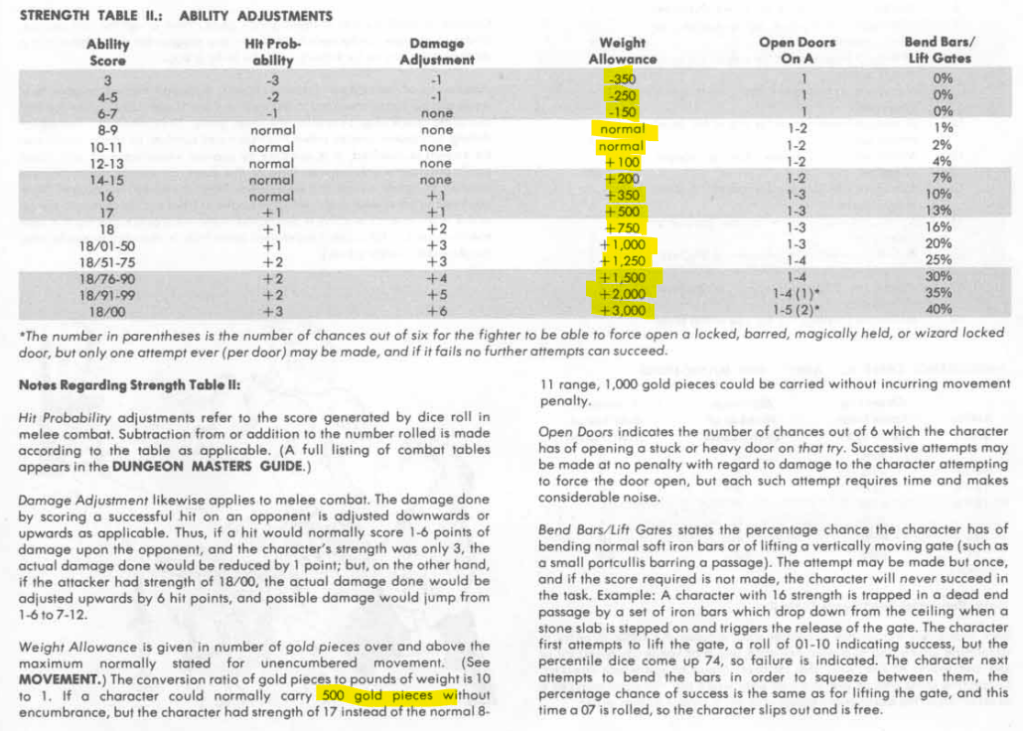
One thing to note is that Strength Table II in the PHB gives a “Weight Allowance”. Every character starts with a minimum 500 gp allowed weight that then gets modified by the weight allowance. This gives a range of 150 (STR 3) coins to 3,500 (18/00) coins that a character is able to carry without becoming encumbered. Without becoming encumbered! So, a character can still more to some degree while carrying these weights. That cannot be a deadlift. While some may be able to move to some degree at their maximum deadlift, generally they really aren’t going anywhere. So, the PHB values are not deadlift values.
But if they were deadlift values, and you mapped the listed weights to the dataset I used you get something like this.
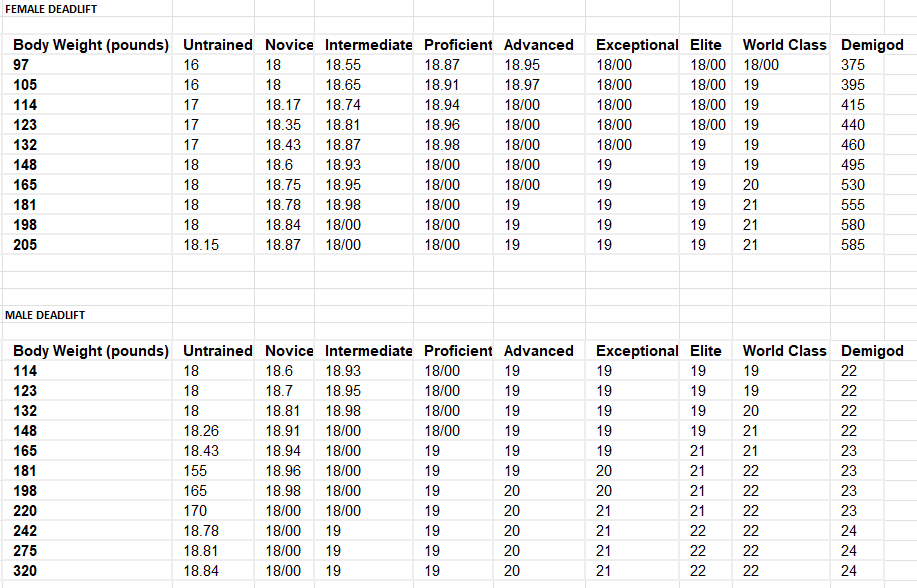
Meaning that even for smallest women the lowest value is at a strength 16. And, the men then get into godly realms of strength. That’s a problem. But it isn’t crazy since the deadlift by weight category values, while at different levels of training, are goals for people engaged in active deadlifting.
Page 225 of the DMG states.

But what does that mean? Normal strength. Is “normal strength” that marked as “normal” in the weight allowance on Strength Table II? Is so, this would only apply to strengths 8 through 11. Or, is normal everything up to 18 with the percentiles are exceptional? Or, is it all the way up to 18/00? Don’t know.
A Nepalese Sherpa carries something like 110 to 175 lbs which would put them in the 18 to 18/75 categories, but some loads would be above the 150 pound maximum.
I do know the PHB page 101 and 102 lists weights which would lower movement rates.
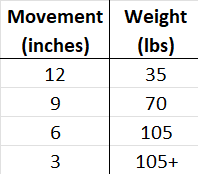
The 150 maximum does seem in line with the PHB values, extrapolated to a zero movement rate. I take the150 lbs (1500 coins) as triple the normal 500 coins value applied to those with no additional weight allowance. Otherwise, there is a contradiction to the other additional weight allowances which go over 150 lbs and thus mean one isn’t encumbered.
An 18/00 strength gets 500 + 3000 coins or 350 pound load. Using this tripling rule of thumb, this would set a maximum lift at 1,050 pounds. Hafþór Júlíus Björnsson on May 2, 2020 set the male world record dead lift at 1,104.5 lbs. And, things have advanced since the writing of the 1978 PHB. The male world record deadlift in 1978 was 815 pounds (369.6 kg), set by Vince Anello, so a 1,050 pound seems suitably heroic for 1978. Note the PHB was written before Anello’s record was set.
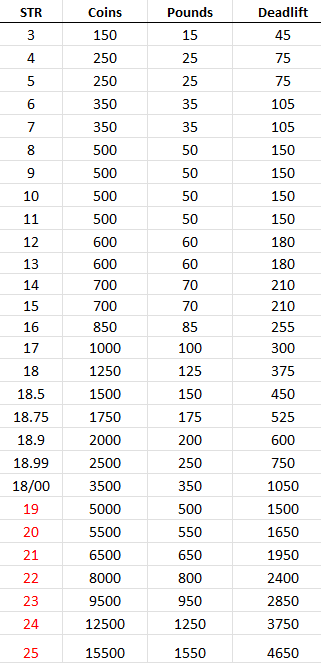
This scaling would put Hafþór Júlíus Björnsson in the strength 19 categories. It would put Samantha Rice in the 18/99 category (or 18/93 if you interpolate from her record of 655.9 pounds). It puts Vince Anello’s 1978 record between 18/99 and 18/00 (I’m not going to the thousandths place). Likewise, it puts Jan Todd’s 1978 record of 412 pounds (first woman break 400) at 18/25 And, it puts Arnold’s 710 pound lift 18/97.
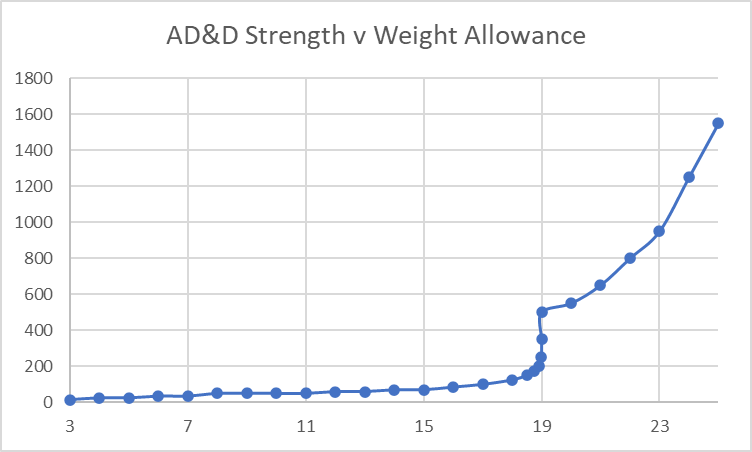
I think I like this tripling procedure better than that in my earlier approach. But it also has a flaw. Now, this is a flaw contained in the strength table distribution itself. There is little differentiation between weights at the high end. It’s pretty flat through most of the scale, skyrockets at 18, and then continues into the godly more sedately.
One observation is that nowhere in the PHB or DMG is there a definition of maximum lifting ability. There are maximums for how much can be lifted before becoming encumbered. And, there is the maximum one can lift and still move. But nothing that explicitly says the point beyond which one can lift.
The closest we get is the bend bars/lift gates values. Bend bars/lift gates gives a percentage change of lifting heavy objects. There is no maximum (beyond DM judgment), just a percentage chance to lift an extremely heavy gate (and presumably other heavy objects). It isn’t quite true, strengths 3 through 7 have 0% chance to bend bars/lift gates. But, generally, most characters will at least have a chance to lift that heavy thing of whatever weight, subject to referee judgment.
As to Arnold? He comes pretty close to my extrapolated height and weight for Conan (perhaps my weight was a little low). But, that 710 pound deadlift. It just doesn’t hit that 18/00 no matter how I slice it.


Leave a Reply