
There was this.
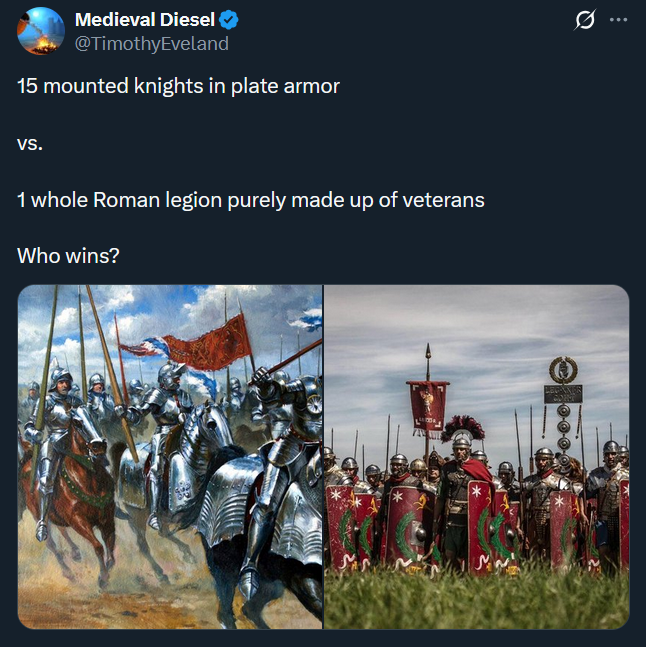
Followed by this.
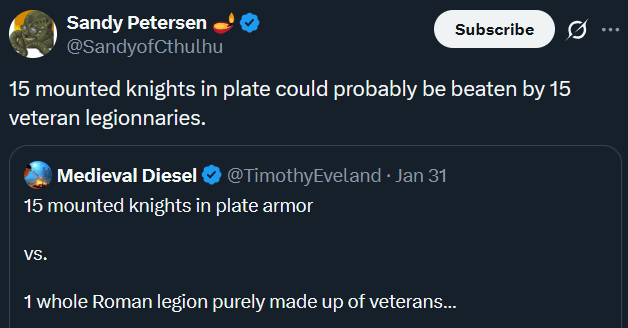
Which led to a lot of discussion and assertions.
The first claim is obvious. The Romans. Doesn’t matter what Roman era. A legion is thousands of men. There is no scenario where 15 men, however superior their arms and armor, beat a legion. At least not armed with hand weapons.
But 15 mounted knights in plate armor versus 15 veteran legionaries? My money is with the knights. The mass effect of the horses and lance will be overwhelming. But, opinions differ. Let’s play it out. I’m choosing AD&D.
To start, how would a “knight” and a “veteran legionary” be represented in AD&D? The knight is a fairly straight forward presentation in AD&D. the legionary is somewhat difficult to represent in AD&D, as the AD&D rules are representative of something like late 13th/early 14th century arms and armor.
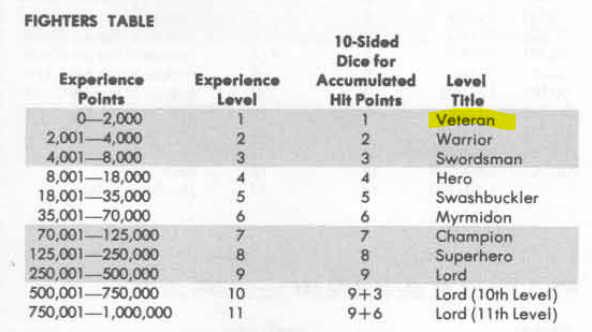
Let’s start with the legionary. As a “veteran” the legionaries will be first level fighters. They then have one ten-sided hit die for an average hit points of 5.5 hp. I’m choosing the classic high Roman Empire arms and armor setup of lorica segmentata, scutum, gladius, and two pila. There are arguments of whether lorica hamata (chain shirt) were superior, but lorica squamata (scale mail) is certainly inferior. How should lorica segmentata be represented in AD&D? Lorica hamata is chainmail, but it is only a chain shirt where AD&D chainmail is more like 12th century head to toe mail coverage. So, I’d call lorica hamata AC 6 over chainmails AC 5 due to the lessened coverage. Lorica segmentata might be considered banded or splint mail (both AC4), but like lorica hamada, lorica segmentata covers less body area than either splint mail or banded mail. So, I’d bring lorica segmentata up a notch to AC5, but, I’d use the armor class adjustments for banded mail due to its plated nature. It’s a judgment call. The scutum is a large shield in AD&D terms.
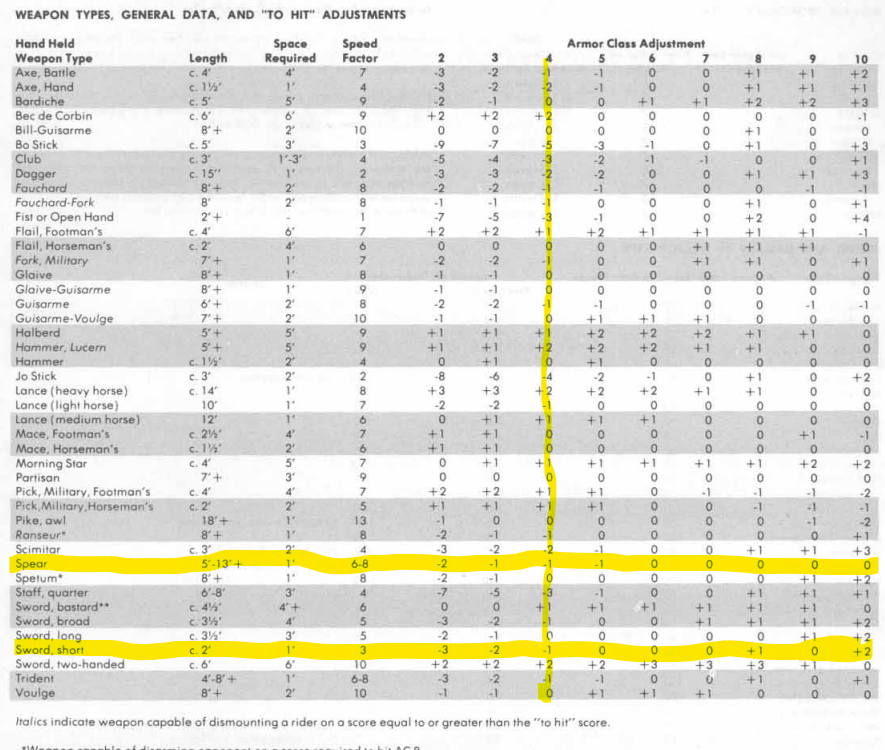
For weapons, I’m calling the gladius equivalent to the AD&D short sword. The pilum is more tricky. The pilum is often referred to as a kind of javelin. But, comparing the AD&D javelin versus the spear, I lean toward treating it as a spear in terms of damage, throwing range, and effectiveness against armor. For length, the spear is listed 5′ to 13′ in length. A pilum is 6 to 7 feet in length. For this example I’m choosing the long side of 7 feet for the pilum.
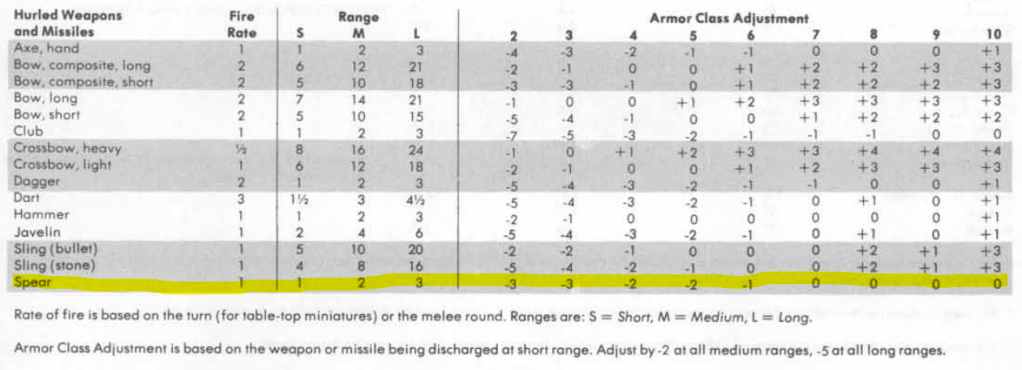
So where does that put us stat-wise for a legionary?
Legionary
HP 6 (5.5 rounded up)
AC 4 (lorica segmentata AC5, -1 for large shield.
Move 9″ (on foot)
Short Sword
Spear x 2
For consistency’s sake, I am making no assumption of any extraordinary character statistic for either the legionary or knight. No exceptional strength, no exceptional constitution, no exceptional dexterity for either side. These are average representations of humanity. Now, I suppose, one can argue that the Romans or the Knights had better physical training or were raised on more robust food or whatever, but that train of thought will just lead to a mess of rationalizations for this or that. However, while I’m not taking this into account for the exercise, it is a reasonable assumption that the knights, as a privileged class, likley are taller, stronger, in better health, and with greater reach than a typical legionary.
For the knight, how should they be represented? I’m going with medium warhorse, plate mail, shield, medium lance, dagger, broadsword. Yes, an argument can be made that they might also have a mace or war hammer or bastard sword. I’m not going there. This version of pretty much the standard “knight” equipment in people’s minds. It’s not the most heavily armed and horsed version, nor is it the lightest. What about hit points. Knights, are not necessarily veterans. The legionaries are veterans by designation of the scenario. So, the knights will be treated as typical mercenary soldiers (4-7 hp, 1d4+3) with an average of 5.5 hit points (like the legionaries, rounded to 6 hp).
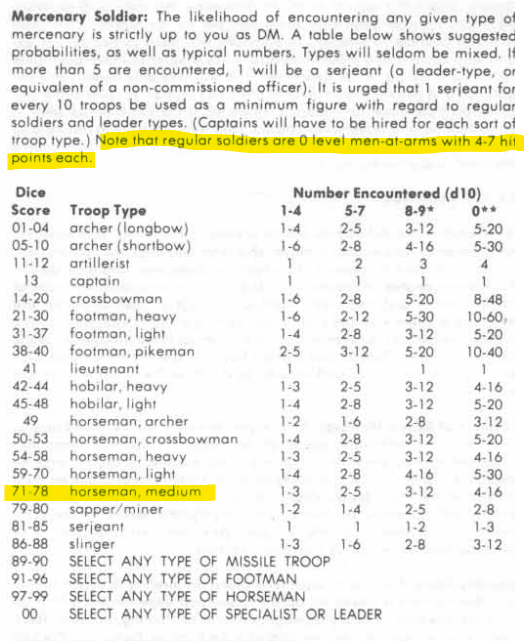
Knight
HP 6
AC 2 (plate mail AC3, -1 for shield).
MV 6″ (on foot)
Medium Lance
Dagger
Broadsword
Medium Warhorse
HP 11
AC 7
MV18″
#Attacks: 3
Damage/Attack 1d6/1d6/1d3
Size: L
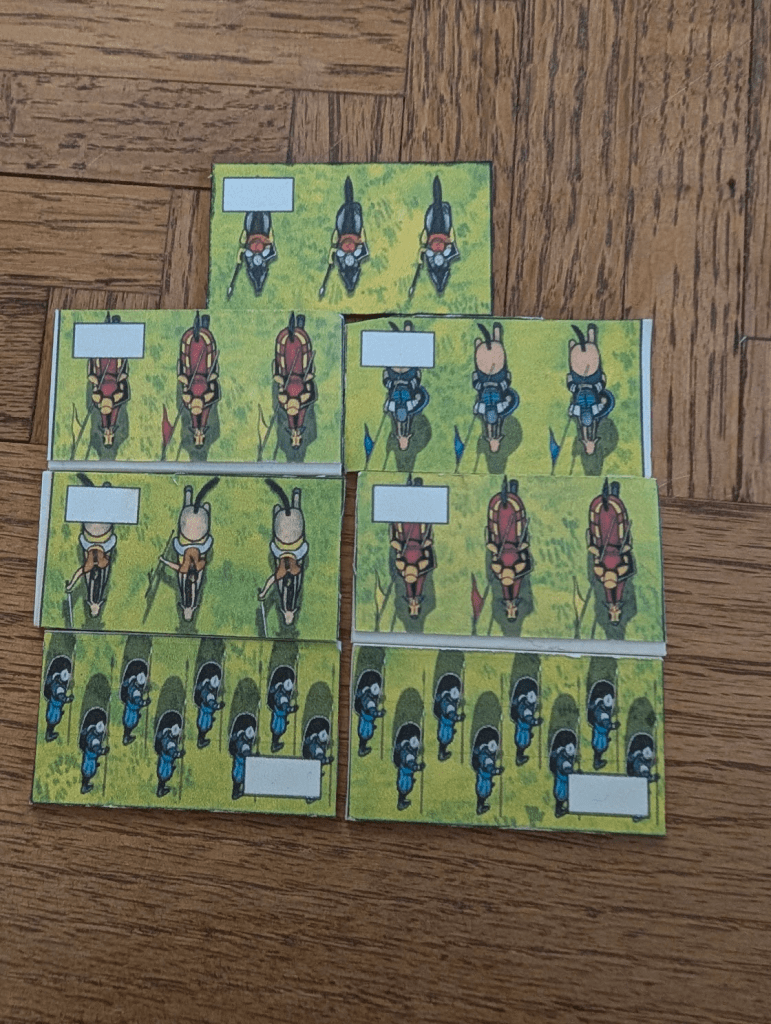
Assume the legionaries are arrayed in two ranks, with the cavalry evenly arrayed to face them. This puts roughly three horses arrayed against eight men. Call it six horses abreast versus the whole fifteen. A head-to-head confrontation is about the best case scenario for the legionaries. One might posit that the cavalry might be able to catch a flank for such a small troupe of soldiers. But, equally, one might argue the foot can easily turn to face incoming horse. So, a face-to-face battle it is.
Assume the horse come at the charge to maximize their damage and to-hit chances. When charging, initiative need not be rolled if one side has the longer weapon. The longer weapon attacks first. The AD&D medium lance has a length of 12 feet and the pilum, as previously determined, a length of 7 feet. The lance attacks first. Or, does it?
The legionaries carry two pilum. Let’s assume they get a volley of thrown pilum off in the face of the charge. Then assume the second pilum is braced to receive the charge. When analyzing the angles of a braced pilum versus the angles of a couched lance, it rapidly becomes less clear whether the lance or the pilum gets first attack. The pilum is clearly shorter, but the horseman must hold some of the lance behind as a counterbalance. Plus, the horseman must sit back on his horse. It may be the knight is safe from the pilum, but his horse is not.
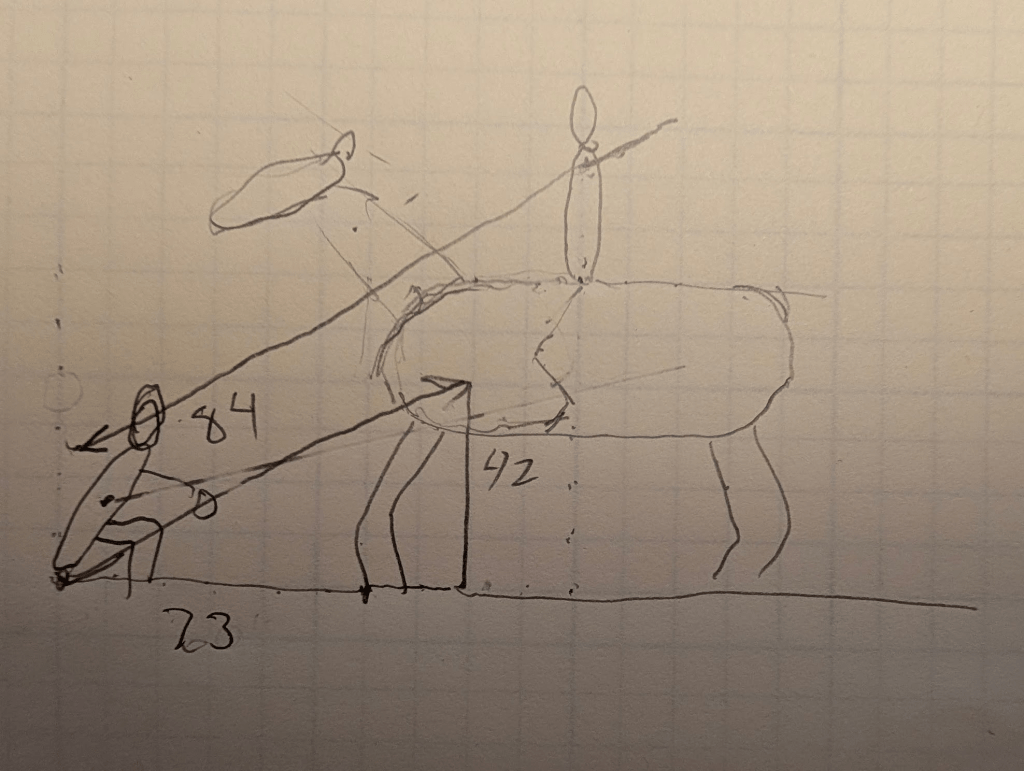
To really, evaluate this, we need to look at more than one scenario.
- Lance strikes first. All pila braced.
- Pila strikes horses first. All pila braced.
- All legionaries throw a pilum. None are braced.
- Seven legionaries throw a pilum, eight are braced.
The reason here is, the horses come in fast (18″) at the charge. Missile fire comes before melee, but I cannot reasonably assume one can both throw a pilum and brace a pilum within the same round. For thrown pila, I assume the target is the horses in the front rank.
Target Numbers
Knights need a 17 to hit a legionary. First (charging) round, a 15.
Legionaries need an 18 to hit a knight. When being charged 17.
Legionaries need a 13 to hit a horse. When being charged 12.
Horse needs a 12 to hit a legionary. First (charging) round, a 10.
Thrown Pilum
Odds to hit a horse is 40% if all fifteen throw, then six hits on average will be made. The greatest odds will be one hit per the six front rank horses. If each horse takes one hit from a thrown spear, the average damage will be 4.5 hit points damage per horse, which is not enough to kill any one horse. So, all the lance attacks would come in as normal. But, for a 40 percent chance of hitting, there are very real chances of some horses receiving multiple hits. It gets complex very quick and I’m not in the mood for doing that math. It gets worse if you look at the actual spread of horse hit points (4-18). An average horse gets taken down by three average hits. But a strong horse takes four average hits to take down. What happens can have wide swings. But, suffice it to say, more often than not, no horse goes down with fifteen throw. So, similarly for the seven throws scenario it’s even more unlikely that a horse goes down from the thrown pilum. But, oh no, I’ve forgotten to add the armor class change for charging. This modifies the odds to hit to 45 percent. This improves the odd of getting three hits on one horse, but not enough to make it more likely than not. The lesson here is that odds are, throwing pilum will not reduce the lance attacks coming in. Scenarios three and four are not winning strategies in that both reduce the number of braced pila able to attack later in the round.
Pila Strikes First
There are fifteen pila and six horses. This is an average of 2.5 attacks per horse. Legionaries need a 12 to hit (45%). Average damage per horse is thus, 2.5 attacks x 0.45 odds x 4.5 hp x 2 braced = 10.125 hp. Again, on average, the horses, while extremely damaged, none go down. Each lance and each horse get a chance to hit. The charging lancers have a 30 percent chance to hit. 0.30 odds x 4.5 hp x 2 charge = 2.7 hp damage for six men. So on average, the lances also take no men down. The horses also get to attack. The horses have three attacks each, two hooves and a bite. The horses have a 55 percent chance to hit. (2 x 0.55 x 3.5) + (1 x 0.55 x 1.5) = 4.625 hp damage each from a horse. Upshot, 4.625+2.7 = 7.375 > 6 meaning odds are six legionaries go down in the first round.
As I’ve looked at before, AD&D is a little unclear how charging horses work. I’ve discussed this a bit here. There are options. One could assume the horses stop because all the men facing them were not killed. One could assume an overbearing approach, which as I showed in my previous post, that medium-sized men basically will be bowled over by a horse running them down (shocking I know). Or, one could turn to the original D&D rules for charges (Chainmail).
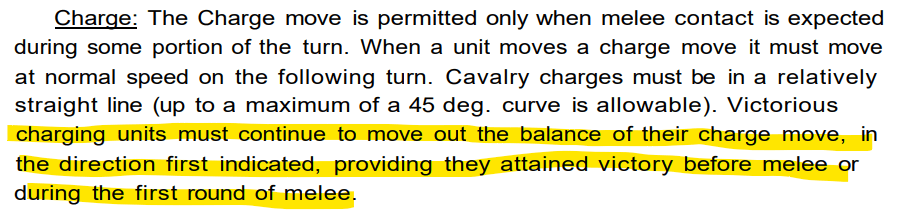
None of the knights or horses died. That sounds like attaining victory to me. So, Chainmail would say, finish out the move. Okay, that first rank of horses, moves through the line and ends up in the back field somewhere. But here comes the second rank. There are six more charging knights on horseback meeting only nine legionaries now. Given the previous analysis, on average, another six legionaries go down. Now there are only three facing yet another group of six charging knights.
I don’t see the point of analyzing the first scenario where the lances strike first. The legionaries still will (on average) not drop a knight (or his horse), while the Romans will still lose six men per round.
While I am not going to go through the effort to figure exact odds, I reckon a typical encounter, will result in no knights even being wounded. Though, the AD&D ranges of specific hit points per man, and per horse, vary wide enough, that if played out in detail the are many permutations where either side can win, and knights and horses do become casualties.
But the betting man should choose the knights every time.
Looking at other rules, Chainmail presents, while not exactly the same ratios, a similar advantage to the cavalry – roughly 4 to 1 legionary to knight loss ratio.
Now, I’m not arguing that AD&D and Chainmail perfectly represent everything. Far from it. But, both AD&D and Chainmail, are both based on loose but reasonable assumptions, and more or less produce in general the results discussed here. If one wants to argue for the legionaries, one must address what was an unreasonable assumption, what was missed, or what was not accounted for.
One might say that AD&D and Chainmail underestimate the abiltiy of spears or pila to fend off horses. And, I would agree. But, I would also say, there was a period of history where mounted lancers in favorable terrain did consistently dominate spear armed foot. It wasn’t really until the reinvention classical era pikes and formations that lancers were taken down a peg. And, yes, legionaries are able use those formations. But, the pilum is not the pike and fifteen men do not a phalanx make. The literal mass of the horse dominates at that scale, and the setback of the lancer on the horse, including higher quality armor, gives a significant advantage to the protection of the knight.


Leave a Reply