
It could be argued that the Alternative Combat System that appears in th original Dungeons and Dragons is what distinguishes Dungeons and Dragons from the earlier game Chainmail. From one viewpoint, OD&D is just Chainmail with the ACS bolted on.
But, that’s not what this post is about. What this post is about is continuing the tradition of Alternative Combat Systems. Or, at least a step in that direction. This is an experiment of an idea I had to replace the D&D procedure of rolling to hit, followed by rolling for damage. After all, Chainmail has but a one-roll procedure, both within its normal rule, and it’s man-to-man rules. So, in that way, my experimental method is just another reinvention of the wheel.
But, this method has some features I’m curious about. It’s not fully tested. Nor, am I saying it’s better in any way than the existing systems (or the earlier Chainmail approaches). It’s just another means of generating hit points of damage with particular features that 1) try to address certain issues people have complained about, and 2) might be fun. But, it has yet to be proven. It could be awkward, a pain, and not fun. Try it out and let me know what you think. Does it have promise? Are there things you’d change about it? Or, is it just bad and should be abandoned. Let me know. I’d love to see what people like or dislike about it.
Before I get into the details, here are the issues it is trying to address.
- Since the beginning, people have complained about Armor Class. They say it makes no sense that Armor Class affects the to-hit number rather than the damage. Rather, they argue, armor absorbs damage or blocks weapons from damaging a person. A better model, they argue, is to roll damage and then subtract damage based on armor type. No matter how many times it’s explained that a to-hit roll isn’t really a roll to hit, these people will not be mollified. Fair enough. My system addresses this.
- Since the beginning, people have complained that the increasing hit points with level makes no physical sense. What do you mean, I need to hit that tenth level fighter ten times to kill him? In real life, people of any skill level can be downed by a single successful sword blow. No matter how many times it’s explained that hit points of “damage” doesn’t really mean a literal wound, these people will not be mollified. Fair enough. My system address this.
What features would such a system have? The first one is pretty evident — armor must be subtracted from damage. The second one is trickier. Because hit points increase with level, then damage must also increase with level. In effect, equivalent level characters should be knocking each other off at a similar rate as they do at low level or higher level, but characters of increased ability (level) should nonetheless have a distinct advantage over the low level characters. Combats should have some level of predictability, but also have enough swing (in odds) to remain tense and uncertain. Okay, here’s my approach.
Assumptions:
- This is to be inserted into AD&D only for the to-hit roll and damage roll.
- All rules for creating and leveling characters remain the same. Except for armor class. Ability scores, hit points, saving throws, etc. all stay the same.
- All combat rules remain the same, initiative, surprise, etc. except for rolling to hit and damage.
Summary
This is a dice pool system. There is an Attacker with weapon, there is a Defender with armor. The Attacker determines their pool of dice based on their weapon type and level. The Defender determines their pool of dice based on their armor type and level. Both the Attacker and Defender roll their dice pools and sum up the dice. The sum of the Defenders dice is subtracted from the sum of the Attackers dice. Any remaining positive points remaining in the Attacker’s pool, get applied to the Defender as hit points of damage.
Rules
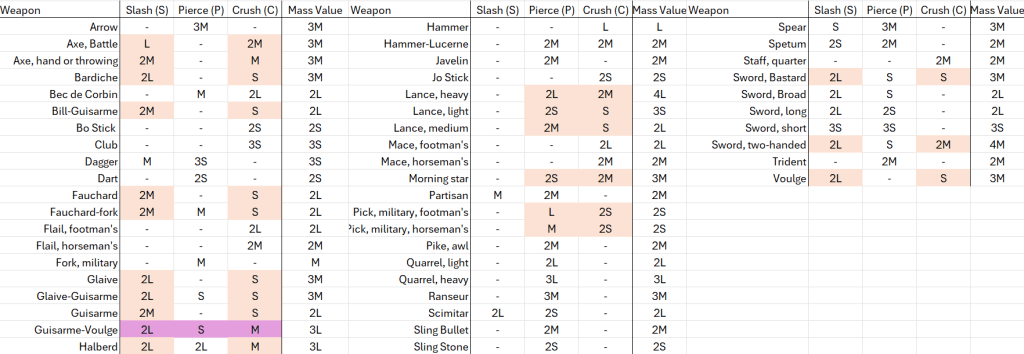
- Each weapon has up to three attack modes. These modes are Slash (S), Pierce (P), and Crush (C). Each armor type protects against the three attack modes.
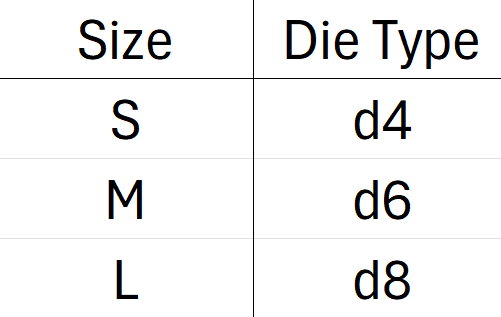
- Each weapon has a rating for each of the three attack modes of Small (S), Medium (M), or Large (L). Likewise, each armor type has an S, M, or L rating of how effective it is against each attack mode.
- Each rating category corresponds to a type of die.
4. Some weapons get combined attack modes. On the Weapon Table, the orange shaded must be taken together, unless one chooses the unshaded third value. Similarly, Purple values, the attack shall choose any two of the three values.
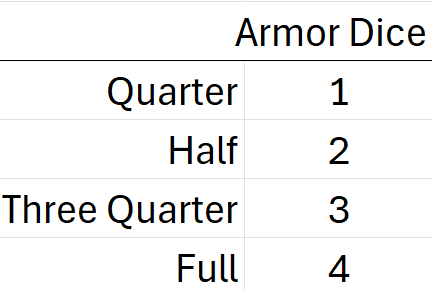
5. Armor. The Coverage Table sets the number of dice available for the defender. The Protective Value Table gives the dice type that are used. Before play, the Defender chooses the apportionment of dice types. For example, a character has bought full chain armor. Full allows for four dice total. A character might put all four dice on Slash, affording themselves 4d8 protection against slash, but then undefended versus Peirce and Crush. Or, he might choose to divide two dice each to Slash and Crush, which would give him 2d8 versus Slash and 2d4 versus Crush. Or whatever permutation he chooses. Once chosen, the dice are set for that suit of armor. When buying armor, the price is multiplied by the proportion purchased — half armor is half price.
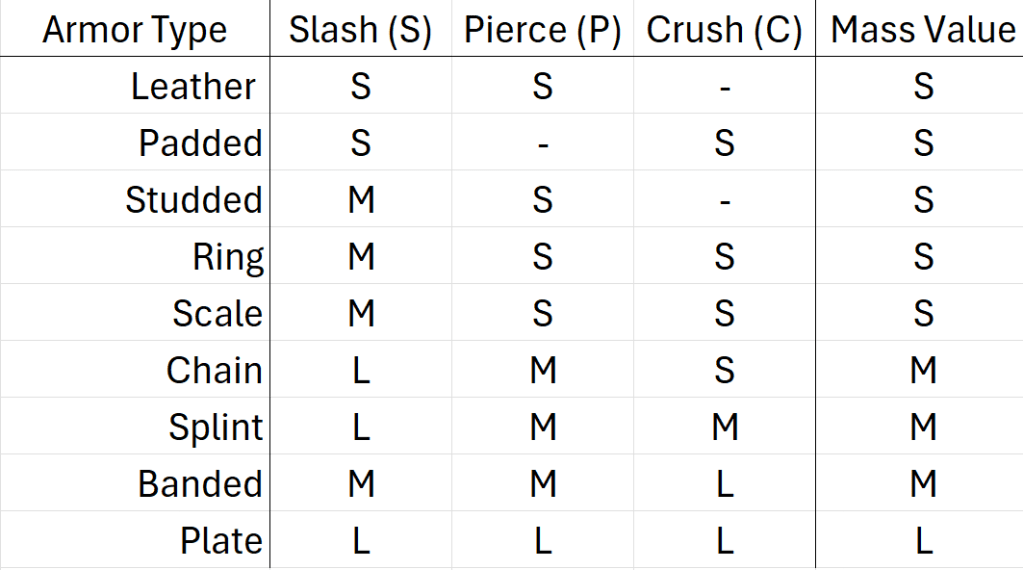
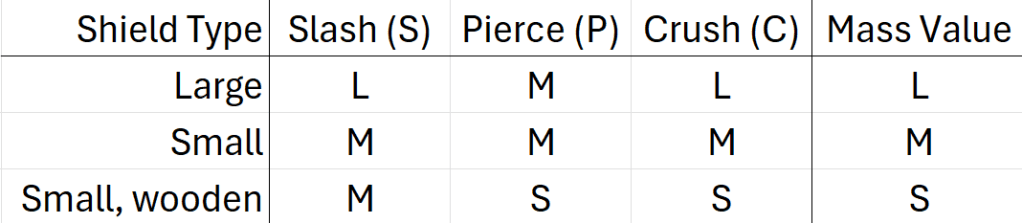
6. Shields add the listed dice types to the Defense Pool. Shield dice can only be used against up to two melee attacks in a round. Against missile weapons, large shields can be used against any number of attacks. Shields may not be used against rear attacks.
7. Helmets. Small helmets add a 1d6 to defense. Great helms add 1d8.
8. Weapons and armor both have a Mass Value. This is a simplification for Mass Combat, which will be discussed later.
9. Dexterity. For Defense, each point of Dexterity defense bonus adds 1d4 to the Defense Pool. For poor dexterity, each dexterity penalty value adds 1d4 to the attack pool. For missile fire, each dexterity bonus or penalty adds to the respective attack or defense pools.
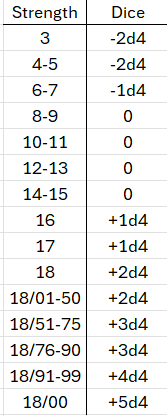
10. Strength. For strength, average the to-hit and damage bonuses and add that many d4s to the attack pool.
11. Magic. Each armor +1 adds 1d4 to the Defense Pool. Each weapon +1 adds 1d4 to the Attack Pool.
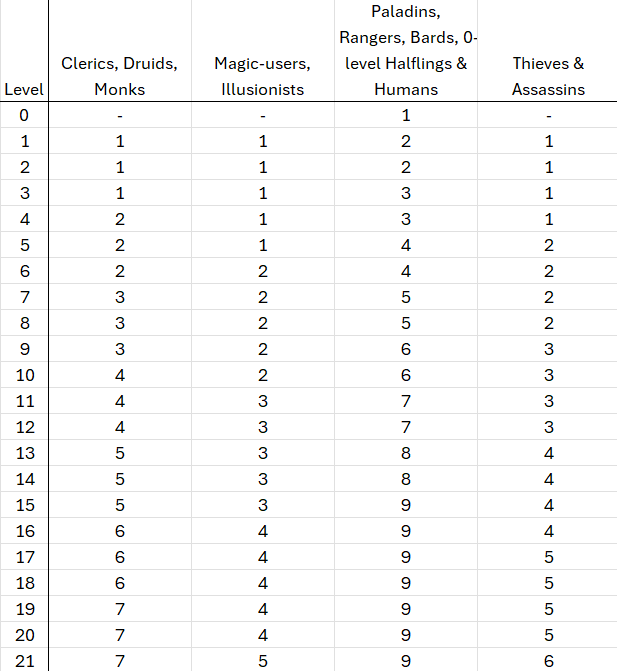
12. Level Dice. A character when attacking or defending adds to their pool dice according to the Level Table. The dice type are equal to the die type used by that class (d4 for magic users, d6 for thieves, d8 for clerics, etc.). Monsters use d8s and get the number of dice allowed by Monter Table. When allocating Level Dice, a character sets aside dice for attack and defense within the round. The total dice assigned to attack or defense may never total more than their total level dice. For example, a tenth level fighter has six level dice, he may choose to assign three each to attack and defend, all to attack, or all to defense, or whatever proportion he wants. (9/27/25 addition in italics)
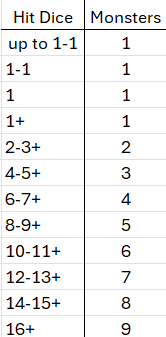
For monster attacks, I have not yet come up with a way to model their variety of melee values. If armed with weapons, use those values. For natural (claws, teeth, etc.) I’m open to suggestions.
13. Attack Pool = weapon dice + level dice + dex dice (if applicable) + magic dice (if applicable).
14. Defense Pool = armor dice + shield dice + level dice + dex dice (if applicable) + magic dice (if applicable)
15. If surprised, only armor dice and magic dice may be used for defense.
16. If prone, or attacked from the rear then only half of level dice (rounded down) may be used.
17. After the dice pools have been determined, both the attacker and defender roll their pools; the sum of the Defense Pool is subtracted from the sum of the attack pool. Any positive remainder in the attack pool gets applied as damage to the defender.
Mass Combat
For mass combat, each figure is scaled per the referee’s choice, such as 10:1 or 20:1, but the scale must be consistent for each side. Each unit will have a certain number of figures and identical weapons and armor. For armor and weapons, the mass values are used. For example, a 100-man infantry company, scaled 10:1, armed with half scale mail, large shields, and spears will have ten figures of 2S+L armor and 3M weapon. For hit points, standard AD&D rules give 1d4+3 hit points per soldier for an average of 5.5 hit points. For each unit, roll and apply across the board, some units will be stronger than others. Or, for simplicity, one can choose to treat all units as 6 hit points.
All soldiers are considered 0-level, so only get 1d10 level dice. If both sides agree, level dice can be dropped in mass combat for 0-level soldiers. This will result in a less variable result, but, mostly, will average out anyway.
For melee for each figure in contact base-to-base will roll attack dice versus defense dice as a group and subtracted as usual. Remaining damage is applied to the figures in contact. For each multiple of the unit strength of damage, a figure is removed, up to the number of figures in contact. Note: that it must be the figures in contact that are removed. Surviving members of a unit can then make the choice to move up or break away. If, after battle, no units are in contact due to casualties, moving away does not incur the fleeing free attack.
Individual characters may participate in mass combat. To do so, they roll the attack for their weapon using the mass value. Roll Attack Pool – Defense Pool, then divide the damage by the scaling factor when applying damage to the mass unit. Similarly, mass units multiply their damage by the scaling factor when attacking individual characters. Decimals are rounded using standard rounding practice.
Comments
Obviously, this is not a refined system yet. I don’t have a good feel for how well it works. Or, whether it’s fun. I’d love to get feedback from anyone who tries it. Note: this is not house ruling. It’s an experiment for potential use in later game developement. Using AD&D as the structure is just for convenience.
The downsides:
- It’s more fiddly. There is time spent figuring which dice are to be rolled and doing the math to determine the damage.
- It requires a lot of dice of a variety of types, thus it is an expensive system or a slower system. Even more so for mass combat.
- It is pretty deadly when there are level disparities. This is true per the normal rule too, but I expect this one will be more so.
The upsides:
- Weapon damage and armor resistance is modeled subtractively. No longer does armor affect hitting directly. It’s a matter of how protective is an armor versus how damaging is the weapon.
- As skill improves (levels), damage becomes more a factor of skill rather than weapon type. This represents the fact that any particular weapon in the right hands can be deadly. And, skill essentially avoids the armor on a person. Not everything can be covered. This also means that high level versus high level fights can more or less be short. Yes, characters gain more hit points by level, but they also can do a lot of damage as they level. But, the law of averages mean two similar level characters of the same class, usually will cancel each other out in terms of level damage — usually, but a set of good rolls versus a set of bad rolls can still be devastating. For example imagine two 10th level fighters with average hit points of 55. Their level dice along (6d10) will average 33. But the range of the roll is betwee 6 and 60. It’s not likely, but it is possible to take 54 points damage from level dice alone.
- Eliminating the to-hit roll is more consistent with the 1-minute round. Given one-minute of tussling the issue is less whether one can hit the opponent, than how effective one’s hits were.
Addendum: a quicker and dirtier version here.
A couple examples:

Here is a 10th level fighter versus a 10th level thief. Thief dies first round. On average the thief dies in one round, while the fighter takes no damage.

This is an example of a 5th level thief versus an Orc. Orc died in two rounds. On average the thief kills the orc in one round and takes no damage. So, this fight, the thief did a little worse than average.
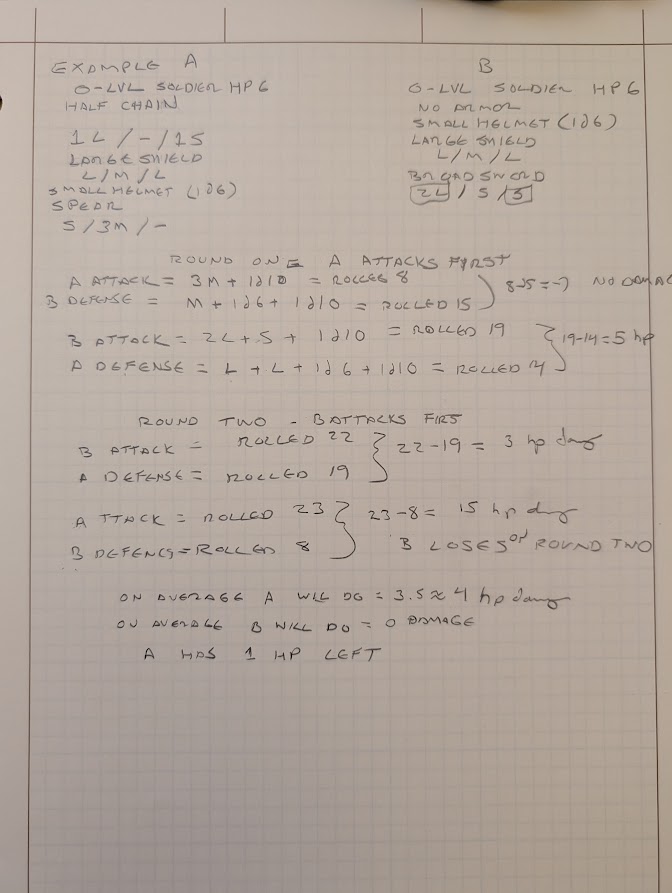
In this example two differently equipped 0-level soldiers fight. Soldier A has an advantage on average. And, Soldier A did win. But, A ended the fight with but one hit point left. It could easily have gone the other way.


 Fluid -- Druid
Leave a reply to AD&D, a dueling method – Fluid — Druid Cancel reply