

In an earlier post, I discussed the spear versus the dagger efficacy versus the armors available in AD&D. I also present, more generally, the entire list of weapons and how they’d fare versus a 0-level mercenary soldier in AD&D. Here I expand on this discussion a bit.
But first, go take a look at Grim Schneider’s work here. He took a similar analysis approach as my own to assess the best weapons for each class, out of those available to each class. Excellent work whose results match my own. No need for me to go on here. For this post I’ll be looking at two things, the best weapons for equipping an army, and the best overall weapons.
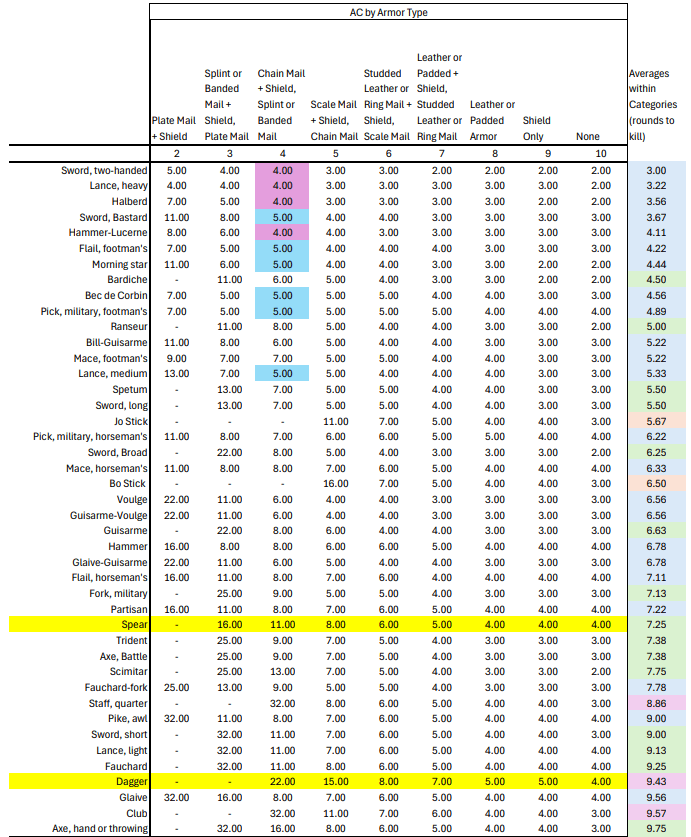
For my previous analysis, I calculated how many rounds a 0-Level average man-at-arms would survive on average for each weapon. Now, to determine the better all-around weapons, I average those rounds for each armor type. This was complicated by the fact that some weapons were completely ineffective against the more protective armors (for example, club versus plate armor). In practice, this wasn’t so bad because the best weapons (surprise) also tended to do well against all armors.
The top four weapons, each taking four or fewer rounds to defeat an opponent in any type of armor are (from best to worst) are the: two-hand sword, heavy lance, halberd, and bastard sword. Not far behind were the Lucerne-hammer, footman’s flail, morning star, bec-de-corbin, and military pick. I guess it should come as no surprise that many of these weapons are either knightly weapons, or those used by others to dispatch knights. Though, this calculation does also cement my opinion that AD&D over-rates the two-handed sword when put against the heavier armors. Conspicuous by their absence are some of the knightly weapons, long sword, mace, and dagger, but these always were the second or even third tier of knightly weapons — those used as sidearms for use after a primary weapon was broken or lost.
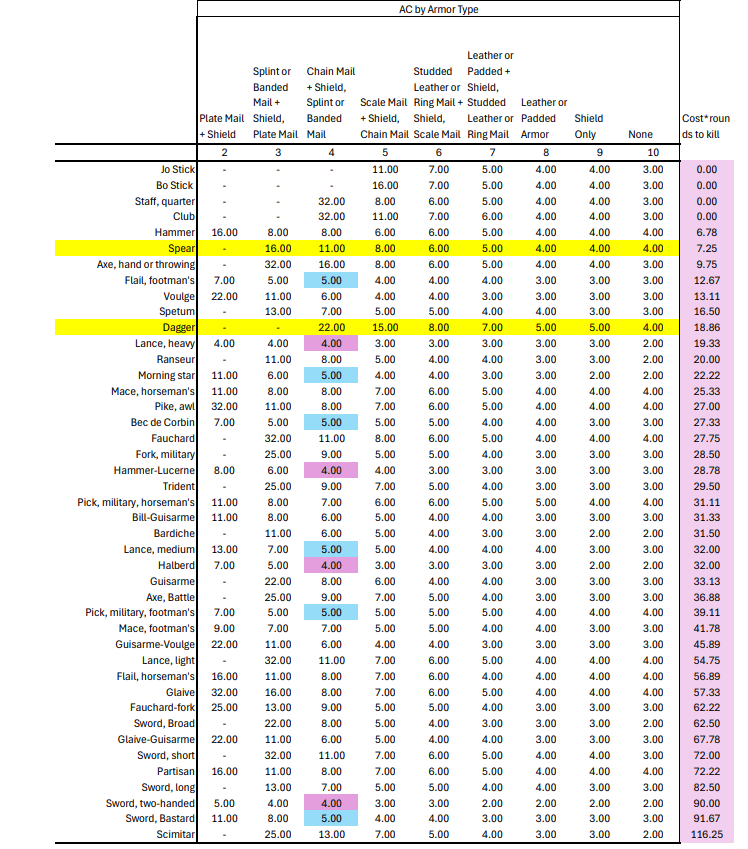
But are these the best weapons for a military? Perhaps not. For an army, weapons must be both decently effective and cheap. After all, you are going to be buying hundreds or thousands of them. So, I took the same averages and multiplied them by the price of the weapon type to get a measure of GP*Rounds to kill. The smaller the number the better low cost and low rounds to kill. I was shocked by the result. Under this measure the optimum weapons are the jo stick, bo stick, quarter staff and club. What the heck? In retrospect, it’s not that surprising that the free weapons did very well when looking at the economics. Zero cost is a low number and totally overrides all other considerations.
It does make sense that the caveman weapons, all versions of clubs, would also be the most economic. Ignoring the prehistoric weapons, the top seven were in order of cheap versus effectiveness: hammer, spear, hand axe, footman’s flail, voulge, spetum. Now, the hammer? I’ve not heard much of armies being equipped with hammers. Well, unless we go back to primitive times.
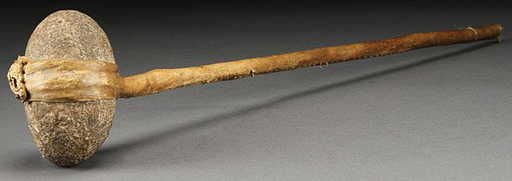
The hammer is, ahem, just a stone’s throw away from the club. Cheap, effective, made from readily available materials. Maybe it’s not so surprising that the hammer comes in first.
Nor, should anyone be surprised the spear comes next. And, the spear demonstrates why few armies equipped themselves with hammers when spears were available. The spear has been called the King of Weapons for good reason. The spear is dirt cheap, effective, and has something not taken into account in my calculations — length. In AD&D terms, the spear’s length will often give it first attack. Plus the game allows spears to be grounded versus charges and that doubles the damage. The double damage plus the bonus to hit against a charge, converts the spear from a fairly middle-of-the-road weapon to one right near the top of effectiveness. So, cheap, and has a feature that mitigates mightily against the enemies big advantage in the charge? Sign me up. And, if you look at armies throughout history, sign everyone up.
The hand axe, takes us back to the primitive weapons category or near it at least. The main attractive is relative cheapness. The hand axe will always be a secondary weapon when the spear is available. But, let’s not forget the viking’s love for the hand axe. Cheap and handy to wear without fancy scabbards, and a decent backup to one’s spear.
Now the footman’s flail. It is pretty effective in game, and it’s the peasant’s weapon when faced with heavily armored knights. Not a bad choice.
Next, the voulge, it’s approaching the more middle expensive items but not quite there yet. The sort of weapon a well-to-do yeoman might choose.
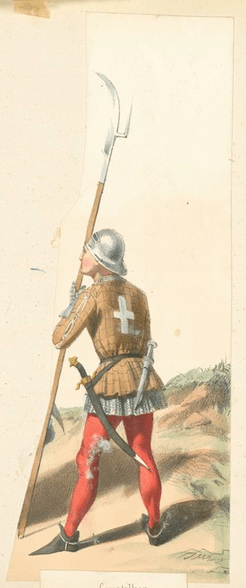
The spetum is the last of the second rank weapons. Not as good as the voulge against the heavier armors. But, in AD&D terms, it has a hidden ability which is to disarm opponents when hitting against an AC8 target. So, that could convert that guy with a two-hander into a guy with a dagger. Maybe hits a little above it’s weight.

So, that’s the most cost-effective weapons per performance. What are the worst? The worst is scimitar, followed by bastard sword, two-handed sword, and long sword. That doesn’t mean these are bad weapons, it means they are expensive weapons. Two-handed sword and bastard sword were after all at the top of the most effective list we started with. But they are not cheap. Leave these for the nobles, knights, and if you are equipping heavy cavalry — everything looks cheap compared to a heavy warhorse. Or, if you know you will go against heavily armored foes. The scimitar and long sword, really reserve them for going against the lightly armored enemies because they are not going to do well against plate armor or even chainmail.
The lesson here. If one squints, AD&D doesn’t do so bad at both representing and predicting the knightly weapons in terms of price and effectiveness. And, also, not so bad at producing armies that more or less match historical forces. For the same reasons — people and the armies they built did make choices in terms of cost versus quality. The items with both low cost and high quality generally won out.
As a sidenote, I also noticed that, as mentioned before, the typical mercenary soldier in AD&D has 1d4+3 hit points — for an average of 5.5 hit points. The first level fighter has 1d10 hit points for an average of, oh would you look at that — 5.5 hit points. Thus, the first level fighter (veteran) hit die and the 0-level solder perfectly match. Like with the weapons, AD&D has a consistency within it that the critics rarely notice or value. But, the weapons list, the armor adjustments, and the average hits points all point to an internal consistency of a well-thought-out game.
Addendum:
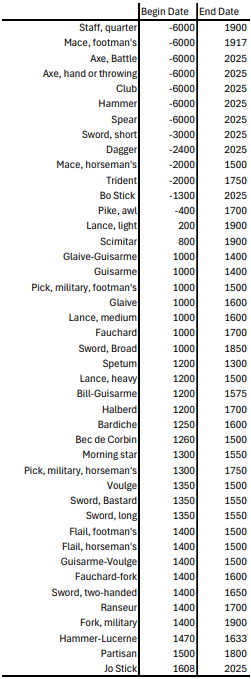
Here’s a pretty crude list for the historical dates the weapons were available. It’s not science and actual historians will have plenty to quibble with. But it’s just a game, folks. It’s intended just as a rule of thumb is you want to limit some weapons to some time periods or areas in your game representative of certain eras. The -6000 values here just mean earlier than we really know.
Addendum 2
It’s been pointed out that I have neglected the space required. And indeed I have. Let’s take a look at those free weapons, jo stick, bo stick, quarter-staff, and club. Except for some clubs, all require more space to use. And those highly rated weapons like the two-handed sword and the bastard sword need many times the space that spear requires.

What this means is that when operating in ranks, one can put a lot more spears across a frontage than one can, for example, two-handed swords. Even hammers, which otherwise looks favorable compared to spears, can only fit in six across a frontage one can fit ten spears. Then given the length advantage of the spear, add in a second rank and that becomes twenty spears for every six hammers. Oof. Again, the spear is the King of Weapons.
Now pikes, which are essentially long spears, with the same space requirement, you might get to add another rank or two. So maybe forty pikes for every ten spears. But there the lengths start get pretty unwieldy (don’t get me started on speed factor). And, pikes are essentially useless in the dungeon.


 Fluid -- Druid
Leave a comment