
This post is inspired by this video. Though this one pretty much sums up my conclusions pretty well. In summary, Shad’s argument goes like this, when held up next to one another a dagger and a spearhead, despite the variations within each type, superficially resemble one another and therefore, one would expect them to give similar wounds. Because of this, Shad criticizes RPGs and video games that treat daggers as vastly inferior to spears for giving damage. He then tests this using a tire as a target and sure enough, both the daggers tested, and the spear tested, fared about the same. At most, the spear had some marginal advantage. Fair enough.
Generally speaking, I agree with his point. However, when it comes to the most popular RPG, Dungeons and Dragons, I think he exaggerates the difference between those weapons in the game. Now, I’m not talking the later editions of the game. I have not looked at those. But, in OD&D all weapons did the same damage (1-6). There were differences in chance to hit based on weapon type imported by Chainmail. Later editions of the game added changes to damage by weapon type. AD&D, which I look at here, has the dagger doing 1-4 hp of damage and a spear 1-6 hp of damage, and retained modifiers to-hit based on armor class. In both editions, spears had the added advantage, when charged, of getting first attack due to length.
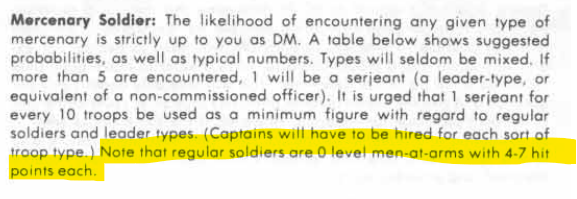
So is 1-4 a big difference from 1-6 damage. Well, the range is two hp wider, but the average is only a one hp difference. The dagger on average does 2.5 hp damage, while the spear does 3.5. So, that’s forty percent more damage. I guess that’s significant. But, of course, there can be a big difference given who wields the weapons. Let’s take a look at the common soldier. The common soldier has 4–7 (1d4+3) hit points according to the DMG p. 30, or an average of 5.5 hp, and they attack as 0-level fighters. For the 5.5 hp average, doing average damage, it will take the spear two rounds to dispatch a foe and the dagger three. But, what about armor? Well, I calculated it.
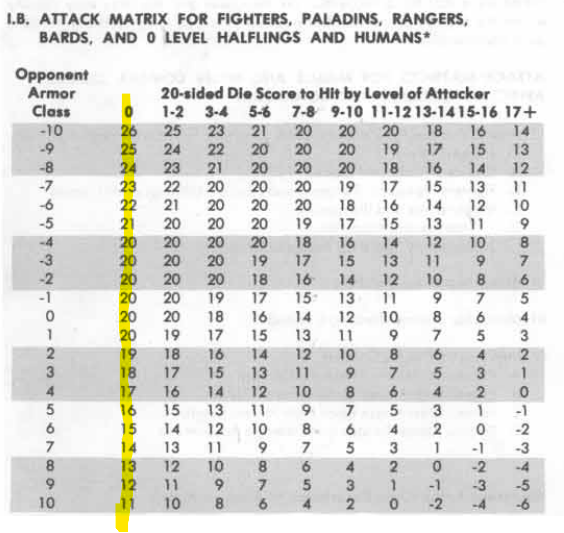
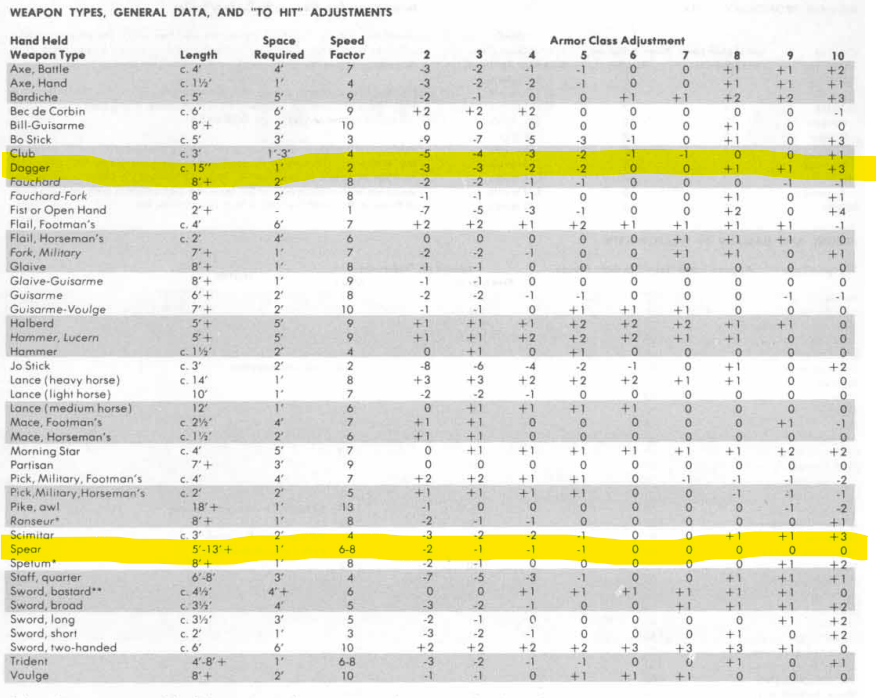
The weapon tables on pages 37 and 38 of the Player’s Handbook give weapon damages and the modifiers to-hit for each of the standard armors. The weapon damages seem mostly to vary based on the weight of the weapon and whether it is one or two-handed. The to-hit modifiers seem based on (obviously) the armor types, but also the reach and leverage a weapon might bring to bear.
Below shows how many rounds on average it will take a 0-level man-at-arms to dispatch another 0-level man at arms. I did it for all the melee weapons and highlighted the dagger and spear.
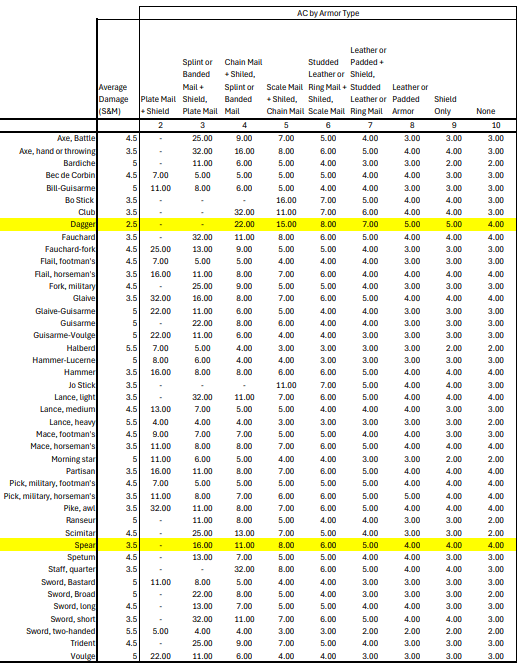
For AD&D with an unarmored opponent, both the dagger and spear dispatch the average soldier in four rounds of combat. So, equal? Yes, and no. As armor gets added, the spear has a modest advantage up to armor class of five. At five and below, the spear has a distinct advantage. Is this realistic? I don’t know. Maybe. But, at least in terms of Shad’s initial comment that the wounds given should be quite similar, and they are given unarmored opponents.
Now, for unarmored opponents both the spear and dagger are less than ideal (in AD&D). Looking at the table, one can see that most of the weapons are able to take out an unarmored foe in three rounds and some as short as two.
Looking at the other end of the armor scale, plate mail and shield (AC2), neither the dagger nor the spear has a shot. These heavy tanks are near impervious to both weapons. In fact, the only reason it isn’t is if some other advantage is brought to bear, like being flanked or prone or surprised or being backstabbed. Though, I really think the quarter staff was treated unfairly when compared to the club. The best weapon against AC2 is the heavy lance, and even that can’t be expected to defeat an opponent in a single round. Even the heavy lance needs the doubled damage of a charge to feel confident in a single round kill.
Don’t lose hope, the dice can swing. While on average the spear does a mere one extra point of damage in comparison to the dagger, the spear can roll a 6 while the dagger cannot. The spear won’t kill an opponent in a single stroke on average, but it can do it. The dagger, capped at four damage, cannot ever defeat the average opponent in a single round. Yet the same can be said about hit points, the individual soldier has 4-7 hit points. So, there are some weaklings out there that the dagger can tag in a single round. Yet, the maximum of six hit points damage, is a real advantage because the spear can get lucky where the dagger has much less chance of doing so. Sucks to be short.
But, for all the criticisms Shad has about RPGs and video game treatments of weapon types, it looks to me like AD&D got there first and tried to address them. While, the weapons v AC modifiers can be open to criticism, Gygax and Arneson and Perren did give it a decent shot at addressing most of the issues to some measure of success.


 Fluid -- Druid
Leave a reply to AD&D Weapon Optimization – Fluid — Druid Cancel reply