
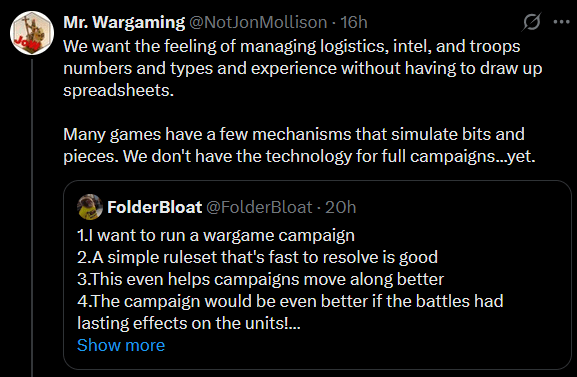
Recently on Twitter/X there was a discussion of what would be needed for a simple, yet still interesting, campaign game. Mr. Wargaming set out the criteria he was looking for. This made me think that the old Risk variant game Samurai Swords, more or less, met his criteria.
In Samurai Swords (AKA Shogun), the game added to the basic Risk skeleton, spending Koku, Spying/Assassination with Ninjas, Generals (Daimyo) who gain experience. Spending Koku to buy troops, hire ronin, bid for the ninja, and build castles kind of satisfies the logics criteria. The Ninja the intel criteria, and the buying of troops types and Daimyo experience meets the experience criteria. And, no spreadsheet required. The allocation of Koku and the round-the-table bidding process makes all these things pretty simple to keep track of.
The Risk-based method of combat is pretty satisfying and quick. So, a full game/campaign can be held in a few hours of play. But, if one wanted to use the game as a mechanism to generate battles for miniature armies, one wouldn’t need much more. One would need a miniatures rule set for feudal Japan, but those are readily available. One would need some method to translate the Shogun troop types to whatever rules were chosen. And, one would need some method to drill down from Shogun’s provincial scale to a battlefield.
I can’t really address translating Shogun troop types to a specific rule set. I think it should be a fairly straightforward exercise. But generally speaking, I think I’d treat each figure as a regiment (about 1,000 men) or, perhaps two regiments. But, for the rest of this piece, I’ll discuss an approach to generating terrain for a battle.
Terrain Generation Rules
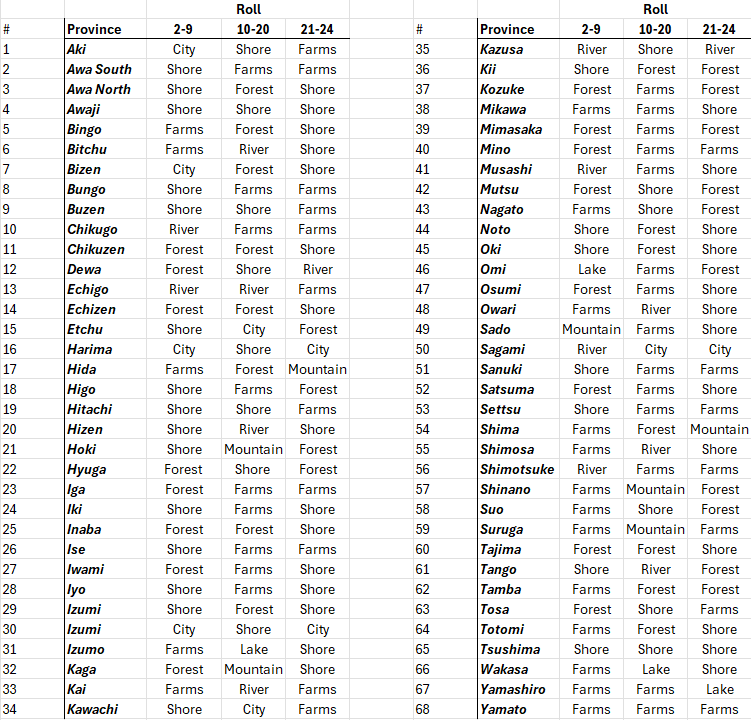
- Roll 2d12 on the provincial table for the province in which the battle occurs to determine the base terrain type. If a player has a ninja, he may elect to use the ninja to choose the base terrain type. Note: if the province has a castle, the castle will be on the field placed by the owning player.
2. Each player rolls three times on the specific terrain type table to generate terrain. Each player has opportunities to re-roll a terrain type equal to the level of his Daimyo involved in the battle.
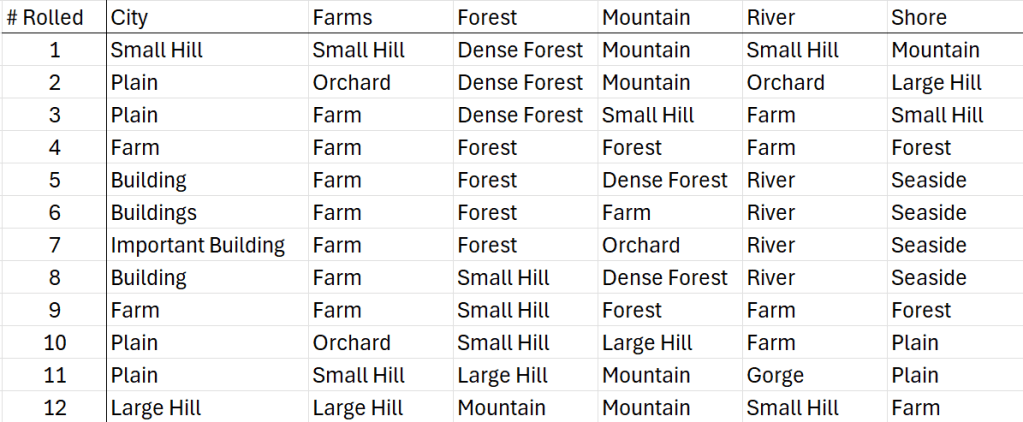
3. Each player takes turns placing terrain on the table, starting with the player with the lowest ranked Daimyo.
4. Rivers will divide the table based on a randomly rolled direction. If multiple rivers are to be placed, each river placed after the first intersects with the first river and is truncated on a randomly rolled side of the main river. On a roll of 1-5 on a 12-sided die, a river will have a bridge which is placed randomly along the length of the river.
5. Plains are not placed. But, merely result in more open space on the table.
6. Farms include fields which must be placed. If it is spring, summer, or autumn, there is an 8 out of 12 chance the field will be crops growing — the remaining time it will be mud. Of crops, half will be rice paddies.
7. Seaside allows designating one table edge as ocean. There may be multiple edges so designated. Battles where one side is entering from the sea will automatically have one table edge designated as ocean.
8. Gorges will have a river passing through them but are not able to be moved across (or use whatever your minis rules say).
9. Designate time of year and weather (I assume one round of play represents a single year). Roll on the Season Chart for the number of players. The Player who initiated the battle rolls based on his position in the current round sequence. Once a month has been determined, roll each of the percentages to determine any environmental effects that might occur. There can be multiple effects simultaneously. Wait to roll for fog until after the next step (starting hour). For fog, the value in parentheses is to rolled when precipitation has already been determined to occur — in which case it is vision obscuring rain.
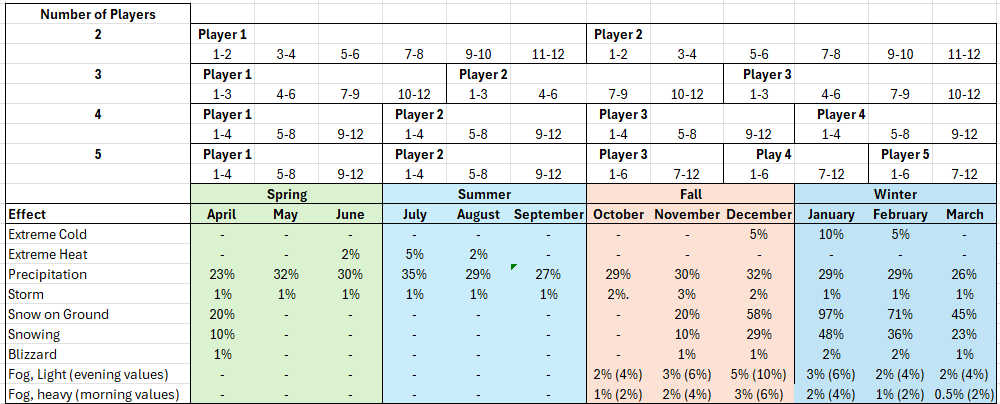
10. Determine the Hour of the Day the battle starts. Hours given are in military time. The Daimyos may shift the roll one place for each level the Daimyo has, starting with the lowest ranked Daimyo. The hour may be shifted outside the range of the table, in which the battle occurs at night.

So there it is, this is a method for setting up your minis battle using Samurai Swords. I think it should be more than enough for the typical miniatures player. After the battle is complete, you still will have to determine (probably based on your minis rules), how many units survive to occupy or retreat out of a province. But, I know you can do it. Good luck!


 Fluid -- Druid
Leave a reply to Fluid the Druid Cancel reply