

This conversation discussing H.P. Lovecraft got me thinking of sanity mechanics in RPGs. The video has James Raggi and Zak Smith discussing Lovecraft — primarily his racism and how it affected his works. But, in addition, they briefly discuss the sanity mechanic in the Call of Cthulhu RPG.
Raggi seems to dislike the sanity mechanic while, Smith seems more accepting of it. Raggi’s defense of his stance seems a bit weak to me as he says it doesn’t seem to reflect the stories. Many people he argues have read the Necronomicon in Lovecraft without going insane. Smith, more correctly to me, argues that it’s matters of degree which the mechanic seems to address.
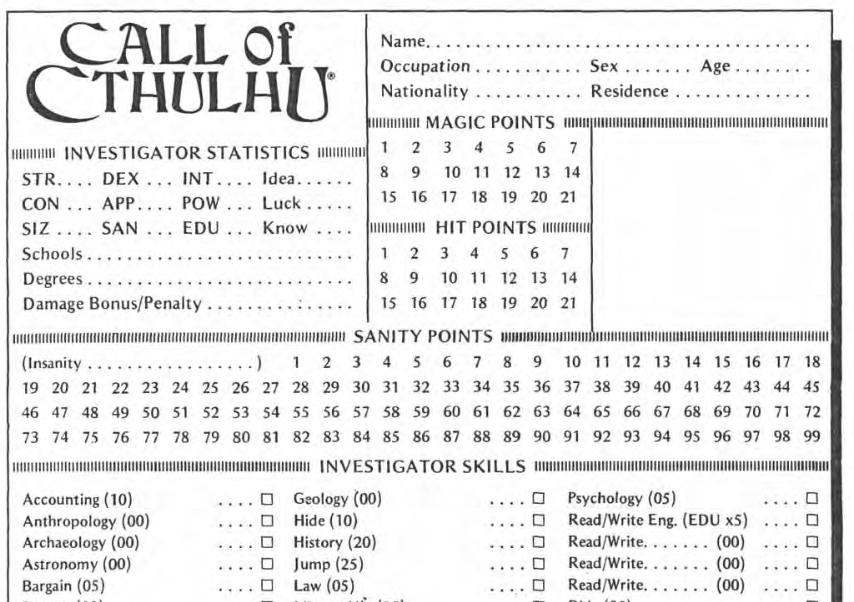
For those unfamiliar with the Call of Cthulhu sanity mechanic, each character starts with a ranking of sanity points, up to 99. Certain action/events in the game can cause characters to lose sanity points thus lowering their ranking. There are also events that might cause a “sanity check” where rolling percentile dice under the ranking results in retaining a character’s sanity. If the ranking drops to zero a character is insane but also, more commonly, a character might go insane by failing a sanity check. The actions/events that cause a character to lose sanity points include things like seeing various monsters, reading eldritch tomes, learning and/or the casting of spells, and learning about the details of the Cthulhu Mythos (a skill in itself which sets the maximum sanity one might obtain). During the course of play, it’s nearly inevitable that a character loses sanity points and eventually goes insane. Insane characters are removed from play temporarily or permanently depending on the circumstances.
I lean toward what I gather is Smith’s position, that Lovecraft’s works are chock full of various characters who either go nuts or are at some level of mental decline due to their exposure to esoteric knowledge and creatures. I could go into detail here but I think its unnecessary — go read the stories if you haven’t and judge for yourself.
In my opinion, Raggi’s dislike for the mechanic is less based on literary reasoning than aesthetic. Raggi seems to prefer a more organic expression of character insanity. That is, players express their characters insanity anyway, so there is no need for a sanity mechanic. The actions players choose their characters to take are often insane when viewed from without but may be perfectly rational when taken in context. The example Raggi gives is a party of characters who choose to share a hotel room, set watches, and otherwise act like paranoids is already kind of insane under normal world circumstances. But, such actions make perfect sense, in a universe where one’s prior actions may have set one up to be hunted by various cults and/or monsters. Players don’t need a sanity mechanic for them to make their characters act like crazy people. Insanity to Raggi is just the natural consequences of play.
Raggi isn’t wrong. Players often do have their characters act like crazy people. Smith isn’t wrong, Sandy Peterson’s sanity mechanic can be defended using literary sources. But one thing neither mentioned is what I appreciate about the sanity mechanic. The sanity mechanic allows for the periodic forcing of a player to play another character. Players get attached to their characters, even obsessed, which can lead to an overly predictable game and party and/or player to player dynamics. The forcing of a player to roll up a new one throws a wrench into what might otherwise be a set of players’ well oiled machine.
Ultimately, the sanity mechanic is a form of morale mechanic. Morale game mechanics come out of the war games from which RPGs spawned. In those war games, large units of men, a company, a phalanx, a regiment come under various stresses, melee fire, missile fire, artillery, changes on the flank, etc. and, everyone knows that units under stress sometimes crack and run. So war games have developed a variety of means to address when the morale of the men, the lowering of that morale, and means to determine when units falter. When a unit falters it flees the battle and future success in the game is determined using other units.
Many role playing games have morale mechanics. Often morale mechanics are only applied to monsters and non-player -characters (NPCs). Player characters do not often have morale mechanics because often player characters are assumed to be heroes and thus, brave. When a player character loses their confidence and runs is when the player themself loses their confidence and has the character run. I’ve written about this before and made arguments that there might be times where morale mechanics make sense to apply to player characters.
But are the player characters in Call of Cthulhu heroes? The first role playing game Dungeons and Dragons assumes player characters are heroes. This is also the assumption of the game that preceded Dungeons and Dragons, Chainmail. Chainmail was a war game which allowed for the use of individual soldiers which were heroes (or even super-heroes). And, heroes were not subject to morale checks. These individual heroes in Chainmail became the player characters of Dungeons and Dragons. So, it stands to reason no morale checks for player characters.

But the characters of H.P. Lovecraft are not the same types of characters as the characters of fantasy and adventure fiction assumed in Chainmail. The protagonist in an H.P. Lovecraft story is no d’Artagnan, or Aragorn, or Conan, or Elric. They are George Gammell Angell, world expert on the Cthulhu Cult. That is, they are modern men given to normal sloths, normal enthusiasms, and normal expectations. If anything, a Lovecraft protagonist is even less fit, less aggressive, and less willing to seek out conflict than the normal man. They are dreamy socially maladapted bookworms. You know — dorks. So, it is entirely appropriate that morale mechanics apply to such characters, and the sanity mechanic is a morale mechanic.
One benefit of moral mechanics is that often a unit that failed morale and runs away can live to fight another day. And, so it is within Call of Cthulhu. Monsters are particularly dangerous in Call of Cthulhu. Often it’s suicidal to try to fight them. So, a character who sees a monster, loses some sanity points, fails a sanity check, and runs away might live to fight another day (after a recovery period in the asylum). That is to say, the sanity mechanic mitigates, to some degree, the deadliness of the monsters.
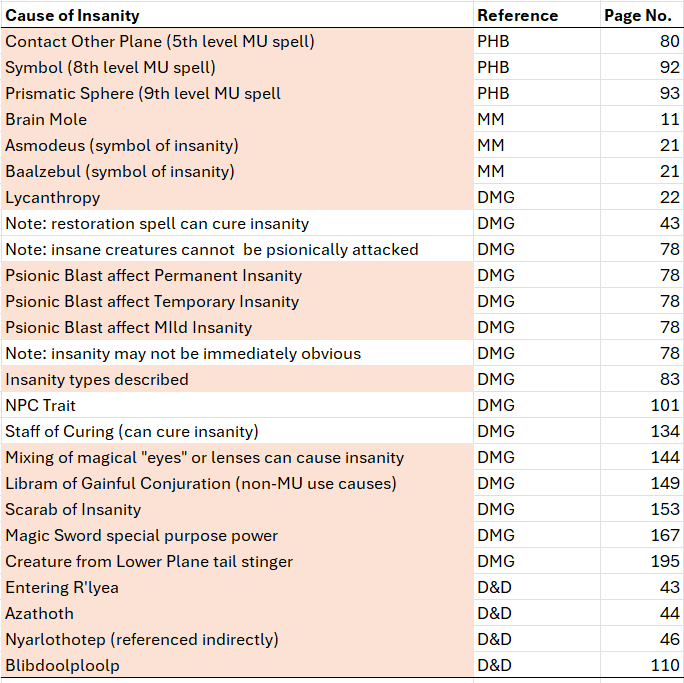
Now, in Dungeons and Dragons, the characters are heroes. Morale doesn’t apply to heroes. Dungeons and Dragons has no need for a sanity mechanic then? Well. Let me point out that H.P. Lovecraft’s works as a whole are included in the famous Dungeons Masters Guide Appendix N. Dungeons and Dragons characters can also go insane. There isn’t the unified mechanism of Call of Cthulhu though. Insanity can strike a Dungeons and Dragons character but it isn’t nearly so common, nor so inevitable. In AD&D 1e there are various spells and magic items that can cause insanity, subject to saving throws. A saving throw in this case is also a form of morale check. The 1980 Deities and Demigods also includes insanity as an effect of interacting with various Cthulhu Mythos deities.
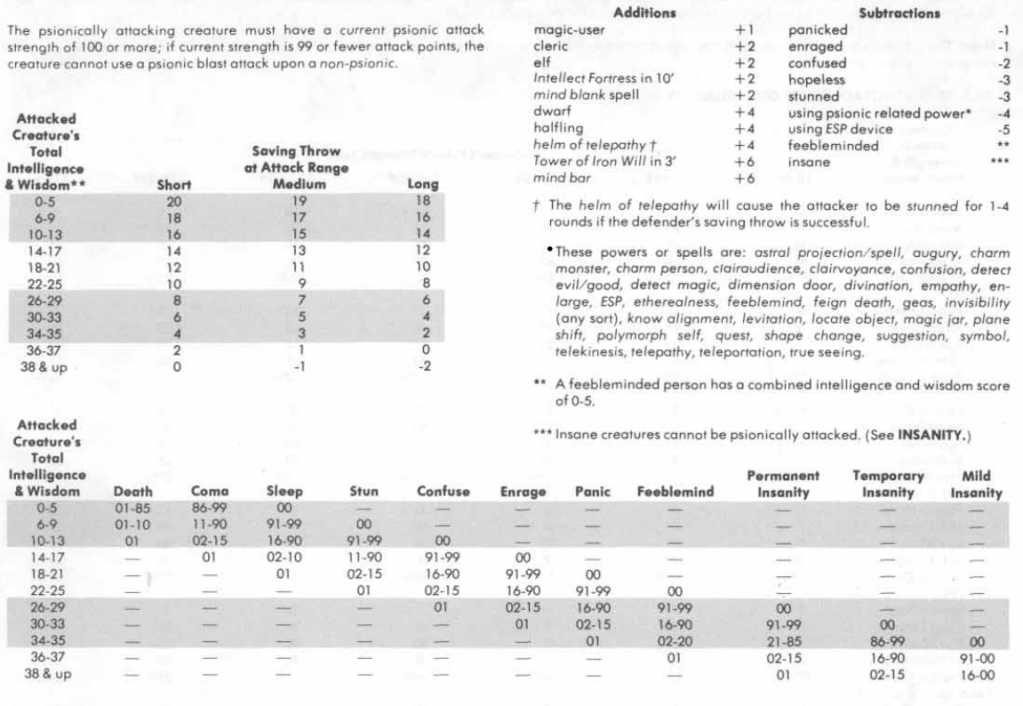
But, one of the major ways to go insane in AD&D 1e is through the use of psionics, in particular the psionic attack known as Psionic Blast. Psionics was first introduced in the 1976 supplement Eldritch Wizardry and the insanity effect of Psionic Blast is found in that supplement. Psionic Blast has different effects when used against psionic creature and non-psionic creatures. When used against psionic creatures Psionic Blast does not drive the target insane — it might kill, daze or confuse them but psionic characters don’t go insane. However, when used against the non-psionic, Psionic Blast causes a variety of effects, insanity among them.
In essence, when Psionic Blast is used against the non-psionic the character gets a saving throw (subject to a variety of modifiers) which if failed the effect of the attack is visited upon the character. The effect is rolled randomly but is affected by the sum of the targets intelligence and wisdom attributes. The greater this aggregate value the easier it is to both save for no effect or to have a lessened effect. Permanent, temporary, or mild insanity being some of the lesser effects. As noted above, insanity here acts as a defense in that creatures that go insane can no longer be psionically attacked. This, to a degree, falls into the “fight again another day” morale check approach, and can preserve characters from continuing deadly psionic attack.
It should be noted that in addition to entities with specific insanity effect, many of the Cthulhu Mythos entries in Deities and Demigods include psionic abilities which would include Psionic Blast. Thus, much as I discussed with my previous post on psionics and the Great Race of Yith, the insanity inducing effects of Cthulhu Mythos creatures are induced organically from the overarching rules rather than needing numerous creature specific rules. Similarly, many of the Demons & Devils in the monster manual also have psionic powers — though not all have psionic blast.
The upshot of all this, is that while the sanity mechanic in Call of Cthulhu, is unique to that game, the mechanic itself is in the greater class of morale mechanics. And Dungeons and Dragons got their first both in the original 1974 edition, the 1976 Eldritch Wizardry supplement, and the 1980 Deities and Demigods edition that included the Cthulhu Mythos. Call of Cthulhu’s first edition was not published until 1981. Love insanity mechanics or hate them, Dungeons and Dragons got there first.


 Fluid -- Druid
Leave a reply to AD&D 1e Psionics and the Succubus – Fluid — Druid Cancel reply