
The illustrious Mr. Wargaming has a nice post where he takes a look at the odds of finding treasure using the DMG Appendix A rules. He has these words of wisdom.

Which is exactly correct. By looking at the statistics of the tables, as Jon does, one can detect the rhythm. The best way is to learn the rhythm by extended play. Nonetheless, looking at the statistics is informative, and can inform one of the nature of the world of AD&D implied by the tables. Also, if one is setting up one’s own world, this can be done through the design of the tables you make. So, looking at Appendix A can be instructive on how to go about doing this, and how changes will affect the rhythm.
Jon was looking at the rhythm implied by treasure frequency. This made me think about another rhythm in the dungeon, encounter frequency. This sort of inspiration is part of the reason I keep this blog. I hope to inspire discussions about various rules so understanding can build on itself. I made a post, Jon made a post, now I have a new inspiration to make this post. Part of the fun.
Appendix A has two types of encounters, Wandering Monsters and Random Monster Encounters in Chambers or Rooms. But, let’s take a step back. Appendix A presents a method for generating random dungeons. So, primarily, is about determining the geometry of the dungeon itself. But the first step is the Periodic Check.
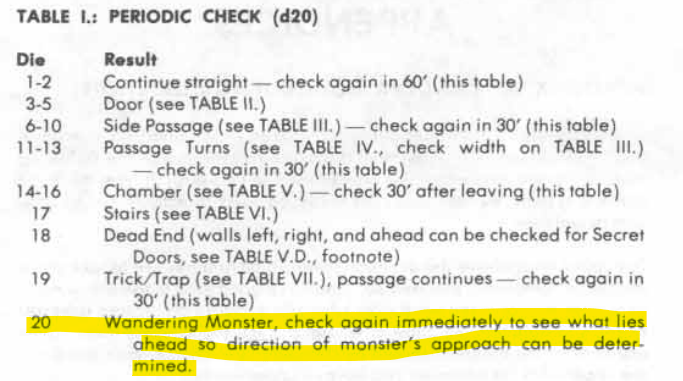
From the Periodic Check table one can see that in two of the entries are not architectural. There is a Trick/Trap entry and a Wandering Monster entry. For the purpose of this discussion I’m only interested in the Wandering Monster entry, but it is worth noting that Appendix A not only generates the dungeon but the hazards of the dungeon, and also (as Jon notes) the rewards of the dungeon. For here though, not one in twenty periodic checks will be Wandering Monsters. Really one in twenty-one checks as the Wandering Monster check says to roll again to see what’s ahead. The other thing to notice is that Chambers are encountered three times out of twenty rolls.
Why are chambers important? Because they are where you find treasure of course. But, also where you might find monsters. From the Chamber or Room Contents table we can see that a full quarter (5/20) of the rooms will contain monsters. Or, possibly more. One in twenty rooms are special “put in what you desire” says the footnote. Really, six rooms out of twenty might contain monsters. But for this review, I’m assuming the special thing isn’t a monster.
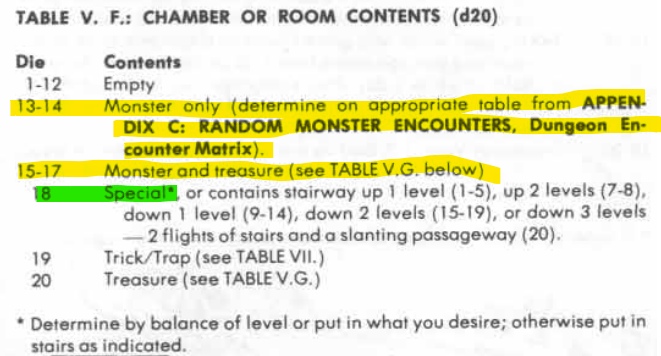
Upshot of this, (1/20) + (3/20)(5/20) = 0.0875. A bit over one in eleven Periodic Checks will produce a monster. Since Periodic Checks occur once per round (one minute) of movement, assuming no other actions (such as searching rooms, looking for secret doors, disarming traps) occur, one should on average encounter monsters once per eleven minutes using Appendix A.
What, then, is likely to be encountered. Here I’ve only looked at dungeon levels one through three. Both to limit the work, but also hirelings will not venture below level three so, the character of adventure in the lower levers of the underworld changes. In any case, as the tables say, we must check Appendix C for what monsters are encountered. Specifically the Dungeon Encounter Matrix.
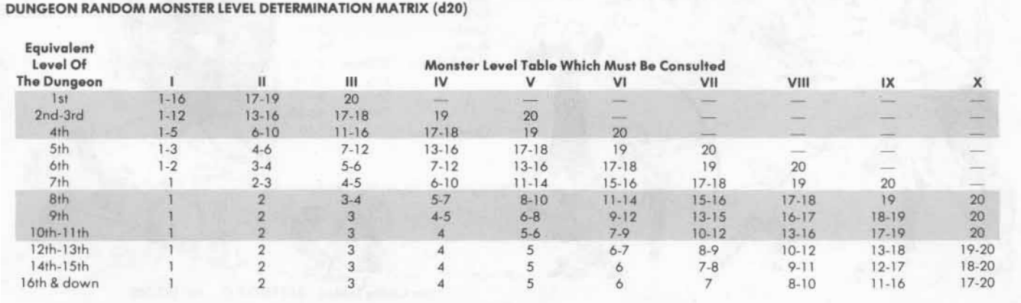
The Dungeon Encounter Matrix (p. 174) includes no monsters. What it does is informs you what further tables to consult. As can be seen from the table, the first level of the dungeon draws from three tables (Monster Level I, Monster Level II, Monster Level III) while the second and the third levels of the dungeon draw on the previous three table plus add in two more (Monster Level IV & V). One can see that as one descends deeper in the dungeon, the odds of drawing from low level table decrease and from drawing from higher level table increase. Even in the deepest levels, once might still meet a monster from a low level table. For example, Monster Level I table is used eighty percent of the time on the first level of the dungeon, while the same table is used only five percent of the time on the seventh level of the dungeon. But, even on the first level of the dungeon, once might draw from the Monster Level III table five percent of the time.
Without getting into the details of each monster level table, the Monster Level Tables include lists of monsters and the odds of rolling each monster on the table. Shown here is Monster Level I as an example.
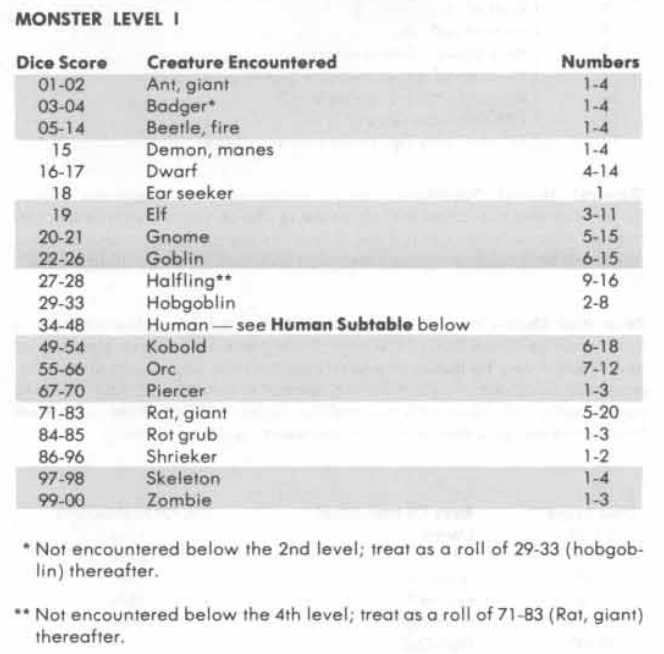
The takeaway from this is that the Monster Level encounter tables do not correspond to the level of the dungeon. They don’t even correspond to the hit dice of the monster, though, in general the monsters get tougher as one works up the tables.
I took a look at the Dungeon Encounter Matrix and the Monster Level Table I, II, & III, and calculated the odds of encountering the various creatures listed therein. A few creatures were included on multiple tables and I also calculated the overall odds for those. Then I sorted the odds from most frequently encountered to least.
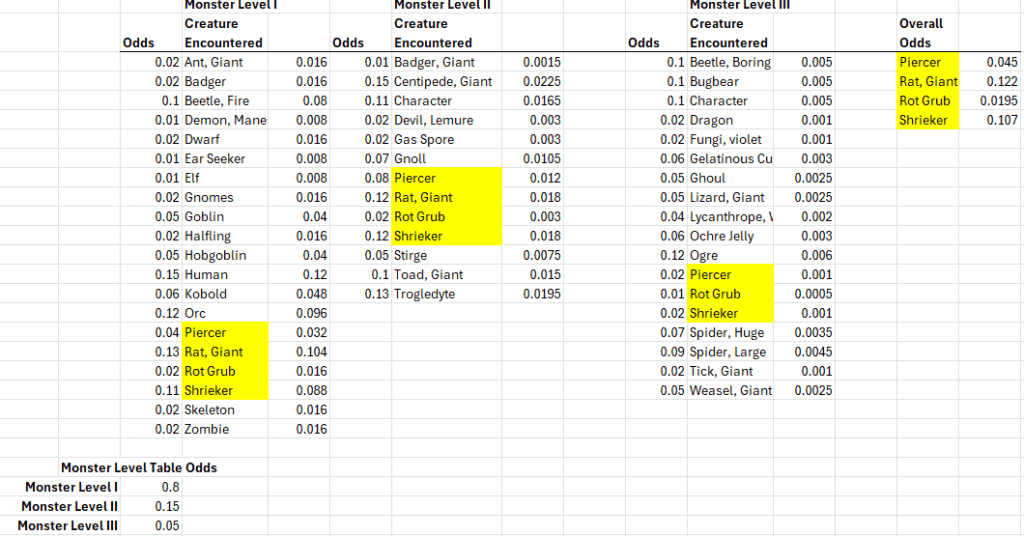
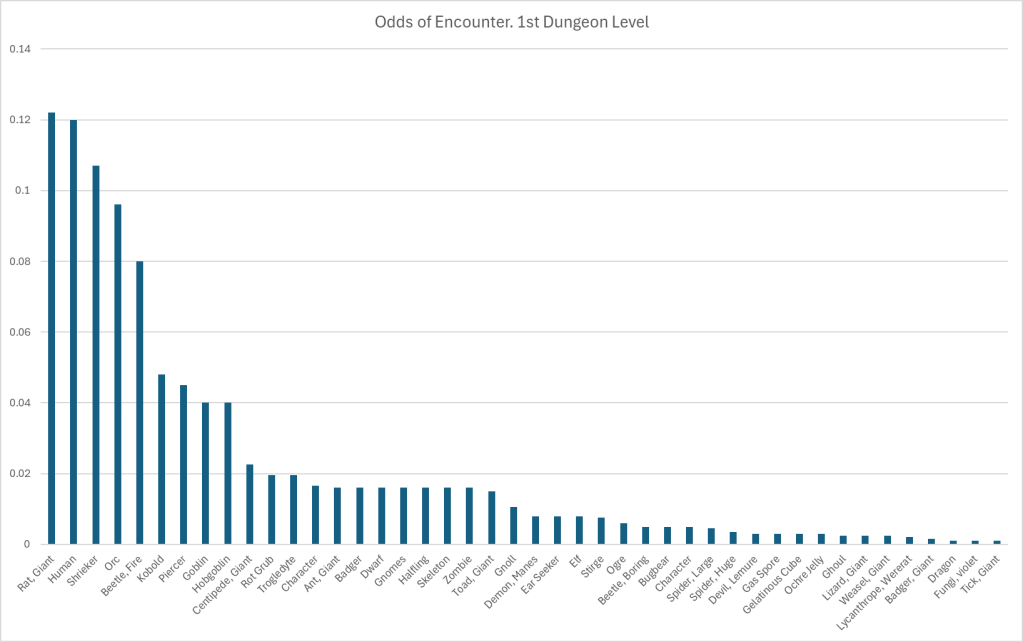
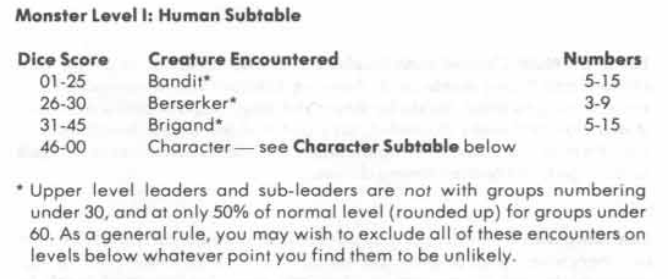
Most common encounter on the first level of the dungeon probably comes as no surprise, giant rats. But the next most common might surprise some, it’s Humans. Now, Humans have their own table, Bandits, Berserkers, Brigands, and Characters. Characters is interesting because humans more often than not (55% of the time) will be other Characters. Those looking closely at the table will see Characters represented as a 1.6 percent chance of an encounter. This is because Characters are also shown as a separate encounter on Monster Level Tables II & III. Characters are Classed characters. The more bold classed characters will do so. In fact, Characters show up on all the Monster Level table except Monster Level I. Classed character really show up on Dungeon Level I, 8.25% of the time and other Humans, 5.4% of the time. The tables are tricky that way.
The next most common encounter is the Shrieker. Now this is problematic when looking at odds. Because the whole point of the shrieker is to make noise, which forces wandering monster rolls. How, many wandering monster rolls will depend on the cleverness of the players, so this is a good demonstration that statistical analysis only goes so far. Finally, the fourth most common encounter is the first true monster, the Orc. But, even Orcs, famously overused, only appear 9.6% of the time. Less than one in ten dungeon encounters will be orcs.
But, what about the least common encounters. Dragons, Violet Fungi, and Giant Ticks each have a one in a thousand chance of being encountered on the first level of the dungeon. But, the chance is not zero. There are dragons in Dungeons and Dragons right out of the gate. Dragons have a long tail and so does the encounters tables.
The second and third level of the dungeon both use the same row on the Determination Matrix. Meaning in one sense levels 2 and three are really, the same level of the dungeon. As previously mentioned the Dungeon Levels 2 and 3 add in two more monster level tables. The long tail from dungeon level 1 only gets longer.
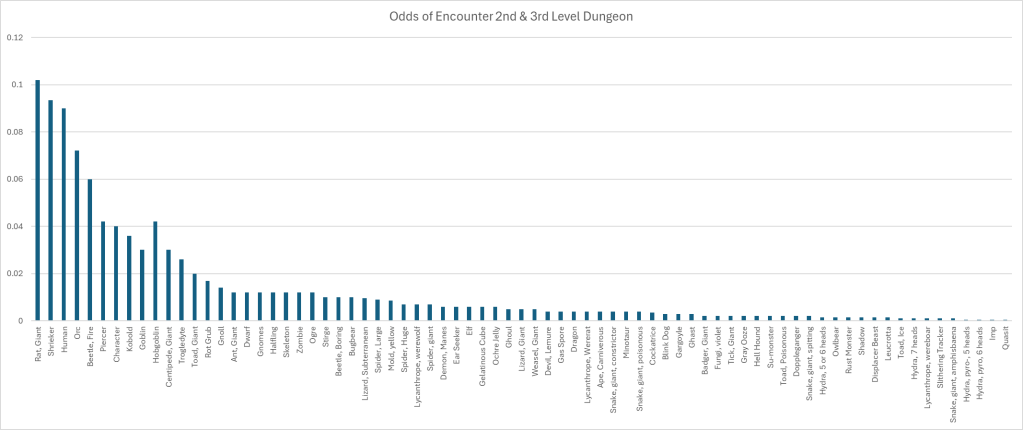
The chart here is probably hard to read. The most common encounter remains, guess what, giant rats. Shriekers knock humans down to number three in frequency. Then in fourth place again, Orcs. Orcs though drop in odds to 7.2 %. Dragon is not the bottom of the list now. In fact the odds of encountering a dragon quadruple to four in a thousand. And, the bottom of the list is Imps and Quasits each at 5 encounters per 10,000 rolls, 1 in 2,000. Some might note there is an odd man out on this table. What is that blip upwards in the first third of the odds. That is Hobgoblins. It should be shifted up to sixth place. Hobgoblins get shifted upward because of the footnote on Monster Level I table that notes that Badgers are not found deeper than the 2nd level of the dungeon. So, really, this table only represents level three. For the level 2 version, just visualize Badgers occurring 1.2 % of the time. and Hobgoblins 3%.

This sort of analysis could be extended to all the dungeon levels and all the monster level tables. Perhaps, one day, I’ll do that. But it shall not be this day!
Overall, looking at the Dungeon Random Monster Level Determination Matrix and the Dungeon Random Monster Tables, one can see the movement of different monster types between levels, where certain monsters are most common, and the gradual transition from less to more dangerous with depth in the dungeon. Not only transition from less to more dangerous but also from normal to abnormal to supernatural the deeper one goes. The nature of danger widens with dungeon level but, also the variety also get larger. From the 8th level of the dungeon and deeper one can encounter everything from, yes, giant rats to Demon Princes.
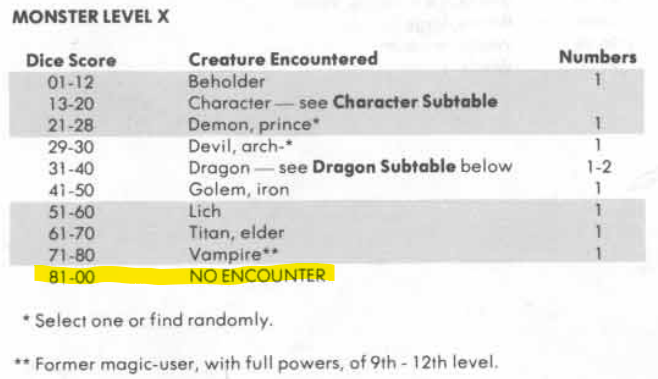
One funny thing is that Monster Level X table. It’s the last one. And, it includes an entry of “NO ENCOUNTER”. This means that in dungeon levels 7-11 the odds of an Appendix A encounter drop from one in eleven, to one in thirteen. And for dungeon levels 12 and down, the odds of an encounter drop to 1/15. The deepest darkest parts of the dungeons are somewhat less populated than the upper parts. I mean, really, who wants to be neighbors with a Balrog? Kind of makes sense?

 Fluid -- Druid
Leave a comment