
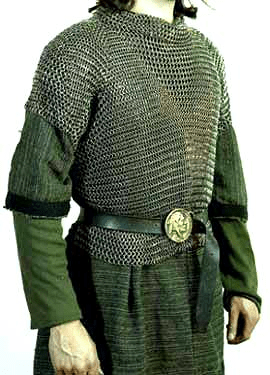
In this previous post I explored the odds of hitting in Tony Bath’s Ancient Wargaming and in Dungeons and Dragons. I’ve had a few ideas since them. In the previous analysis, I found some close correlations in the odds. Some of the odds were exactly the same, such as unarmored and mail. Many others were within a few percentage points of each other but for this look let’s concentrate on the unarmored and mail suited figures. Unarmored figures had a 50% chance of survival while the mail shirted figures a 75% chance of survival. But, I always wondered why those odds, and how were they determined? Thinking about it today, I think I’ve hit upon the logic of it all.
Strategos was an set of military professional war gaming rules by Charles Totten. It is known that Dave Arneson and his Minneapolis crew had based some of their early wargames on simplified or modified versions of Strategos. Meanwhile Gary Gygax in Lake Geneva had roots with Tony Bath. And, of course, there are likely many others early war game designers that Arneson and Gygax drew from. But it is Strategos that I was looking at today and which generated my idea.
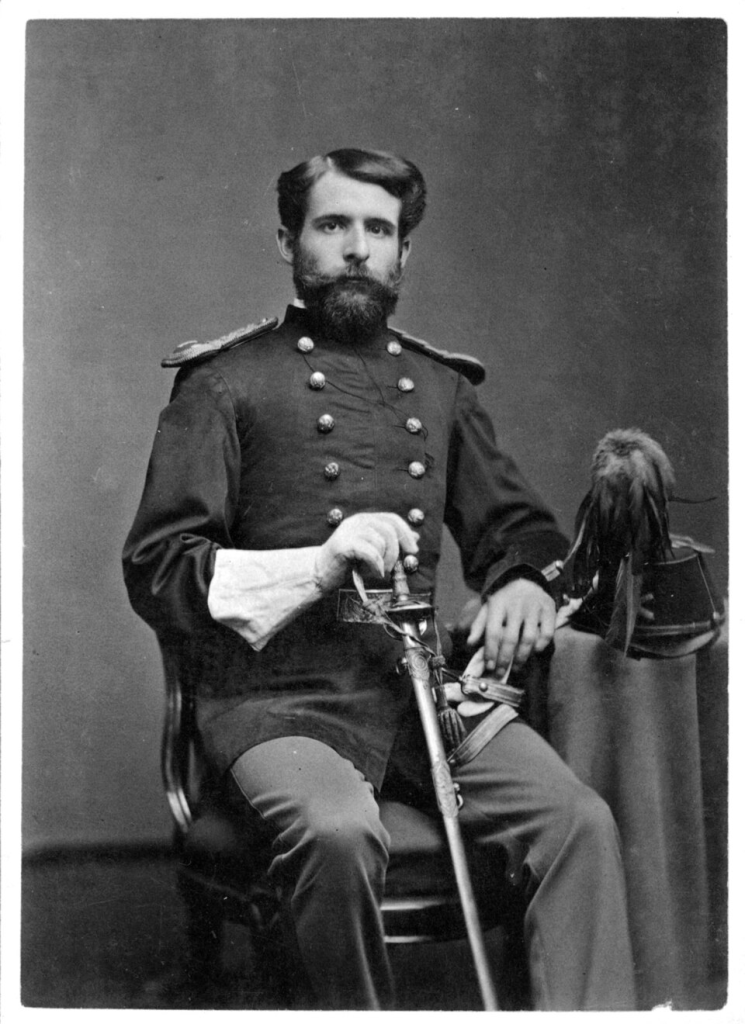
Charles Totten
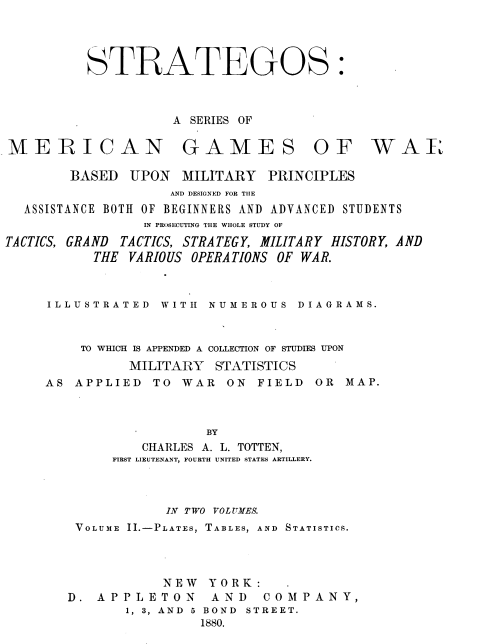
In Strategos, one of the early tables in the second book of the game has shows a means of resolving attacks. It gives odds ratios in the left colump. The top columb shows the roll of a die. So, for example looking at the top row (the 3:2 row), a roll of 1 is a push, a roll of 2 or 3 results in the smaller side winning (the 2 of the 3:2), and a roll of 4, 5, or 6 results in the larger side (the 3 side of the 3:2) winning. Each row represents different ratios of numbers of attacks versus numbers of defenders. You’ll note that the ratio of wins to loss match the ratio of troops. At 3:2 troop ration the larger side has three chance to win as compared to the smaller side having two chances to win. Following this logic down the rows, we see at the bottem with a 5:1 ratio, the dice also have five wins to one loss.
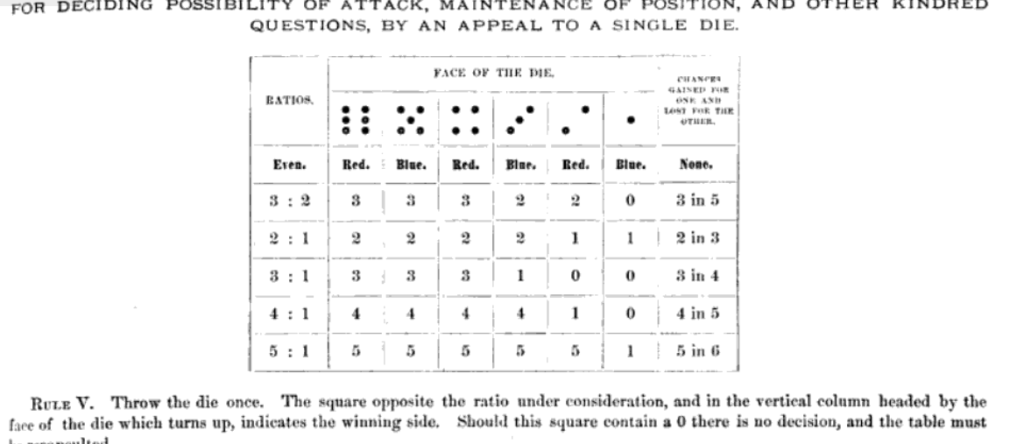
But a 1:1 ratio is not covered. I wondered about this for a moment. Then it hit me. At a 1:1 ratio, on a die that would be three wins to three loses, or 50/50 odds. One to one ratios can be resolved with a coin flip. And, the logic makes sense. All other things being equal with two contestants there can be but one winner, so it’s always a 50/50. Then it hit me again. Those Bath and D&D odds. Why was the unarmored soldier struck fifty percent of the time? Same reason.
But things aren’t always equal. In Strategos, Totten is looking at troop ratios as a means of tilting the odds in the favor of the larger mass of men. Bath and Gygax were looking at armor as a means of reducing the odds of losing. Below I’ve copied he table from my previous look where I calculated the odds in both Bath and AD&D.
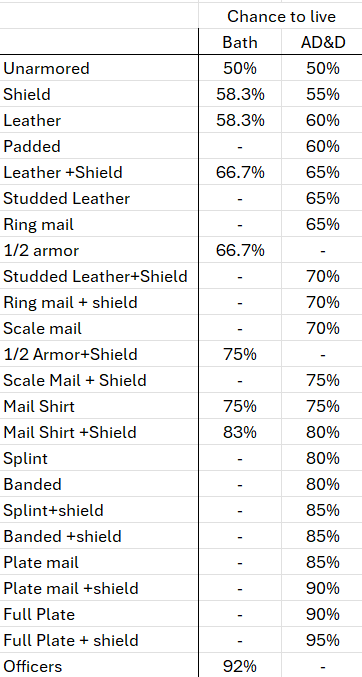
In Bath, the armor he has is leather, 1/2 armor, and mail. I don’t know exactly what half-armor is, but it’s a clue. I think in simple terms what being used to estimate Bath’s odd is how much of the body is covered by the armor. There’s a quality component too, but that’s secondary. In Bath’s game he’s looking at a time period where a mail shirt was not the total coverage of the medieval crusades. The mail is described as a mail shirt — so a hauberk or byrnie. Both of which cover roughly fifty percent of the body.
But lets take a step back and look at the unarmored. In both Bath and Gygax, the unarmored man has a fifty percent chance of being hit and killed. It’s a little more complex than that with D&D due to variable weapon damage, and numbers of hit points. But, for the common weapons used against the common man, it’s about fifty percent. These odds match those in Totten for the one to one odds. Two men enter, one man leaves. But what if one man has armor? Assume the armored portion is impervious, then that mail shirt that covers half the body divides the odds in half. With the mail shirt the odds to living raise from fifty percent to seventy-five percent. And that matches the odds in Gygax as well.
Now, AD&D adds more armors. That plate armor, covers near all the body. So, that would be the other half that wasn’t covered by the mail shirt. But that would raise the odds of safety to 100% and we know it wasn’t that. Even knights in armor can be killed. And, indeed there are still raised visors, and gaps in the plate. So, call it 85% protection, 90% with a shield.
And, for the other armors, it’s easy to fill the gaps in between based on subjective assessment of coverage and quality of the protection. Now, I am not saying that Bath necessarily drew from Totten. But, it all starts with an assumption that if two people (or groups) are fighting only one can win. It’s a pretty logical and straightforward assumption. I expect many game designers start here. Indeed, I’m shocked it didn’t occur to me sooner.
What I think leads us astray is the term “to-hit”. “To hit” doesn’t mean “to hit” it means “to win”. It started with an assessment of odds of winning and then evolved into the idea of hitting with damage as a secondary step. In the Dungeon Master’s Guide Gygax has a clue here in his explanation that hit points do not fundamentally represent wounds and that the to-hit roll represents all the attempts to attack an opponent within a one-minute round. And, in the end, the roll is not looking at an arm swinging a weapon and estimating the odds of a strike. The roll is looking at a generalized conflict over a set period of time and estimating the odds of who is going to win. Well, one of the two of us is going to win. How can I swing the odds in my direction? Put on some armor says Bath and Gygax. Get some friends says Totten (Totten was looking at a period without much significant armor).
Addenddum: Shields.
Gygax follows the same methodology as Bath.Adding a shield adds one pip to the die. However, Bath was using a six sided die and Gygax a twenty sided die. The twenty sider is useful in representing odd to a finer degree, which allows fitting a lot more armors into the scale. But, the totality of the Bath approach adds 8.3% more protection with a shield, while Gygax add only 5%. Looks like Gygax chose to round down but, I’d likely have round that one up to shields add a 10% increase in protection. Gygax preserved Bath’s methodology but this skewed shields to being fairly paltry protection. And, really, shields likely should get even a bigger increase than 10%. Because would you rather be hit on an armored spot, or, have a shield hit and not have your body hit at all?

 Fluid -- Druid
Leave a comment