
I’ve talked about western themed campaigns before. I provided an overview of the Gunslinger campaign system. I talked about a more detailed game play loop and random wilderness encounters to Boot Hill. I discussed professions other than gambler for Boot Hill. And, I discussed adding animal encounters to Boot Hill.
Now, I’m taking a look at three different systems and how they treat campaigns: Boot Hill, Gunslinger, and Aces and Eights. Specifically, what rules do they have and what setting materials do they provide as part of the base game.
Before I start, let’s discussing setting a bit. It’s no secret that I prefer role playing games that emulate genre rather than provide a lot of setting information. An example of this is AD&D. AD&D provides rules for emulating whole genres of fantasy with no specific setting specified. Though, in AD&D, the tables and rules define a lot of what the setting is like without specifying geography, cultures, or personalities. In fact AD&D provides tools to create the geography, cultures, and personalities. Starting around the mid-1980s, RPGs started getting very specific about setting while leaving out tools to create setting. This was good idea financially for game companies in that it allowed the endless selling of more setting related splat books. It was not, however, great for gaming overall. A good example of this is Shadowrun, which is set specifically in a near future version of the pacific northwest with emphasis on Seattle.
The American West though is different. It’s a creature of a specific place and a specific time period. So, historians themselves have created endless splat books for gamers to utilize — these are called history texts. Does a role playing game of the Wild West, then need much in the way of splat? Maybe, maybe not. Role playing history is tricky. One can easily feel confined to historic facts. Just because the play is set in Tombstone, Arizona, must the Okay Corral fight happen as in history? Should players be prevented from influencing that event? I think the answer might vary depending on the game, the players, and the DM. Yet, mostly, I say no. Players should not be restricted on taking action to keep history the same. But also, players should also not choose actions based on knowledge of how history played out.
Further, the scale of role play, both geographically and personally, is usually at a tighter scale than history texts. Yes, there are broad sweeping vistas, but play is often confined to a town or its environs. Usually, a general region is used for play rather than the whole of the West. A history text might tell you who is the mayor of the town or who is the Sheriff, but not who runs the stable or, which rancher resented which sheep herder. So, games still might usefully provide more information of a play locality than history books might.
Additionally, the history of the West may well be divisive. There are historical and ongoing differences of opinions on that history even today that one might not want to bring to the table. Or, maybe one does want to bring them to the table, but in a more distanced way.
So, here we go. Let’s look at how three different games handle this task of campaign setting.
Gunslinger
Rules
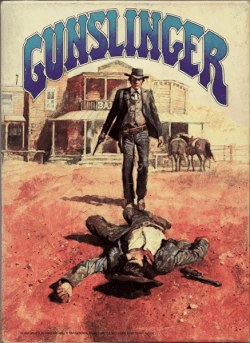
I’m going short here because I’ve already written a whole post on the Gunslinger campaign rules. Suffice it to say, the game presents a very rigid structure for running a campaign. Playing the campaign is a series of ten years played out in monthly turns, each month featuring one Showdown.
Setting
The game has no specific geographical location other than “the West”. It does, however, have a specific temporal location of January 1877 through December 1887. Why those dates are chosen, I don’t know, but it is interesting that the Okay Corral fight occurs pretty close to the middle of that period.
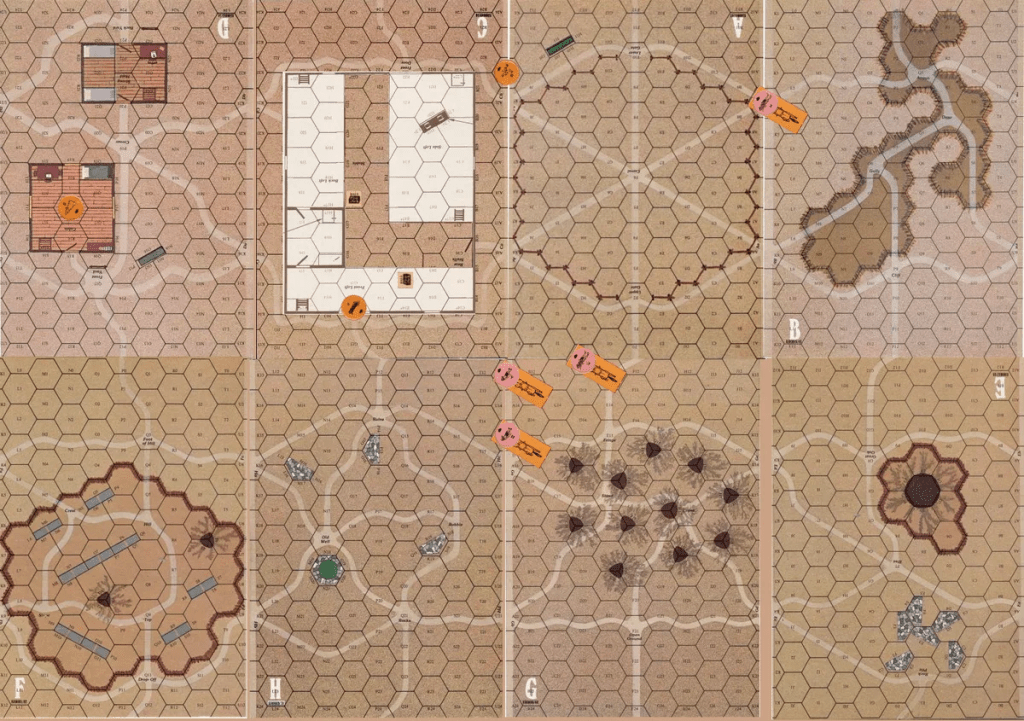
What is specific are the locations which are provided through a specific set of repeated scenarios and boards that can be configured in a variety of defined ways. If you play Gunslinger, you will get very familiar with those boards and their orientations.
In summary,
- Rules — rigid and detailed
- Overall Setting — amorphous, non-geographic
- Temporal Setting — rigid and specific
- Local Setting — rigid yet with built-in flexibility
Boot Hill
Rules
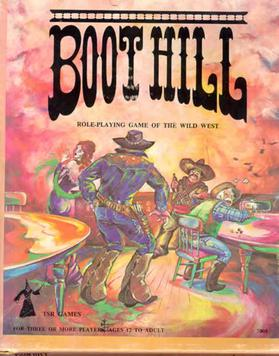
Boot Hill has two editions, 1975 & 1979.
1975
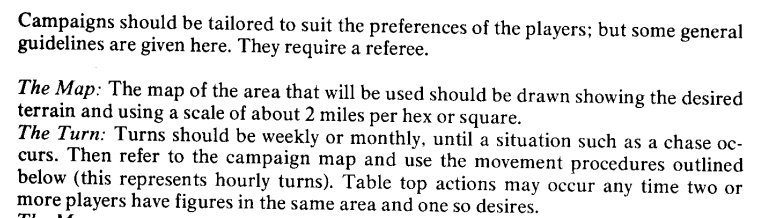
The 1975 version also provides rules for cross-country chases, aging, posses, and tracking. That’s about it. There is no guidance on how the weekly or monthly turns are intended to be carried out or adjudicated.
In addition, there are two Appendices. Appendix C which provides some details of prices and wages. Appendix D gives a map of a “typical section of town”.
But, overall, the 1975 edition provides a very loose structure to campaign play in terms of rules.
1979
More details are given. Right off the bat is a section discussing the duties of referee, the need to be impartial, and to set the scope of the campaign.
Then it discusses campaign scenarios provided in the game. There are two, really three, scenarios. One “quasi-historical”, one “completely fictional”, and also the provision for a referee to start a campaign “from scratch.” So, between editions, they deciding more discussion was needed of the dilemma of playing in a historical setting.
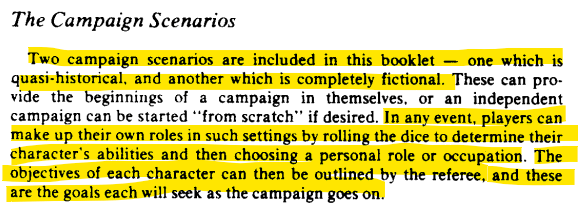
But the thing I find most interesting here is, while the player creates a character and decides on its “role or occupation” it is the referee that determines the objectives for each character. This is a step away from “total player autonomy” that I prefer. Though, presumably, a referee would be expected to set objectives based on the type of character and its profession. It would not be appropriate for a referee to take a character determined by the player to be a prospector and define that character’s goal as to start a farm and get the crop in before winter.
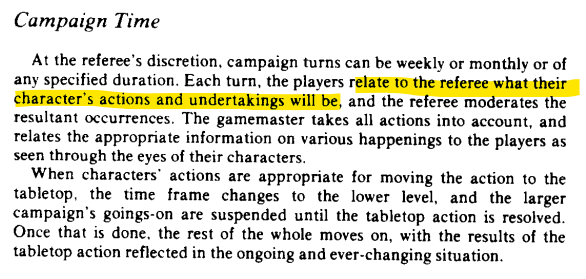
The 1979 edition retains the weekly or monthly turn structure. But it also gives more details as to how the referee manages the turns. The players relate their actions to the referee, and then the referee adjudicates while maintaining a fog of war.
Like the earlier version it also gives rules for overland movement and posses and aging. It adds healing rules. It takes the price lists out of an appendix and includes it within the campaign section. But it also includes a paragraph on “Roles & Objectives”. This is guidance to the referee depending on the chosen scope of the campaign.
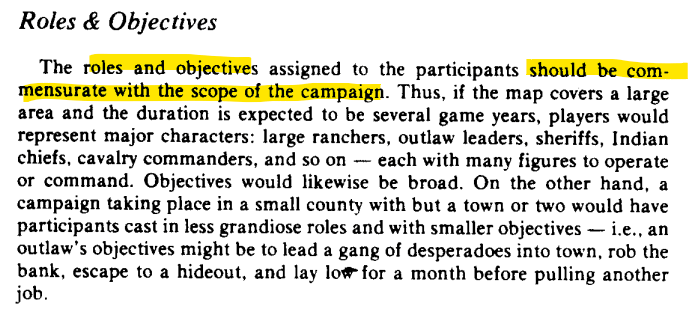
It’s pretty straight forward, is the geographic scale is large then the players should be in roles of major players in the area with men under their command. If a small region is chosen then, commensurately the focus should be on smaller objectives. This is important in that it empowers the referee to make the game into essentially a domain-scaled wargame. Or, also, a more tightly focused, more Braunstein-like activity. In the former, players are staking out territory and moving their forces about the map. In the latter, it is more tightly focuses on a place (e.g. Brownstone) and individual characters that are more frequently interacting directly.
A section on the importance of record-keeping is added. The example is of keeping track of cows in rancher’s herd. Though, this section also notes that the referee can receive orders orally but also might consider written order to have a record of the game.
There is an expanded list of characters from history and fictional Non-Player-Characters.
Setting
1975
The 1975 edition provides no specific setting in place or time except the broad era of the wild west. The campaign rules leave it up to the referee to make a map at two miles per hex.
1979
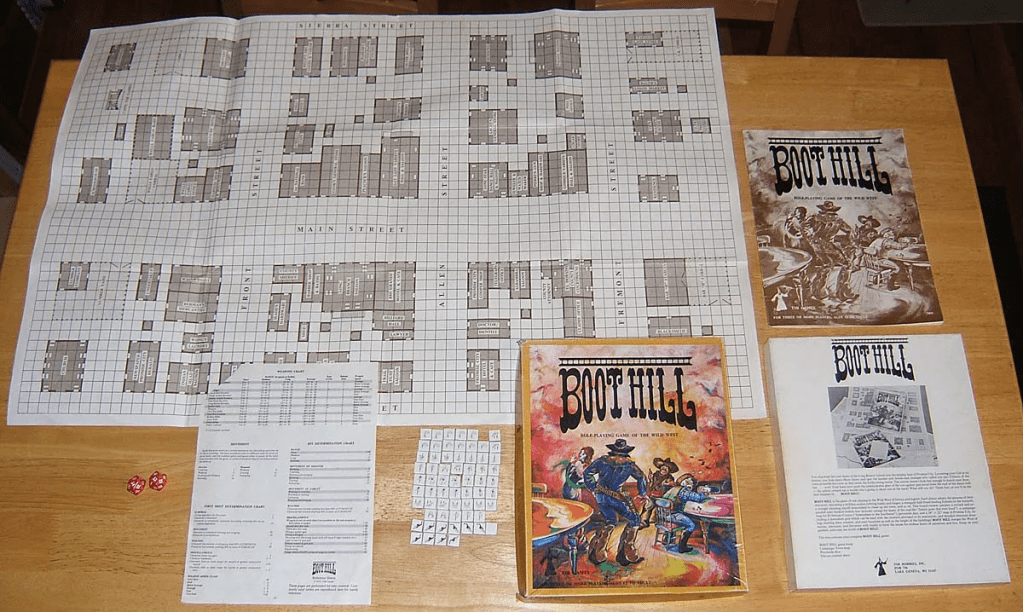
As previously mentioned, there are two major campaign settings outlined, one “quasi-historical”, the other “completely fictional”. Both are set in the fictional town of Promise City. The game comes with a two-sided map. One side is a detail of part of Promise City, the other side is of the region around Promise City. The map shows the main area of Promise City and the book gives a couple of examples of building interiors But, this does not have the flexibility of the Gunslinger game boards. Though it does allow infinite expansion for referee willing to do the work to map other areas of town.
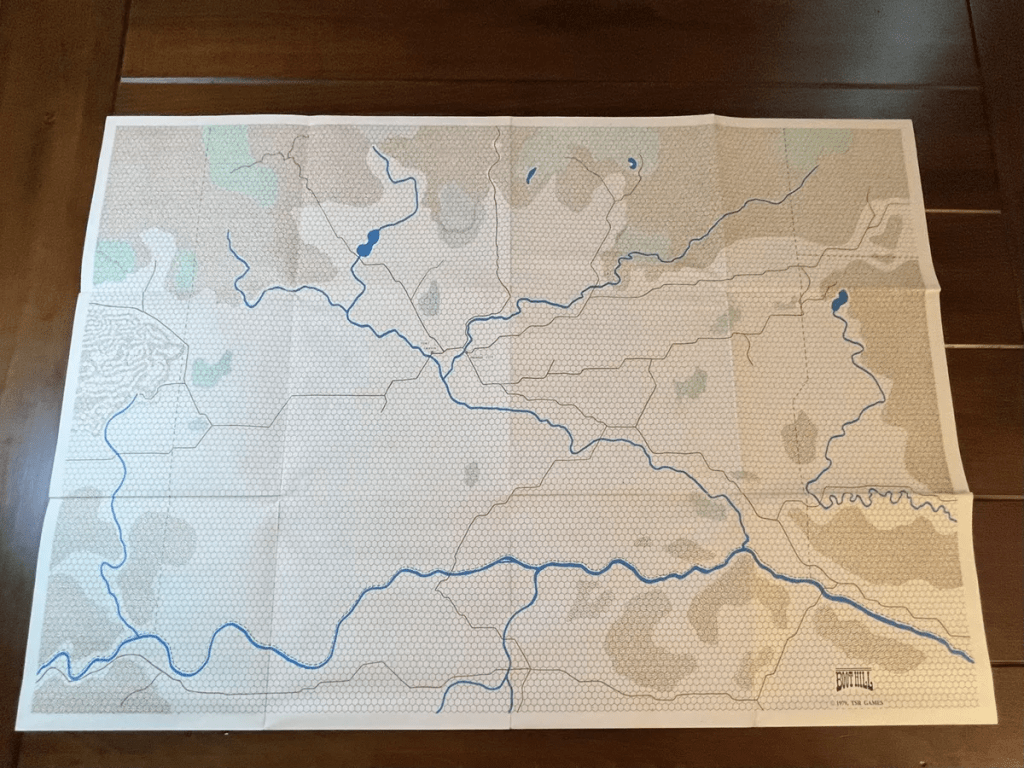
Note, the region is about 300 x 224 miles at two miles per hex (67,200 square miles). This is, near exactly, about a quarter of the size of Texas. Does it match any actual geography of Texas? Not that I know of. But, it does say that the “quasi-historical” location is set in Texas along the Great Southwester Trail near a fort and Indian Country. My guess is it is supposed to be representative of something like this area.
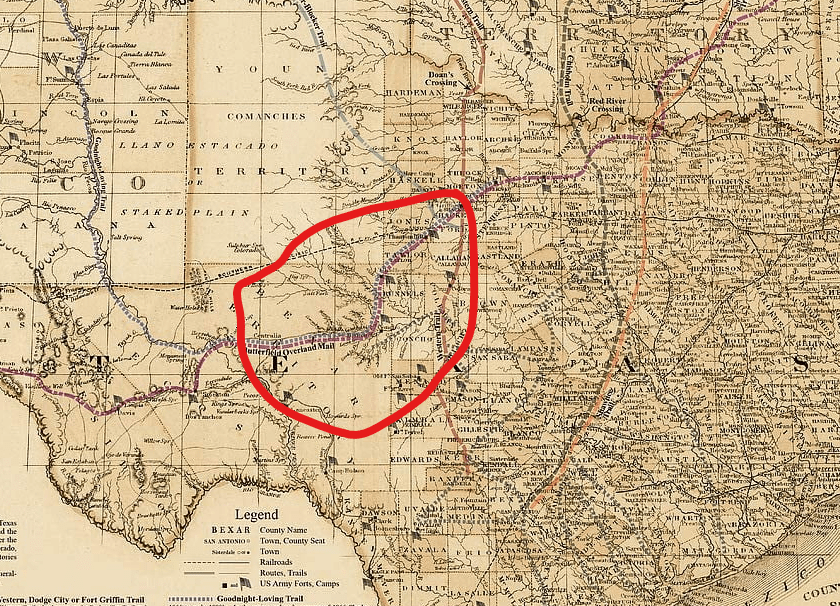
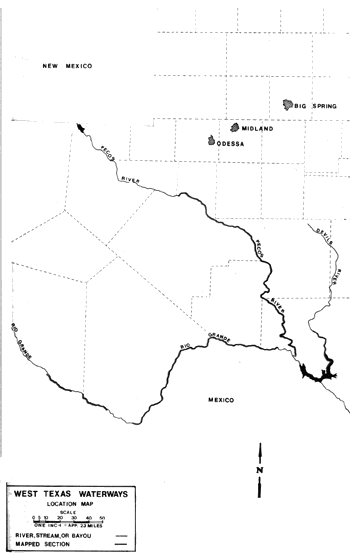
A friend more knowledgeable about Texas than I say the river resemble the Rio-Pecos-Devil’s river system, but not exactly. So, generally, I’m thinking Abilene or Odessa was the model or somewhere like that. I any case, it’s almost certainly intended to be representative rather than real. The upside here is you are not beholden to history. The downside is if characters leave the bounds of the map, you have nothing to go on.
The main feature of the “quasi-historical” campaign is that it uses a set list of historical figures (e.g. Doc Holliday, Johnny Ringo, etc.) as NPCs and focuses mainly on the town rather than the greater environs. Though it does say if one wants to expand the scope to the greater area, one can do so.
The fictional campaign does not use the historical characters but, also provides a list of towns, ranches, mines, and other geographical features that can be placed on the greater regional map by the referee. Twenty towns, six mines, roads, trails, water features, ten ranches, trading posts, forts. This results in a consistent area of play that nonetheless is unique to each campaign. It also presents options for moving the location about: near Indian Territory, near Mexico, or even into Colorado. In addition, it does allow for placing a variety of historical figures into the campaign. So, really, there is quite a bit of overlap between the two campaigns provided in the game. The main difference, other than populating the map, is that the fictional game adds an objective.
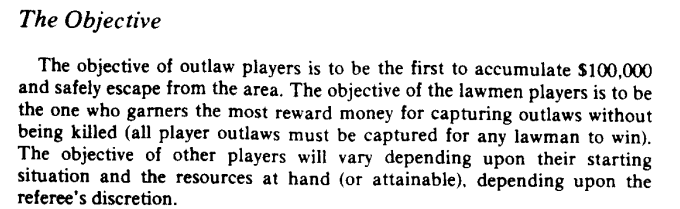
It also gives rules for setting rewards and determining the value of loot. So, it’s lawmen versus outlaws. There are enough places and geography that the outlaws can ride around and rob banks or trains, while the lawmen chase them, do stakeouts, or try to lure them into capture. There are plenty of places to hide in there. It’s pirates of the inverse Carribean. Instead of moving across water to hide at islands, the outlaws ride across prairie to hide out at watering holes.
In summary:
- Rules — fewer than Gunslinger
- Overall Setting — fictional geography set within a general area (Texas, Colorado, etc.)
- Temporal Setting — not particularly specified. Post-Civil War West
- Local Setting — both more and less flexible than Gunslinger. More work than Gunslinger.
Aces & Eights
Note: here I am discussing Aces and Eights: the Shattered Frontier rather than the second edition Aces and Eights: Reloaded. The reloaded version is mostly corrections and erratta added in, but also with key elements of long term play systems removed. These systems were them sold seperately to those with interest in using them. So, for this summary, I’m looking at the most holistic version of the game.
Rules
What I would call the campaign game rules is presented in two sections. First is a seventy-seven page chapter titled The Aces & Eights Campaign. Second is a fifty-nine page section titled The On-Going Game. Just from the page lengths alone, one can see this is a different beast from eithe Boot Hill or Gunslinger. It has both advice an rules.
Despite the length and the rules there is this sidebar presented early on in the campaign chapter.
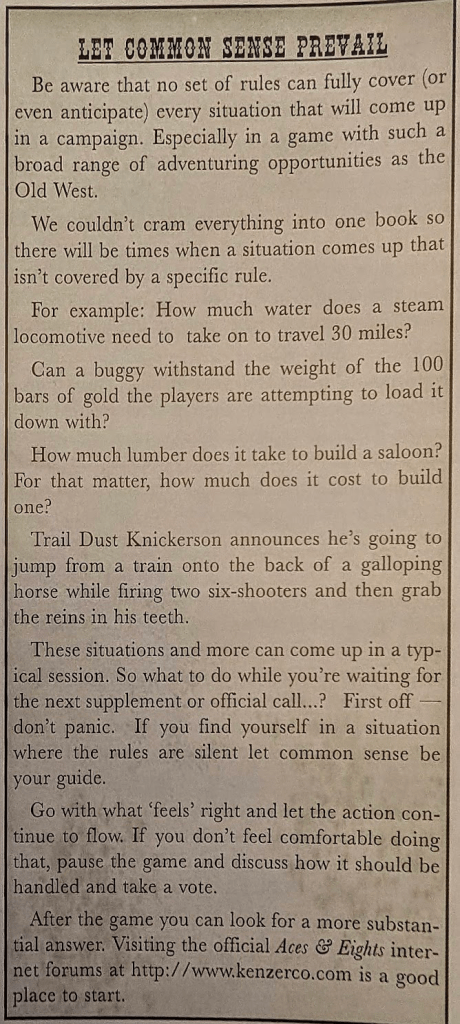
This could apply to all three games, but especially Boot Hill. The reality is that in any RPG, you are going to have to wing-it a lot of the time. The world is a complex place and no game can cover even a small fraction of it. Gunslinger is differerent because its rigid campaign structure eliminates a lot of these things.
Like a lot of modern rule sets, Aces & Eights spends a lot of time discussing generalities for beginning role players. There is a discussion of timekeeping about how game time is different than real time and that records need to be kept. But, it does not really get into the details of how to do that.
The campaign chapter has a lot of setting discussion of the games “Shattered Frontier” setting and alternative history. I’m not going to get into that much here, but will cover it more below.
Then follows some general role playing advice on different ideas of how to start a game. Then presents ideas for “adventure hooks”. This is all in the conventional paradigm of the referee presenting set piece scenarios.
There is a useful listing of comment archetype NPC townfolk. And, horses.
The two major rules section in the campaign chapter are rules for acquiring (or losing) Reputation and Fame and rules for Professions. The Reputation and Fame rules are useful mechanics for evaluating how NPCs and possibly how other characters might view a character. And, gives players a goal to choose what kind of rep and fame they want to seek. The Profession Paths give the details of how characters with certain skill sets can set out to follow a profession and earn “Build Points” awards which can be used to improve their character’s skills. Aces & Eights of the three has the most detailed skill system.
The On-Going Game chapter has several rule sections (or modules one might say) on carrying out specific activities within a longer form game. These are: cattle ranching, mining, gambling, trading and buying goods, holding trials, drinking & drugs. Each of these sections (with the exception of the goods list) has detailed rules on how to carry out the activity which IMO is very useful. Ranching, mining, and gambling are common western activities which one can easily see characters engaging in so maybe a systematic approach is better than just winging-it. Similarly, trials also seem likely to be in many characters futures. The drinking and drugs section details alcohol, laudenum, opium, morphine, and peyote in terms of effects and addictions. Characters may well be exposed to these compounds both through necessary use (alcohol may be better than questionable water) and through medical neccessity. There is a fair amount of rules regarding diseases and healing from wounds in other parts of the game.
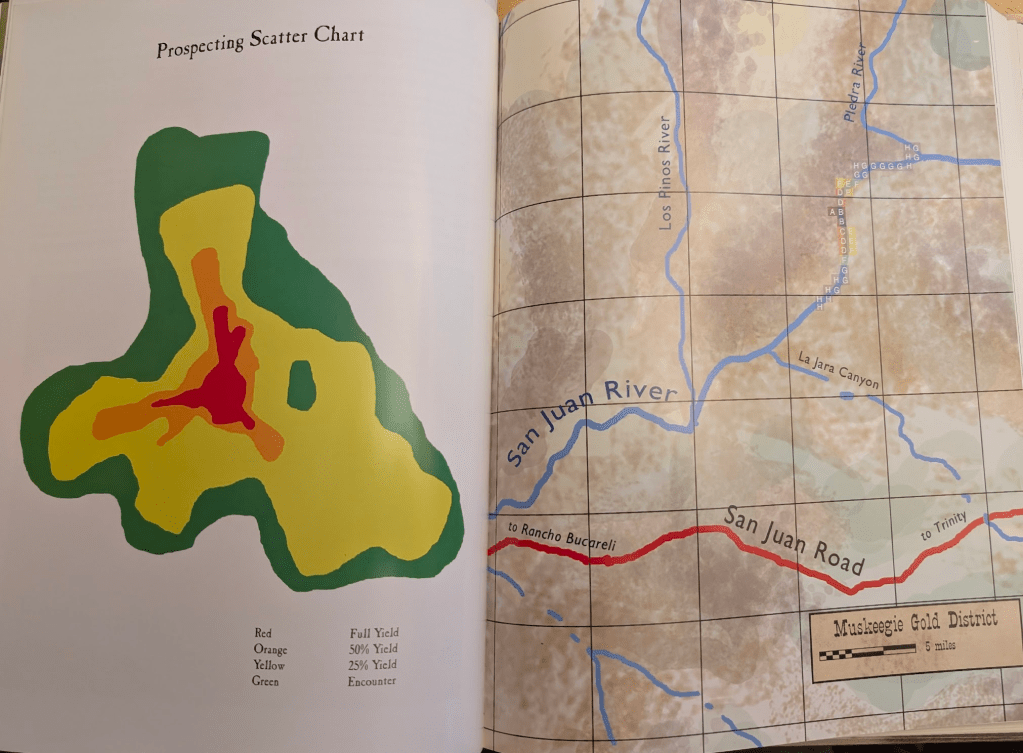
But the ranching, mining, gambling, and trials parts of the game really shine in my opinion. No other role playing game that I know of has better prospecting rules. It’s mostly about placer deposits and does not spend a lot of time on mining other loads. I think there is the assumption that players will mostly prospect, define their ore bodies then sell out to the bigger developers. Nonetheless really remarkable. The rules provide an example mining district, a map (secret to the players) for where deposits might be found, and a scatter chart to be used in defining the actual deposits if one is found.
The cattle drive rules follow similar detail as the mining rules. If perhaps not as unique as the mining rules, it has enough in there to detail overland journeys while policing a herd. Certainly something I wish other western games covered in more detail.
The trial rules are a clever dice mechanic to influence individual jurors leading to a real tension on whether one might be convicted or not. Though, I expect player milage may vary on how much detail they really want to put into the a trial. Some might prefere just a single roll with some modifiers. Though, the western setting is mundane compared to many and trials are a place to keep things spicy.
The trading section is really just the sort of price lists you seen in all role playing games. I think for characters given to running general stores or farms some more detail of commodity trading could have been added.
Things that I wish were there include rules for: random encounters, hunting, farming, sheep herding, building railroads, logging. All of these things were also big parts of the west and create inherent conflicts with other aspects. For example, farmers and sheep herders commonly came into conflict with ranchers who prefered an open range. Plus, who would not want to play buffalo hunters coming into conflict with the various tribes. Now, this is not a black mark on the part of Aces & Eights as neither of the other two rules I’m looking at here address these things either. It goes back to the initial advice to learn to improvise.
Setting
The overall campaign setting for Aces & Eights is The Shattered Frontier which is an alternative history of the west. This setting has a United States where the Civil War ran to a statement, Texas remained a seperate Republic, Mexico did not lose the Southwest and most of California, and the Mormans have set up their own country of Deseret in Alta California.
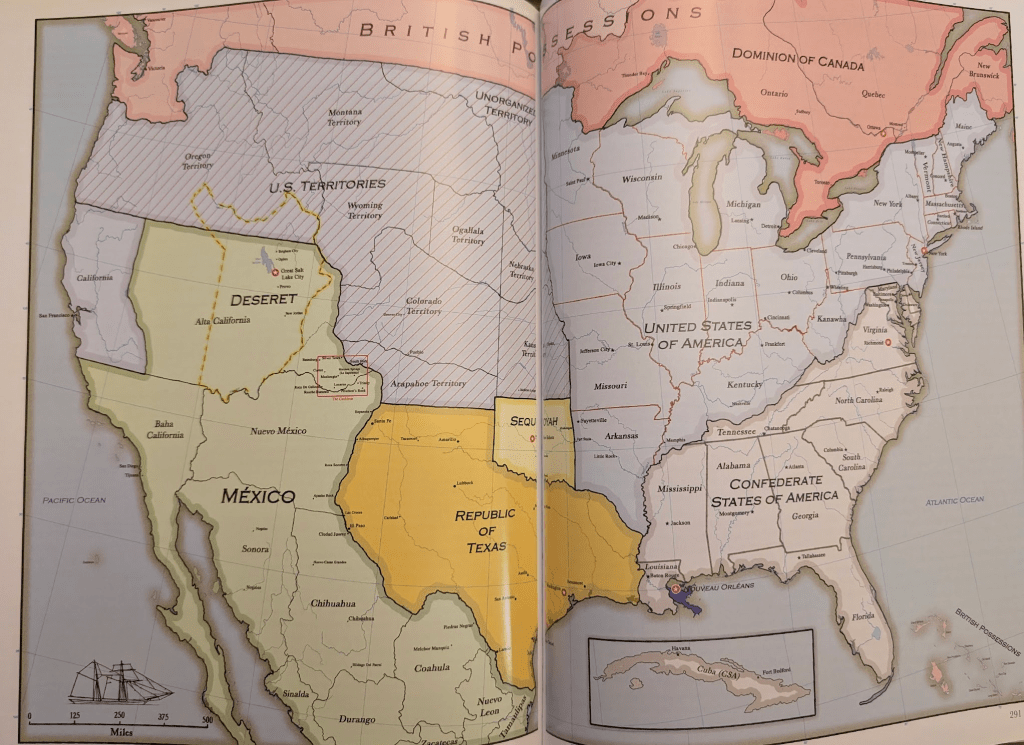
Not going to cover the detail here other than to say, using the setting isn’t required to play the game.
If you focus into the center western part of the map you will see a red rectangle which is the main setting area presented for playing in. This is an area referred to as The Cauldron. It sits at a rather lawless confluence of Mexica, Deseret, the US, Texas, and overlapping tribal territories. A place where a lot of people and groups people need to pass through.
The Cauldron is based explicitly on real terrain. The map pretty much matches the real west. The differences on on the towns.
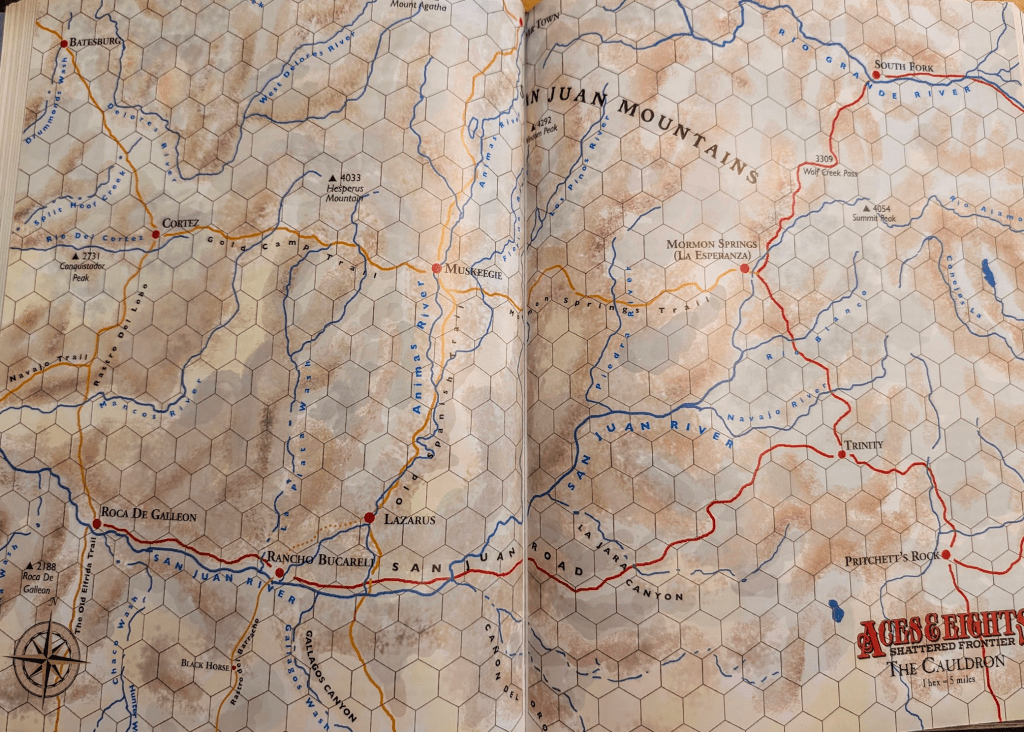
The fictional town of Muskeegee replaces the real town of Durango. The fictional town of Lazarus is (I think) analogous to La Plata. And, the fictional town of Black Horse doesn’t appear to have any historical analog, but does seem to be in an area currently given over to various mining activities.
Black Horse is given as a place a referee might make his, there is a map provided but few details. Lazarus is presented in fairly high detail in terms of both maps and NPC personages one might find there.
The Cauldron map covers 17,250 square miles,or thereabouts. So, it is a significantly smaller area than provided in the Boot Hill map. Near a quarter of the Boot Hill area. Yet still plenty of room for shenanigans.
But another map is provided in the cattle drive rules. This map covers a cattle drive between Silver Town on the north border of The Cauldron all the way to Fort Worth. The cattle drive map covers roughly 974,292 square miles which is over fourteen times greater area than the Boot Hill map. More than plenty of room for shenanigans. Like The Cauldron the cattle drive map is a mix of historical and fictional places, but the terrain is real.
Conclusions
Pick your poison.
If you want a steady diet of shootouts over a long period of game time with little improvisation needed, then Gunslinger is the game for you.
If you want maximum improvisation, among many detailed factions, then Boot Hill is the game for you.
If you want detailed simulation of life in the west, and in particular running a profession in a small western town, while also foraying out sometimes as prospectors or cattlemen, then Aces & Eights is the game for you.
Now, myself, I think something in between Boot Hill and Aces and Eights would be the sweet spot campaign-wise. I’d like more of game-play loop where randomized elements are included along with faction based play. There is something missing here in all three.
I’m not really discussing the combat rules in any of these games. But in general, Gunslinger presents a fun hex and counter card-driven wild west skirmish game, Boot Hill also presents a skirmish game with less detailed tactics that plays faster, Aces & Eights presents a hightly ideosyncratic (but kind of genius) game for split second showdowns with poor integration between brawling and shooting rules (though each have a crazy charm). All three are about the fighting. But, really, Gunslinger is about the skirmish, Boothill large faction sized skirmishes, and Aces & Eights more the individual shootout or very small skirmishes.
None of the three provide any mass combat options, so don’t look to them if you want to play out Little Big Horn.
All three are good games, with clear strengths and weaknesses, trying to present a very specific thing to players. In some ways they represent three different era of game design, but also (and may moreso) different philosophies of game deisgn. All worth taking a look at.

 Fluid -- Druid
Leave a comment