
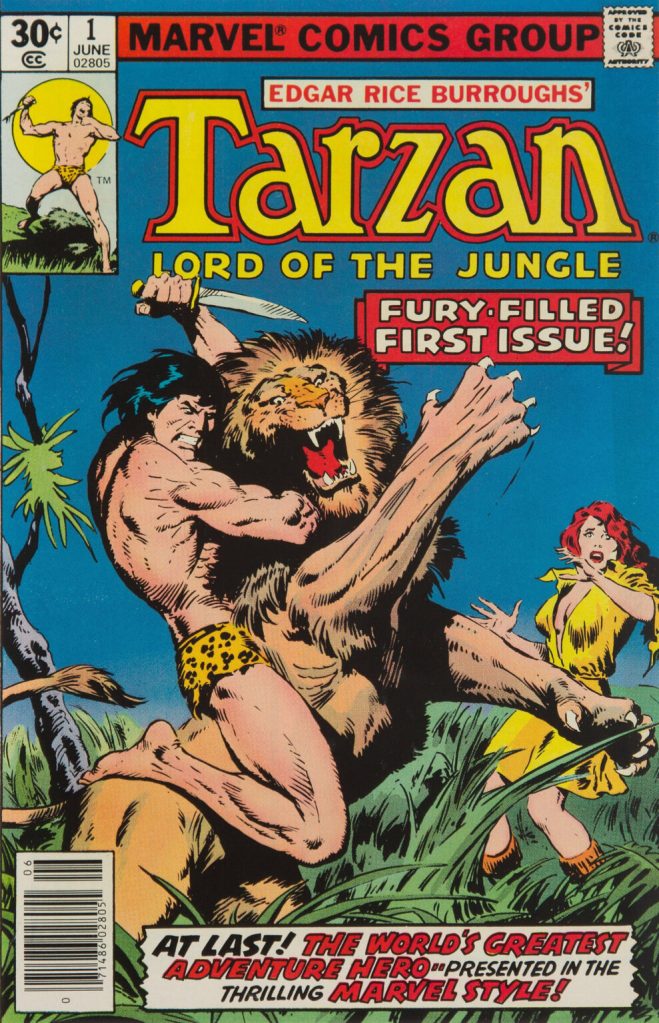
This post isn’t about gaming? Or, is it? Both Tarzan and Conan are present in Appendix N. Which sources one draws from Appendix N will influence one’s game. So there is that.
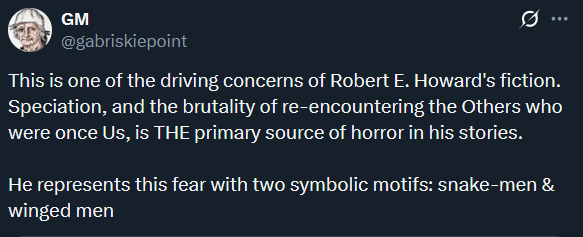
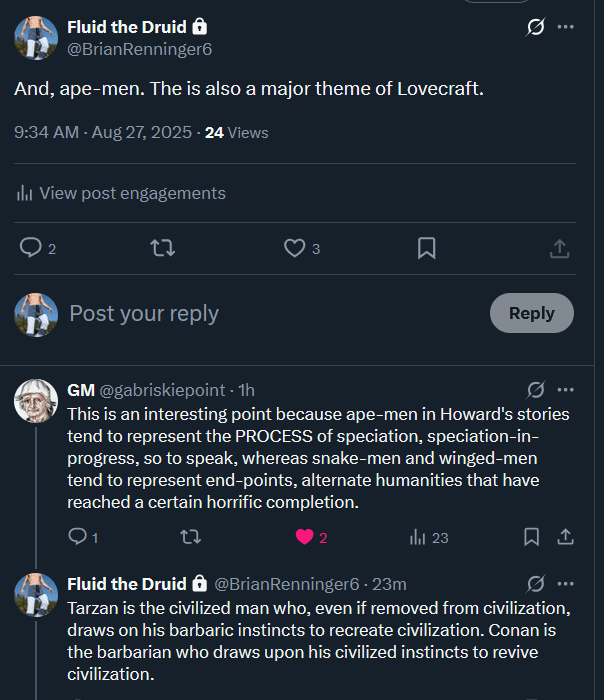
This post inspired what I write here.
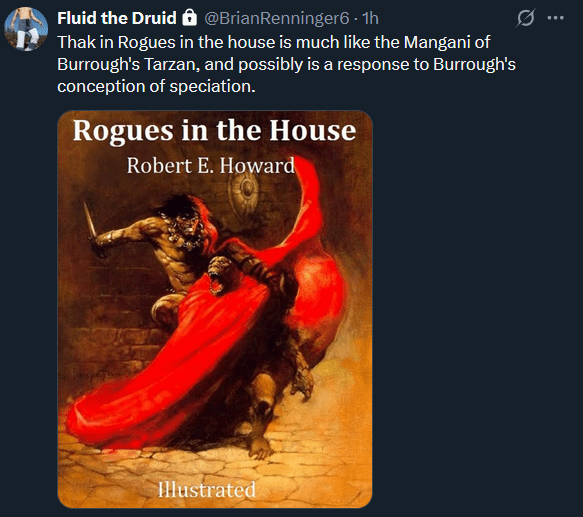
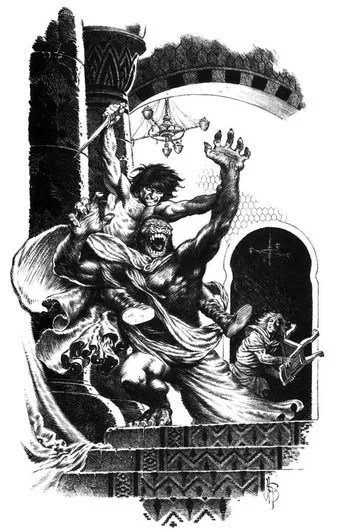
Tarzan was invented by Edgar rice Burroughs in 1912, in magazine form, then first published as a novel in 1914. Conan was invented by Robert E. Howard in 1932 and first (and mainly) published in magazines. I don’t know the history of Howard’s influences, but it seems unlikely to me that Howard would have been unaware of Tarzan (much like Kipling was skeptical that Burroughs was unaware of his own Mowgli). So, my assumption is that, even if not deliberate, Howard is writing to some degree in response to Tarzan. Certainly, Conan’s fight with Thak in Rogues in the House, could be looked on as a direct comment on the Ape-man concept of Tarzan.
On a superficial level, the two characters, Tarzan and Conan, bear quite a few similarities. Both are large, well-muscled, intelligent, physically accomplished. Given the descriptions by Burroughs and Howard, the main physical difference is Conan has blue eyes, while Tarzan has gray eyes. The interesting thing about this, is that blue eyes are due to less melanin than browner eyes. Gray eyes, are due to a similar lack of melanin, but with the addition of collagen deposits which change the nature of light scattering when reflected. Blue eyes are mostly found in Northwest Europe. Gray eyes are mostly found in parts of Algeria, Middle East, Central Asia, and South Asia. Perhaps, more importantly, the Greek goddess Athena has gray eyes. Athena being associated with wisdom, warfare, and crafts. So, Conan’s blue eyes connects him to the British Celts and Scandinavians, while Tarzan’s gray eyes connects him to the ancient Greeks, Athena symbolically, but also I suspect to the path Alexander the Great travelled through Asia.
The timelines of Conan and Tarzan are dramatically different. Tarzan draws from our distant past (Athena, Alexander) while exists in, what to Burroughs was, a contemporary setting, but in the uncivilized parts of a contemporary setting. Tarzan is man, raised feral, even beyond barbaric, animalistic, whose ancient civilized nature refuses to be battened down. Tarzan is a civilized man who draws upon his feral instincts to protect civilization. Conan, exists in a lost prehistoric setting, even more ancient than ancient, a barbarian, whose (perhaps genetic, or through race memory) influences future existing races of people of Howard’s time (to Howard, the Celts and particularly the Irish). Conan is the barbarian who draws upon his civilized instincts to recreate a falling civilization.
Despite the stereotype of Conan being a barbarian in a loincloth, Conan clothes himself at every opportunity. Sure, he starts his career as a loincloth wearing thief. But he was young and poor. When he has the means he immediately sees the advantages of clothing, wearing armor, and, in his midlife piratical career, even style. Conversely, Tarzan generally wears clothes (as Lord Graystoke) and then reverts to the loincloth when times get tough. Tarzan dispenses with civilization under duress, Conan seeks out every advantage of civilization (armor, weapons, wealth), he can obtain.
Tarzan wanders, but is always going home to the jungle. Conan, conversely, never goes home, Conan seeks the next horizon.
In summary:
- Conan is the past, moving to the present. Tarzan is the present, moving to the past
- Conan draws upon the resources of civilization to win. Tarzan dispenses with civilization to win.
- Conan seeks clothing. Tarzan is confined by clothing.
- Tarzan often fights barbarians to preserve civilization. Conan (the barbarian) often fights the civilized (who fail to appreciate what they have) to preserve civilization.
- Tarzan wins by doing things the hard way (using only a knife, relying solely on physical prowess). Conan wins by seeking arms, armor, and allies (despite often being betrayed), in order to win.
- Conan is the noble savage. Tarzan is the savage noble.
Now, there are plenty of examples throughout the Tarzan books where he seeks allies. But when the chips are down, Tarzan relies on himself. So does Conan. But, Conan’s career is one of assembling and losing and reassembling bands of fighting men, right up to succeeding in becoming a king and ruling a country. Tarzan has temporary allies, but always wants to go home to the more comfortable (to him) jungle.
So, anyway, what does this have to do with gaming? Well, both characters are cited in Appendix N, and may well inform a player’s choices when they are running a character. And, in particular, how a player’s choices may be informed by alignment. People may be of different opinions here, but I’d set Conan at Neutral Good, and Tarzan at Chaotic Good. Why? Conan reverts to personal honor to do good. Tarzan reverts to the chaos of the jungle in order to do good. But, some might say, Conan was a thief, a pirate, a leader of bandit tribesmen? This is true, but Conan doesn’t stick long with his career as a thief. Conan wants more and at every step, he’s creating ever larger organizations he can lead. That is, Conan creates order wherever he goes. One might even go so far as to call it Lawful?
Despite, superficial appearances, Conan is something of an inversion of the character of Tarzan.

 Fluid -- Druid
Leave a comment