

On the old Twitter, it was recently asked what’s the best version of Call of Cthulhu. This led to a cascade of thoughts in me, as well as discussions with others about the game.
Before I get into that, I suppose I should set out a little bit of my bona fides. I was an early adopter. I ordered my copy of the first boxed set from a mail-in coupon in a gaming magazine in 1981. Since then, I’ve owned every edition but one. I’ve skipped seventh edition for several reasons, first nothing that was added seemed that necessary and overall it just seemed overproduced. I’m pretty sick of full color glossy paged RPGs. I wasn’t going to be seduced by some painted whore of a game just because she’d put on a new layer of makeup. You see, I’d been there and done that too many times already. You did see I said I’d owned every edition of the game but that one.
So, the best version. The answer is it doesn’t matter. They are all, with slight variations, the same game. So, yes, I’ve been seduced by new artwork and reorganizations before. Too many times really. I guess I like version 6 the best. But, really, if you are looking to get into the game, you can’t go very wrong with the recent re-release of the original boxed set.
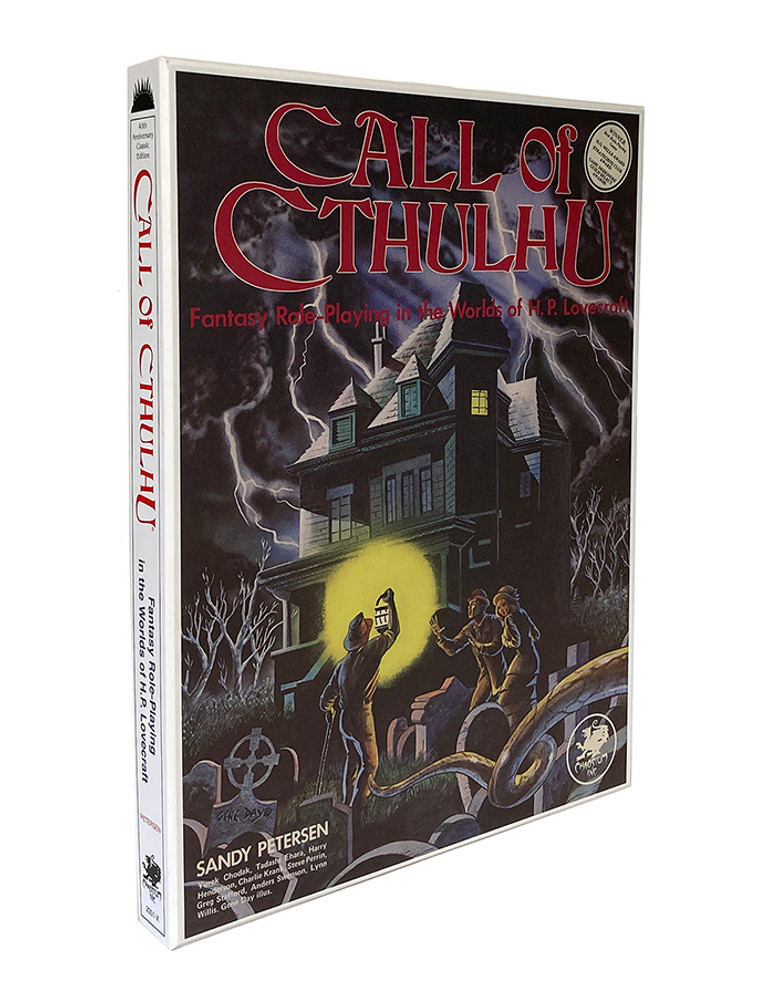
It’s got that great Gene Day (RIP) cover. All the basic stuff is there. Roll some characters and get cracking. It’s got the rules, the 1920s sourcebook, the world map, the classic silhouette standees.
But, oh! There’s another option, the 2″ box. This has all the stuff of the 1″ box and also reprints of many of the classic modules. Let’s talk about those.
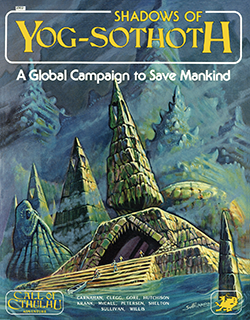
Shadows of Yog-sothoth. It’s great, but it’s a railroad of the worst sort. Annoying in this way at the time, and annoying today. A railroad, only outdone by the (not included here) Fungi from Yuggoth campaign book. Also, wonderful Tom Sullivan (of Evil Dead fame) art.

Of the original run of modules, The Asylum & Other Tales is my favorite, Seven unconnected scenarios, that aren’t railroads, they just present a situation. Perfect. And, if taken as illustrative instruction, these scenarios present a variety of circumstances that show how a referee might handle similar sorts of situations. Again, evocative Tom Sullivan art. That cover is my all-time favorite of any Call of Cthulhu rpg art. This one hits things out of the park.
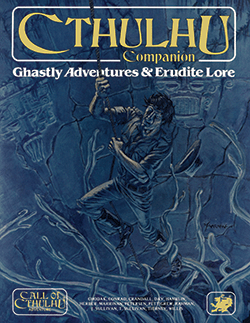
The Cthulhu Companion isn’t really a needed book, but it still has some fun stuff in it. It’s an odd mixture of useful background information, new rules, game aids, and a few scenarios. If you get the 2″ box, it’ll be in there. Read it, have fun with it. But, it’s something of a dog’s breakfast as a book.
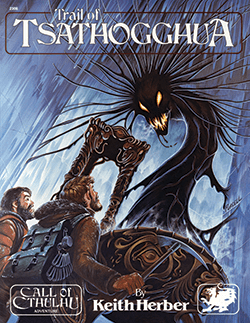
I can’t comment much on Trail of Tsathoggua. I had it back in the day, read it, but never ran it. I think it could be fun, and I think I’d be better at running it today than I was back then. Also, of note for the reprint version, the last page has a moving tribute to artist Gene Day by his younger brother David Day. Did you know Gene Day was colorblind? I didn’t, but maybe that helps explain his superlative use of black and white and negative space.
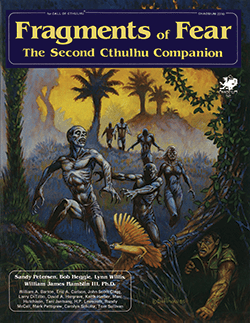
Like the first companion, Fragments of Fear lives up to its name. It features a couple of scenarios, a list of spells, stats for some normal animals, and other potentially useful information. I can’t say I really did much with it. The animal stats are useful in helping complete the game. And, it has the best rendition of the flying polyp ever drawn, by none other than the great Tom Sullivan.
But back to that “helping to complete the game” comment. Here’s the thing with the Call of Cthulhu RPG, it’s not complete. At least that’s my opinion. Now, this is not anything unusual, many (arguably most) RPGs are incomplete. It’s this nature of being unfinished that kept me buying each new editions. Hope springs eternal. But, like Sandy, I’m getting old. It isn’t going to be done by Sandy. If his Twitter account is any indication, he both sees no need nor has any inclination to do that work. Nor, do I have any hope that the people (whomever they may be) that currently make up Chaosium would find it to be in their interest to do so. Filthy lucre corrupts. Note that the incomplete games sold to me over and over when a complete game would need no new versions.
So it’s up to me to complete it, if anyone will. Don’t expect anything soon. But, this is a place to put down some thoughts in that direction.
For me, a complete RPG has a feedback loop that generates new adventures, content, and scenarios. Dungeons and Dragons, through first edition AD&D has this. I’ve said it before, and I’ll say it again here that the 1e DMG Appendices A, B, C, along with the wilderness travel rules (p.47-49), make that complete loop and are the real game within AD&D rather than the d20 combat mechanic. In essence, Appendix B generates territory, the wilderness rules allow movement through that territory, Appendix C governs meeting things within that territory, and Appendix A creates dungeons for the ruins and tombs and alike that are generated with Appendix B.
- Makes village and its environs (Appendix B)
- Players move from village to environs (wilderness rules)
- Players meet monsters/allies along the way (Appendix C)
- Eventually a dungeon is found (Appendix A)
- Loot is gathered (Appendix A)
- Surviving players return to the village (assuming they survive whatever they meet on the way back (Appendix C). Get XP. Buy stuff with gp.
- Return to step 2.
In its basic form, this is the gameplay loop of Dungeons and Dragons. With this, the game can be played forever. No modules or other information needs other than what is provided in the three main rule books.
What would a similar loop look like for Call of Cthulhu? It would need:
- A world, or at least a place. Now, the game is already set on earth in the 1920s. There are almanacs and similar for the time. Appendix B equivalent isn’t fully needed. We can also use the places described in Lovecraft’s (and others’) fiction and place them in that 1920s world where they were. But do we want to slavishly copy Lovecraft, or would we prefer to create new eldritch places that mimic Lovecraft? If your players have read Lovecraft, there wouldn’t be much of a surprise finding R’lyeh would there be? So, ideally, we at least need the world map already in that boxed set. And, we’d need a method for generating the typical places found in Lovecraft’s fiction: mysterious lost cities in unexpected places, libraries with mysterious tomes, the tomes themselves, the spells within the tomes.
- The gods/aliens, the factions with the gods/aliens, their servitor races, their minions, and their followers. Now there are problems here. For one, Lovecraftian gods are inscrutable to the mere minds of men. How do we define similar and set them against one another. Well, let’s not overcomplicate things. In D&D, the players may randomly run across a band of orcs, where those orcs are going and why, who knows? All we need to know is they are there, there are going over that way, and when they get there maybe they want to do/find X for reasons not known to the players. A similar approach can be taken here. The gods are inscrutable. But, their cultists, less so. From normal peopl => Cultist => Servitors => Deity => alliance/conflict between deities. The farther up that chain, the less detail is necessary and perhaps impossible for players to know. Googoomuck is at odds with Rastagrad for some reason, Googoomuck’s servitor beings want to open a gate so Googoomuck can attack Rastagrad, the servitors tell the cultists to perform Ritual A, which needs B, C,D before it can be completed, the cultists work toward these ends because they think they will be rewarded in some way (or are indeed rewarded), the Cultists deal heroin to fund their eldritch activities, the normal person is a junky who likes the smack, the Police Officer player character interacts with the junky and starts working up the chain. It can be that some links in the chain are missing. For example, there could be no deity, just a monster, the monster interacts with NPCs, who bring the interaction to the player’s notice. In that case, there is still the movement from understandable (normal people) to inscrutable (monster). In some ways, this is a bidirectional path. The characters move from normal to inscrutable while also, in terms of information, from general to specific. In the Lovecraftian mode, the closer one gets to the inscrutable, that this the more information that one amasses about the inscrutable, the more specific knowledge of the revealed “real world” is gained, the more likely one can’t handle it and goes, well, insane.
- Player characters will move about the world gathering resources or expending resources in their efforts to move up the chain. Why move up the chain, though, if it always ends in insanity and death? Why indeed. The world of Lovecraft is, ultimately, in human terms a nihilist world. But that doesn’t mean the characters or the players need to be so. In Lovecraft’s fiction, it’s often by accident a character stumbles across something and then curiosity killed the cat. It may be though, we want some random method to define what drives a character. Gold and XP isn’t what does it in Call of Cthulhu. Perhaps the character is a theosophist and really wants to find those hidden masters, perhaps the character is a cop driven by a sense of justice, perhaps he’s a scholar who wants to translate rare works, perhaps (Mr. Jones) he’s an archeologist who wants to put things in museums. Ideally, there may be professions and driving passions associated with those professions. The nature of the passion will help, dare I say it, role play, but also help determine just how far up the chain they are willing to go. Eventually most characters, for sanity’s sake, will drop out someplace other than the top of the chain. Once that cop captures the murdering cultists perhaps that character is quite satisfied. Whereas the scholar may continue farther up by reading the books found in the cultist lair. Upshot here is I think a random assignment is better than a player picked passion. It is a role playing game and players need to branch out and work with what they have.
- Encounters along the way of potential allies and enemies. These need to be randomized so that the referee does not have to memorize a bunch of stuff. These needs to be who they are, what they do, what’s their social connection, what (if any) connection do they have related to the central chain of inquiry.
- So, that’s a few things off the top of my head. And they need to be set up so that they iterate in time. We are not limited to a single chain. In fact each deity/alien likely has their own chain which intersects with the other chains in variouos way.
- And it has to iterate. The cycle of finding a thread and pulling on it should resemble the D&D iteration. The threads generated on the go, then at different points, the players decide to pull on another thread and off they go again.
That’s a very rough outline. But, I think if, just as with D&D, once started in a confined area (ahem, Arkham or some such) then the local slowly works out into the greater world without having to define/generate it all at once. With something like I describe here, perhaps we can get away from the famous Call of Cthulhu railroad and get more to a player directed and game generated Lovecraftian adventure. It may be that something akin to this has already been made.
I am tempted to suggest a Braunstein-like game where the culitsts and god-aliens as well as the players interact in a fog-of-war against one another. But, I’ve found in RPGs that players often balk at playing truly evil factions, and then the added inscrutability of Lovecraftian entities really complicates this. But, maybe for the cults with randomly generated goals, then a player might be able to work a cult leader position against the other players to some success without needed to understand why he wants the things he wants. I also suspect that the normal rules of learning spells, Cthulhu Mythos skills, and associated sanity losses may generate characters that eventually become beings akin to the cult leaders, etc. under the system I describe above. Like in D&D, not every character, but some characters may end up as domain leaders.
So anyway, that’s some thoughts on getting started with Call of Cthulhu and also where I think the game needs to go to become a complete game. Maybe I’ll get to work toward this end at some point. Though, I’m swamped with other projects for the time being.


 Fluid -- Druid
Leave a reply to Why RAW is important — Beyond just common sense – Fluid — Druid Cancel reply