
Call of the Wild RPG
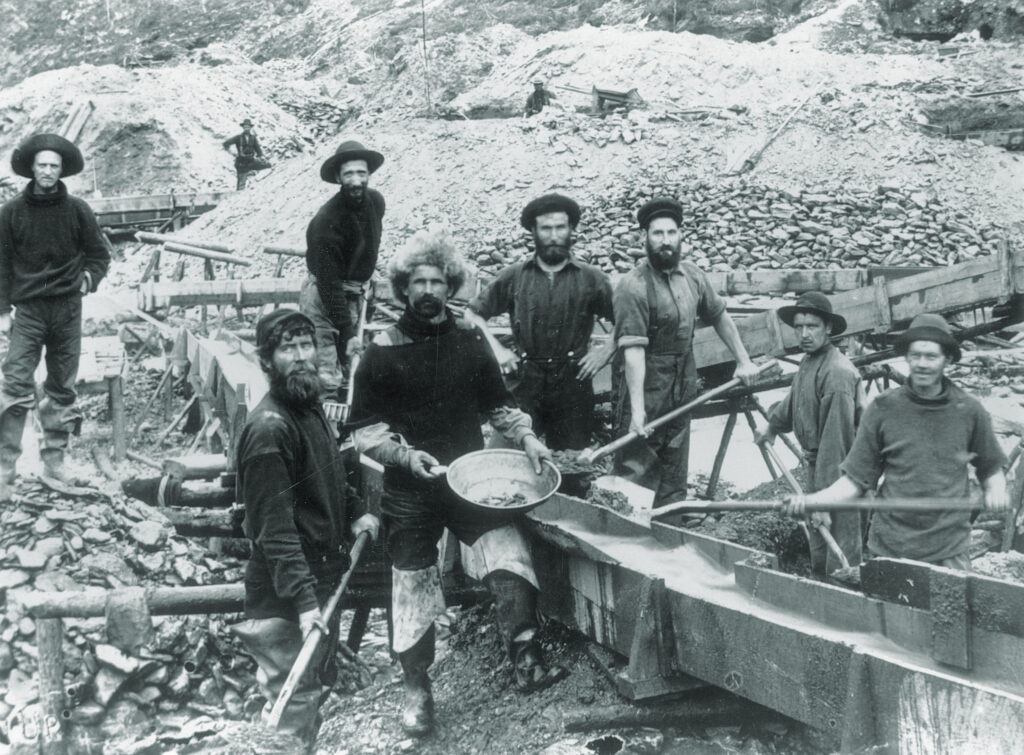
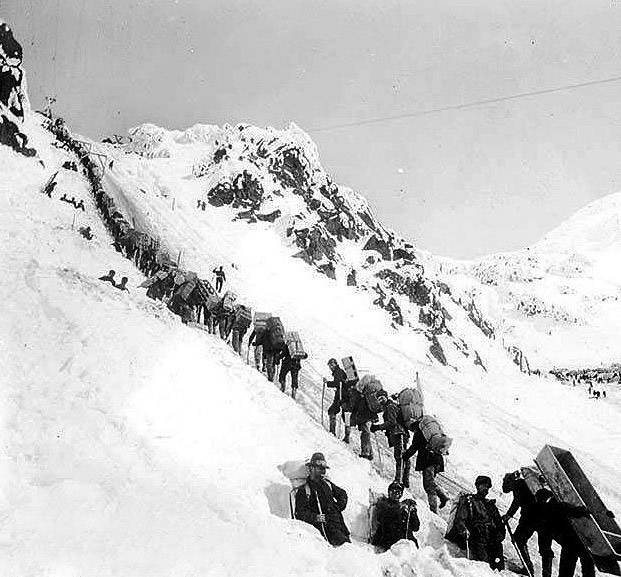
A few years ago, I started down the path of making a role-playing game about the Klondike and Alaskan gold rushes, tentatively titled Call of the Wild. I never finished it. Primarily because I came to the conclusion that I didn’t know how to make it fun. These gold rushes came at the very end of the wild west. And, well, it wasn’t so wild. There was only one major shootout in the period — the killing of Skagway crime boss Soapy Smith. Native relations with the prospectors, if not always friendly, did not result in picturesque raids and battles. Mostly, the history is one of braving the elements and partaking in the back-breaking physical labor of creating mining camps out of wilderness. And, of course, the mining itself. I just didn’t see players being interested in the minutia of trying to earn a buck in the wilderness. So, I gave up on the idea.
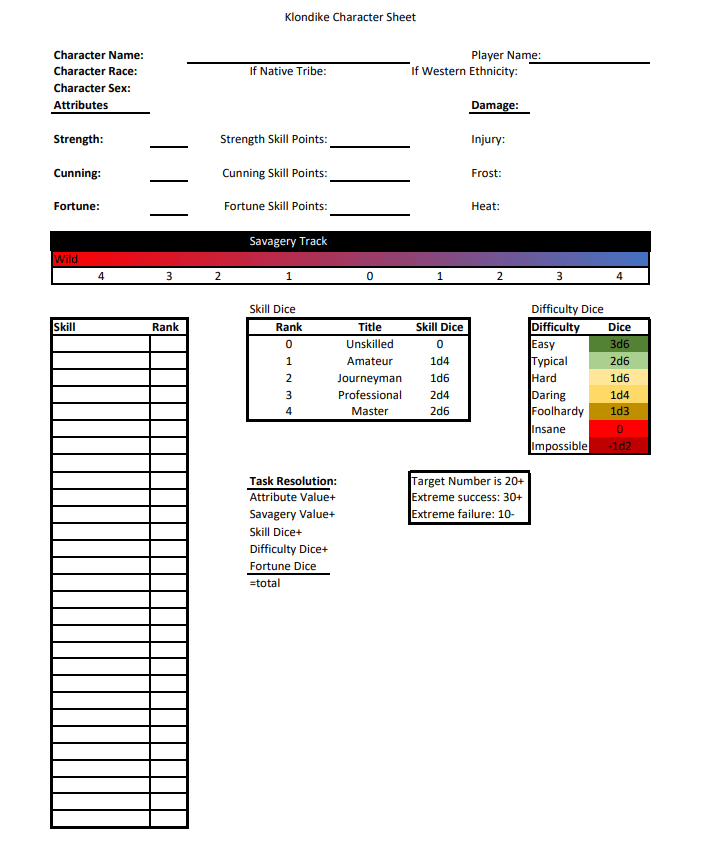
But, I recently went back and looked at what I’d drafted, and there is one part I liked pretty well. Which might be usefully used in other contexts. That being the Savagery Index. The Savagery scale is a continuum of nine points. On the left is four points toward the Wild and on the right, four points toward the Civilized with zero in the middle.

Generally speaking, the longer one spent in alone in the wilderness, the more one moved toward the Wild, the longer one spent in town (and around the opposite sex or children) the more one moved toward Civilized. Skills were then tagged as Civilized or Wild skills, where one stood on the Savagery Index, influenced one’s abilities with those skills.
Below are the rules I drafted. It’s not a complete game, but the bones are there. If you have ideas on whether it is worth pursuing farther or how to make such a game fun, It’d love to hear it.
Call of the Wild
Character Attributes
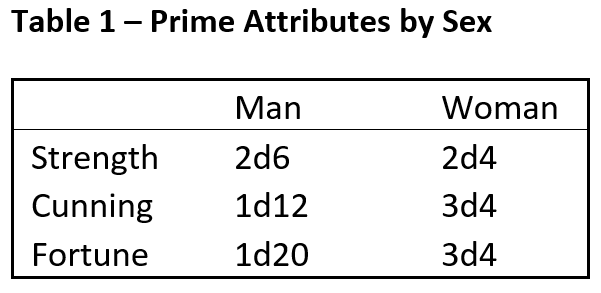
Each character has three Attributes. Attributes define the character’s natural abilities inherent in their being. The three attributes are: strength, cunning, and fortune. Characters can be one of either two sexes: male or female. Attributes may differ between the sexes or may not as defined in Table 1. When creating a character, a player chooses the sex of the character they want to play and rolls the dice indicated in Table 1 to define their characters attributes. If a character’s attributes sum to 13 or less, a player can choose to either keep the character or re-roll all attributes.
Strength
Strength represents several physical aspects of a character. Strength includes the abilities to lift weight, carry loads, general endurance, health, constitution, survive injuries, and even mental toughness. Strength is a measure of the characters grit in tough situations and should be turned to whenever a character wants to influence a physical object or resist a physical object. But, Strength can also be turned to when attempting a task that takes long-term concentration or resisting attempt to mentally dominate or wear down a person. For example, strength, is the attribute to turn to when resisting the ravages of cabin fever, snow blindness, or an attempt of another character or NPC to intimidate a character. In the sad event of violence breaking out, Strength is the attribute to use for boxing, wrestling, kicking, biting, and the use of weapons such as knives, axes, and clubs.
Cunning
Cunning represents several mental aspects of a character. Cunning includes general intelligence, wittiness, language skill, ability to learn mental skills (e.g. mathematics), and trickery. Note that cunning does not represent the kind of mental toughness described under Strength. For example, cunning, could be used to accurately survey the boundary of a mining claim, or to convince the camp meeting to expel a disruptive conman. But, cunning, would not be used to resist someone trying to intimidate a character or discourage a character. In the sad event of violence breaking out, Cunning is the attribute to use when firing firearms, shooting bows, throwing harpoons or throwing rocks.
Fortune
Fortune represents the luck of the character. Fortune is rolled once when making a character and can decrease or increase as the game progresses. Fortune is used to influence task resolution or another character’s task resolution. Fortune also is used in initial acquiring of skills.
Savagery
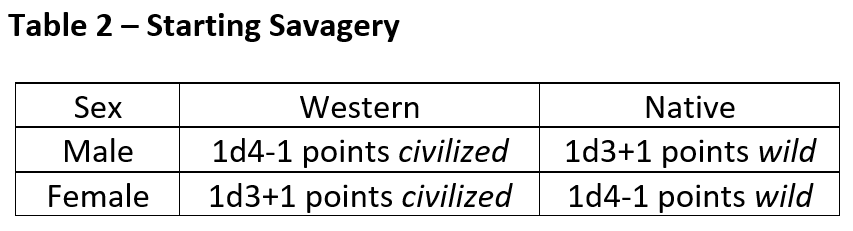
Each character has a secondary attribute, savagery. Savagery is a measure of how domesticated a character happens to be at any time. Savagery is a continuum, with wild on one end and civilized on the other. Savagery cannot be influenced by skill points or experience. There are only three things that affect a character’s savagery: 1) initially a character’s race; 2) the length of time spent in town or in the wilderness; and 3) the sex of a character or time spent with female characters (or children). Savagery will be discussed more under skills but starting savagery is determined from the following table.
Skills
Skills represented the acquired ability of a character to carry out tasks or accomplish goals.
Starting Skills
Characters get skill points equal to their attribute values to acquire skills. One rank of skill can be purchased for each point spent. Each rank must be purchased separately. Thus, to purchase a rank 2 skill cost three points (one point for rank 1 and two points for rank 2). Table 2 shows the Rank of Skills available. The maximum rank of any skill is four. Strength skill points can only be spent on Strength skills. Cunning skill points can only be spent on Cunning skills. Fortune skill points can be spent on any skill. However, skill bought using fortune subtract from the attribute. A player must spend a least half of their skill points during character creation. Any remainder skill points can be saved for use to acquire skills during play. Once skill points are spent that cannot be regained.
Native characters may buy western skills at twice the cost. Native characters may not buy education skills. Western characters may buy native skills and education skills at twice the cost.
For example, Yukon Bob has rolled a Strength of 7, Cunning 10, and Fortune 3. The player chooses to spend strength skill points on: boxing (amateur 1, costing 1 point) and logging (professional 3, costing 6 points). The player then chooses to spend Cunning skill points on: prospecting (professional 3, costing 6 points) and mining (Journeyman 2, costing 3 points), and a save the remaining cunning skill point for play. Finally, the player chooses also to save his three Fortune skill points for play.
Skill Ranks
For each skill rank, there is an associated skill die to be used in Task Resolution as shown in Table 3.

Apart from tasks that require education-based skills, all skills may be used by a character at Rank 0. If a task requires an education-based skill and a character does not possess that skill, then the task may not be attempted.
Tasks
Tasks are any well-defined goal a player would like their character to accomplish. Tasks must also entail some risk of failing and the natural consequences that come with failure. For example, no task roll is required for walking down the street but, a task roll may be required for walking along a narrow icy trail on a cliff edge where a dangerous fall is possible. No task roll would be needed for shuffling cards but, a task is needed for an elaborate shuffle that impresses the other card players or puts a needed card on the bottom of the deck.
When a character attempts a task for which the outcome is uncertain, the Player suggests:
- The appropriate skill to use
- The difficulty of the task
- The amount of time the task will take to complete
After hearing the Player suggestion, the GM rules on the skill, difficulty, and time. The GM is encouraged to interpret skills broadly. If a player can make a reasonable argument as to why a skill might apply, then the GM should grant it. Though, if a skill appears only tangentially relevant, the GM may choose to allow the skill to be used at an increased difficulty or an increased amount of time or both.
For example, let us say a character wants to build a log cabin but, does not have carpentry skill. The Player might argue that their character’s logging skill is relevant. The GM might allow the use of logging at either an increased difficulty level or increased time or both depending on the situation.
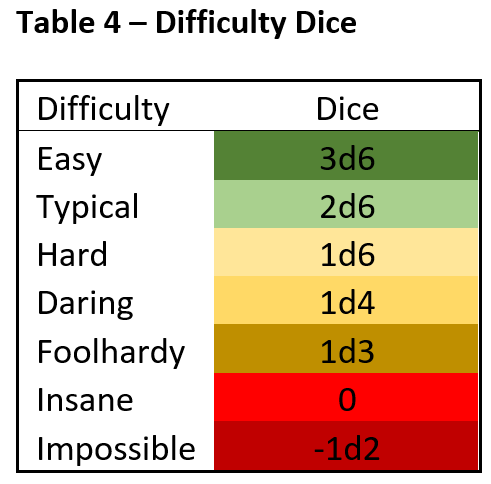
The level of difficulty of a task defines task related dice. Table 4 shows the dice allotted to each difficultly level.
Task Resolution
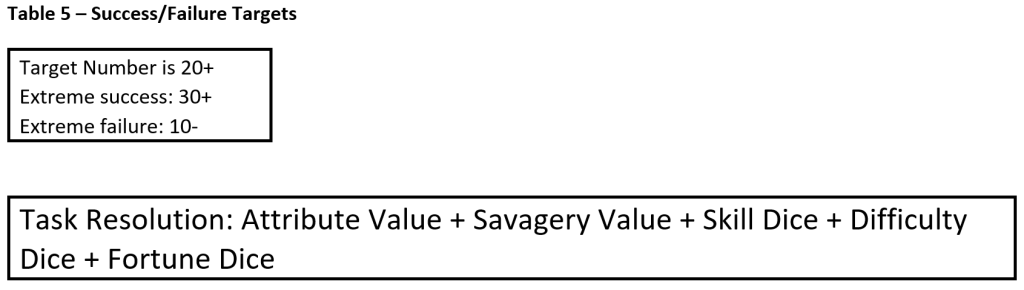
Tasks are resolved by rolling dice, summing the rolled dice, and comparing the result to a success target of 20 or greater. Rolling a 30 or greater is an extreme success and rolling a 10 or less is an extreme failure. It is up to the GM to define the nature of an extreme success or an extreme failure.
GM authority in defining the meaning of “extreme” is unlimited. However, GMs are encouraged to choose less numerical extremes than situational outcomes. For example, a player is running a sluice box and makes a Task Resolution attempt for the Mining skill to determine how much gold is recovered. The player rolls a 7 which is an extreme failure. Rather than merely limiting the amount of gold recovered, a GM might choose to have the sluice flood the characters camp or engulf the character in mud instead.
Fortune Dice. For any task a player may choose to subtract one from their Fortune attribute to add 1d6 to a Task Resolution roll. A character’s Fortune may be spent down to zero. If a character has no remaining Fortune, then no Fortune Dice may be rolled. For each extreme success rolled a player may add one to a character’s Fortune attribute but, only for extreme successes rolled when no Fortune Dice were rolled. For each extreme failure rolled a player must subtract one from their character’s Fortune.
A player may choose to spend one Fortune point to roll 1d6 to add or subtract from another character’s or NPC’s Task Resolution roll. For any Task Resolution roll, only one point of Fortune may be spent to change the roll. The player must describe how they are helping or interfering. An opposed character or NPC (at the GM’s discretion) may elect to spend a single available Fortune point to counter opposing Fortune but, in no case may a character or NPC roll more than a single Fortune Die during a Task Resolution Roll. It is up to the GM discretion to determine how many characters may aid or interfere in a task.
Savagery
These points will be modifiers to skill rolls depending on skill type. Civilized skills (blue) get modified how civilized a character is. Wild skills (red) get modified by how wild a character is. Each month spent in or near town increases the points toward civilized up to a max four. Each month spent out of town drops the points toward wild up to a max four. For men each week spent in the wild without woman (or children) drops a point toward wild. For men each week spent in a town with woman (or children) adds a point toward civilized. Mixed groups of men and women in the wilderness do not change savagery. Children alone in the wilderness lose one point per day. Women always gain or lose savagery monthly. Savagery is neither gained nor lost when traveling by ship unless a storm is experienced – drop Savagery by one point for each storm experienced during a voyage.
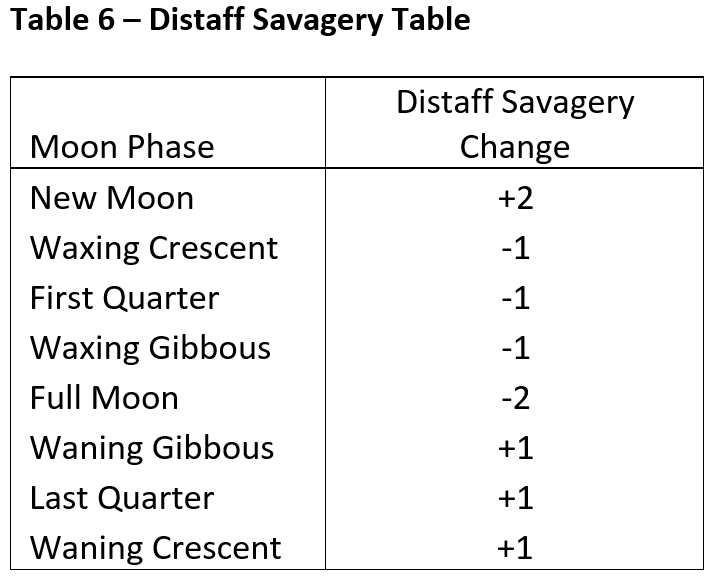
For women characters, they lose points and gain points on the savagery scale according to the phases of the moon. Women in the wild without men lost one point per two weeks.
Opposed Tasks
When characters or NPCs act in opposition to one another it is an opposed task. Each character makes a task resolution roll and the greater roll wins the task. Normally, no difficulty element is incorporated into these rolls. However, the GM may choose to add a difficulty element in which case the greater roll that succeeds in the task wins. If tied, roll again until a winner is determined.
For example, two characters may be participating in a tug-of-war. In this case, the task is in direct conflict and no difficulty element is needed to resolve the task. If the contest were between two loggers competing in tree climbing, the GM may assign a difficulty to the tree climb in which case it is possible for both characters to fail the task.
Tools
Some tasks require tools to accomplish. The GM may rule that some tasks may not be attempted without a needed tool. In general, having tools modifies the difficulty of the task per GM ruling. For example, without some tool, felling a large tree may not be possible at all but, with an hatchet the difficulty may be Daring, with an axe Hard, with a saw Typical, with a herring Insane.
Another effect of tools is the length of time to complete a task. It is up to the GM to determine how long a task with normal effort may take. The GM should consider the tools used an make an assessment of the length of the task based on the tool type and quality. Once the difficulty level and time needed is assessed by the GM, the player may choose to decrease the time needed by proposing a greater difficulty. However, should the task resolution result in a failing task, the GM then gets to assess the consequences. This might be a damaged or broken tool, some detrimental effect on the task itself, and potentially, depending on the circumstance, injury to a character or bystanders.
Skill Notes:
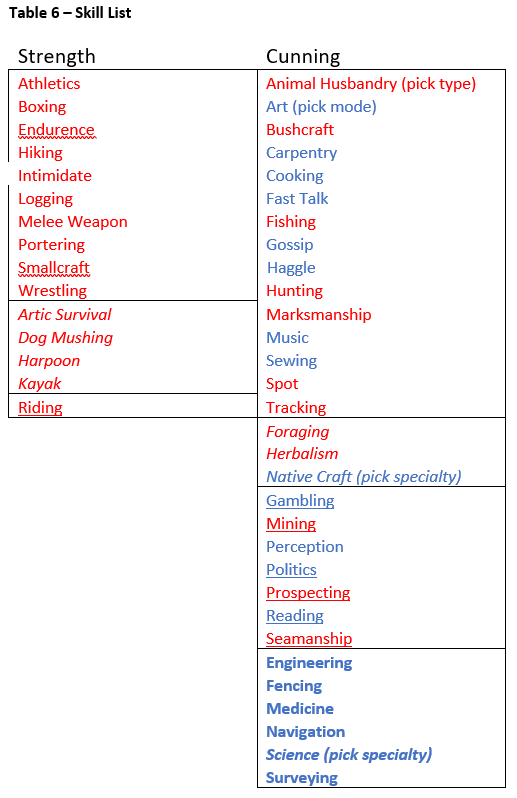
Blue are Civilized skills
Red are Wild skills
Italics are Native skills
Underlined are Western skills
Bold are Education skills.
So, there it is, a false start. Not every idea always comes to fruition. But looking at it now. I think there is some useful ideas there, that might lead to something in other contexts.

 Fluid -- Druid
Leave a comment