
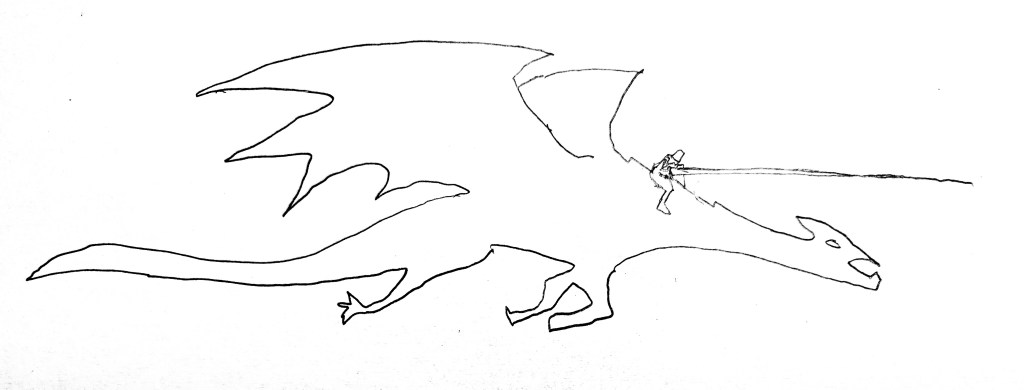
I cover unarmed combat for dragons here. Jousting with dragons here. There is still a bit more information to cover when jousting with dragons.
First there is the lance. Given the ratio of neck to body of a dragon, the lances used in dragon jousting are specialized instruments quite a bit different from those used on horseback. The lance must necessarily be quite a lot longer than a horseback lance. But, long lances rapidly become heavy and unwieldy. So, to make it usable, the Drachenlanze is rather spindly and flexible in comparison to the horse lance. The Drachenlanze is more akin to a footman’s pike, though a bit longer even and heavier.
The result of this is that the Drachenlanze may not be used on foot, it is far too heavy and awkward to make a melee weapon.

The damage of the Drachenlanze, is relatively small but is based on the closing velocity of the hit. Example 1, two dragons (size L) approach one another head-on each flying at a speed of 24″, closing velocity is the sum of both speeds (48″); divided by three results in lance hits doing 16d4. Example 2, a dragon flying at 24″ attacks a pseudo-dragon (size S) on its broadside, closing velocity is 24″; divided by three results in 8d2 damage.
Dragons come in a wide variety of ages and sizes. Not all are well suited for jousting. The young may not be capable of carrying riders. The very large may result in the Drachenlanze being too short to be effective. The table shows which dragons are suitable for riding, by whom, and for what purpose.
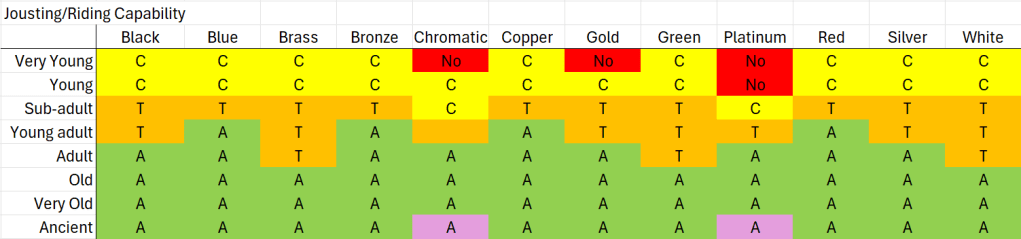
- Red indicates the dragon is too small to carry riders
- Yellow indicates that children may be carried at full speed, teens may be carried at 3/4 speed.
- Orange indicates the teens may be carried at full speed, adults may be carried at 3/4 speeed.
- Green indicates that any (M humanoid) rider may be carried at full speed.
- Purple indicates that riders of any (M humanoid) maturity may be carried, but has grown beyond the size of practical use of the Drachenlanze.
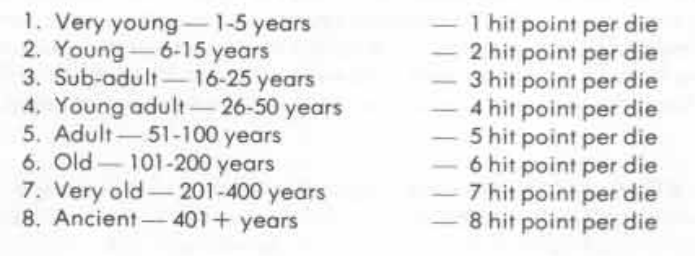
Given that most dragons are not able to carry adults until they are also adults, one can see that it is a long term project to raise and train a dragon from the egg to be ridden. Most dragon riders will be children and teens. A dragon might go through a couple generations of teenagers before it is ready to carry and adult rider. As such, it can be seen that the combination of the rarity of dragons combined with the rarity of patience to train a dragon for jousting means that special circumstances will be needed to have any significant concentration of dragon jousters.


 Fluid -- Druid
Leave a reply to Dragons in the Dungeon: will they fit? – Fluid — Druid Cancel reply