
In my previous post of unarmed combat in AD&D, I discussed the basic mechanisms and gave an example of pummeling. Here is an example regarding grappling human versus ogre.
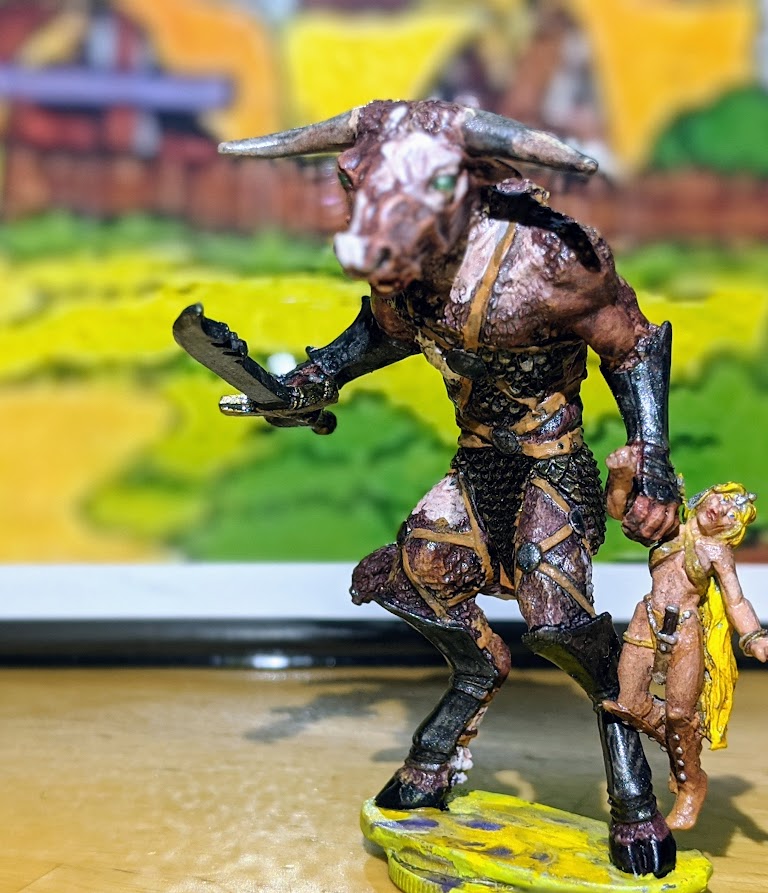
A few years ago, when I was running the Trollopulous Campaign, we had an incident where a human fighter decided to attempt to grapple an ogre. This turned out to be misguided, given the rules for grappling. But there were questions related to those rules. Like with pummeling, grappling has a success roll and, if successful, an effect roll.

The base chance of success is AC x 10 then modified by various factors. So, AC. This really means not the armor class modified by dexterity, but the class of the armor. For example, leather armor is AC8 but a thief wearing such armor with a dexterity modifier of -4 lowers it to AC 4. It stands to reason that dexterity doesn’t hurt one’s chances to wrestle. But what is an Ogre’s dexterity? And, what does an ogre’s armor class represent? Well, a DM has to use judgment. But there are clues. The general stereotype of ogres does not portray them as ballet dancers. So, my take is to treat ogres as dexterity of eleven — an average 3d6 roll. Arguably, one might choose a lower value because Ogres are often portrayed as klutzes or awkward.
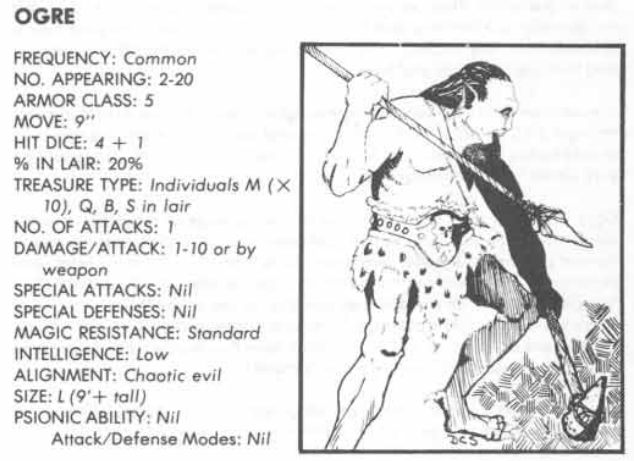
An ogres armor class is five. Now, AC represents a variety of factors, including dexterity and, well, armor, but for monsters it could mean thick skin, magical hardness, scales, whatever. From the picture of the ogre in the Monster Manual, the ogre looks to be dressed in minimal skins. AC 5 normally represents chain mail. Is an ogres skin flexible but hard as linked steel? Possibly. My take is either one chooses unarmored (the picture) or one chooses that an ogres toughened nature restricts his movements and interferes with his grappling. I chose the latter, this is at least consistent with the awkward stereotype of ogres.
For the human, I want to maximize his advantages. So, I assumed unarmored and dexterity of 18.
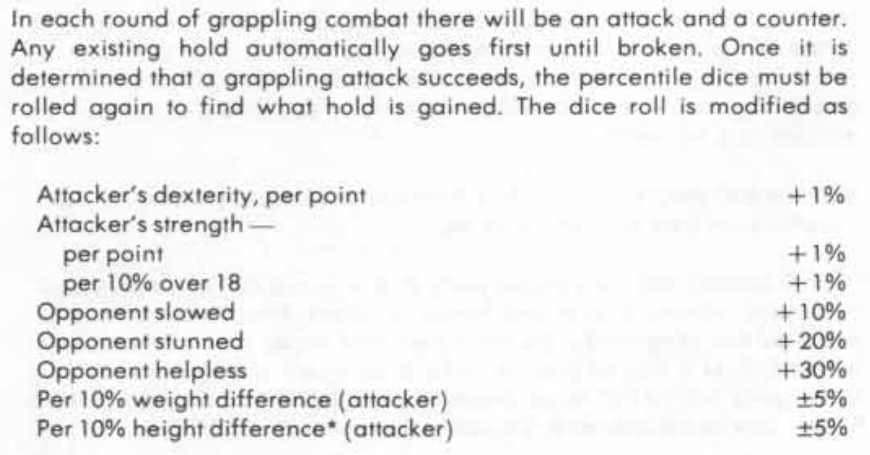
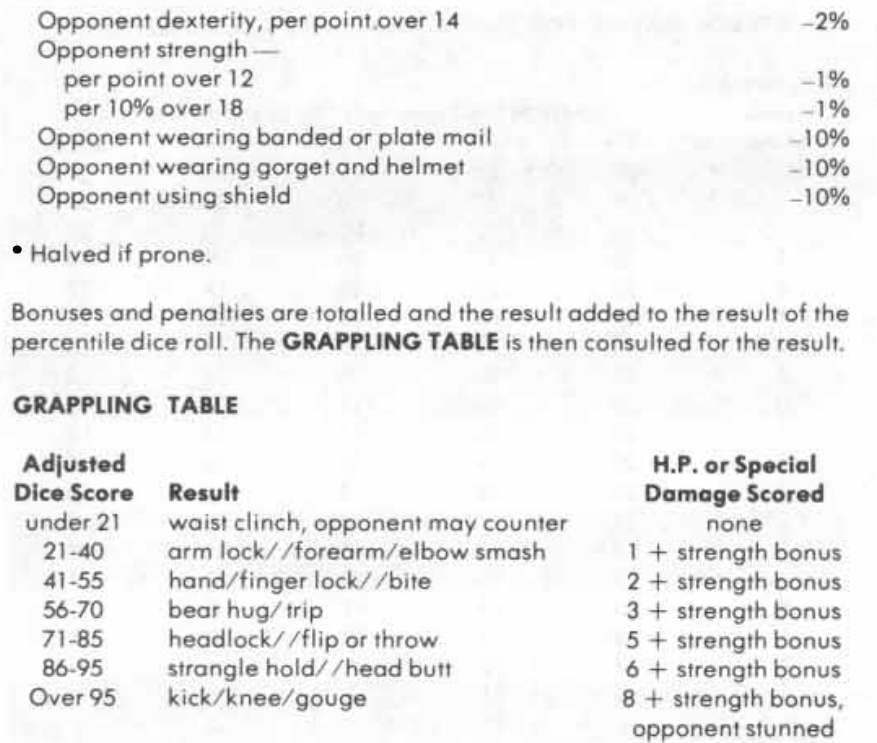
Given a success, there is the effect roll, which is just a modified percentile roll. The modifiers are based on attacker’s dexterity, attacker’s strength, attacker’s difference in weight and height, defender’s dexterity and strength. Note for the defender, only exceptional dexterity counts.
Like with the success roll, this raises questions. We’ve already discussed an ogre’s dexterity, but what about strength, height, and weight? The Monster Manual description does not help. But, the Dungeon Masters Guide has the magic item Gauntlets of Ogre Power which sets the wearer’s strength to 18/00. So, ogres are 18/00 strength. I’ve previously written about monster height and weight here. There are other ways to estimate such things but I am going to try to be consistent with what I’ve come up with before. So, height and weight using the table from my previous post.
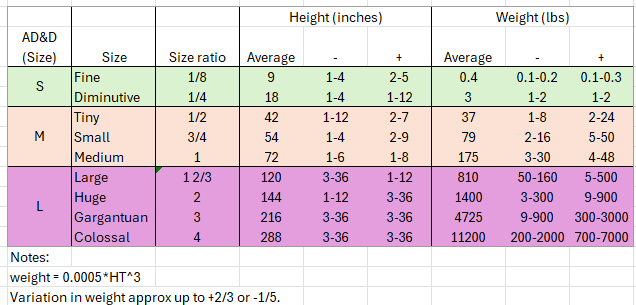
The Monster Manual lists ogres as 9+ feet. A hill giant is 10.5 feet or about. Both are in the Large category. My choice was to treat ogres as near the low end of the large category. So, at minimum 108 inches tall, 650 pounds. 650 pounds is roughly that of a small grizzly bear, or a large black bear, or a Siberian tiger.
The human, again I’ll try to maximize their advantages, so also 18/00 strength. Using the human height and weight tables, maximum height is 82 inches, maximum weight is 235 pounds. It all sums up to the graphic below. I’ve calculated the Base Success rates and effect modifiers.
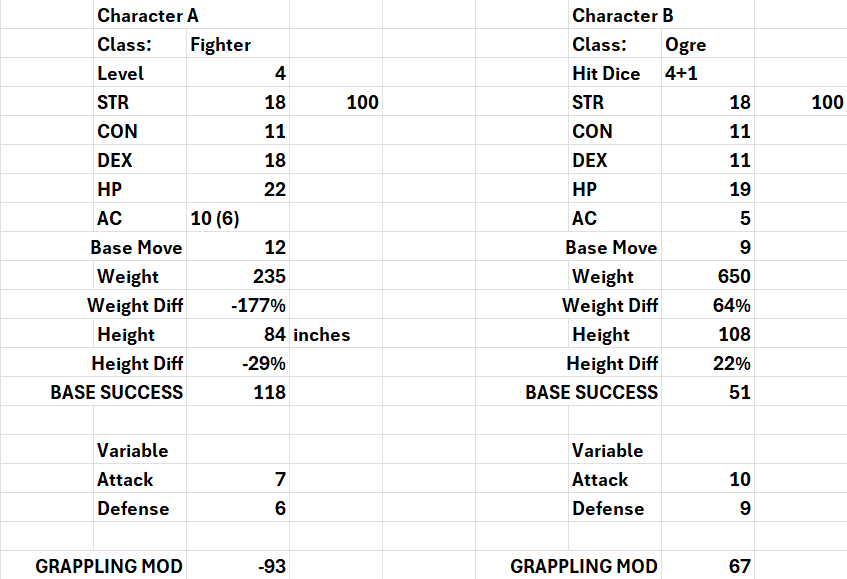
A note in calculating the weight and height differences. The Dungeon Master’s Guide assumes one knows how to do this. But, really, it is ambiguous. It does say Attacker’s weight and height difference, so I choose to do this in comparison to the attacker’s parameters. So, these percentages will be different for each participant despite their differences remaining constant. For example, the percentage difference when the human is grappling is -177% (235-650)/235. I also chose to round to the nearest ten percent, rather than truncating to any completed ten percent. So, for the human, the weight difference results in a -90% to the effect roll. Conversely, for the attacking ogre the weight difference is +64% which in the end results in a modifier of +30%.
There is a thing to note about the base success calculation. Two unarmored opponents of AC10+dexterity mods, meaning in a classic unarmored wrestling bout, both characters will have a base of greater than 100 percent — you might as well just proceed to the effect roll. Unless the opponent is a Monk. Monk’s movement speed starts at 15″ and goes up by level. The monk class has an automatic advantage over other classes when grappling, since one subtracts 10 percent off an opponent’s success roll for every 3″ of movement faster. When characters are armored, the armor both makes them easier to grapple, and slows them so it is also harder for them to grapple others.
Back to the table. The human then has a huge advantage in attempting to grapple an ogre, +118% base chance, but, sadly, for effect, the human has little chance to do anything once they have grabbed on -93%. Ugh. the ogre, has a decent if not great success chance of 51%, but an excellent modifier once they get a success, +67%. It’ll be two or three rounds before the ogre gets a success, but after that it’s a bear hug at minimum and a middling roll will result in a stun which will pretty much end it for the fighter.
It’s worse for the human, really, because looking back at the rules. the 18 Dexterity human will attack first, succeed, but with that horrible effect mod, will end up with a waist clinch which the opponent may counter. So, the ogre will nearly always get a response before his normal attack.
So, as you can see, this example nerfs the ogre as much as possible and buffs the fighter. Note, if 3d6 are rolled for each ability statistic, the human fighter shown here (18/00 strength and 18 dexterity), is approximately one in 4.6 million odds of coming up. That’s a pretty rare character. Even then, the human has very little chance of effecting the ogre.
If the human fighter was 17th level, he’d still only get to add a maximum variable die of +16 resulting in a maximum possible result of +23 — an arm lock. So, even a huge level fighter, isn’t going to have great odds wrestling an ogre. So, Wesley in The Princess Bride will be doing this.
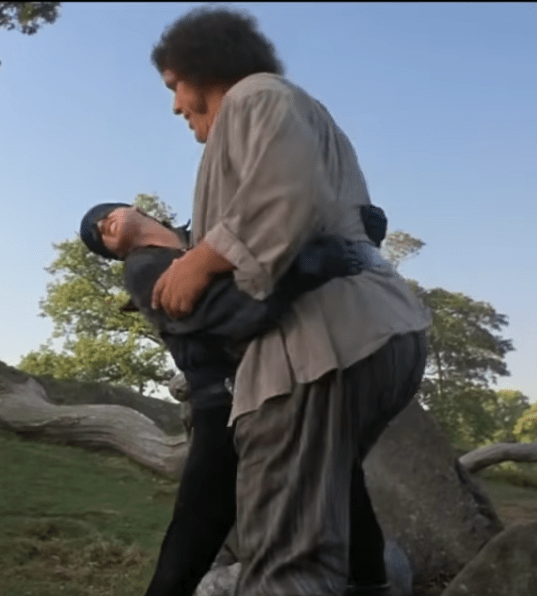
Not this:
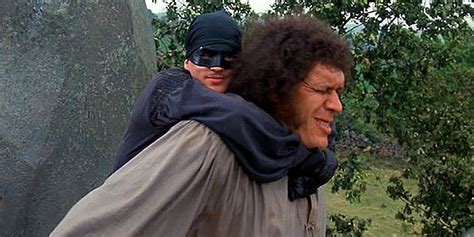
But, shouldn’t a human have at least some minor chance of getting the ogre into a sleeper hold? Your mileage may vary, but I say yes, it shouldn’t be impossible. Difficult, yes, but the AD&D grappling system clearly leaves some things to be desired when it comes to applying it to monsters — especially the large ones. The easiest thing is to assume the system really is intended for medium-sized creatures. One might even say, medium-sized humanoid creatures. For ogre-sized or bigger creatures with limbs capable of grappling, it’s a legitimate call to say, they can grab you if they want to. Perhaps, that’s too generous. Remember, the ogre had only a 51% chance of success. My recommendation is to calculate the percent success, and see if they fail. The smart player will then choose for their character to gain some distance.
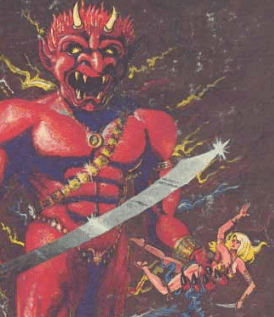
Note: the Monster Manual was written prior to the Dungeon Master’s Guide. Many monsters in the manual, have grappling-like attacks that follow different procedures than the Dungeon Master’s Guide rules. One should follow those rules if they are listed.
Lets looks at another example, given the above analysis. Let’s posit the same human fighter being attacked by a Roc, swooping down to carry him off. The illustration shows a Roc carrying off an elephant. A small elephant is in the gargantuan size range, so a Roc is Colossal (60 foot wingspan!) Being a bird, it’s likely lighter than it looks, but compared to a human? A puny human of whatever capability has basically zero chance of escaping if seized. The human had better hope the Roc misses.
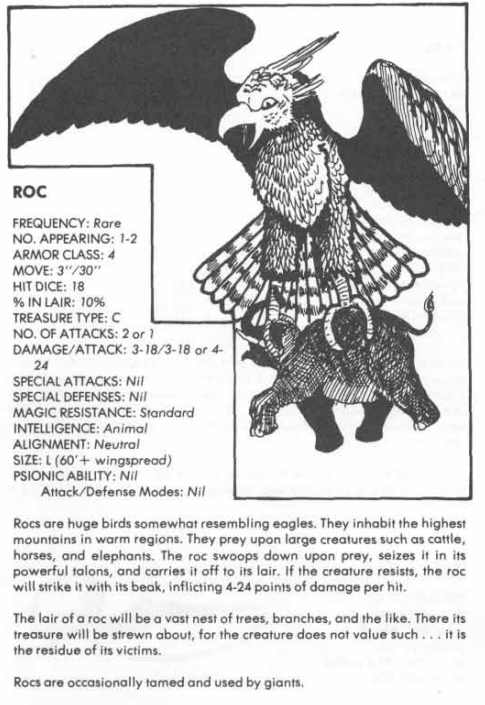
We only need to know the Roc’s base success chance then. It has an AC of 4. Unlike an ogre, birds of prey aren’t known for clumsiness. Its AC is probably a mixture of the padding of feathers plus dexterity. It doesn’t seem like their feathers slow a bird down much so, for grappling on a dive, I’m treating it as AC10. If the Roc is on foot, I’d probably go with the AC 4, it’s awkward to both stand and grab. For dexterity, I’m going with 18, maybe even greater (see Deities and Demigods for Dexterity stats greater than 18). So, we end up with a 118% base chance to grapple, just like the fighter above. Let’s compare this to a melee attack. For a melee attack with a claw, the Roc (being 16+ hit dice) needs an -3 to hit AC10 or if one takes the fighter’s 18 dexterity into account, needs to roll a 1 to hit AC6. I don’t think you can roll less than a 1 on a d20. Now, were the fighter armored (let’s say plate, AC-1 with Dexterity), melee odds go to needs to roll and 8 or better (65% chance). But, for grappling the plated fighter, the odds go to 148% chance. The heavily armored fighter has a decent chance to avoid direct injury from a claw, but essentially worse (but the same) pretty much automatic chance to be swooped up.
As a Dungeon Master, despite the Monster Manual description not saying so, I might well rule that the Roc can conduct both a melee and grappling attempt simultaneously, after all that is what birds of prey try to do. Or, just rule that the Roc can choose to grab a character, if it wants to. Forget the melee, just crack those armored nuts by dropping them from a great height. Though, a nice DM, might give the puny humans a benefit on the reaction roll. After all, compared to an elephant, a human is but a morsel to be ignored. For an ogre, a human is a decent catch, an ogre might just decide to stuff a character into a bag for later.


 Fluid -- Druid
Leave a reply to Unarmed Combat in AD&D: horses, dragons and overbearing – Fluid — Druid Cancel reply