
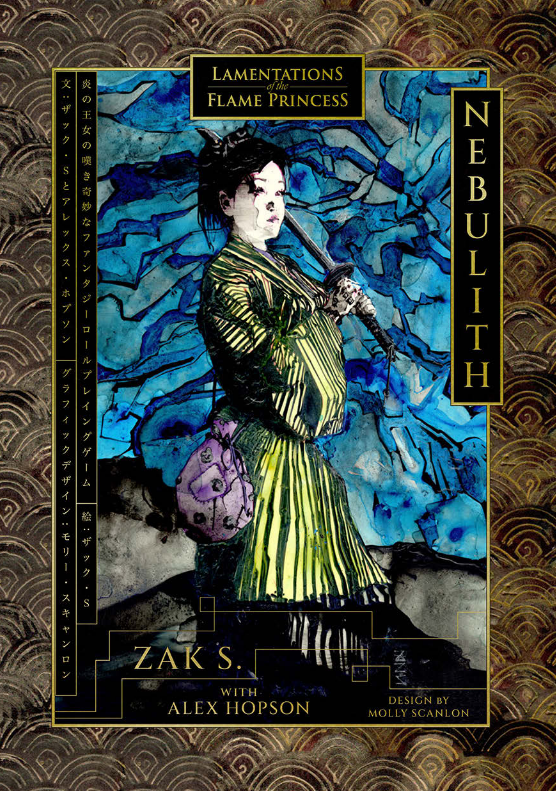
As of this date, I haven’t really done any product reviews. I don’t reckon I’ll be doing many. Unless, discussion of old games is considered a product review. But, nonetheless, I have been considering doing some product reviews despite that I view this blog more as a place to post things I’ve made, or discussion about various aspects of role playing games. This one was instigated by this.
In the linked video, Raggi laments the lack of reviews for his product, Nebulith. He does not say why people will not review it, he just says that some people have refused to review it for fear of their reputations. Zut alors! Sacrebleu! Get the smelling salts. So, I have no idea whether what Raggi says is true, but I’ll take it as is if it were. If not, well, good job Raggi on priming the pump. I guess it primes the pump either way. I’ll be your huckleberry.
What could be the reason for refusing to review a book? What hideousness is contained therein? At first glance, nothing particularly outré. It seems that the reason is that it is written and illustrated by Zak Smith. Oh no! I find it all to be weak sauce. Smith was loved, then hated, for what appears to an outsider to be for exactly the same reasons. The internet did its fickle thing. Really, one should raise the eyebrow of skepticism whenever a person raises things said behind closed doors. In the end, it’s not my business. Or, anyone’s besides the people involved. Not my monkeys, not my circus.
The truth is this, when it comes to writing, art, production, the making of things, the character of the creator matters not. The worth of the thing is entirely separate. And, Nebulith, turns out to intersect with my own interests a bit. Because, I had kind of reviewed a Zak Smith product before. And, in a context related to Nebulith.
Years ago, I used Smith’s Vornheim as a tool to generate a city for a game of AD&D Oriental Adventures I happened to be running at the time. It was a real playtest of Vornheim, and Vornheim, was a useful tool that worked great. I said so in the post. And, what do I see about Nebulith? Well, Nebulith, is also an oriental adventure setting. This is the reason I feel compelled to give a review.
Some caveats first. I have neither played Nebulith, nor have I a physical copy of the book. I merely have the pdf. Likewise, I also have not read the whole thing. In many ways, this is really more a first glance than a review. Take it all with the salt grains you choose. I am going to go with the assumption that the production quality of the book at least meets Raggi’s usual standard. Probably a bit more than his standard, since Smith is involved and known to be particular about production. But I haven’t seen the book.
The pdf is 316 pages, so this is a sizable volume. First off a comment on the acknowledgments page.
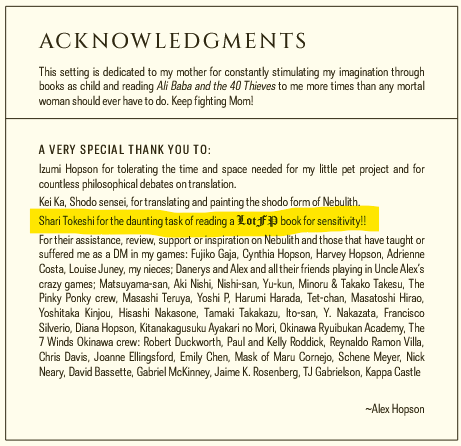
Sensitivity reading. Sigh. You can suck up to them all you want, they still won’t review your book. Don’t cater to this poisonous ideology. Now, reading for fact-checking and accuracy that’s another thing. But, really, accuracy in a fantasy setting? What part of fantasy don’t people understand? Though, it looks like a bunch of Orientals helped out in making the book, so its facts or probably more or less okay. And, by Orientals, I mean East Asians, in the American sense, not the silly middle easterners and Indians in the British sense. Oriental is a perfectly fine word, you knew what it meant when you read it in the context that you read it. That’s how language works. Oriental is a word, however, that doesn’t appear to appear in the book. Which is a little sad, does history and tradition mean nothing? And, since we are being all sensitive, be aware that the books, being illustrated by Smith and published by Raggi, does contain the occasional bit of nudity, body parts, and general gruesomeness. Not such that it’s big deal but some might want to shield youth’s innocent eyes.
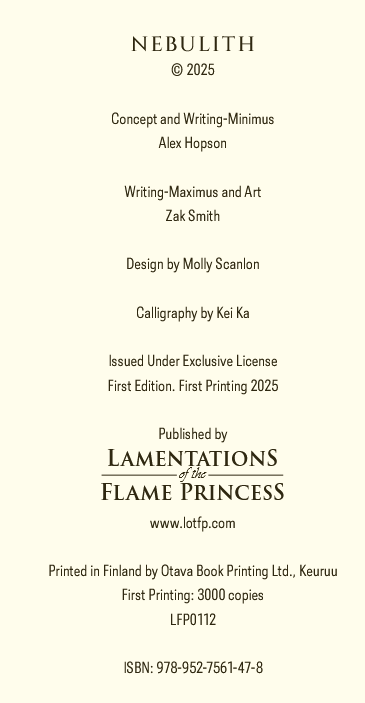
And, really, Smith gets second billing on this one. Alex Hopson gets the top despite Smith apparently doing most of the writing and art. I don’t know where the lines are drawn exactly, but clearly it’s a collaboration. It’s Hobson who provided the main inspiration and direction of the book. It’s Hobson who writes in the introduction.

But he also says,
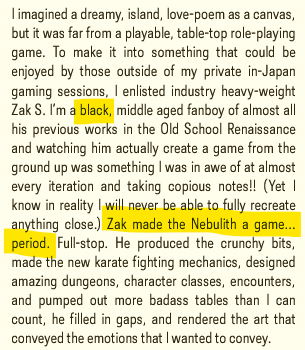
Yay, Hobson is black. The people who won’t review his book should go buy it because that’s the sort of buying decisions they make — what a world we live in. But, Hobson, to his merit, gives Smith the major credit for making his ideas into actual game material. Like the chicken and the pig, Hobson was involved, but Smith was committed to the breakfast.
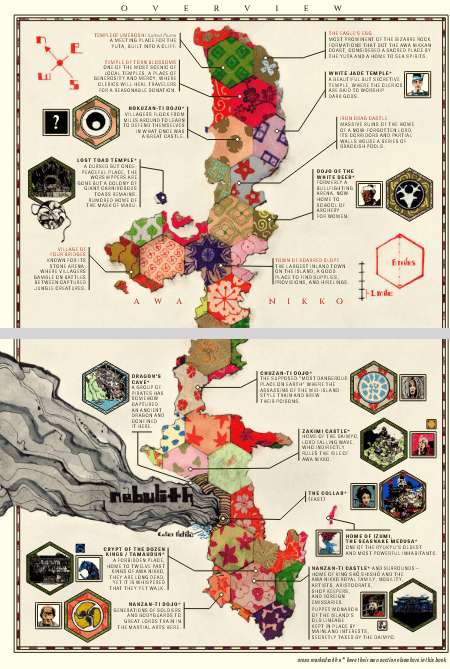
Hobson says the book is a love letter to Okinawa. And it is indeed set in Okinawa. The map is pretty, covers the high points, and in usual Smith style perhaps a little busy for my old eyes. I think I would have preferred more standardized terrain iconography, but I’m sure the map serves its purpose.
In essence, the book is the Oriental Adventures for the Lamentations of the Flame Princess (LotFP) role playing game.
Page 13, literally sums it up. No need for me to write it all down again. And, of course, for me the most important thing is the random tables. These being the heart of RPGs even more than any particular combat system or dice mechanic.

The setting is a fantasy Okinawa called Awa Nikko. So, Okinawa spelled backwards. Let’s just keep calling it Okinawa.
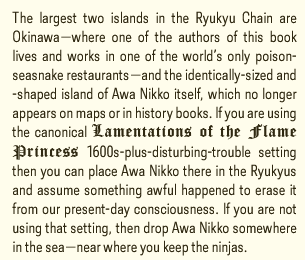
The reality is, you can use the supplement far beyond Okinawa, and extrapolate it into other oriental lands and cultures. Okinawa being a sort of melting pot containing many ethnicities. Will you get everything right doing so? No. Who cares? It’s a fantasy game where near everything is made up anyway. Just as with the original Oriental Adventures, it has a love for the genre and peoples, but is not intended to be a history book. Get over it. After all, the Nebulith itself is a giant tower of solidified volcanic smoke, within which is contained a giant dungeon for adventuring. Last I heard, this wasn’t authentic to Okinawa either.
Without going into a huge amount of detail, the book has all of what one would expect of a setting book. So, good for them. Really, it has more, in that many publishers would have broken it into several books in order to make the more moolah. But Nebulith really does have all you need. The monsters, the classes, the dungeons, new martial arts game mechanics, magic items, etc. I haven’t read it all, but at first glance, it’s got a little of everything and a lot of most things. All without getting too bogged down in lore. Yes, there are factions and back histories, but, it tends to hit the sweet spot of giving you just what you need to get going without having a two thousand year timeline of information you aren’t going to use. What follows is just a few of the fun stuff that caught my eye.
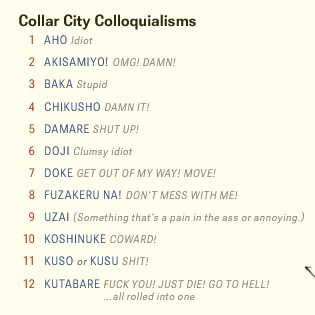
These, of course, are all one needs to know of another language.
You’ll be happy to know that the tradition of game unbalancing martial arts is included. As if Europeans had no martial traditions or training. While I think there is an opportunity to add similar schools and training to the European based game, with their own European flavor, this game isn’t about that. It’s about a different genre with its own traditions to keep up.

In the Character Classes section, the headings are on the sidebar. I fumbled around, confused of which class was being discussed while scrolling through, before I noticed the side headings. I think I’d prefer normal horizontal headings, but it’s not really a problem once you are aware of the approach. I expect that this is more intuitive in the physical product.
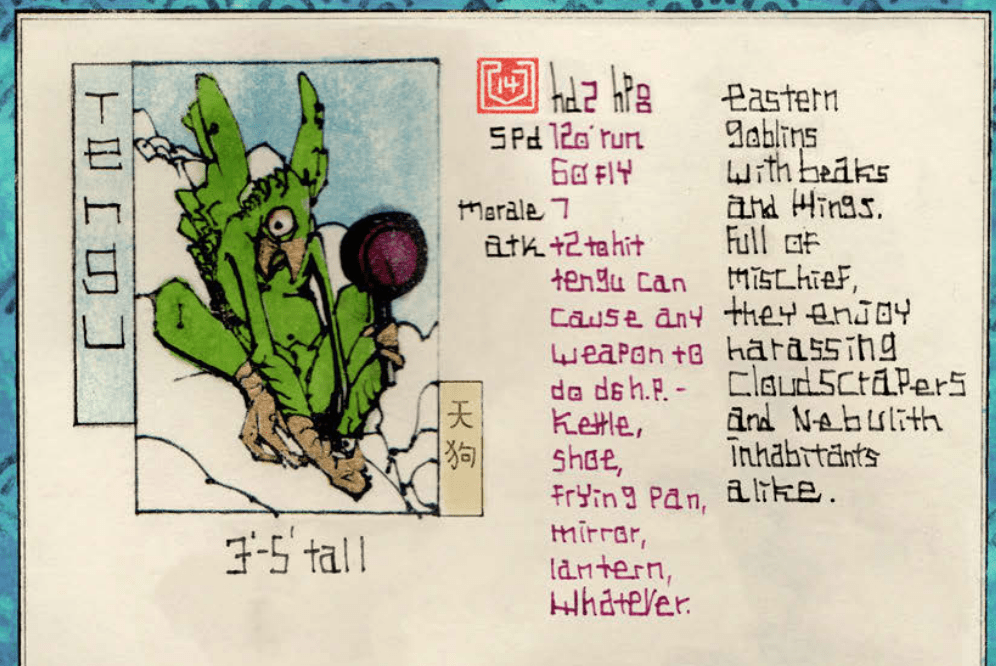
Similarly, in the bestiary section, I do not like this lettering style in terms of legibility. What’s this guy called? Maybe it’s just me, your mileage may vary. That said, I do appreciate a monster listing that is short and to the point. It’s just that when rolling random encounters, you want that monster info available as quick as possible; fighting with the text is counterproductive.
The Nebulith is a giant solidified tower of volcanic ash which is riddled with natural and man-made tunnels and structures. Exploration of these is called a Cloudscrape, analogous to the term dungeoncrawl. The base of the Nebulith is surrounded a by a large, sprawling area of habitation called The Collar. The Collar has sprung up to support the various exploration activities associated with the Nebulith. And, one suspects, also full of intrigue as the various factions try to profit off the finds and money associated with the Nebulith.
Smith describes a general method for setting up a Cloudscrape using the variety of random tables. This section is full phrases like, “…the referee has decided…”, and, “…the referee decides…”. Myself, I’d like a more rigorous algorithmic procedure for generating the Cloudscrapes. But, that’s a matter of preference, and the random tables are fairly self-explanatory on how they should be used.
Similarly, the section describing travelling around Awa Nikko is clearly trying to hit the sweet spot of providing sufficient detail to get started without being over prescriptive of every little place and personage. This succeeds just about right too.

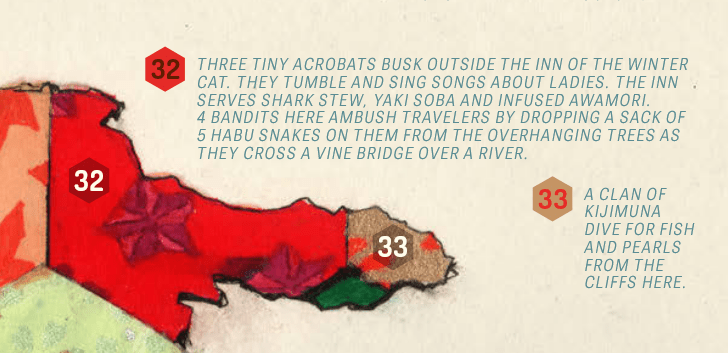
A lot is “flavor” detail rather than things set in stone. It can be used or not as the referee desires. Again, it is the bare bones, but points you, and hopefully the players, in good directions.
Similarly, the number and details of the various personages of The Collar are not so many as to overwhelm, while also having some real meat to work with. However, I think I see an error in the description of at least one of the characters. Or, it is? I don’t know, but “12 attacks per round per hit die” for a 12 hit die NPC seems like a lot. Even one attack per hit die seems like a lot, but as it reads, it looks like this character is entitled to 144 attacks per round? Surely, this is in error?

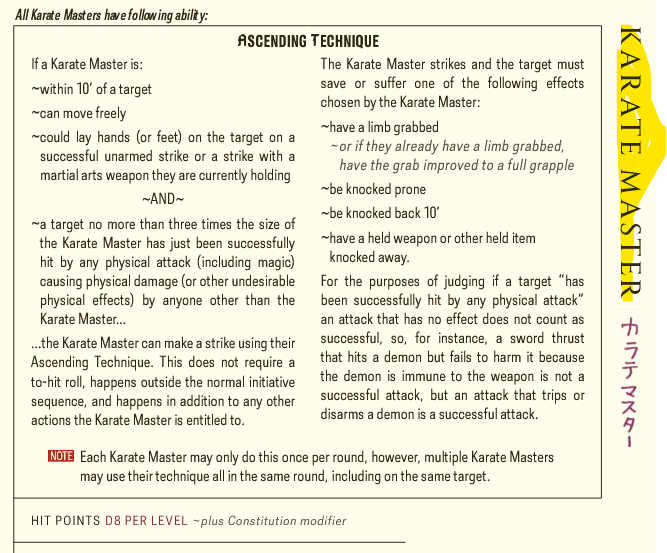
I did not review the martial arts section in any detail, but it not only looks to serve its purpose but also defines several rival schools of martial arts that I expect will provide for many opportunities for posturing and duels. Plus there is this fun rule.

Many a game has sought realism through detailed disabling wounds and wound up pretty unfun as a result. Smith squares the circle here by coming up with a method to deal out the disabilities while also meeting the genre expectations and keeping fun back into running a mutilated character. Well done.
There are a few detailed dungeons both in and outside the Nebulith. I won’t present any clips here because why spoil it. Just nice to see that Smith produces a variety of dungeon types and means of presenting the dungeons.
Similarly, there are new spell listings, the few I reviewed varied from fairly standard (ventrioliquism) to pretty clever (Hold Nature) to quite involved (Summon Spirit).

The book also provides and Appendix N for the game, further divided into Alex’s List and Zak’s list. This is one of the essential elements. In order to properly run a game based on a genre, the first task is to gain an understanding of the genre. While, am familier with quite a few of the works on their lists, there are also just as many as I am not familier with. I expect, catching up on these may be the most use I gain from the book. Which isn’t a dig at the rest of the book.
The section of random tables is quite nice. It covers the gamit from adventure hooks, random encounters in the different environments of the island, plus many fun ones like the Brawl Knockback Table. Also, treasure and magic item tables. All in all, this is the meat of the game and includes pretty much all one might expect.
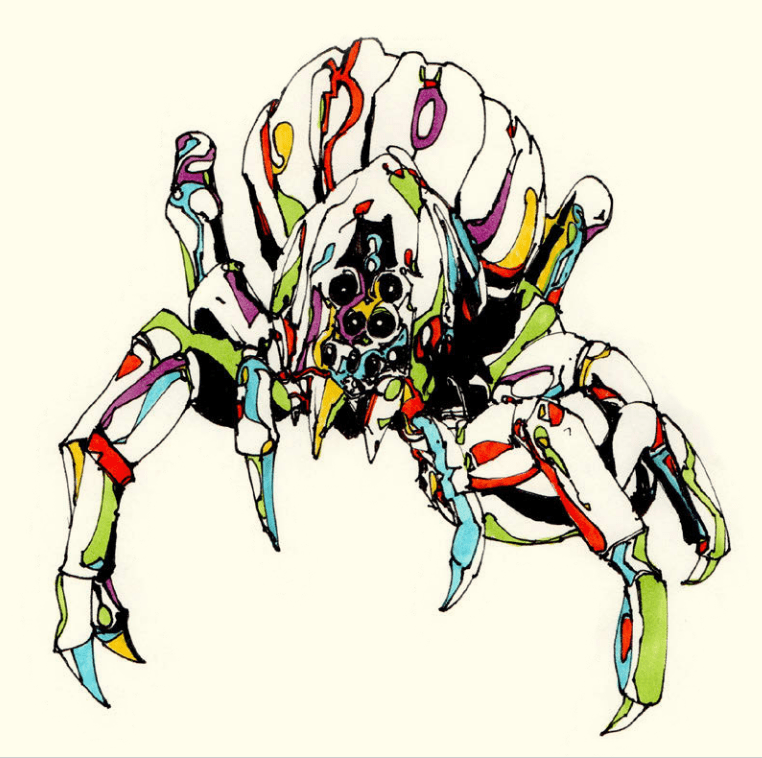
As a taste, here is one of the magic items I found, pretty funny.

Well, there you have it. Not a real review as I haven’t played it, but a review review. It’s a pretty complete setting book, with some actually quite striking art, and fun ideas. And doesn’t get too bogged down in detail. It certainly meets the goal of being an Oriental Adventures for LotFP. Despite a few quibbles, it’s an overall quite well done, and fine looking document. So, if the far east catches your fancy you could do worse.
Addendum:
I’ve now received a physical copy of the book. As expected it meets Raggi’s typical quality level. In some ways I’d say exceeds it. There are two book marks, as well as foldouts and useful endpapers that one has come to expect from both Raggi and Smith.
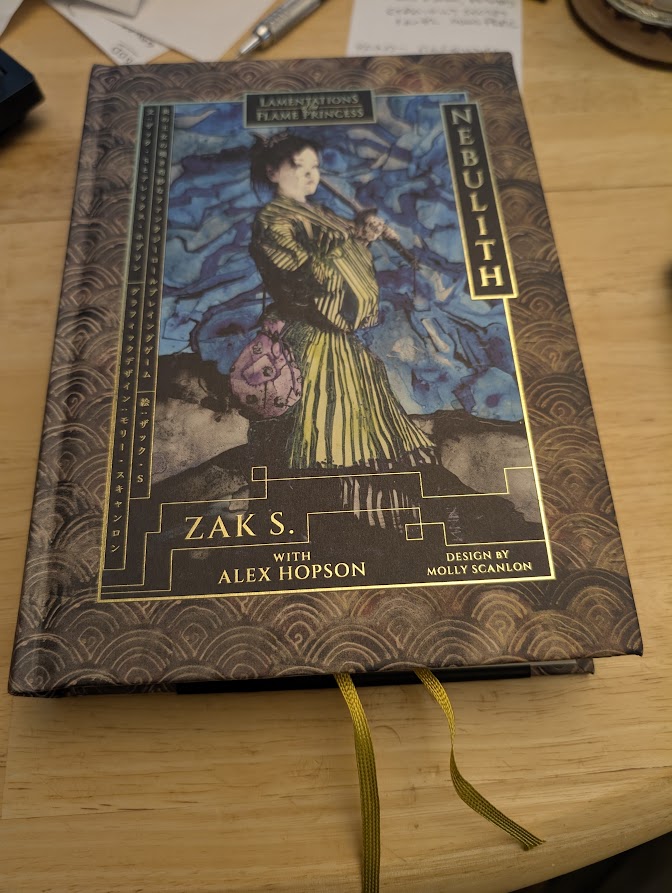
There is a nice matte cover. I know some prefer glossy covers, but in this case I feel the matte cover isn’t too greasy feeling and the color has the more muted tones of watercolor or block prints. Similarly, unlike many LotFP books, this one does not feature heavy glossy paper in the interior. I’ve never cared for glossy interior paper — too stiff. Yet the paper is still fairly robust and presents the artwork in similar muted tones to that of the cover.
The artwork looks even better on paper than on the pdf. Even the wonky font in the monster section reads better on thepage. Still not happy with that font, but it is improved somehow on the page.

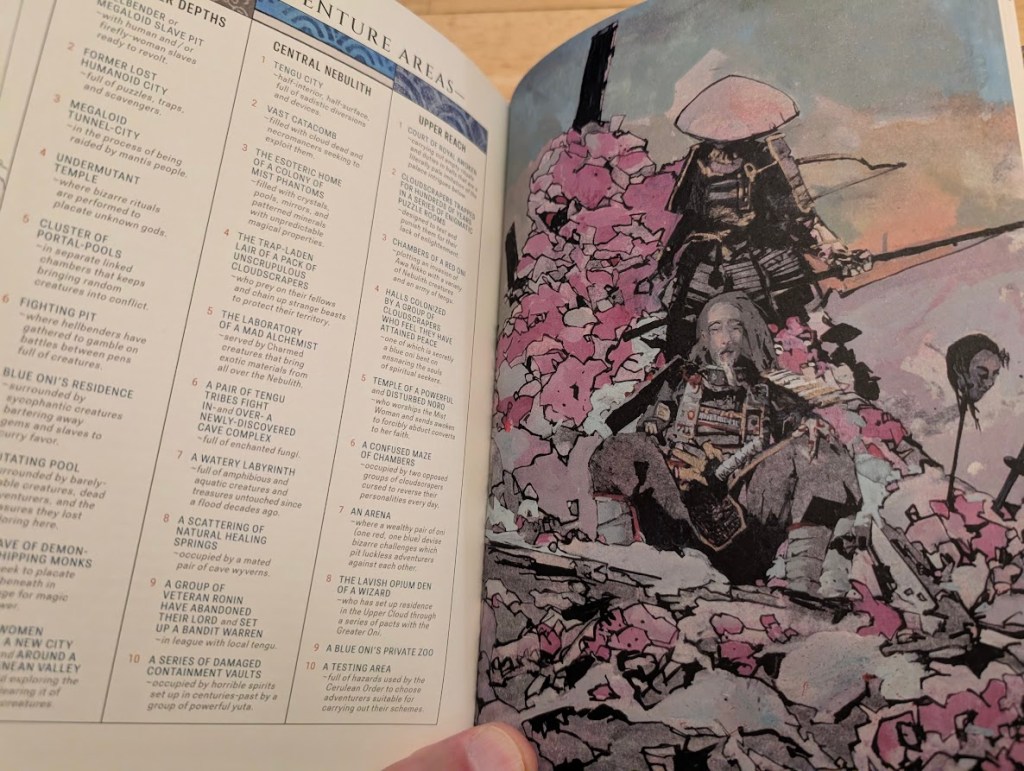
So, well done to all involved.

 Fluid -- Druid
Leave a comment