
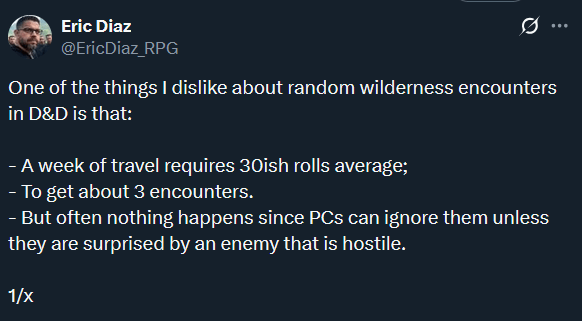
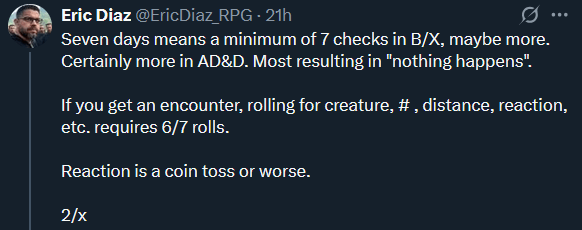
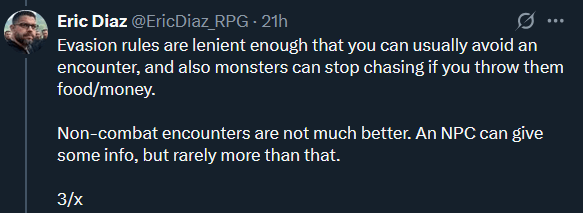
This post is inspired by this X post discussing random wilderness encounters. He’s not wrong. But, he’s not right, either. I’ll explain.

Plus he’s got this blog post.
What he’s talking about is the procedure that is described on p.47 of the AD&D 1e DMG. The reason I’m particularly interested in his points is that in recent years I’ve become convinced that if D&D has a core mechanic, it is not the d20 rolled in combat or for saving throws, it is the mechanic described on p.47 of the DMG.
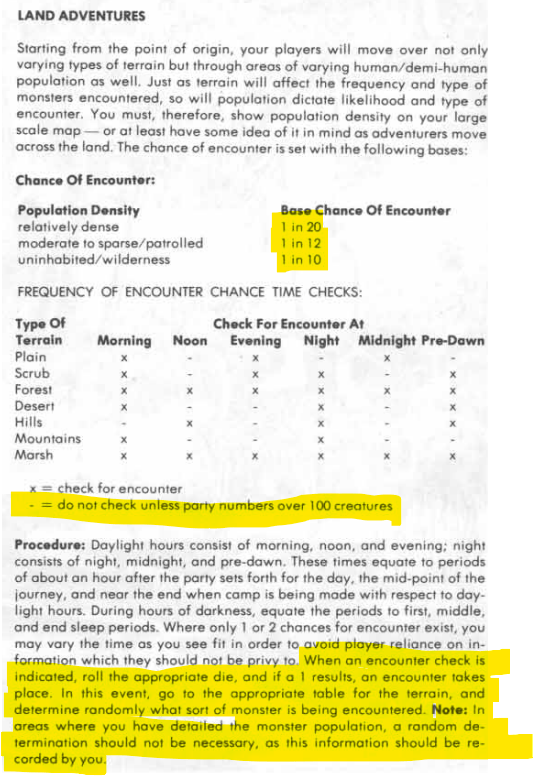
Or, rather, it is the mechanic described on p.47 of the DMG along with the Appendices A, B, and C of the DMG. In essence, it is these sections that make D&D into a game.
Quickly, for context, I’ll summarize the Appendices.
- Appendix A — is random dungeon generation, including wandering monsters, monsters, treasure, and trap placement.
- Appendix B — is random terrain generation, including placement of settlements.
- Appendix C — is random monster encounters for both dungeons and wilderness.
The gameplay loop looks something like this:
- Characters leave the house into the outside world. The outside world (at a scale based on DM preference) may be pre-generated terrain hexes and settlements using Appendix B. Or, one might choose to generated terrain on the fly using Appendix B.
- As characters move about the world, random encounters are rolled for. If an encounter occurs, the encounter is generated using Appendix C. The players must deal with each encounter in someway (runaway, defeat it in combat, make friends).
- If a ruin or deserted castle or a destroyed city is found among the terrain, then there likely will be an associated dungeon, which may be generated using Appendix A.
- If they leave a dungeon, then they are back into the wilderness and the gameplay loop iterates through the p.47 random wilderness encounters.
So, he’s not wrong, there is a lot of rolling. But it can be reduced by following the last line I’ve highlighted from p. 47. “In areas where you have detailed the monster population, a random determination should not be necessary, as this information should be recorded by you.” Fair enough. The p.47 process isn’t the only possible way to generate encounters. But, there is a hidden benefit by going through all the rolls.
By being seen carrying out the rolls (or, even letting players carry out the rolls), the players see that you (the referee) are utilizing a fair and unbiased system to determine encounters. Let me repeat, by carrying out the rolls, you are seen to be acting fairly. This has two effects. The first, if a tough encounter occurs or, heaven forfend, a TPK occurs, it is not you the referee that did it to them. It was the dice, or rather — fate. Conversely, if an easy encounter occurs, or some other sort of windfall of treasure or magic items, it is not you, the referee, treating them to free giveaways, it was the luck of the dice.
Players may form opinions of how fun a game is if they think they are being treated unfairly by the referee, and a poor opinion can occur whether the result is against them or in their favor. Participation badges aren’t fun, neither is being slaughtered for another’s amusement. If players understand a fair process is being used, these sorts of perceptions are avoided.
The above is my main point. Yes, it is totally fine to generate encounters ahead of time, including dungeons. And, it can speed up gameplay at the table. But, one does lose out on the effect of players seeing a fair process being carried out. So, my suggestion is yes, pre-generate to your heart’s extant, but include some uncertain items for the tabletop, so the players see you doing the process. Also, this allows a middle ground between entirely having to improvise with each encounter and having zero improvisation. It is nice when you (as referee) are surprised by events, too. A big part of the fun of playing is not knowing what comes next. Same with the DM.
The DMG has plenty of wiggle-room to pre-generate stuff, forgo encounters, create custom encounter tables, etc. But Appendices A through C along with the p.47 wilderness procedures are a game, arguably the game. And, in practice, while there is a lot of rolling, it works. These Appendices, especially if you follow the notes regarding meeting patrols, encountering unexpected castles, etc. really do generate a world. And, it’s not your world DM, but The World that is consistent for both you and your players while still consistently coming up with the unexpected for everyone. Relax into it and let yourself be surprised by what comes up. Accept where the dice lead, it’s likely to be better than anything you imagined.
That said, I’ll address some of his specific criticisms. Yes, the evasion procedures, especially for small parties, allow for relatively easy escape from a lot of encounters. This is a feature not a bug, given a random encounter might generate hundreds of orcs or other powerful creatures that in terms of combat are well outside the character’s combat abilities. Allowing players the autonomy, in many cases, to choose the level of interaction they desire also frees the DM from being blamed if things go poorly. Some examples from my own play.
- A low level party (less than 3rd level) encountered Cloud Giants in their lair. They could have bypassed it. They choose not to. This lead to an unexpectedly fun jack-in-the-beanstalk-like affair with the party sneaking about the clouds, stealing things, trying not to get caught, then parachuting to safety below.
- A mid-level party encounters a lone wereboar. The reaction roll was favorable, he was having a picnic and invited them to join. He’d snuffled out some funny truffles and offered them to the party. Those who partook spent the rest of the day in a psychedelic trip but gained one point of wisdom, those who didn’t partake lost out. If I roll a wereboar again, it’s likely this guy. A random element has created something that may reoccur.
- One night the party rolled an encounter with elves, I knew this area already had drow about. They are much too powerful in numbers for the party to engage them. However, the encounter distance, and surprise was such that the drow didn’t detect them. The party spied the drow bathing in a moonlit pool. The use Unseen Servant spell to steal the drow clothes and magic items. No combat occurred, but the great drow panty raid is still discussed to this day.
- A random copper is rolled in the mountains in the lair. Randomly determined to be a young dragon by itself. The treasure is rolled for the lair, and a significant magic sword is part of the treasure. I determine the young dragon is sleeping in the bones of its mother, with the sword lodged in here chest. The party makes friends with the young, and impressionable dragon. Later, another random copper dragon is rolled. This time ancient. I determine it is the father looking for its child. Later, using Appendix A, the party encounters two hostile white dragons. They lure the white dragons to the copper dragon’s lair, who manages to defeat them. In this case, a whole series of encounters, dispersed in time, has built up several campaign elements that have become important.
- The party encounters “herd animal”. Boring. I determine the specific animal is a herd of buffalo. Most players want to move on. One player decides to try to capture some buffalo and train some of their allies to ride them. Chaos ensues.
So, yes, it can be a lot of rolls, but if one takes the results as a starting point rather than an ending point, the AD&D 1e Appendices A, B, and C plus wilderness travel rules (p.47) can create a world that no one expected, including the DM.

 Fluid -- Druid
Leave a comment