
In my last post, I wrote about a specific scenario analyzing in AD&D the odds of Ogres and Trolls cooperating with one another. What about in general? Well, I’ve got ya covered. But first a little recap of tables that I include in that last post.
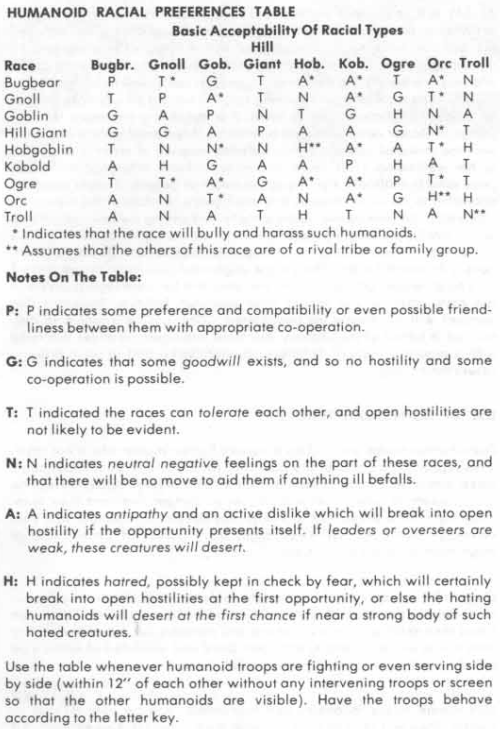
There is the Humanoid Racial Preferences Table.
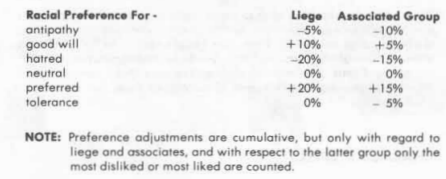
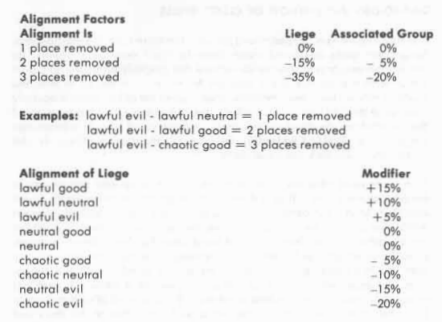
The racial and alignment modifiers.
And the Encounter Reactions table.
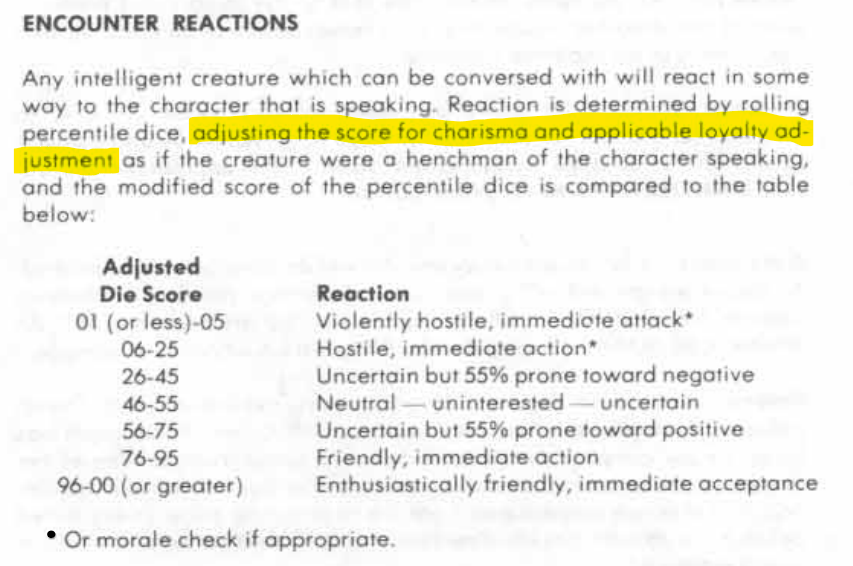
Like before, the assumption I’ve made here is we want a 76 or better for one group to be clearly friendly to the other. Again, I’m ignoring the uncertain but prone to positive category.
Note that the racial preferences table has two groupings: Liege or Associated Group. The Liege category is for when both parties are working for the same liege (boss). In general, having the same boss is helpful in groups working together. However, not always. I’ll get to that later. I’ll start looking at Associated Groups.
First, I just translated the Racial Preferences table categories into the listed modifiers. It’s notable that the Hill Giant, overall, is the friendliest among the group of humanoids — I guess being the biggest means they have less to fear from the others. Hobgoblins and Orcs are the worst, their tribalism limits even their ability to get along among themselves.

I did the same for alignment. In this case, all the humanoids are either Lawful Evil or Chaotic Evil. So, there really are only two sets of modifiers for these two alignments. Which makes sense — they are aligned.

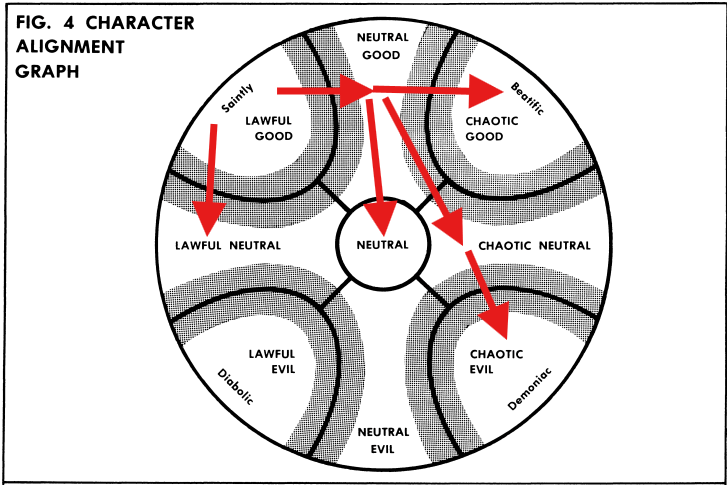
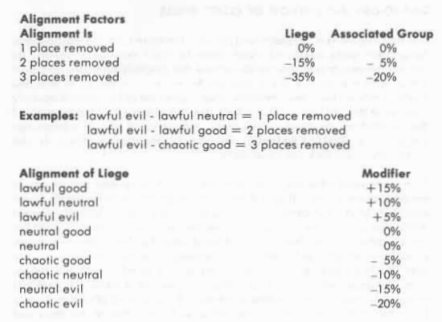
When it comes to determining the alignment modifiers, there are modifiers for one to three steps away from the other party’s alignment. What is meant by steps? I use Lawful Good in the example above, it can be seen that Lawful Neutral is one step away, Chaotic Good and Neutral are two steps away, and Chaotic Evil three steps away. In this case, Lawful Evil and Chaotic Evil are both two steps away from each other.
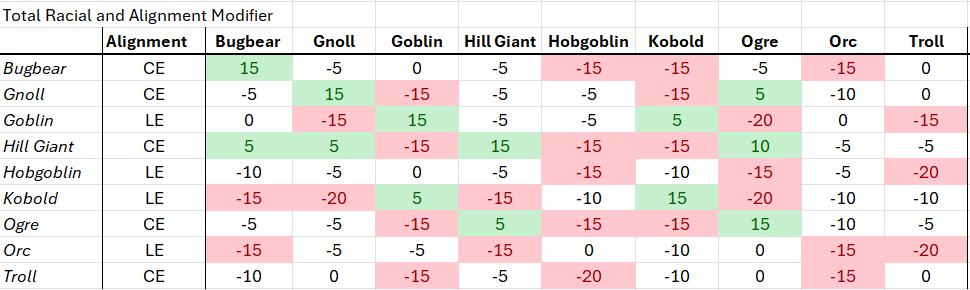
Then, I summed up the racial with the alignment modifiers. The marking here are just green for positive modifiers and red for the bigger negative modifiers.
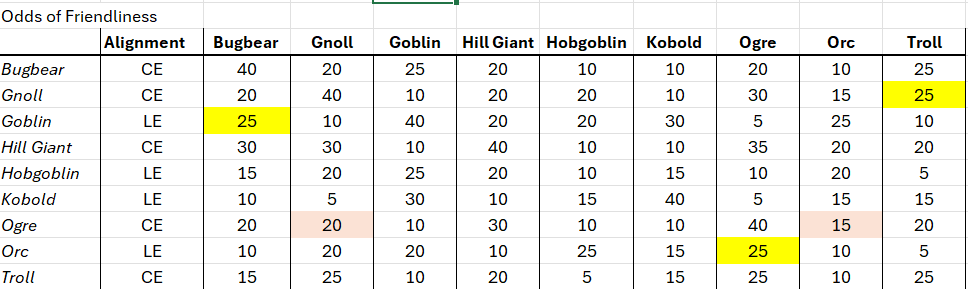
And, translated that into a percentage change of being friendly. This is the modifier plus the range of friendliness on the reaction table — so modifier plus 25 and expressed as a percentage.
On this table, I’ve marked in yellow groups that the Monster Manual expressly says can be found together. For example, the Goblin entry notes that within Goblin villages, sometimes Bugbears will be there. For Ogres, there is no listing of other races found within Ogre settlements, but it does note that Ogres are often found are mercenaries allied with Gnolls and Orcs.
This is getting close. Clearly, some humanoids are more friendly with some groups over other groups of creatures. But, cooperation takes two to tango. The next table show the odds of mutual friendliness. For this table the blank areas don’t mean non-cooperation, it’s just that the odds are the same because it’s a mutual calculation. Note that I’ve applied normal rounding to these values. Hobgoblins really have a 0.25% chance of being mutually friendly with trolls, but it’s rounded to zero. Similarly, for kobold and ogres, it’s 0.5%, but it rounds to one percent.
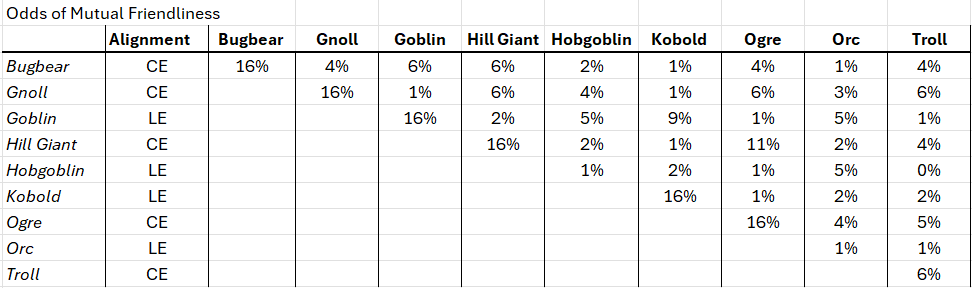
One thing that is clear from this, cooperation is pretty difficult even in the best of cases.
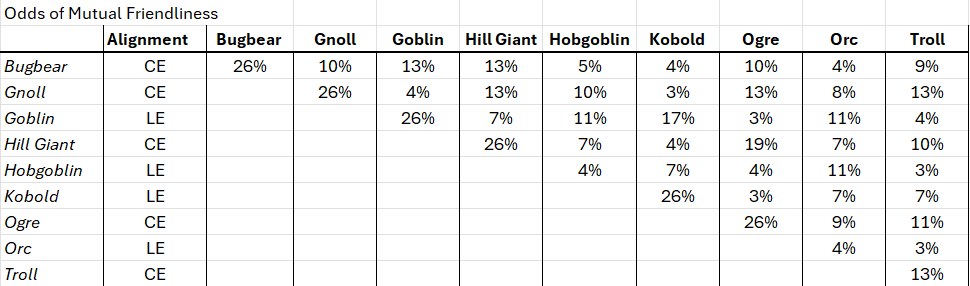
But, let’s now look at that “Uncertain by 55% prone to positive category. The Uncertain category covers a range of 20%. Fifty-five percent of twenty percent is eleven percent. Combined with the clearly friendly range increases the odds to 36%. Using this value, does improve the odds of cooperation significantly, yet in absolute terms even in the best of cases only a little better than a quarter of the time will humanoids cooperate even within their own race. Man, that Caves of Chaos must be a fractious place.
But wait, the Caves of Chaos has the High Priestess for which the humanoids seem to be working for. In other words, she’s their liege. How do the odds stack up there. Well, I won’t recapitulate the steps I did above but, in the final tally, including the uncertain category range, here are the odds.
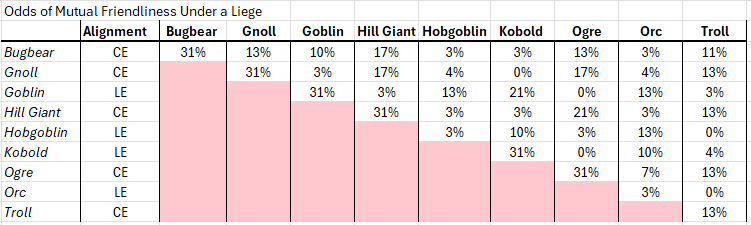
It’s an improvement, yet still not great odds. And, there are a few oddities. For example, Hobgoblins and Trolls, and a few others, the level of cooperation actually goes down when working together under a liege. Why is that? Well, it’s because under a liege, if hatred is involved, reaction actually gets worse under differing alignments under a liege gets worse. I’m not sure why. Maybe it’s a typo? In all the other categories, working under a liege improves things. But, maybe it’s a case where the creatures are pissed off they are being forced to work together by the boss — or are rivals for the boss’s attention? I dunno, but were I a Dark Lord, or the High Priestess from the Caves of Chaos, there are some groups I’d really try to keep apart. Or, maybe relegate some groups to associates. You guys, sit over there, you don’t have to have desks next to each other.
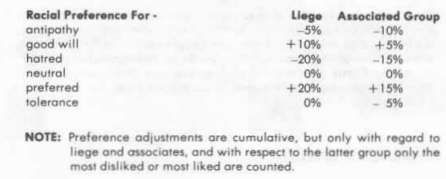
Now there is another thing I don’t understand. This is the alignment of the liege modifiers. These calculations do not include those. Let’s go back to that High Priestess. Assume she’s Chaotic Evil, does she get a -20% when commanding Chaotic Evil creatures? What about when commanding Lawful Evil creatures — -35% (-20-15)? Does this make sense? Maybe? Should the Lawful Good Paladin be equivalent at commanding the Chaotic Evil (+15-35=-20) to the aligned priestess? Not sure what to make of that.
Now, a similar analysis could be done for the playable races in the Player’s Handbook. And, it should have similar results, given the Monster Manual normal alignments for those races. Which makes the case why The Fellowship of the Ring was so unusual. Gandalf really had to work to keep everyone together.


 Fluid -- Druid
Leave a comment