
In a prior post, I looked at AD&D movement rates in relation to missile fire. In that piece I used the DMG overland movement rates and terrain classification to explicate short-term movement rates during combat. Now, I have revamped the presentation of that movement rate data for each of use. And, also, will be discussing encumbrance and armor choices. The DMG does not define base movement and how one is to modify base movement.
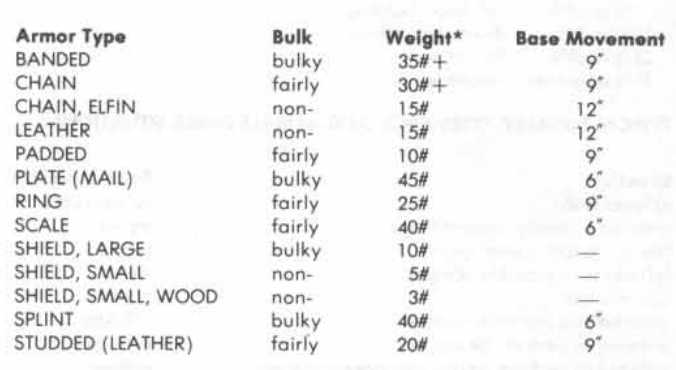
The Player’s Handbook has some discussion of normal loads, weight categories, associated movement rates.
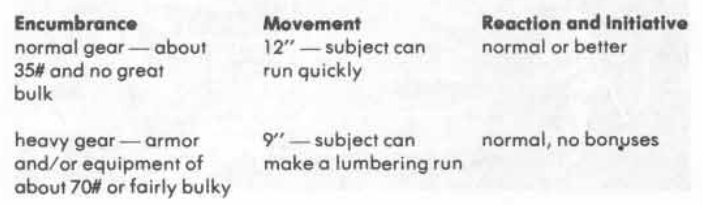
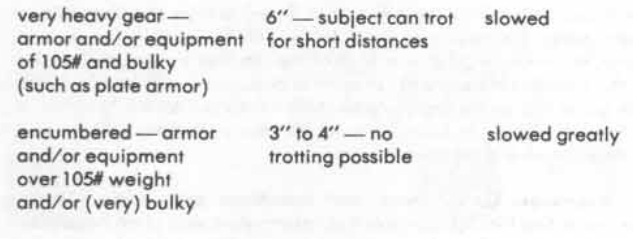
For clarity I’ve summarized the PHB groupings here.
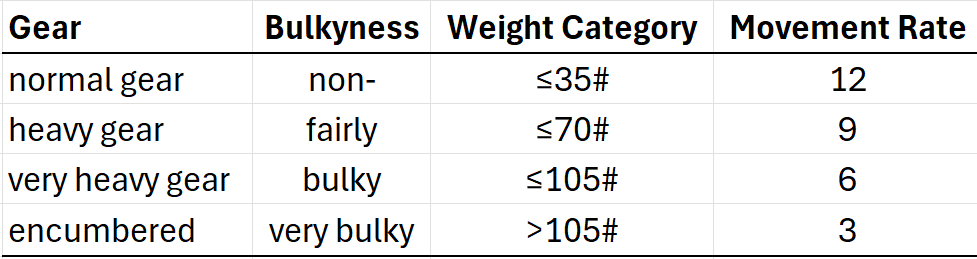
In practice here is how I’ve always treated encumbrance. First, check the armor type movement rate, then add up weight of carried items and if the total weight kicked things to a slower encumbrance category then use that slower value. For example, a character wearing chainmail has a basement of 9″ but if the total weight carried was between 71 and 105 pounds then movement is 6″. But, now thinking about it, I think I’ve missed something.

The DMG has the comment that magic shields weight the same as non-magic shields. And, looking back at the DMG encumbrance by armor type table it shows that small shields are non-bulky while large shields are bulky. The concept of bulk is supposed to do something other than just weight.
For normal items carried the gold pieces weight given, the DMG explains, do not just represent the actual weight carried but also their bulkiness. Scrolls in the example do not weight two pounds but are treated as two pounds due to its “relative bulkiness” which I guess related to factor. Conversely, we can see for armor type the weight and bulkiness category do not necessarily equate to the weight categories shown in the PHB. So, some items are treated as more bulky than the listed weight and other items just have an increased weight parameter to account for bulkiness. Sigh.
So, what does it mean when a large shield is considered bulky? The DMG lists no base movement rate for a shield. That might imply that shields have no effect on movement rate one way or another. That is, in fact, how I’ve always treated shields. But, what then to make of the large shields bulky rating?
There are a few options. I’ve come up with three. First, my usual practice just ignore it. Second, second treat the listed categories as forcing the movement rates shown in the PHB. Third, note that the PHB non-bulky category has a movement rate of 12″ and the bulky caregory has a movement rate of 6″, therefore a large shield halves the movement rates from the base movement category.
Under the second option, an armored character with a large shield would default to the basement of the most bulky item. For example, a character with leather armor (non-bulky, 12″) and a large shield (bulky, 6″) would default to the slower 6″ movement rate. A character wearing plate armor (bulky, 6″) and also having a large shield (bulky, 6″) would still move at 6″.
Under the third option, the large shield halves the base movement rate. In that case, for the examples above, the character with leather armor with a large shield has his base movement of 12″ halved to 6″, while the character with plate and a large shield has his base movement of 6″ halved to 3″.
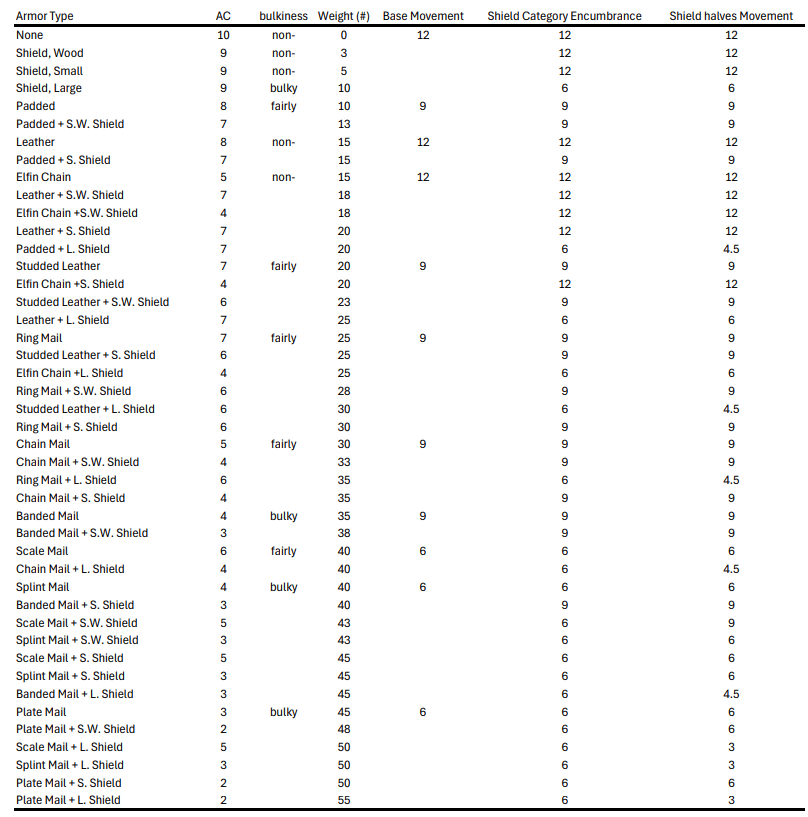
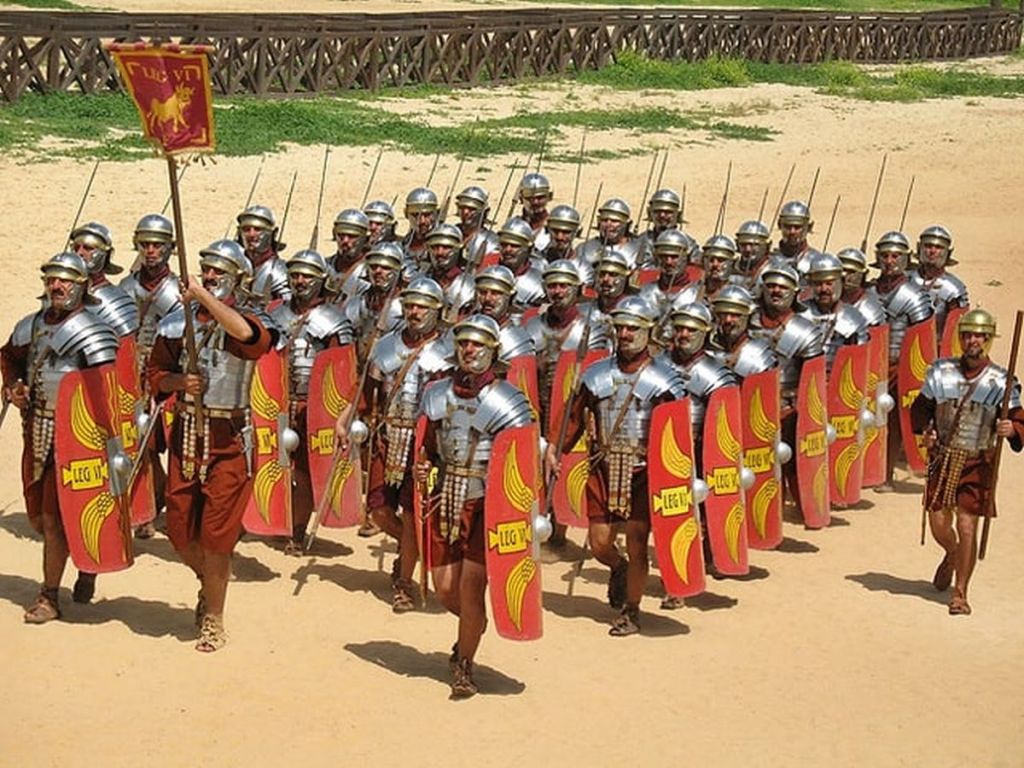
In both Options 2 and 3 the effect of a large shield is fairly harsh, especially for those with other light or no armor. On the other hand a Roman Scutum seems pretty unwieldy and awkward. Using Options 2 or 3 would recreate some effects like discouraging light foot from carrying large shields or making phalanxes unwieldy.
However, Option 3 can result in some low movement rates 3″ and 4.5″. Three inches is equivalent of being encumbered which both seems harsh but, also, too low for any effective military formation. OD&D with its simpler encumbrance method never have a movement rate so low as 3″.
While I’m pretty okay with the logic and effects behind using option 2. I think I’m sticking with my longstanding original approach. Just use the base movement for armor and kick it into a lower category if overall load in weight requires it. I think that is how most people do it. So, in this context what does the bulky term mean? I don’t know. All I think of is that bulky is used by the referee to make judgement calls about what items might be carried and/or how much is taken up by people carrying bulky items. For example, a referee might rule that a ten-foot wide hallway might be blocked by two men with large shields but require three men with small shields.
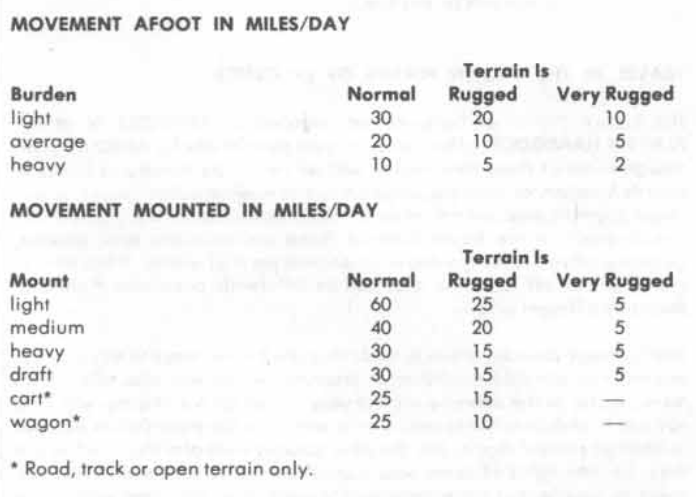
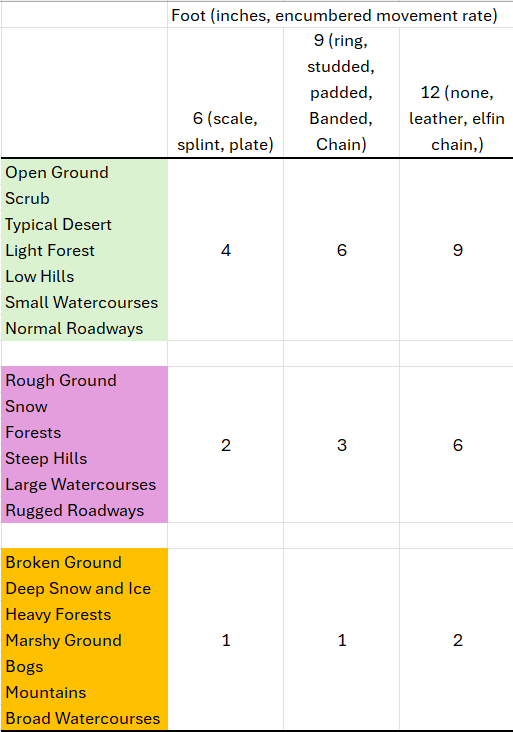
In any case, I’ve reorganized the presentation of my previously calculated terrain movement effects rates. Shown below. Note for horses, the encumbered rates are using the Monster Manual defined encumbrance for horses.

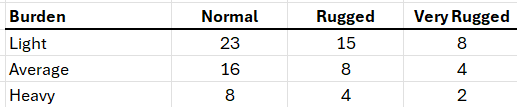
The AD&D 1e rules are silent on the movement rates of the shorter races (dwarfs, halfings, gnomes). So, the default is that these races move at the same rates are the all the other, taller, races (humans, elves, half-elves, half-orcs). But in the Dragonsfoot forums Gary Gygax fairly strongly asserted that the short races should move slower — with a Base Movement of 9″. And then as below for the various levels of encumbrance. So, I calculated terrain movement rates based on these factors. However, I didn’t quite follow Gygax’s numbers. The reason being the Monster Manual. The Monster Manual gives movement rates for Dwarfs of 6″ while wearing chainmail. Similarly, for Gnomes the Monster Manual lists a movement of 6″ while wearing studded or ring mail. And, for halflings wearing leather, the Monster Manual movement is listed as 9″. To remain consistent with the Monster Manual I dropped Gygax’s 7″ to 6″ and also knocked one off the the heavier encumbrance from 5″ to 4″ to allow a better spread between ranges. This is getting into house rule territory but at least I’m trying to be consistent with the published Monster Manual.

For the shorts:
Reversing the approach I took to determine the terrain effects the short character movement rates can be used to estimate daily movement rates.
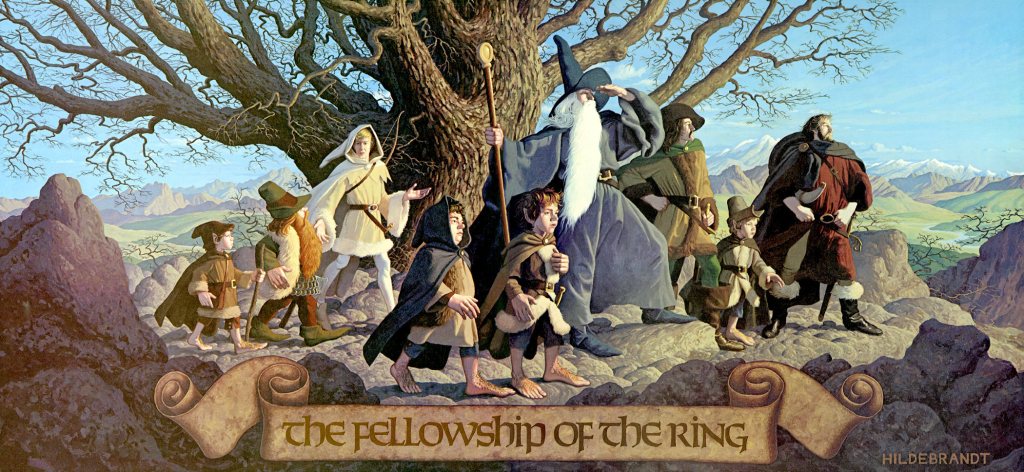
At the top of this page is Tim Hildebrandt’s illustration of the Fellowship of the Ring. They make a fair illustration for how this discussion of movement rates all adds up. The characters wear different armor at different times in the books.
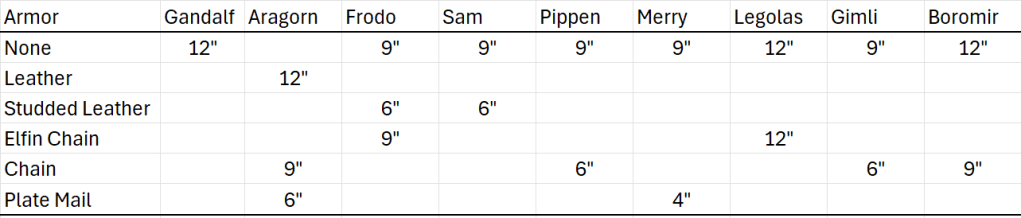
One can see that Gimli is at a distinct disadvantage to Legolas. Especially, since legolas with his elfin mail can move as unencumbered, while Gimli wearing his normal mail is slowed. Gimli might be advised to roll up the mail and carry it in a pack rather than wear it while moving cross country. Frodo, also with elfin chain, still lags Legolas but manages to keep up with the other halflings despite his greater protection. One can understand why Frodo and Sam abandoned wearing orc armor as soon as possible while crossing Mordor. Similarly, one can see why Merry stayed mounted as long as he could while fighting for Rohan.
In any case, one can see, again, that picking one’s terrain while fighting is very important. But, also, how load and terrain combined can dramatically change movement rates.

 Fluid -- Druid
Leave a comment