


At the end of the recent Arbiter of Worlds stream, with Alexander Macris and Harmony Ginger, the issue of game rulings and precedent came up. I commented in the chat my view that rulings should not establish precedent in RPGs as they are case-specific. Macris countered that he strongly disagreed with me but it was the end of the stream so did not have time to get into the details as to why. Which is fine. I, however, feel compelled to state my reasons in more detail. Mostly, through looking at AD&D and the history of D&D in general. But, my thoughts are pretty applicable to most role playing games.
But first let me talk about the role of running a role playing game. Dungeons and Dragons has the term Dungeon Master. I don’t know when this term was first used. The earliest reference I can find is it appearing in the 1975 Blackmoor supplement. It is notable though, the term does not appear in the 1974 OD&D original three booklets. In those rules, the term referee is used. Is the player who “runs” the game a “master” or a “referee”. I prefer the term referee.
The preface to the 1979 Dungeon Masters Guide holds a cryptic warning.

It says, through play, a campaign will “slowly evolve” and in doing so “lies a great danger.” Holy crumbs! Danger! What danger?
Gygax goes on to say that a mutable system can lead a campaign in an undesirable direction and end up wrecking a campaign.
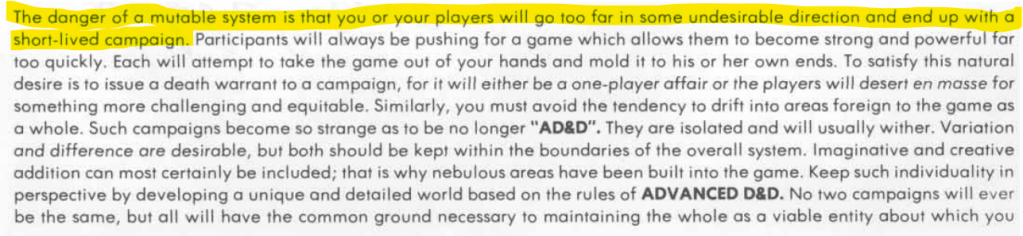
And, what mutates a system? Rulings as precedent mutates the game. It is acknowledged, that RPGs cannot and should not have rules for every little thing. It becomes too cumbersome and results in an unplayable game. Also, on a business side, publishers have choices to make regarding the costs of any game they are trying to sell, and this consideration impacts the space available for rules and compromises must be made. The thirty-four pages of Boot Hill has far less detail than the sixty-four pages of Gangbusters which has far less detail than who knows how many pages of AD&&D. While not unimportant these commercial concerns are not really my concern. My concern is as a game player. I want to play a particular game, not another game. And, if rulings create precedent the game changes.
A common objection is that one wants consistency in game and that precedents create consistency. I don’t disagree that consistency is desirable. But consistency in what? The game or the campaign? If rulings create precedent then each ruling is a new rule. And adding a new rule makes a new game. What would happen to say, Major League Baseball if the details of every arbitrated call were written down and the history must be scoured before making further calls. Soon we’d be playing cricket. No. Rulings are ad hoc decisions made in the heat of the moment. Many will be fine. But, also, many will be fine but suboptimal or cumbersome. And, some will just plain be wrong. Bad calls. Referees make mistakes, it’s expected. And, the rules of baseball don’t (or at least shouldn’t) be changed based on every umpire decision.
Now, sports do change. The 1901 decision to treat uncaught foul balls as strikes, dramatically changed the game of baseball. The 1979 addition of the three point line to basketball dramatically changed the game. And, of course, Boxing prior to the 1867 additions of the Marquess of Queensberry rules, is hardly recognizable to the Boxing after. Just the mere addition of gloves entirely changed the sport not to mention the other rules. But neither referees of boxing matches, nor umpires at the plate changed the rules. Rule changes were the result of a complex interaction of both the participants of a sport and the august bodies set up to regulate the sport.
So, for me as referee of role playing games, it is not desirable for every decision or arbitration I make to be considered law. Authoritative, yes, at the moment. But, to set precedent for all future decisions? No. I neither want my bad calls to be set in stone, nor do I want my freedom to arbitrate case-specific issues to be limited. In the end, precedent builds up to box one in and create rigid structures from which all logic escapes. We see this in law all the time. Our own current system is so bound up in precedent that very little gets accomplished and what does get accomplished is only through incredible costs of both time and money. Do I want that in my role playing game? No, I do not.
Now, I’ve quoted Gygax and leaned on his authority. Do I slavishly agree with him in all things? No.

As to the text above I entirely disagree. Here, he avers that the rules in the DMG are the “exclusive precinct of the DM”. He then goes on to discuss all the punishments one should inflict on “peeping players”. Gygax is entirely wrong here. Players not only should read the DMG and know the rules, they should help the referee remember the rules. This is not “rules lawyering”. This is knowing and playing a complex game in a cooperative fashion (even though it is also a competitive environment). Players have the right to know the rules of the game and the right to expect that the rules do not change except in well-considered fashion. I dislike the term Dungeon Master because the referee has authority but is no master. Or, should not be. The referee is just another role to be played in the game.
Are there decisions that should be remembered over the course of a campaign? Yes. But these things are more in how the world is presented. The map looks like this. This trap worked like that. Yes, there are floating cities in the sky this week, and also next week. But, what I’m speaking of are the grey areas. There is no rule. Or, there is a rule that might apply in some way. Or, there is no rule, but the situation is analogous to an existing rule. These get arbitration on short notice by the seat of one’s pants.
It is inevitable that a campaign evolve. But as Gygax says, such evolution should be slow. Treating every ruling as precedent is a recipe for disaster and speeds up the mutation of the game. I expect, Macris likely has a more subtle opinion than treating every ruling as precedent, so perhaps I am being unfair. He generally seems a reasonable fellow. He, after all, didn’t have time to fully discuss the issue.
For me though, referees are not judges, and certainly not legislators. Definitely, not masters. Referees exist to arbitrate the confluence of rules with situations, and facilitate the proceedings of a game. A referee’s decision from the prior week should mostly be forgotten as a case-specific decision of the moment. Today’s cases are slightly different, and who knows, perhaps a better decision will be made. Most importantly though, this week’s game is much like last week’s game, and everyone knows next week’s game will be the same game. Avoid the “great danger” and relax into the rules as they are, and be okay that some slight inconsistency of a referee between sessions is less important than knowing what game is being played. I feel fine with this opinion as it is the practice of nearly all refereed sports, contests, and games.

 Fluid -- Druid
Leave a comment