
In AD&D, a typical movement rate is 12″ per round. Cursory review of the missile weapon ranges shows that for most weapons an infantry unit moving to engage in melee with a unit of missile weapon armed soldiers will have to suffer at most one round of shots prior to engaging in melee. A long bow for example has a maximum range of 21″. A unit moving at 12″ will be at 9″ after one round of movement, and then in melee at the end of the second round. Even the heavy crossbow with its range of 24″ is stymied because heavy crossbows must skip a round of fire to reload. For many weapons such as spears, the range is so short, one might get no chance to attack. It’s enough to make one think that the cost of paying and equipping archers is hardly worth the price. But is this true?
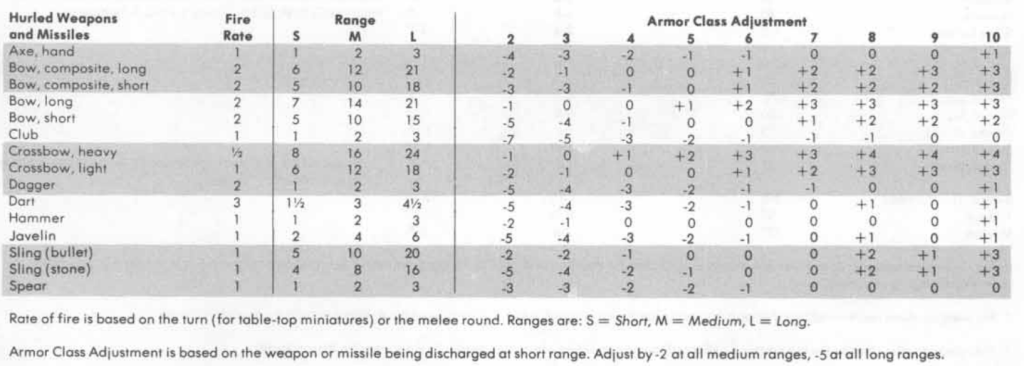
AD&D Rate of Fire and Ranges
This issue prompts the question, can something be done to slow troops down. There are two main ways (without resorting to magic) to slow troops down. The first is to armor the troop up. Armor slows troops down, opening them up to more missile attacks, but also affords the troops more protection. But an opponents armor isn’t (or not fully) under one’s control. The second means of slowing a troop is to engage in combat in terrain that puts your opponent at a disadvantage in speed.
It doesn’t take much flipping through the Dungeon Masters Guide to see that AD&D is silent on how terrain affects movement during combat. It may be that this was left out because a large part of the game focuses on dungeon exploration for which terrain type is not relevant. It may also be that Gygax felt it was obvious or that players would be referring to other rule sets like Chainmail or Swords and Spells when conducting outdoor movement.
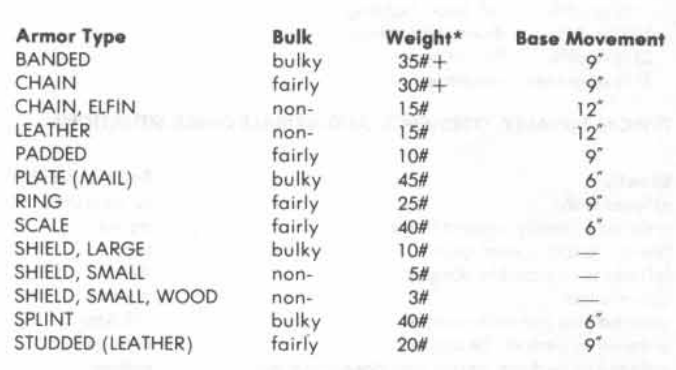
AD&D Armored Movement Rates
Looking at Chainmail, movement rates and missile ranges are similar to that of AD&D. Similar enough that one can tell the lineage between Chainmail and AD&D. Chainmail does describe how terrain affects movement rates. It’s pretty simple pretty much any terrain other than clear terrain halves movement rates.
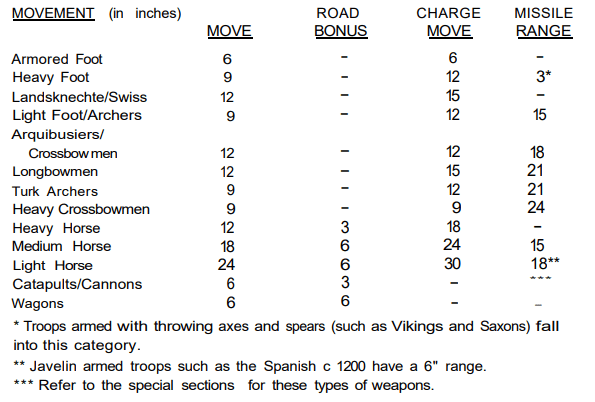
Chainmail Ranges
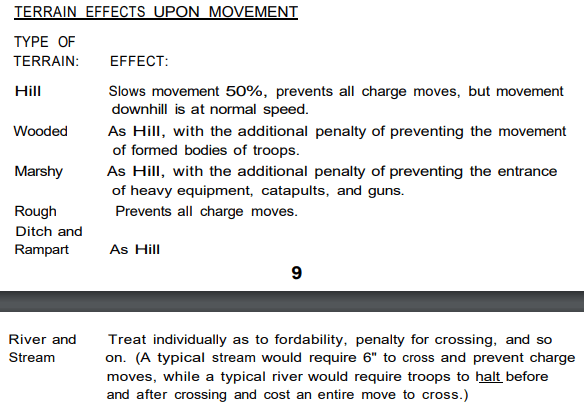
Chainmail Terrain Effects
It’s pretty simple to see how even this halving effect changes the efficacy of missile weapons in Chainmail. Opportunities for attack double. Swords and Spells is very similar so I will not go into detail for those rules.

Chainmail Rounds of Possible Attacks per Opponent Movement Rates
AD&D does include overland movement rates but only on a per day basis. This does not necessarily follow that the same proportions apply to short term movement rates. So, what to do? With no rule, it is up to the DM to adjudicate overland movement rates during combat. But it would be nice to base an adjudication on something other than mere fiat. The Chainmail rule is darn simple, one can choose to use that. But, let’s take a look at what happens if we do drill down to short-term movement rates using the AD&D daily movement rates. After all, one is then at least referencing and existing AD&D rule.
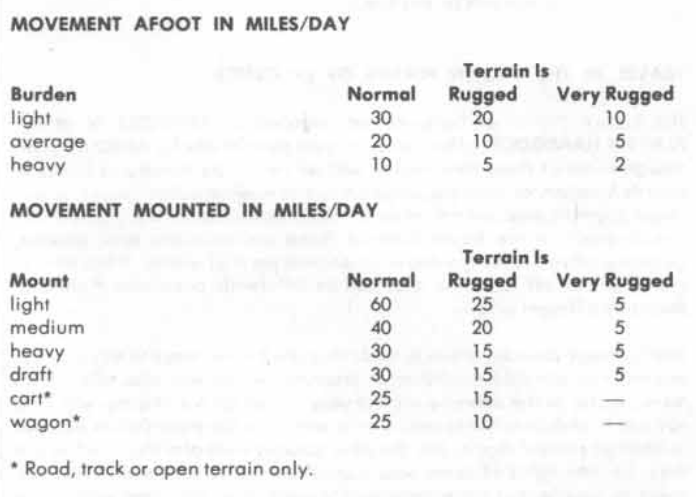
AD&D Outdoor Movement Rates
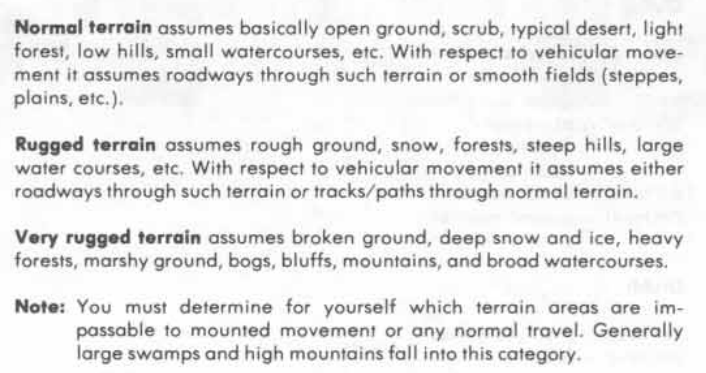
AD&D Terrain Ruggedness Categories
The overland movement rates give some general categories of encumbrance and general catefories of ruggedness of the terrain. Terrain types are then grouped in terms of ruggedness. Lightly burdened is 25 pounds or less. Average burden is 26-60 pounds load. Heavy burden is between 60 and 90 pounds. From the armor movement type table reference earlier one can see that the weights of the armor do not really line up with these burden categories. Of course, an armored fighter is not carrying just his armor. Yet, the movement rates in armor given do fit into three categories 12″, 9″, and 6″. For the purpose of this approach, I am equating these movement rates with light, average, and heavy burden.
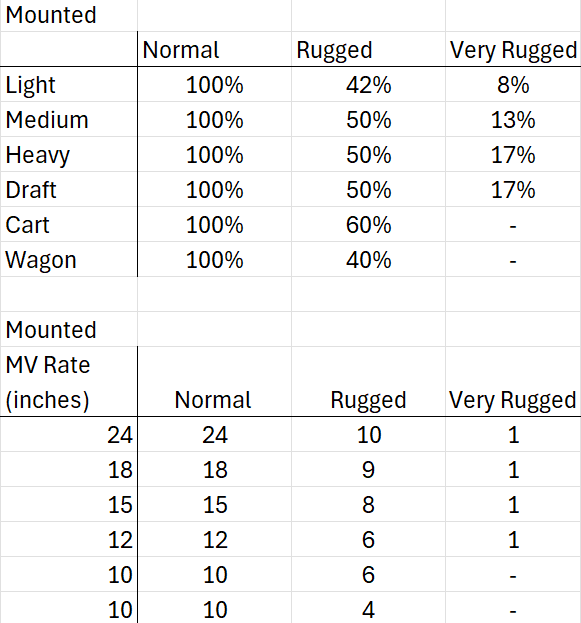
For foot movement then I equated the movement rates to the same proportions of daily travel in the different types of terrain.
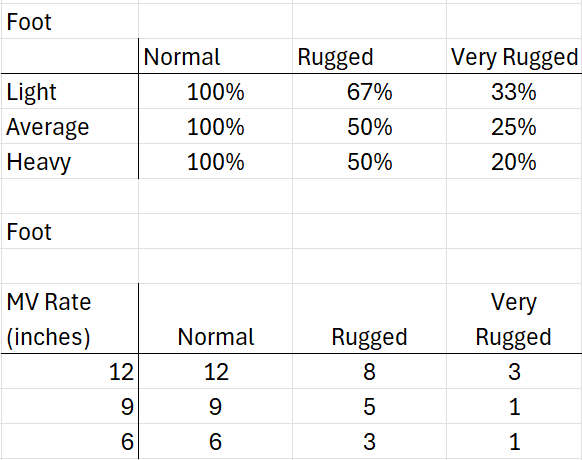
The same approach was used for mounted combat. Except the movement rates are the listed movement rates for horses from the Monster Manual.
Using the same analysis used for Chainmail one can see the possible number of attack opportunities for the various movement rates and missile weapon ranges.
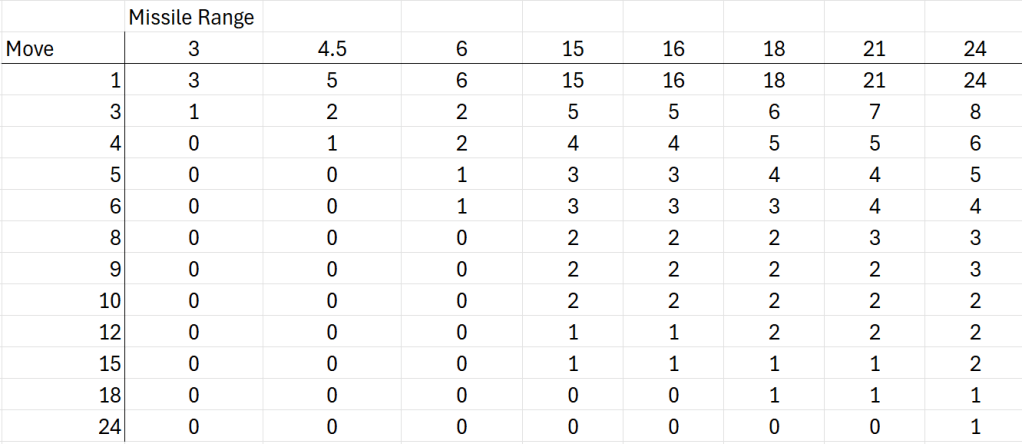
AD&D Missile Weapon Attack Opportunities per Movement Rate
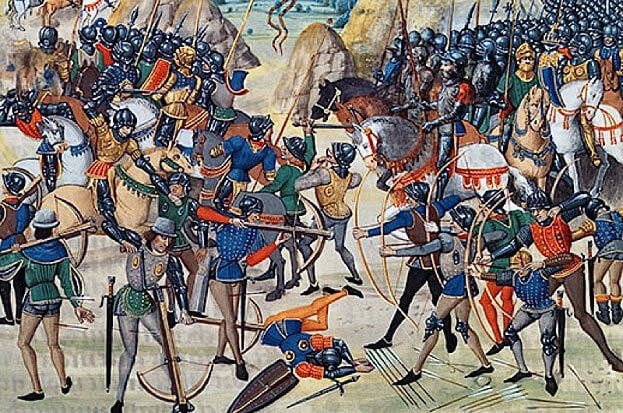
Now just as an example, lets look at the battle of Agincourt. Simplistically, Agincourt was English Longbows versus French knights. If the battle had been open solid ground the French knights would have been mounted. Let’s say mostly medium and heavy warhorses. With movements of 15″ and 18″ the knights would have been open to just one round of bow attacks. But, Agincourt was not fought on open solid ground. The English had chosen ground where the French had to approach them on muddy, even possibly marshy, ground. That then changes the equation to that of rugged and possibly even very rugged terrain the knights had to move across. If considered rugged terrain movement would be slowed to 8″ or 9″ giving the archers two or three shot opportunities. If considered very rugged movement rates are slowed to 1″ and, well, that’s disastrous — the archers have twenty-one chances to shoot. It should be noted that some sources estimate that it took the french knights about 15-40 minutes to cross the field. Twenty-one rounds for AD&D, not so different. Good job AD&D.
What about the knights heavy armor? Does it protect enough? The knights are also zero-level men-at-arms. Meaning the have 4-7 hit points (1d4+3, average 5.5). Over the 21 rounds of fire, the heavily armored knights are expected to only receive two hits on average. An arrow does 1-6 hit points damage (3.5 average).
So most of the knights are taking 7 hp of damage while only having an average hp of 5.5. It does not look good for the knights. If Agincourt were merely rugged ground with only two or three rounds of fire, odds are zero hits on the heavily armored knights before reaching melee range. This doesn’t take into account rate of fire or modifiers for range, let’s treat these as a wash (though the range modifier decreases likely predominate over the rate of fire increases).
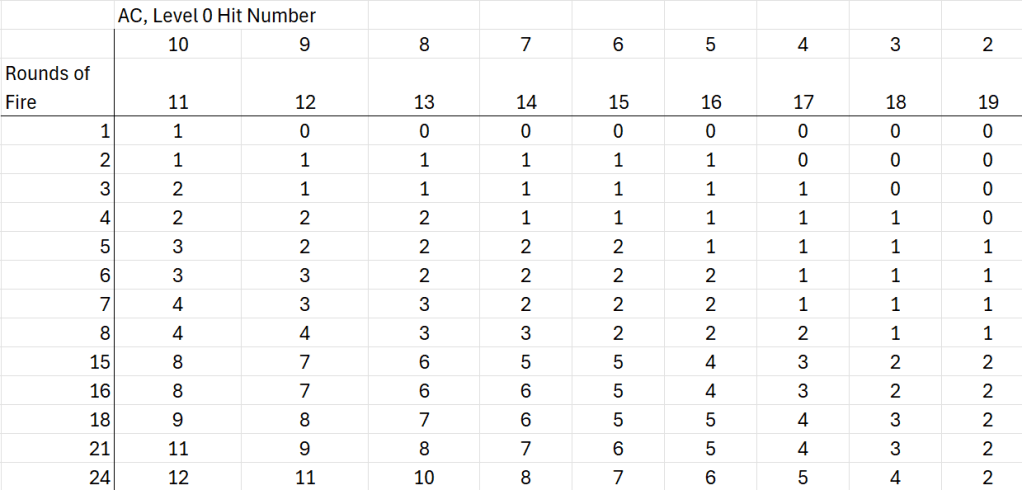
Average Hits per AC and Rounds of Fire
One can see armor does help significantly, especially in less extreme circumstances than found at Agincourt. For up to four rounds of fire, AC2 is sufficient to drop expected hits to zero. And, with a movement rate of 6″ that allows a heavy knight to close with archers pretty safely. Even chainmail + shield (AC4) only expects a single hit in the three rounds it would take to reach the longbowmen — and that single hit is not guarantee to ensure a kill. For vikings in chain +shield going against short bows, moving at 9″ that again drops expected hits to zero. Again AD&D, taking historical armor v weapon pairings, does a pretty good job in showing that armors were designed to nullify expected weapons.
AD&D also has this cryptic passage about light footmen. Light footman it says are useful in rough terrain. Useful how? The rules are silent.

But let’s assume the light footman are also lightly armored (say AC8). They can move at 12″ and even through very rugged is 3″. A 3″ movement rate opens them up to seven rounds of fire from the long bowman. And, at AC8, that is still odds of three hits. Not so good. The light footman still ends up dead. But against mounted or heavier armored units moving at 1″ in very rugged terrain, well, it’s not likely the light footman are going to let the archers into range. Plus, the light footman can in daily movement essentially move across areas that can only be passed with much effort by other troop types — there are a lot of implications toward strategic movement there as well.
The overall conclusion here is that missile weapons deployed poorly achieve poor results. While, conversely, missile weapons deployed cleverly taking terrain into account can be decisive. Choose your terrain wisely fellas.


 Fluid -- Druid
Leave a reply to AD&D 1e Movement Rates Revisited – Fluid — Druid Cancel reply