

Top Secret is, like many of the early TSR role playing games other than Dungeons & Dragons, underappreciated. This is TSR’s take on the action spy genre. Think James Bond. Think Cold War. Think 1972 Munich terror attacks on the Olympics. But mostly think James Bond.
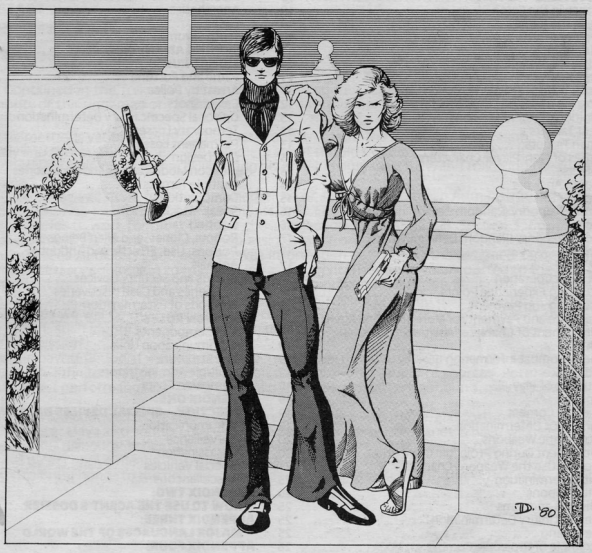
Top Secret features many of game mechanisms I’ve come to appreciate in recent years.
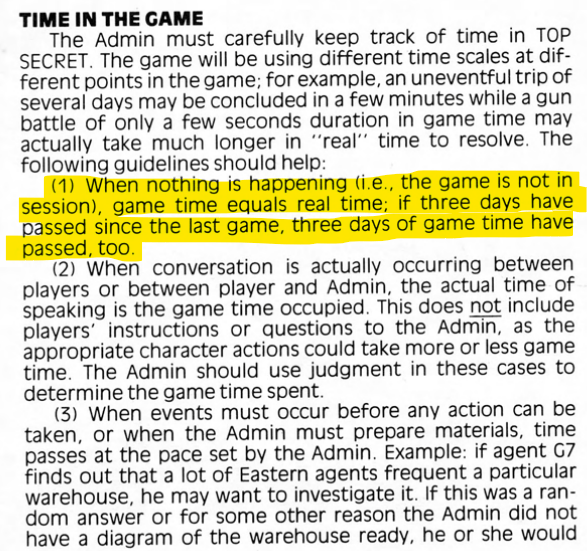
Top Secret has 1:1 time.
Top Secret has factions
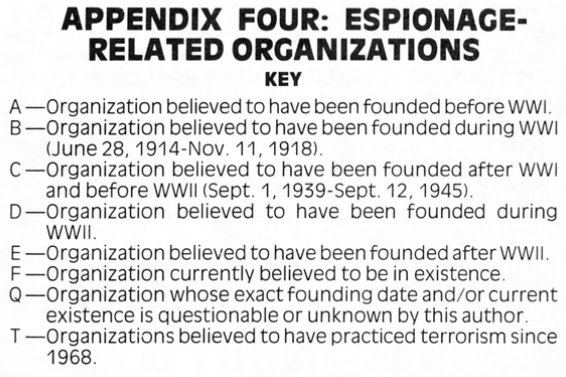
Several pages of factions.

Top Secret has Braunsteins.

Top Secret has low prep.

But only to a degree. And, this is where I feel it falls down as a complete game. Games need feedback loops to keep the game going. In Advanced Dungeons and Dragons 1e, the Appendices A, B, and C, provide that feedback loop. Appendix A is random dungeon generation. Appendix B is random terrain generation. Appendix C is random wilderness encounters.
Appendix B makes terrain with towns, castles, and ruins. Towns, Castles, and Ruins lead to Appendix A dungeons. Appendix A dungeons generate loot that must be carried through Appendix C wilderness encounters in order to get XP. Moving through the wilderness creates new opportunities for towns, castles, & ruins. This feedback loop is the most important part of the Dungeons and Dragons game. All the other subsystems could change (rolling d20s for example) and the essence of playing the game would remain.
Top Secret is missing the feedback loop. It’s close but it’s not quite a closed loop. Top Secret has a mission table from which one gains money and experience points. It has random locations.
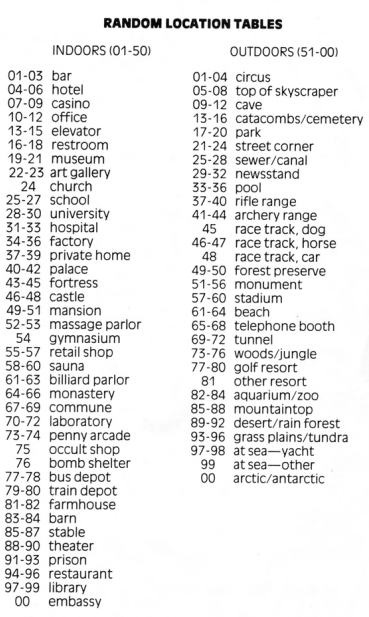
Top Secret has a limited selection of Random enemies through generating random guards.
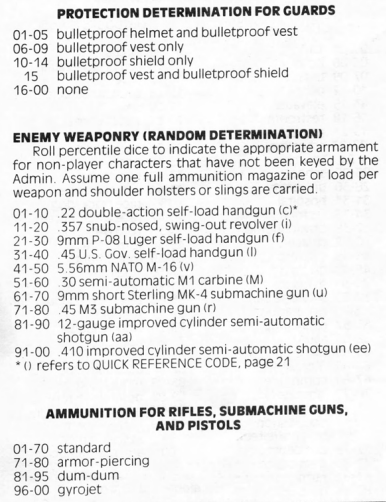
But Top Secret does not have a random mission generator. This in AD&D terms would be essential a combination of random terrain rolls combined with random monster encounter rolls, and other random NPC rolls (like castle inhabitants). In Top Secret it’s up to the “Administrator” (referee) to come up with missions. Or, is it?
Well, if one is playing modules it isn’t. A module contains a mission. Rinse repeat.
Or, if one is playing the Braunstein with faction play, the referee needn’t generate missions. Because missions will be either created by one’s opponents or self determined by the players given the context of the game.
Even within the context of Braunstein play, especially when carrying out an ongoing game, there may be times where you just need a mission on the spur of the moment.
And, myself, I don’t see myself consistently playing Top Secret as a Braunstein. And, I don’t want to play modules. I just want a means to generate missions on the fly to improvise from or to carry out some more elaborate prep a few days before game day. For this, I’ve created a simple random table mission generator. It’s not very elaborate at this point. And, it certainly could have more elements randomly generated to improvise from. But this is a start that is good enough for now.
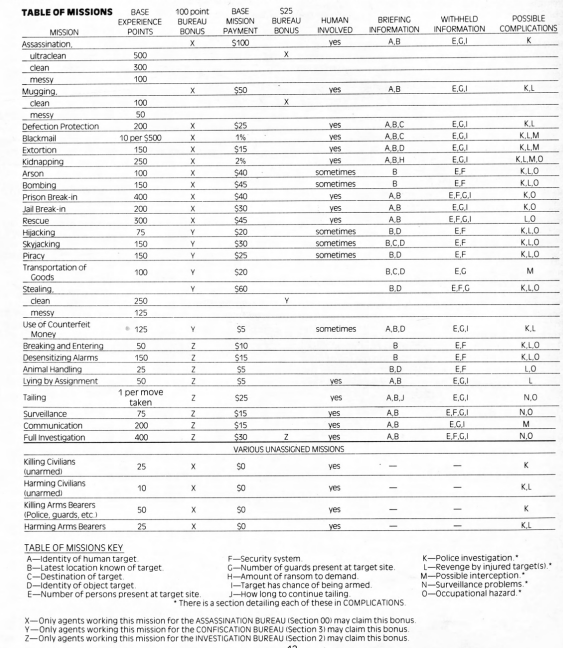
Let’s first take a look at the mission table. Note that for each mission there is a base XP awarded, with some bureaus getting bonus experience depending on the mission type. It has a lot of good basic information from which one can design a mission: type of briefing information, information that might be withheld, and possible complications.
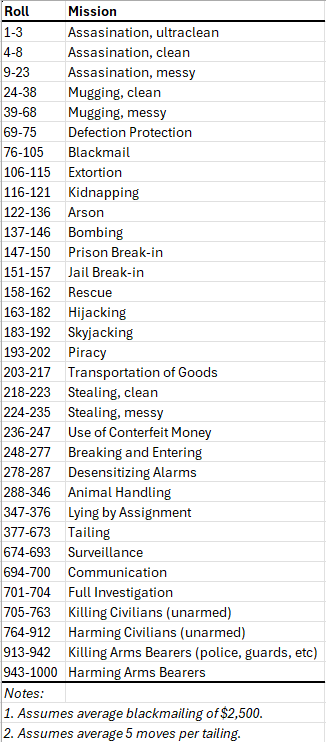
As a first step I generated the weekly odd of mission take as an inverse of base experience point value. Under this paradigm, the more rewarding missions occur much less frequently. Sad to say, but the life of a spy is more often tailing people, blackmailing people, harming unarmed civilians, and reading people’s mail than it is carrying out ultraclean assassinations.
The intent of the odds presented here are under the assumption of a weekly game session. So, game night or a couple days before game night, you roll the table. What are we doing this week Brain? Same thing we do every week Pinky, trying to take over the world! By assisting terrorists in Syria. I’m sure that’ll work out.
A perusal of the mission table shows some missions are of pretty limited scope. Or variable in reward. Really, a whole session just set around desensitizing an alarm? Well, no and yes. In the later Top Secret Companion, TSR clarified that a “Mission” might be composed of several of the tasks on the mission table list and renamed these things “jobs”. For example a jail break-in might also involve one to desensitize an alarm, blackmail a guard, tail people, and the harm unarmed civilians. But, let’s not forget, players are playing operatives in an intelligence agency. There is no expectation, especially for low level operatives, that the play characters are in on the whole story. It’s need-to-know and you just don’t-need-to-know. So, yes, characters might be assigned to tail someone not knowing that that person is to be assassinated by someone else later. They might be assigned to turn off that alarm not knowing it is to gather blackmail information. Starting characters (and players) need to get used to ambiguity.
Now let’s say you, as referee, roll a mission, design a mission around that roll, and present it to the players. The players now come up with a plan to carry out that mission. The plan they come up with might include a number of things on the mission list. If they carry out their plan and accomplish the things they planned do not scrimp of the XP because the mission you rolled here was only the one thing. My understanding of the mission table (or the later job concept) is that the referee will look at what the players achieve and assign XP as appropriate from the mission table. I’d even encourage players to remind the referee of what their character did that fits a mission profile.
Note that, as mentioned previously, this could be expanded. For example, blackmail and tailing mission rewards are based on the size of the blackmail and on the distance required to tail. One could create a random table for determining these parameters. Similarly, one could randomly generate Object and Human Targets from the categories suggested.

But all this can come later as the game progresses. I expect after a few weeks of generating random missions, a focus will develop, a variety of NPCs will then exist, and things will take on a life of their own. I expect, also, that the process of figuring out how a randomly rolled mission fits into the already established elements will become easier both with practice but also because the game now has an established context. A prison break-in, eh? Well, we already know there is a prison at X with Y characters in it. Rinse repeat.
In any case, here is one tiny step toward creating a real feedback loop for Top Secret. You needn’t use mine. It’s not hard to gin up a new random table with odds more to your liking. The point is to close the loop and make your game self-sustaining.
Addendum (variant)
After each mission is resolved, have each player (character) secretly write the type of mission they would prefer for the next session. Then when rolling the mission use the following procedure.
- Roll the dice to determine the mission type.
- Start with the lowest level character modify the roll in the direction of that characters listed mission up to 20 points per character level. Note: the modification stops when either the mission type is reached or all points at used up.
- Repeat Step 2 for each character moving from lowest to highest level.
Example, there are three characters with the following mission desires.
- Character A of 3rd level who prefers a Surveillance Mission.
- Character B of 7th level who prefers an Ultraclean Assassination Mission.
- Character C of 10th level who prefers a Clean Stealing Mission
So Character A has 60 points to modify the roll, Character B has 140 points, and Character C has 200 points. The starting roll is 344, Animal Handling. Character A wants Surveillance which starts at 674, his 60 points move it toward Surveillance to 404, moving it to the Tailing Category. Character B wants Ultraclean Assassination, so his 140 points moves the roll in that direction to 264, Breaking and Entering. Finally, Character C’s 200 points moves it toward Clean Stealing. Clean Stealing is at 218 to 23., only 31 points away. Since Clean Stealing is well within Character C’s 200 points. Character C gets their way.

 Fluid -- Druid
Leave a comment