

Conan is often stereotyped as a naked barbarian clad only in a loin cloth smashing his way through hordes of enemies. This is probably mostly due to the comics and the famous Frazetta paintings. As I showed in my earlier analysis of Conan in AD&D, this isn’t entirely fair.
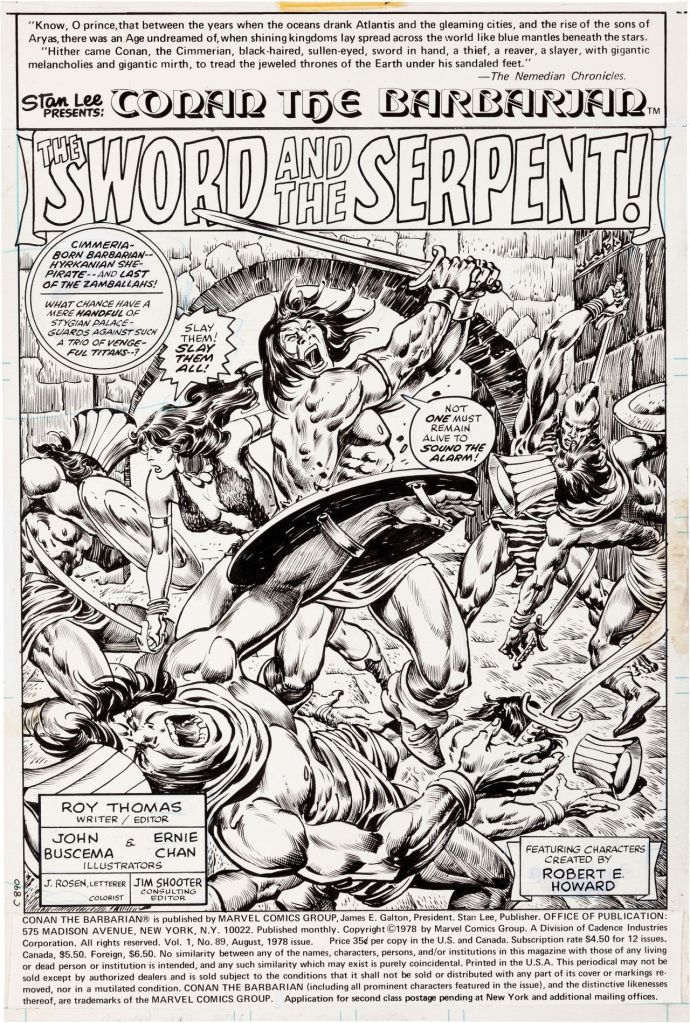
But, the naked barbarian stereotype isn’t totally wrong either. In at least eight of the stories Conan is indeed only wearing a loin cloth. And, in another six he’s wearing clothing but no armor. So 14 out of 26 stories Conan is unarmored. There are literary (or practical reasons for this). When he was young, Conan was a thief, and being quiet is likely more important than protection. Also, he likely could not afford armor at that time. In the later years, his silk breeches and white shirt are during his pirating days and at sea armor can be a liability is one ends up in the water.
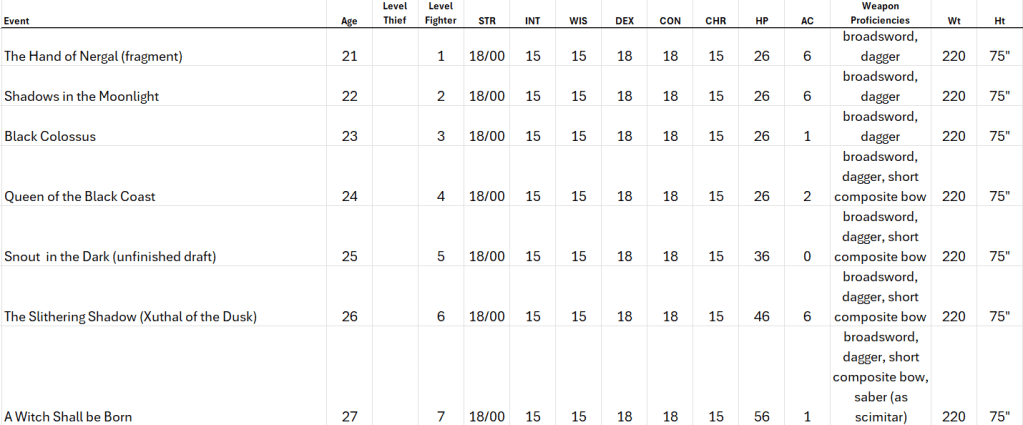
But in AD&D game terms, Conan’s early thieving years, as a thief the game does not allow him to wear heavy armors, and Conan’s dexterity already gives him an okay armor class of six. After Rogues in the House, Conan transitions to the Fighter Class. The rules of AD&D say if you use the abilities of your prior class you cannot acquire experience points until you have exceeded the level of your previous class.

And, we see that in the stories after switching classes, Conan proceeds to wear armor, at least whenever he can. Most often scale mail. But also, chain mail, and once chain mail plus a shield.
But, there are also AD&D game mechanics that might encourage a character to not wear armor. This flies in the face of common gamer wisdom to deck oneself out in the best armor one can acquire. Yet there are reasons one might avoid armor. Like in his pirate days, even in AD&D one can sink to the bottom of the ocean weighed down by armor. But, let’s look at a more subtle reason one might not wear armor. And that reason is, perhaps, best illustrated by the story Rogues in the House. In that story Conan wears nothing but a loin cloth and carries no weapon but a dagger (poniard). I’ve discussed this before using the great Douglas Cole’s Dungeon Grappling as an example. But here I focus on AD&D.
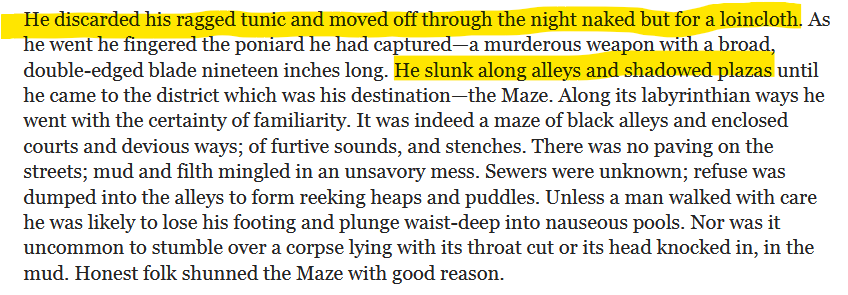
Conan, in the story has just escaped from prison. So, he no longer had access to any armor he might have had. He even discards his ragged tunic. The reason for this is not stated except that it is ragged but presumably it might also be filthy and infested from the pests in the jail cell. In any case, throughout the story Conan wears but his loin cloth. And, Conan also predominantly uses thiefly skills like moving silently, hiding in shadows, and finding traps. Or, not finding traps, as lower level AD&D thieves commonly experience.

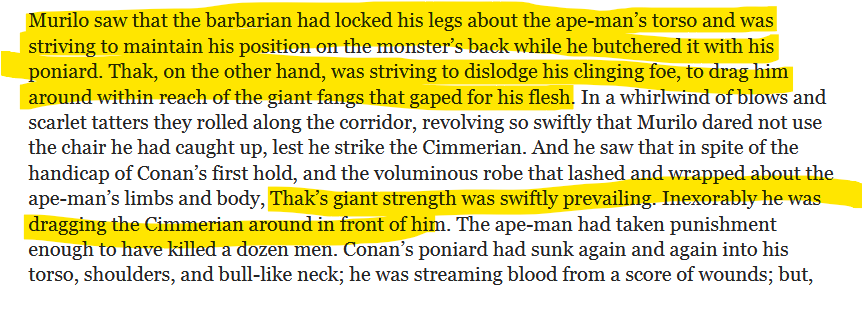
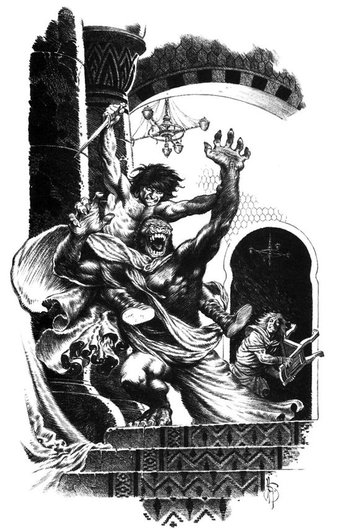
The story ends with a rousing fight between Conan and the ape-man Thak. Conan survives the bout because he takes Thak by surprise with both back-stabs, but also with wrestling.
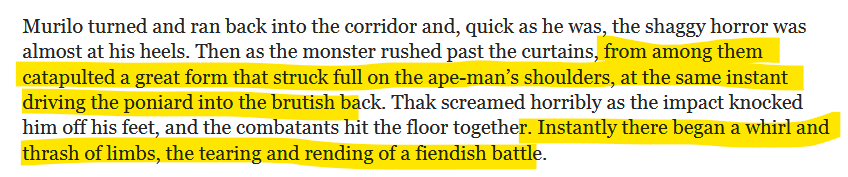
Thak cannot bite Conan because Conan maintains his position on Thak’s back through the use of wrestling.
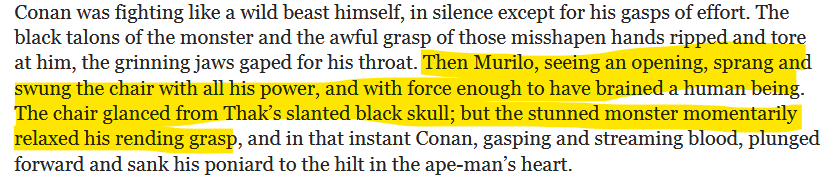
Even still, Conan looks doomed until he gets a little help from his ally Murilo stuns Thak with a chair.
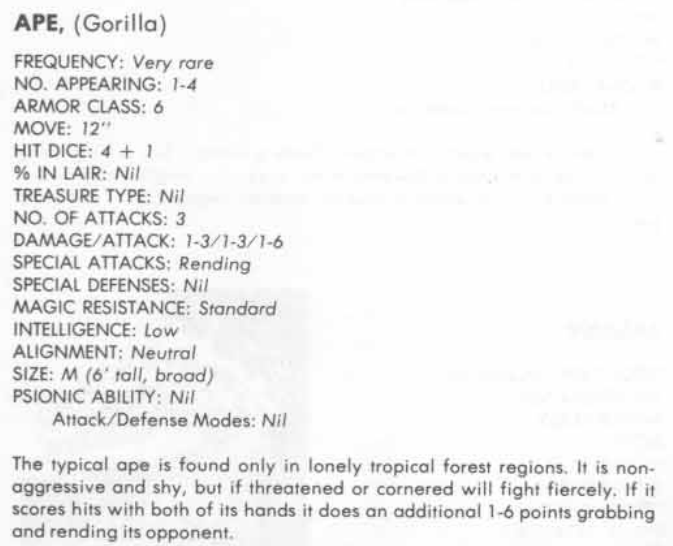
So, how would Thak be represented in AD&D? At first I think Ogre. However, the AD&D ogre is listed as Large. And, while Thak isn’t small, from the text, I wouldn’t put him at nine feet tall. The text describes Thak as an ape putting on airs as a man. The text describes Thak as doing damage from both his hands (claws) and bite. It just so happens that the Monster Manual has an Ape entry. And, the Ape entry shows the ape with a claw/claw/bite routine. There is also a Ape, Carnivorous entry but that, like with the Ogre, goes into the Large territory. I went with the regular Ape.
I’m giving Thak max hit points of 33 because of the text that says that Thak took damage that would kill a dozen men. In AD&D what this means is uncertain because AD&D gives ranges of hit points for a variety of types of men. Mercenaries get 1d4+3 hit points, while Laboring Males 1d6+1, Active Males 1d4+1, and sedentary males 1d4. Assuming sedentary males average of 2.5 hp, a dozen men would be 30 hp. Assuming active men average of 3.5 hp x 12 is 42 hp. Maxumum Ape hit points is 33, good enough.
And, Conan, using my analysis puts him as a forth level thief of 26 hit points.

In normal melee Conan would get one attack per round with a 15 or better rolled to hit Thak’s AC of 6. Thak, on the other hand would need to roll a 9 or better to hit Conan’s AC of 6. And, Thak would get three attacks per round. With a strength of 17, Conan gets +1 damage making each hit do 1d4+1 damage. Thak’s three attacks do 1-3/1-3/1-6 plus if both claws hit, which they will do more than half the time, an additional 1-6 damage is done. Thak will do, more often than not, an average 10 hp damage per round. Conan, meanwhile, will do an average 3.5 hp per round that he hits, and he’ll only hit in less than one in three rounds. Things do not look good for Conan in regular melee with Thak.
But Conan does not choose to undergo regular melee with Thak. Conan leaps upon his back and grapples. Now, what’s described in the fiction cannot be fully accounted for in AD&D. The reason for this is that Conan stabs Thak while grappling. In AD&D, one cannot grapple while holding anything in one’s hands. So, for this example, I will just deal with grappling and not weapon attacks.
Except, Conan gets surprise, is a thief and is backstabbing. Because Conan has surprise let’s assume two segments of surprise. Conan gets to attack for two segments. The first segment is a back stab with the dagger which will do double damage. We know from the text that Conan hits (it would be at a +4, so 11 or better to hit). Assuming average damage (2.5+1 rounded to 4). Thak is now at 29 hp. The second segment of surprise Conan grapples. From this point on, I ignore the dagger.

Second, there are some interpretation issues. In simplified form, an AD&D grapple is carried out by rolling against a base score to grapple, then, if successful, rolling for the effect of the grapple. Determining the base grapple score highlights some of these issues of interpretation and the interpretations I’ve chosen.
The base score to grapple is to multiply AC by 10 and then modify it by various factors. Now, Conan has an AC of 6 which is AC10 reduced to 6 due to his dexterity defensive adjustment. So, a 6 x10 is 60%. But a common man with no dexterity benefit would then have 10×10 or 100%. Huh? My interpretation here is that the defensive adjustment is not used in this case. That the AC referred to here is like the AC referred to in Weapons v AC adjustments, that is just the AC provided by the armor itself. Because why would having worse dexterity give one an advantage in grappling? So Conan has a base 100 percent, after going through the modifiers this is modified up to 118% due to his dexterity. Had Conan been wearing Chain Mail his base would have been 50% (5×10) plus 18 for his dexterity so 68%. In both cases, Conan’s odd of success go up from his normal melee odds of 30%. But, clearly, going totally without armor is a big advantage here. Given a 118% chance rolled on 1d100 Conan’s grapple is automatic.
And the result? Again 1d100 is rolled and then modified. At first, the modifiers are simple, Conan’s dexterity of 18 gives an 18 modifier and his strength of 17 gives a 17 modifier for a total of 35. But then we get to another interpretation issue. What is Thak’s height and weight? AD&D is silent on this. This is because the Monster Manual was published prior to the AD&D Dungeon Master’s Guide that included this method of grappling.
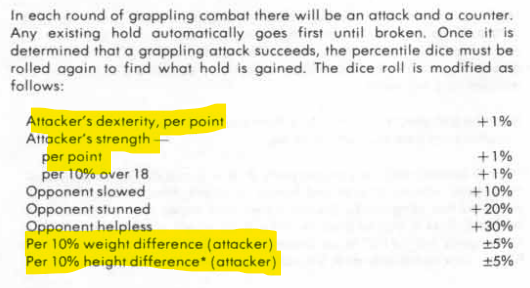
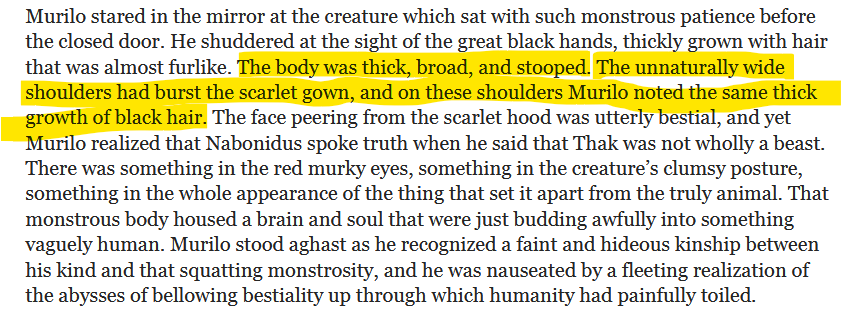
There isn’t a lot of textual information to go on as to Thak’s height and weight except that he seems roughly man-sized and has a stooped posture and wide shoulders. He also throughout the fight seems to be slowly winning against Conan (at least until he gets hit by the chair). So, the other source I’m going with is Frazetta’s painting. It’s hard to tell but, Conan seems taller, I’m giving him 20 percent over Thak. But, Thak seems from both the illustration (compare forearms) denser and stronger than Conan. Let’s give Thak 20 percent over Conan in weight. You might choose differently here. I’ve addressed means of assessing height and weight through random rolls for AD&D monsters here. In a game, I’d recommend that height and weight get rolled randomly. But, for this example, the assumptions I’ve made come out as a wash, Conan’s height advantage is offset by Thak’s weight advantage. Conan only gets the +35 on the effect roll.
But, the effect roll is also modified by both the opponents dexterity and strength. Crumbs. Again the monster manual, for the most part, does not list dexterity or strength for monsters. And, it most certainly does not list these parameters for an ape. So, one has to wing it. Thak has an AC of 6. This could argue for a dexterity equal to Conan’s own which resulted in an AC of 6. But Thak also has a pretty tough hide — like leather armor. Leather armor gives AC 8, so Thak would need dexterity of 16 to produce AC of 6. Dexterity of 16 it is. And strength. The text indicates that Thak is stronger than Conan, but maybe not by a huge lot. As mentioned before Thak is tough, but he’s no Ogre. Ogres are reputed to have a strength of 18/00. Let’s give Thak a straight 18. I mean in a mere hundred thousand years his species might evolve into men, right? So, dexterity 16 results in a -4 to the roll and strength 18 results in a -6 to the roll.
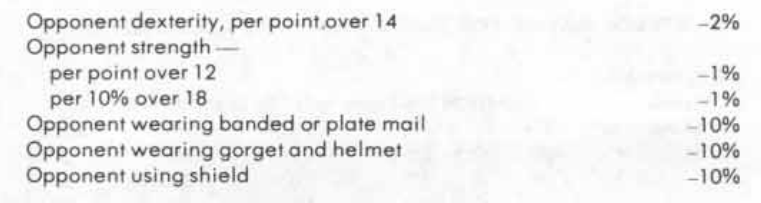
One thing I haven’t mentioned is that AD&D non-weapon combat also has an individual specific variable that may be applied to either the base roll or the effect, player choice. In Conan’s case, as attacker, he gets 1d6+1. The plus 1 is from the column of the attack matrix Conan uses which as a 4th level thief is the first column. And Thak gets, as defender, 1d4+6. The plus six here is as a 4HD creature, Thak rolls on the sixth column of the monster attack matrix. This is another interpretation question, did Gygax really intend monsters to get such a benefit in unarmed combat? I suspect he didn’t think about it, or hadn’t applied the unarmed rules to monsters. But I’m trying to be rigorous so I’m going with the plain text of the rule. Average rolls would put Conan at a variable of 5 and Thak at 9. Given Conan’s superb base roll the only logical thing for Conan and Thak to do is to apply these to the effect roll. The total modifier is (35-4-6+5-9) is 21.
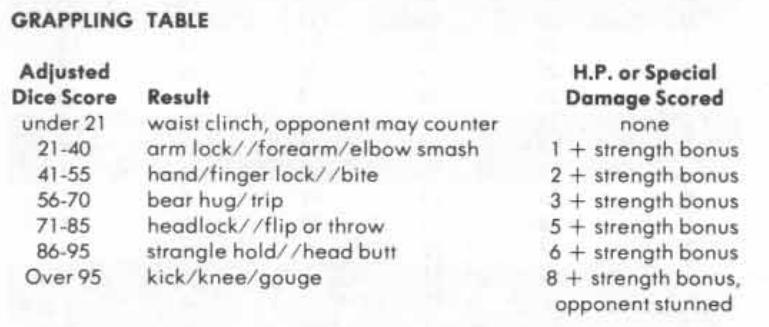
From the grappling table we see that a minimum roll for Conan is a 22. Well, on average for individual variable. If Conan rolled poorly and Thak rolled well, it is possible to go as low as a 17 modifier so minimum 18 roll. Worst case odds, Conan has traded his 70 percent change of doing no damage in melee to a four percent chance of doing no damage. Given an average percentile roll of 50, Conan then is doing minimum (50+15) 4 points of damage, or 5 points assuming average individual variable rolls. Let’s call it the headlock so six points more damage to Thak. So Thak is down to (29-6) 23 hp. Now, of this only 6 hp is real. But no matter an unconscious ape is easy to finish off. And, this also translates to, as a successful grappler, Conan automatically getting first attack the following round. Yet, there is more advantage in choosing grappling for Conan.
Since they are no longer in regular melee combat and Thak is grappled, he has no choice but to try to break the grapple. That’s a single attack rather than his normal three (plus the rend chance). To break the grapple, Thak must roll greater level of hold than he’s currently in.
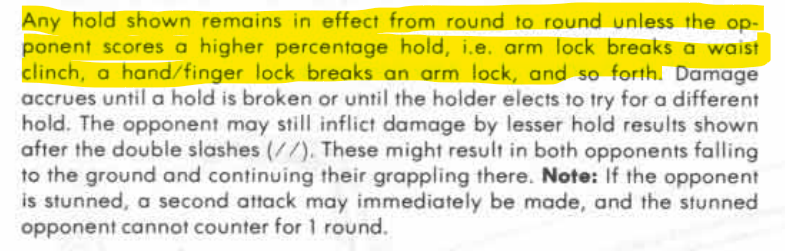
So, here comes another interpretation issue. The rule says the hold remains in effect round to round unless it is broken. So, my interpretation here is that Conan does not need to roll the base grapple each round. Conan can just ride out his lead lock with the hope that Thak does not break the grapple. Or, Conan may choose to go for a new hold. This is risky for Conan though as he may roll poorly and lost the grapple entirely or roll lessor effect. But Thak first gets to try to break the hold. Or does he? Conan’s grapple was the second segment of surprise so Thak gets no response during that segment.
Then a normal melee round starts. Conan has already grappled Thak. Thak automatically takes another 6 damage for the headlock. 23-6 is 17. Eight real damage. Conan is now still undamaged at 26 hp. Pretty good choice on Conan’s part.
Conan has grappled Thak but Thak has not yet grappled Conan. What’s Thak’s base chance? Thak has an AC of 6. So 6 x10 is 60 percent? Well, let’s go back to my earlier interpretation that it’s like weapon v AC. Thak has dexterity and a tough hide, but he’s wearing no armor. So, that’d be AC 10 x 10 =100 percent. Again, some interpretation is necessary here. In the story Thak is wearing a heavy, large, entangling robe. The story describes it as hindering his wrestling. I’m calling that robe for the purposes of grappling, the equivalent of padded armor so AC of 8. So Thak get a starting 80 percent. Plus 16 for his dexterity. So, a 96 percent chance to grapple. Had, Conan been wearing armor Thak would get a +10 or up to +30 to this value. Nevertheless, Thak is no slouch. But, Conan’s choice (or situation) of wearing no armor translated an automatic grapple attempt into a likely but not automatic grappling attempt. But Thak and Conan have pretty similar rasslin’ abilities. Though, Thak’s hubris of wearing the robe significantly holds him back.
To break the headlock, Thak needs an 86 or better. Meaning he needs to roll a 65 or better to break the headlock. Thak has a decent chance to do so, or even if failing do significant damage to Conan. From the text it doesn’t seem like Thak ever quite breaks the hold. But, let’s say he matches Conan’s level that’s seven points of damage. So, Conan again has traded an average of 10 hp per round, for less than 10 hp per round. In fact the maximum Thak could do grappling is 8+2 or 10 per round. Though, it could be 20 as the 8+2 does result in a stunned effect and an automatic another chance of damage. But, Conan also has a chance to roll well here and get stunned results.
As the text indicates Thak never breaks the hold. Let’s say Thak gets a less than average roll of 40. Plus 21 puts Thak at trip (they do end up on the ground) and does 3+2 hp damage (1 real). Conan is at 26-5 or 21 hp. Thak is at 17 to Conan’s 21.
Next round. Both Conan and Thak are now grappled. Conan 6 hp per round and Thak 5 hp per round. Under this scenario Thak will lose unless he breaks Conan’s hold. Conan sticks at the headlock, Thak is down to 11 hp. Thak tries to break the hold and fails, but he does roll well enough to match Conan’s tier, they are flipping/rolling around on the ground. Thak does 7 hp damage. Conan sits at 14 hp (3 real) and Thak at 11 (10 real). Things aren’t looking so good for Conan now. Under this scenario Conan is out in two rounds and Thak also two. But what if next round Thak gets a better roll than Conan. All might be lost.
Luckily for Conan. Murilo gathers his courage and strikes at Thak with a chair and hits. Treating the chair as a form of club Murilo gets a real solid hit in of 6 hp bringing Thak down to 5 hp. The following round Conan’s 5 hp takes Thak to unconsciousness to be finished off with the dagger. The battle is ended with Conan taking merely 5 hp of real damage.
So, Conan being unarmored was an advantage here? Well, maybe. If he’d been armored. As a thief he’s limited to leather armor (AC 8) giving him an overall AC 4 with dexterity taken into account. This does reduce Thaks odds of hitting from 60 percent to 50 percent. And, of course, once Conan becomes a fighting man wearing scale (AC2) or chain (AC1) the odds drop to 35 percent or 40 percent. Perhaps, wearing armor, is the better deal.
But as a 4th level thief with great dexterity and decent strength, the choice to grapple over wearing armor was definitely in Conan’s favor.
Yes, there are interpretations to make, and the Monster Manual doesn’t provide all the answers. But, the sort of tactical choices a character might make in the classic pulp stories are recreated by AD&D 1e right out of the box.

 Fluid -- Druid
Leave a comment