
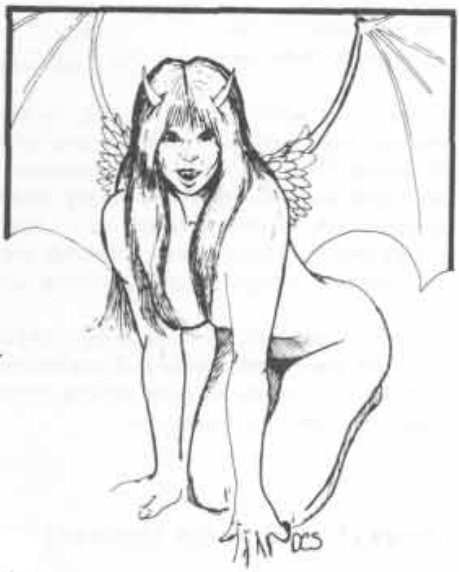
Sometimes you just want to post the cheesecake. Despite that, I do have a serious thing to point out. I’ve talked before here and here how the AD&D 1e psionic rules produce nice representation right out of the box of Lovecraftian horror effects and monstrous abilities. It should come as no surprise that for the Monster Manual’s Demons and Devils the same is also true. But let me give an example with a look at the Succubus.
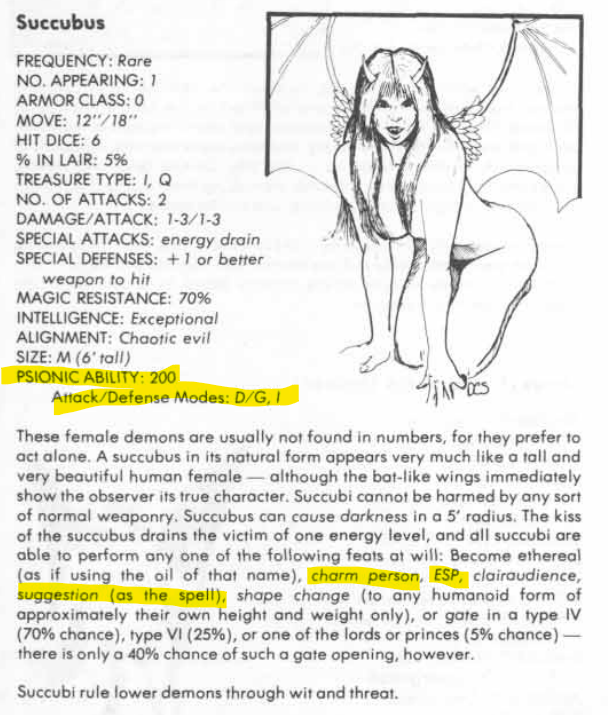
The Succubus, as should be obvious from the name and illustration, is a creature of seduction. The Succubus has several innate magical powers including many useful toward seduction: charm person, ESP, suggestion. So, just their a Succubus can know what you are thinking, magically suggest you take specific actions, and charm you into being if not their slave than willing accomplice. And, in addition, they can shape change to fit whatever predilection the ESP suggests your character desires.
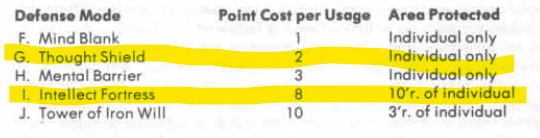
But, if a target is psionic, then there are other options if the character makes its saving throws. Psionic creatures/characters has special abilites but also special weaknesses. Other than Psionic Blast, non-psionic creatures are immune from psionic attack. Psionic characters are sensitive soles that give the Succubus one more avenue of attack. From the stat block one can see that a Succubus has the not inconsiderable two hundred psionic points plus attack mode D and defense modes G and I. What does that mean? First, look at the Player’s Handbook, page 110.
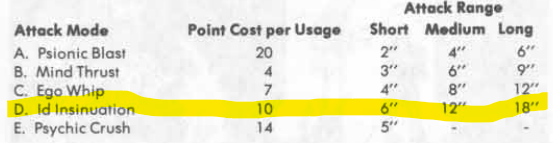
From the PHB, one can see that Attack Mode D is Id Insinuation. Id insinuation?

A psionic attack mode dealing with the part of the psyche that is the source of instinctual impulse with demands immediate satisfaction or primitive needs? Well, that seems thematically appropriate for a Succubus.
And, the Defense Modes G, and I? G is Thought Shield and I is Intellect Fortress. Again, many a femme fatale keeps their thoughts to themselves and hides their intellect from the common eye. Better to be underestimated.
So, right away these psionic attacks and defenses seem appropriate to the Succubus. But, what do they mean in game terms? On the attack, Id Insinuation isn’t the strongest attack (though it ain’t bad) but it is universally effective, there is no defense mode that fully protects from Id Insinuation. The Succubus’s sole attack mode can thus reach anyone. No one is safe from the Succubus’s mental intrusions — such is the nature of the id.
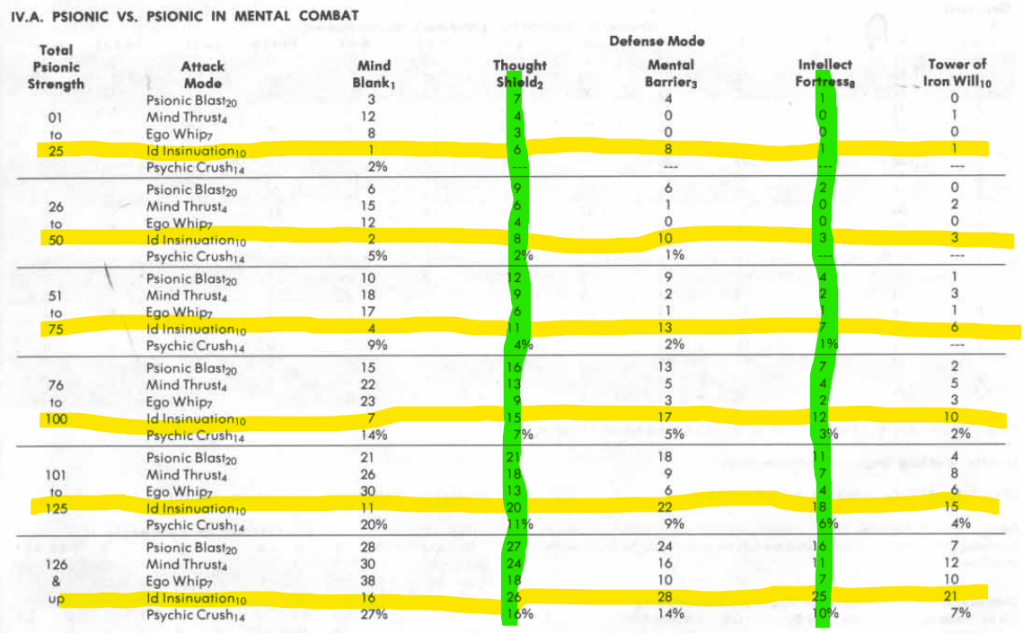
On the defensive side, Thought Shield and Intellect Fortress are not too shabby. Only Tower of Iron Will is better than Intellect Fortress. But at a cost of eight psionic points to invoke, Intellect Fortress is expensive to use and against lessor threats the Thought Shield cheaper cost of two my be good enough. Under a strong psionic struggle, one can imagine the Succubus starting with Intellect Fortress and then resorting to Thought Shield as her defense points dwindle. Or, the reverse, start with Thought Shield then save Intellect Fortress for a last ditch defense. But with two hundred psionic points, against most characters one doesn’t much imagine the Succubus worrying too much.
Once, a psionic opponent’s defenses has been worn down, what are the effects of a successful Id Insinuation?
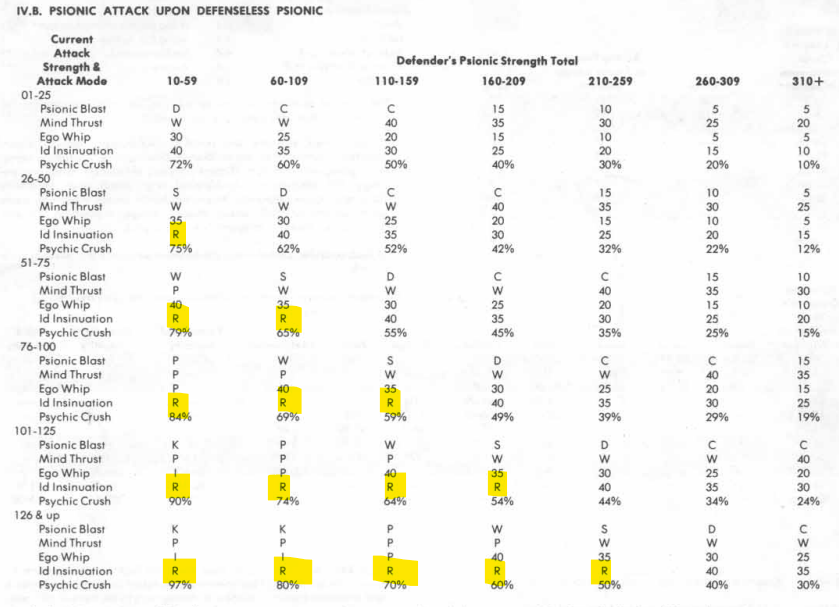

From the table, other than draining psionic points, Id Insinuation has only one effect — R! Not R! Wait, we’ve seen R before. R stands for Robot. The character struck with the R result is in total control of the victor like a robot for two to eight weeks. And if a saving throw versus magic is made. It doesn’t explicitly say what happens if the saving throw is failed but I presume it means another two to eight weeks of control.
In may previous review of psionics and the Yithian, I used this R result to mimic the Yithian mind-swap power. But, in this case, no doubt the character is under the femme fatale wiles of the Succubus. Interpretation can be loose enough for the same result to cover both similar effects.
Now to show how these psionic powers can be used to produce thematically appropriate effects I have a couple of examples to compare to the Succubus. First, let’s look at the Glabrezu, or Type III demon.
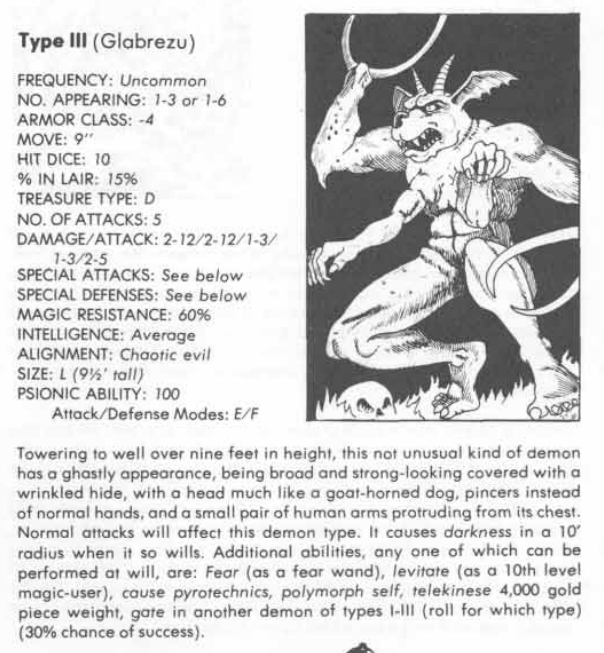
The Glabrezu is a lot different from the Succubus. Of average intelligence rather then exceptional, it is well muscled with horns, fangs, and pincers. Only those with the oddest of tastes would want to hug a Glabrezu. Its psionics reflect this too. It has a hundred psionic points and the sole attack mode E and defense mode F. Attack mode E is Psychic Crush — which is mostly useless in psionic combat. Psychic Crush produces a percentage chance that the target dies outright but otherwise does no points of psionic damage. At best, the Glabrezu would have a mere seven or three percent chance of killing a Succubus outright depending on which defense the Succubus chose. And, after that first round of psionic combat, if it didn’t kill the Succubus outright, most likely can do no further psionic damage to a Succubus. Given the psionic points disparity between the two, odds are any given Glabrezu ends up the Succubus’s willing slave. The Glabrezu’s psychic crush is most useful against the weakly psionic sensitive individual — those the Glabrezu can bully and threaten and push around. But they best not tangle with a Succubus.
For my second example, let’s skip from the demons to the devils — the Erinyes.
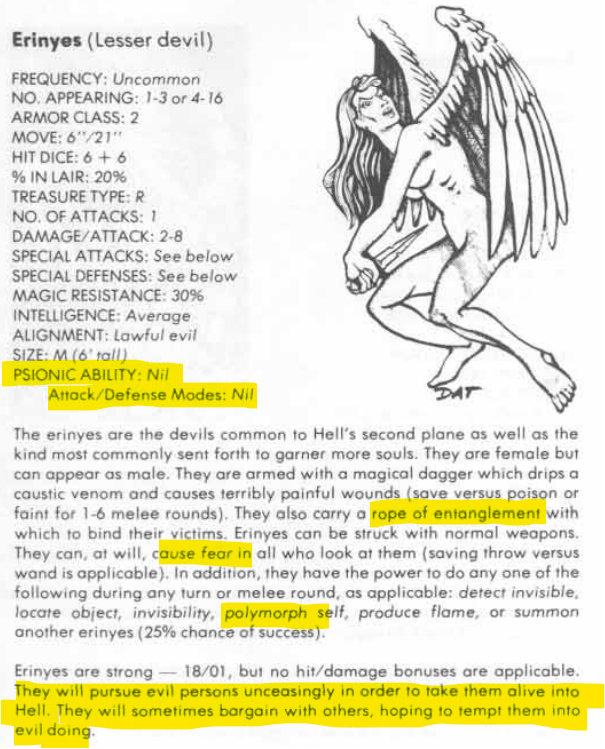
Superficially, the Erinyes resembles the Succubus — naked lady with wings. They both show a lot of skin but it’s only skin deep. However, the Erinyes has none of the femme fatale characteristics of the Succubus. The Erinyes can’t charm, has no ESP, does not make suggestions. An Erinyes job is to seek out the evil and drag them kicking and screaming down to hell with the use of their magic rope and painful dagger. The Erinyes is not psionic in the least. The Erinyes would be totally immune to the Succubus’s psionic attacks. The Erinyes is not a sly seductress. The Erinyes is a fallen angel hell bent to carry out their duty to pursue the evil. Yes, the Erinyes may occasionally hope to tempt the good down to hell but temptation isn’t really their bag and one suspects their coal-like hearts aren’t really all that into it. But, hopefully, one can see how monsters that are superficially similar looking can be very different in effect when psionics (and their other abilities) are taken into account.
I will leave it as an exercise for the reader to take a look at the other Monster Manual Demons and Devils and investigate how their various psionic abilities reflect their nature.

 Fluid -- Druid
Leave a comment