
People have strong opinions on how unarmed combat is carried out in AD&D 1e. The method is a little fiddly, the monster manual does not provided the necessary information to carry out the method, nor do any of the AD&D modules to my casual perusal. Even Gygax provided alternative methods in the Unearthed Arcana book. However, myself, I love it. Why?
- The methods synchronize well with the 1-minute round. Just as each 1-minute combat round is a entire series of strikes, defenses, feints, dodges that results in a certain amount of hit points of damage (or not), the 1-minute pummeling, wrestling, or overbearing, round has a number of possible outcomes. A player isn’t micromanaging techniques but the dice are extracting a statistical result.
- The variety of outcomes is interesting.
- The methods are not affected by level per se, except like in all things characters with more hit points have a greater chance to outlast an opponent. But, a 0-level underdog has a real possibility of winning against a leveled opponent. That means, even the great must be wary of unarmed combat.
I love the methods, but I realized the other day that I’d like for characters to be able to arm wrestle in my games. How would I go about it?
First, an overview of the wrestling rules. Without getting into the fine details wrestling in AD&D 1e is a multiple step process.
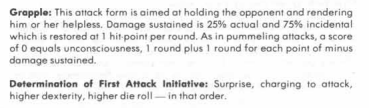
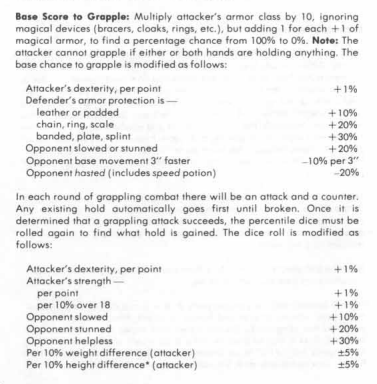
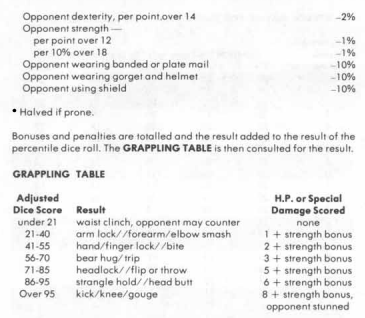
DMG, p. 72-73
- Determine first attack initiative.
- Calculate the base chance to grapple.
- Modify the base chance by situational modifiers.
- Roll percentage dice to determine whether a grapple is successful.
- Roll percentage dice to determine the outcome.
- Repeat the following round until one opponent or another is completely subdued.
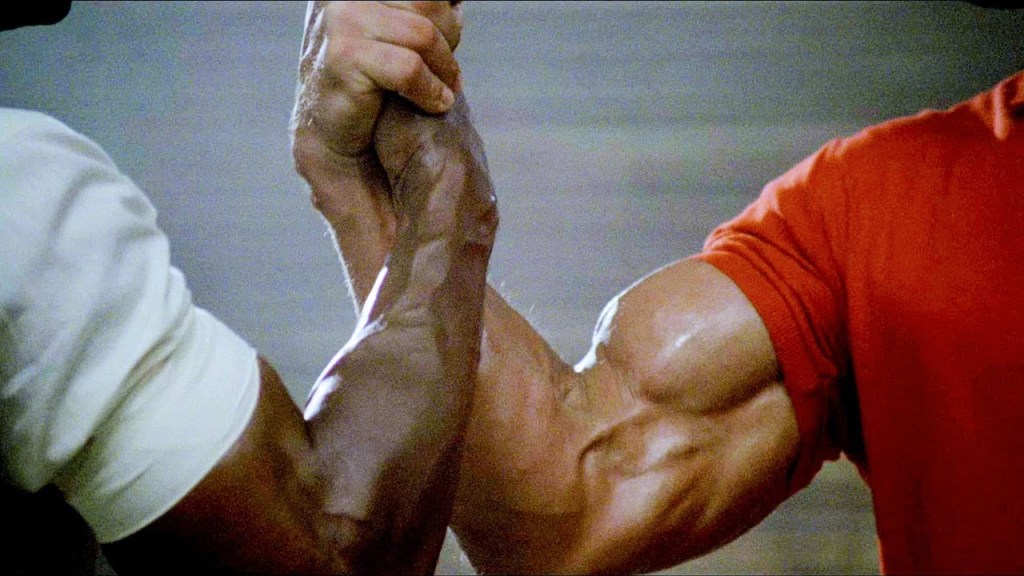
Arm wrestling is different from normal wrestling. First, there is no escaping a hold, both parties voluntarily start in a hold (of hands) and remain in that hold throughout the bout. The position chosen to arm wrestle and the voluntary nature of it, is explicitly chosen to favor strength over dexterity and movement rating. Similarly, the sitting position minimizes weight differences though height differences still are relevant as height relates to arm length and the multiplying effects of leverage. The upshot of all this is that arm wrestling either eliminates or simplifies a lot of whats in the general wrestling method. So, here’s my approach based on the simplifying the method.
- Opponents start grappled so there is no point in rolling to see if a grapple succeeds. But initiative is still important in arm wrestling. It is recognized that first off the mark does give some advantages. Initiative is determined by rolling for surprise, if neither side is surprised than initiative is given to the character with the greater dexterity, if dexterity is tied then initiative is given to the character who rolls greater on a six-sided die — if still tied, repeat rolls until the tie is broken.
- There is no roll to determine whether a grapple happens, the winner of initiative skips to the roll for effect. Roll percentile dice and modify the roll using the following modifiers and cross reference the results table to determine the results.
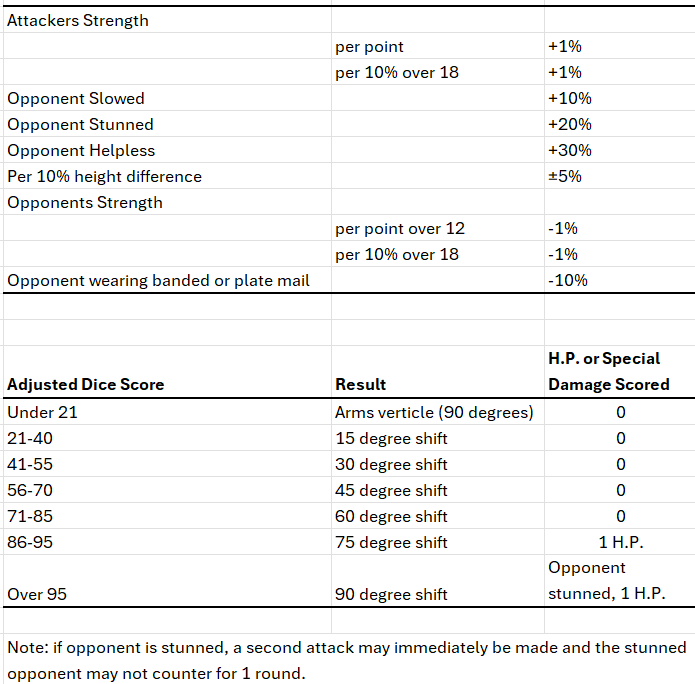
3. Note that the normal variable bonus (see DMG. p.72) may added to the attacker’s result roll, or subtracted from the opponents counter roll.
4. Once the attackers roll result has been determined, the opponent may counter. Just as with the attacker roll percentile dice and modify the number rolled by the variables with the opponent now the attacker to get a result. This result is subtracted from the original result to get the degree shift for the start of the next round. For example, if the attacker gets a modified 60 this results in a 45 degree shift; if the opponent then rolls a modified 75 this is a 60 degree shift, leaving the start of the next round at 15 degrees shifted toward the original opponent.
5. If a party is stunned a second attack may immediately be made and the stunned opponent may not counter for 1 round.
6. If, at the end of any round (i.e. after attack and counter), the degree shift is 90 degrees or more toward on character then that character wins the bout.
7. All subsequent rounds, no initiative is determined. Both characters determine their modifiers and make their rolls. Announcements of where a character is placing their personal bonus must be announced before any rolls. Under this approach both parties might end up stunned. In which case no follow-up attacks are made.
Note that in most bouts the modifiers will be primarily the strength and height modifiers assuming skullduggery is not occurring.
Tournaments
I won’t go into tournament structure here as there are a number of ways to carry out tournaments as individuals or as teams. However, during tournament play things are less casual and people may be sticklers for the rules — that is there is a chance that fouls occur. There could be a variety of foul types: should crossing the center line, touching an opponents shoulder, dropping ones shoulder when in a losing position, lifting an elbow, inappropriate starting, slipping out, etc. We won’t detail every possible foul. But there will be a chance of a foul occurring.
Whenever a result is rolled that results in a 60 degree or greater shift, the person that rolled it must make a saving throw versus paralyzation, failure meaning a foul occurred. Note that this is not a net sixty degrees but for each roll. For example an attacker may roll a 60 degree shift and the opponent may also roll a 60 degree shift resulting on zero movement, but in that case both characters would have to make the saving throw. These saving throws are made at +6, subtracting one for each subsequent round down to a bonus of +0. Whenever, a foul occurs, the bout is restarted.
In non-tournament arm wrestling a character may choose to be a stickler and call for fouls. However, this will trigger reaction rolls from observing NPCs at a -10.

 Fluid -- Druid
Leave a comment