
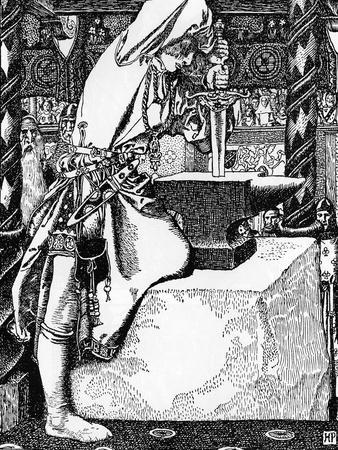

From Cold Iron by Rudyard Kipling
Uh-oh, this post is going to be a problem. I normally try to avoid house rules for AD&D. What, you say, this blog is full of house rules for AD&D? Well, no, it’s not. Or, it depends on what you mean by house rule. What I try to do is address things not covered by the rules of AD&D. These are gaps in rules, areas for which no rule exists. You will never see me (or, at least I hope not) overriding or replacing a rule in AD&D.
For example, I will never override the initiative system as presented in the manuals. But, I will, for example when creating renaissance era weaponry make a decision for how I think those weapons fit into the initiative system. Or mining. The mining rules I present either 1) provide calculated values using the rules methods, or 2) expand the rule into mining for mineral/building roads which isn’t addressed in the books.
But what I’m going to provide here verges at least into the gray area of house rules. Or, depending on your opinion, might overstep into house rules entirely. You have been warned.
The reason here is I think Gary Gygax just plain forgot about something or made a bad decision in not including something. And, that thing is Cold Iron. Of course it starts with Dunder Moose. This post in particular.
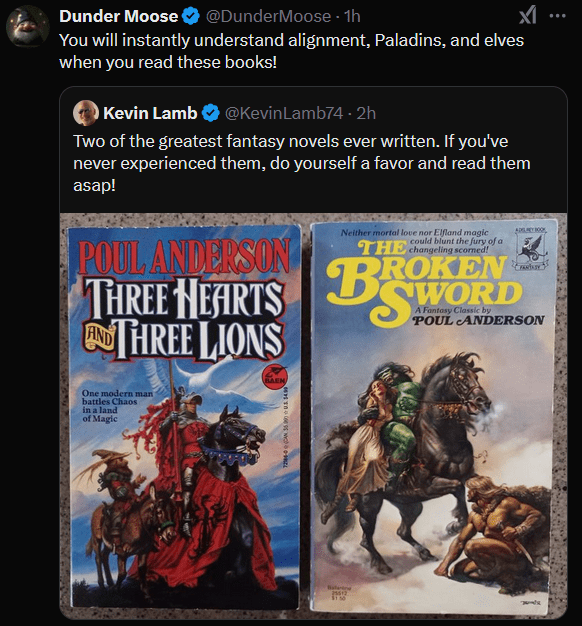
Dunder, says “You will instantly understand alignment, Paladins, and elves when you read these books.” And, truer words have rarely been said. These two books by Poul Anderson define the interpretation of alignment, Paladins, and elves as presented in AD&D. However, there is one thing in these books that is left out of AD&D and that thing is Cold Iron.
In these books Cold Iron is a substance that weapons and armor is made of that acts to fend off supernatural creatures. Cold Iron weapons do extra damage to elves and trolls. When a troll tries to wrestle the hero who is wearing mail, the iron links burn the troll. In Anderson’s conception, the elves make their mail and weapons out of other more exotic metals which allow elves to handle them. But note, elfin mail is not magical — it has different properties because it is not iron (and perhaps wrought finer)

You also see a similar thing in Tolkien where Bilbo’s elfin mail is made from exotic mithril. But, while elfin goods are not supernatural, elves and trolls are vulnerable to Cold Iron explicitly because they themselves (elves and trolls, etc) are supernatural creatures. Supernatural rather than natural. Natural in the Andersonian sense being men and the works of men. In The Broken Sword, the elves, the trolls, and all the fantastic creatures are on the wane because men are ascendant. Well, not just men, but Christian men. The waxing of the Christian faith is banishing the supernatural. Interestingly, in Anderson, this means the world is becoming more mundane. Winds are just the movement of air, no longer are winds the sign of the supernatural great hunt in passing.
This is similar to what medieval people really believed. Or, at least, what the medieval church wanted them to believe. Witches were not prosecuted by the inquisitions because they cast effective spells, but because spell craft was gross superstition in the face of the the truth of the church. The church, and Christianity in general, defined the world, and elves and trolls simply were not part of it, just as centaurs and satyrs were not part of the Christian conception of the world. So, as Anderson shows, in The Broken Sword, as the belief in Christianity ascends, the elves and trolls get pushed into the copses and mountains were there are still some populations of people who believe in them. It is no accident that the motivating action that starts the story is of a viking who converts to Christianity to please his wife, but it never really fully took.
This concept of Christianity ascendant and myth descendant does not appear in D&D or AD&D except tangentially in that it is obvious that in the world AD&D depicts, humans are the dominant factor.
But what is Cold Iron? It’s nowhere in AD&D. Well, here’s the secret, it’s just plain old iron. That is iron is a critical work of man symbolic both of the decline of myth and the rise of the mundane (and what to the dark ages was modernity) as represented by the Church. It is no accident that Holy Symbols are offered in the Player’s Handbook in iron as well as silver versions.
Where did Anderson get this? Well, it comes from many old superstitions related to iron and it’s ability to ward off the supernatural. It’s tied to the superstition of hanging iron horseshoes above doorways for good luck. Because warding off bad luck might well be considered good luck.
But Cold Iron poses a problem in AD&D. How to represent it? You could give iron weapons a +1 against monsters, demihumans, and the undead — but that would really devalue all those +1 swords laying about. Plus, if one is mostly fighting monsters, and all the iron weapons cause extra damage, doesn’t that start to feel just like normal weapon damage and so it can be left out? And, if you include cold iron do you have to include the decline of myth and the Church? This gets into messy social and political issues with which, the history of D&D shows, Gygax did not want to get his game further entangled.
You might not either. But, there may be way to include the effects of Cold Iron without opening too much of a can of worms. Here is my attempt.
- The effects of Cold Iron only affect:
- Demihumans (elves, dwarfs, halflings, gnomes, half-elves, half-orcs).
- Giant Class Creatures (bugbears, ettins, giants, gnolls, goblins, hobgoblins, kobalds, ogres, ogre magi, orcs, and trolls).
- The whole class of Undead creatures.
- Creatures affected by the protection from evil spell.
- The affect of a Cold Iron weapon is:
- If hit by a Cold Iron weapon affected creatures suffer a morale check at -5 percent.
- Wounds caused by Cold Iron to affected creatures may not be healed through magical means (this includes hit point regeneration effects).
- Creatures unaffected by normal weapons still take no damage from Cold Iron Weapons, but the morale effects of hits still apply.
- The affect of Cold Iron Armor is that creatures affected by Cold Iron attempting to engage in unarmed combat with a person wearing Cold Iron armor must make a saving throw versus paralyzation or be considered fended from entering unarmed combat. Plus, if they make the save all unarmed combat rolls are at a -10 percent.
- Items made of Cold Iron may be hung above doorways, windows, or other building openings. Such items do not prevent affected creatures from entering, but, they do trigger a save versus paralyzation, failure of which means the creature will not enter until the Cold Iron item is removed or they will seek another unprotected opening. Succeeding at the check allows the affected creature to enter as normal.
- Cold Iron is unalloyed iron. Meaning that it is not steel. Cold Iron is more brittle than steel and its use has the following effects.
- Cost of Cold Iron items are 20 percent cheaper than the cost of standard steel items.
- Cold Iron weapons must make a saving throw versus normal blows at the end of any round they are used in combat (regardless of whether they hit).
- Cold Iron Armors (and helmets and shields) must make a saving throw versus normal blows at the end of every combat (not every round).
- Failure to make the necessary saving throws mean such item has been destroyed.
This adds some steps to combat where the juice may not be worth the squeeze. It might be a drag on combat. Or, it might add some additional options that some might find intriguing. Your mileage may vary. I’m not sure myself.
I chose not to add extra damage for iron weapons despite Anderson’s description of the iron sizzling in wounds or when touching the skins of supernatural creatures for a couple reasons. First, those +1 swords should be worth something. Second, because sizzling doesn’t imply that much of an increase to damage but that it’s uncomfortable. Hence the fending and morale based effects I chose. I chose not to include steels because The Broken Sword takes place during a period where most weapons were iron and not steel. This is perhaps, too strong a position as steel is more a gradation from iron rather than one single thing. But, we are after all playing a game. Simplification is useful.
So if you really want to get the full Poul Anderson effect into your game, this approach is at least something to contemplate.

 Fluid -- Druid
Leave a comment