
No, this one is not about the designers of role playing games. Not in the least. Myself, I care not one whit about whether any particular game designer was racist or not. And, despite the predilections of our age, you won’t find this being discussed here. Great works are great works regardless of the creators opinions. No, this one is about including racism in your role playing games. And, how it can be fun.
Now, I’m not saying it is for everyone. Players and Referees should know what they are getting into. But, it shouldn’t be that scary. What safer space could one have to explore the causes, the effects, and results of racism than a game. We explore the evils of capitalism via Monopoly? There has even been a board game about surviving and escaping from a Nazi POW camp, and I can tell you Escape from Colditz is one of the great (and fun) board games. Games can address serious topics in serious but also fun ways. Racism is no different than any other serious topic. A game can add distance and neutrality in addressing complex topic in ways that everyone can ignore.
Games revolve around conflicts. And, RPGs especially do. So many games, and all have detailed rules about how to shoot, stab, and punch one another. Surely, there needs to be reasons to bring these rules into play. Well, racism is a doozy. I’m not alone in thinking so. Every wargame (and war mind you) that every existed has racism to one degree or another as part of its backdrop. These truths are self-evident.
Gary Gygax thought so. He famously included in The Player’s Handbook the Racial Preferences Table. A seasoned war gamer and student of history, Gygax knew that (shockers), groups of people sometimes have opinions about each other and sometimes struggle to get along.
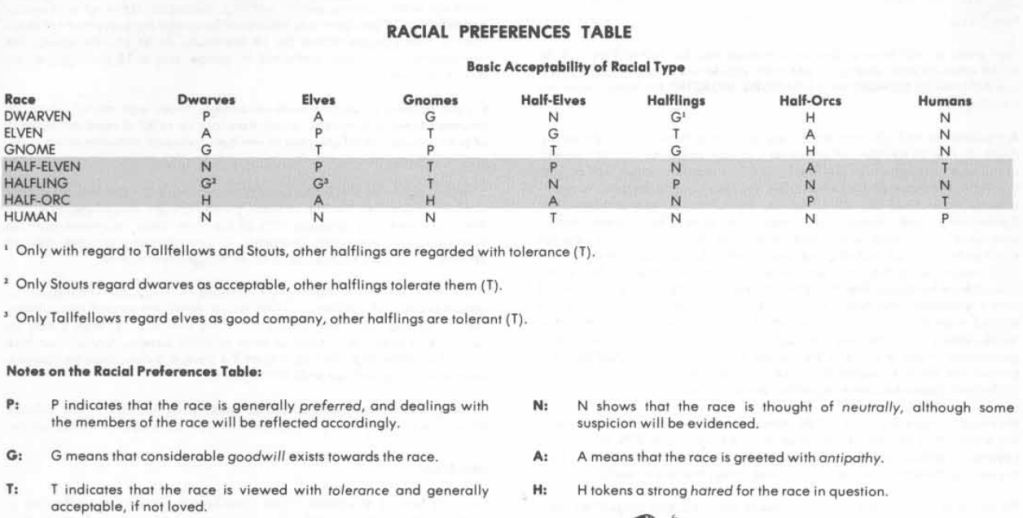
Gygax did not limit himself to just the fantasy races, but also to the monsters. It is notable that he focused on the humanoid monsters. So, was their racism a function of them being monsters or humanoid? Good question. As George Romero implies in his zombie movies, maybe the monsters are really us?
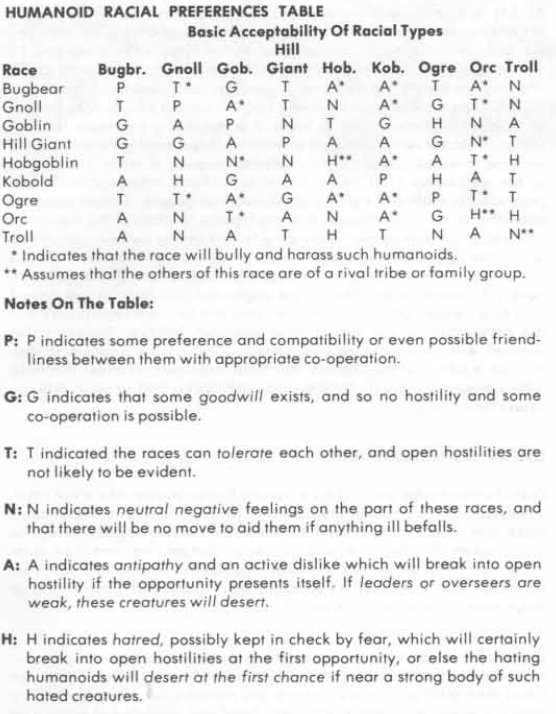
It is notable that Gygax did not see fit to include what the humanoid monsters and the character races thought of one another. Of course all the monsters hate the playable races and vice versa. Goes without question. It is a truth universally acknowledged.
There have been other role playing products that address racism head on. Even award winning products such as the 2017 Harlem Unbound. And, less awarded products such as Reich Star. But, the game I think comes close to addressing issues of class and race the best is the classic 1982 Gangbusters. https://en.wikipedia.org/wiki/Gangbusters_(role-playing_game)
Gangbusters is an RPG about classic 1920s/30s gangsters versus law enforcement. Cops and robbers. Prohibition Agents versus rum runners. Gun molls and city cops. Newspaper men out to get scoops. Detectives solving crimes (or covering them up) All set in the faux midwest town of Lakefront City. Race isn’t addressed in rules, so what am I talking about? I am talking about one of the greatest maps in the history of RPGS. Gangbusters is one of the underappreciated greats of role playing games and the under-appreciation goes double for the Lakefront City map included in the game.
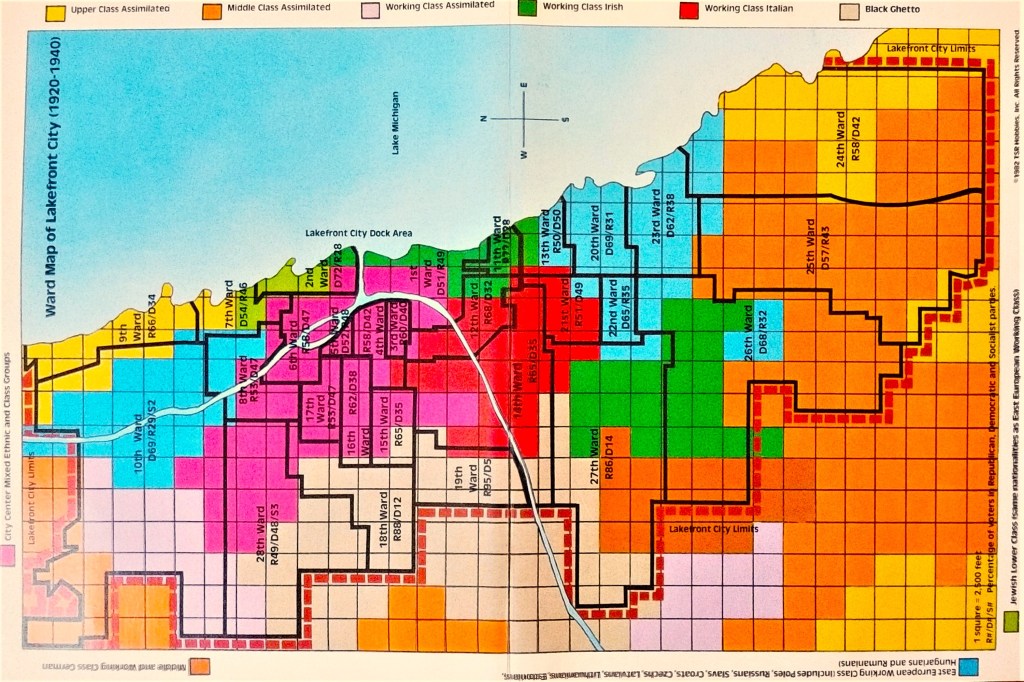
Look at that beauty. There’s no terrain. No, dungeon entrances marked. No trees or parks shown. No fancy lettering or hash marks. But, what’s shown here is all that is needed to bring Lakefront City alive. And, alive in its own terms, the terms of a modernizing industrial American city of 1920-1940 — that is, you know, racist.
The game text says it is not based on any particular city but lakeside Midwest cities in general. But, while smaller, it does bear some resemblance to Chicago. The game credits don’t list who made the maps. It’s hard to put a name on it, but the Lake Geneva Public Library was thanked. My guess is they found a lot of information included in the game there. Maybe even sets of old maps such as these.
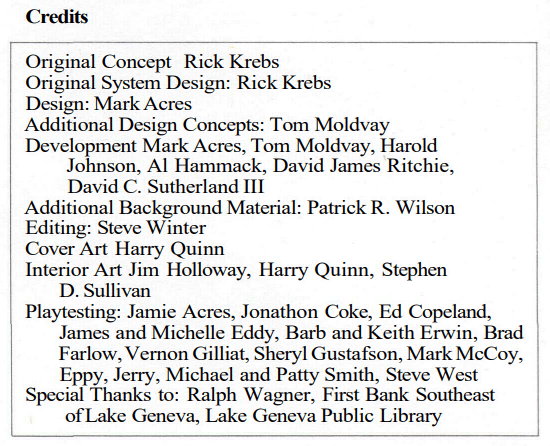
What about that map is so great? What does it have to do with racism? Well, look at it closely. The information on that map includes: the city political districts, the neighborhoods differentiated on race, ethnicity, and class, the boundary between the city and the county, and the voting representation by party in each district. For example, the second ward on the waterfront votes seventy-two percent democrat and twenty-eight percent republican and is predominantly Jewish Lower Class with significant minorities of working class Italian, and working class Irish. If one can’t find a conflict there, I don’t know what to say. Or, take the 28th Ward. 28th Ward is one of the bigger wards and votes Republican forty-nine percent, democrat forty-eight percent, with three percent socialist. Socialist! And, the race makeup of the 28th Ward is a firecracker, near equal numbers of black ghetto and working class Italian, who vastly outnumber the working class assimilated (you know Americans).
Very few of the Wards are racially homogeneous. The only exceptions are the 20th, 22nd, and 23rd wards which are dominated by East European Working Class (you know Polacks). Well, not really just Polacks, the fine print notes that this demographic includes Poles, Russians, Slavs (in general I guess), Croats, Czechs, Latvians, Lithuanians, Estonians, Hungarians, and Rumanians. The East European Working Class is a hotbed of ethic tensions in itself.
But from this information rich map one can glean, who dislikes who, who resents who, who votes for who. You can tell which ethnicities sit as aldermen on the City Council and which ethnicities would like to. You can come up with what which gangs of which ethnicity will dominate which wards and which ones are up and coming. Thinking about this map brings Lakefront City to life in a way that I have never seen another RPG product do. Whoever made that map is an unsung hero of the game.
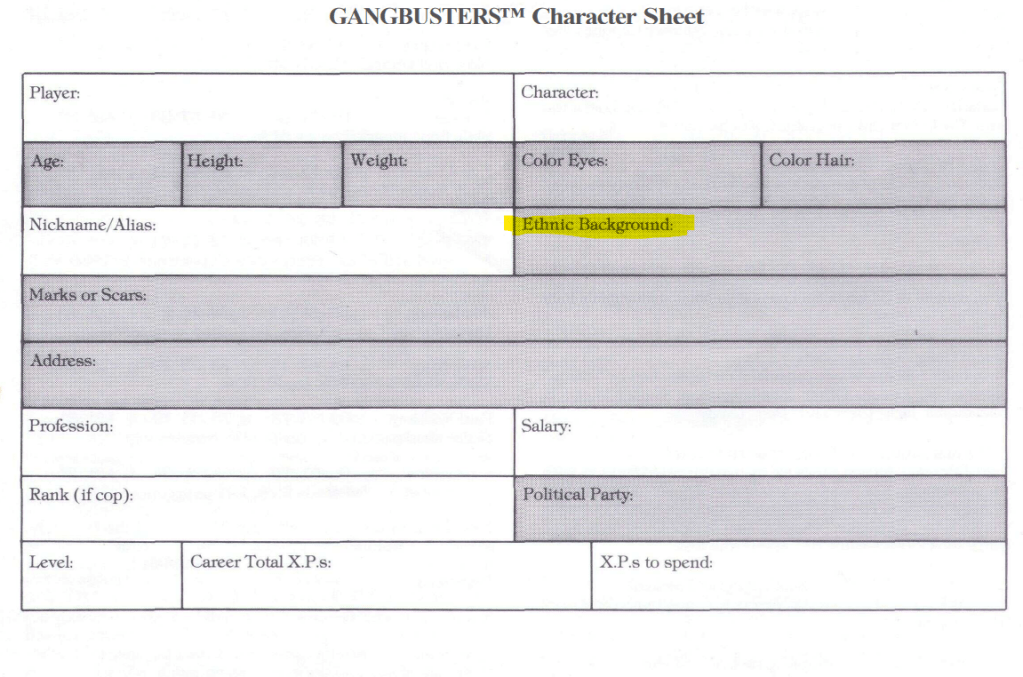
The game mechanics of Gangbusters don’t really talk much about any of the information on the map. The character sheet does have an “ethnic background” box so one assumed this was important enough information to write down.
Gangbusters includes two game mechanism where I think ethnicity could come into play — the Reaction Roll and the Public Opinion Roll. The Reaction Roll is used to determine how friendly an NPC is with a character they just met. The Public Opinion Roll is used to determine what the general public in the city thinks about events in the city. The Pubic Opinion Roll is used to gauge when political forces might be pushed into responding to public opinion, by cracking down on speakeasies for example.
But the game doesn’t address what the different groups think of each other. How differently does Working Class Irish react to East European Working Class? Who knows? Not me. So, I made an AD&D 1e inspired racial preferences table for Gangbusters. Is it accurate? I doubt it. I never lived in a 1920s midwest city. I filled it out based on stereotypes from gangster movies and crime shows. I often drew a blank on how to fill in a box. So, don’t read anything more into it than it being a game tool for coming up with dramatic reactions for the purpose of play. Another person might make an entirely different table.
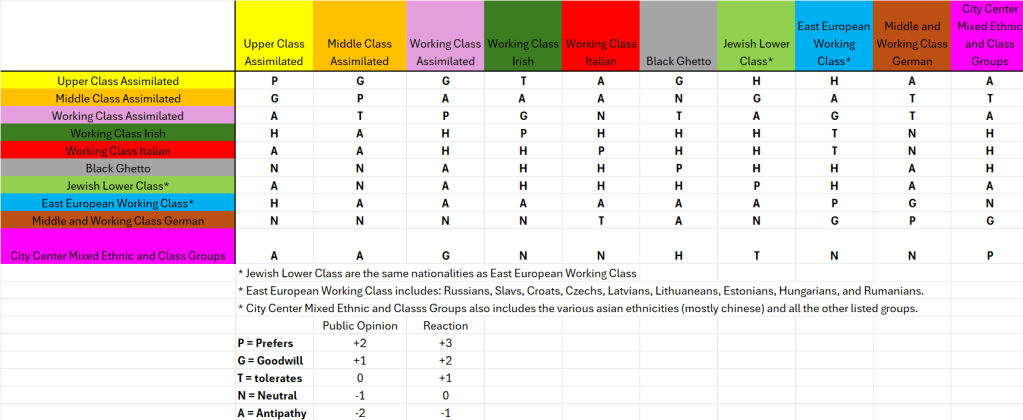
I came up with modifiers to apply to the Reaction or Public Opinion Rolls. So, there you have it. Try it out in Lakefront City and soon the Irish and Italian mobs will by knifing each other in the streets while the Eastern Europeans laugh, the working class assimilated are appalled. Add a little racism to your game, you may find it brings your place to life. But, don’t take it too seriously. After all, it’s just a game.


 Fluid -- Druid
Leave a reply to Fluid the Druid Cancel reply