

AD&D 1e gets a fair amount of flack for being awkward and clunky. This is mostly from people who haven’t played it for any length of time. Gygax’s rather florid style which challenges their comprehension also plays a part. Yet, AD&D 1e has an elegance that few fully appreciate. AD&D 1e deserves better. One aspect that sheds a light into how elegant AD&D really is, is how it treats the Great Race of Yith.
The Great Race of Yith is an alien race presented in the H.P. Lovecraft story The Shadow Out of Time. AD&D includes the Great Race as part of the1980 book Deities & Demigods as part of the Cthulhu Mythos section. The Cthulhu Mythos section was removed in later editions of the book but that is irrelevant to what I discuss here.
First, you need to know a little about the Great Race of Yith. These cone-shaped aliens appear in the Shadow Out of Time, written 1934/35 and published in 1936. The story centers around a professor who goes insane and then once recovering his sanity begins an investigation of the nature of his affliction. The upshot is he was never insane, his body was taken over by time-hopping aliens while his own mind was sent millions of years into the past to occupy the body of one of the Great Race. The alien used his body for several years to learn about professor’s current time. For whatever reasons, the Yithians decide they do not care for humans and instead flee forward in time, avoiding a dreadful enemy, to occupy the bodies of giant beetles in the future. In short, the Yithians have the following abilities:
- Great Intelligence
- The ability to cast their minds through time seeking suitable hosts
- The ability to switch minds with an appropriate host (and switch back again)
The Deities & Demigods listing is shown below. The listing is short. One thing that is conspicuous by its absence is the key feature of the Great Race – the mind control and time traveling abilities. It seems like quite an omission. However, greater review of the AD&D 1e rules shows that in-depth discussion of these abilities isn’t really necessary. The key is in the psionic ability listing: Psionic Ability 280, Attack/Defense modes B, C, D, E/All.
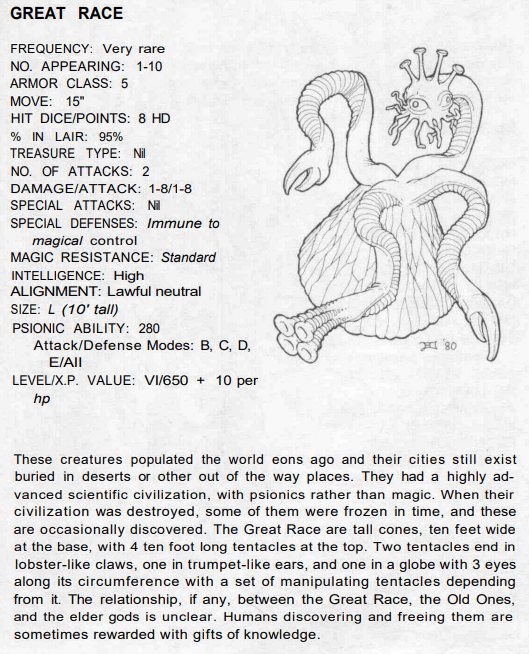
Without fully explaining AD&D Psionics, it’s enough to know that psionic characters and creatures have psionic points, plus may have a variety of attack and defense modes. Psionic points are expended with attacks and defenses as well as in generating various magic-like effects. Attack modes include A) Psionic Blast, B) Mind Thrust, C) Ego Whip, D) Id Insinuation, and E) Psychic Crush. Defense Modes include F) Mind Blank, G) Thought Shield, H) Mental Barrier, I) Intellect Fortress, and J) Tower of Iron Will. It is important to note that out of all the attack modes, only Psionic Blast may be used against non-psionic characters. So, while the Yithians may use all the defense modes, they only have attack modes B through E. Psionic Blast is not available to the Yithian. Because of this, they can only psionically attack other psionic creatures.
For a character to have psionic ability in AD&D, they must have at least one of intelligence, wisdom, or charisma of 16 or greater. To then have psionics on must roll 00 on percentile dice. The odds are improved for attributes greater than 16, but even then, the maximum odds of having psionics is eleven percent given all three attributes are eighteens. Psionics is rare. So, if a Yithian wants to psionically attack a character, they must search for and find one of the few sensitive souls vulnerable to their abilities. This matches the story where the professor (Nathaniel Wingate Peaslee) is singled out due to his intelligence and sensitivity.
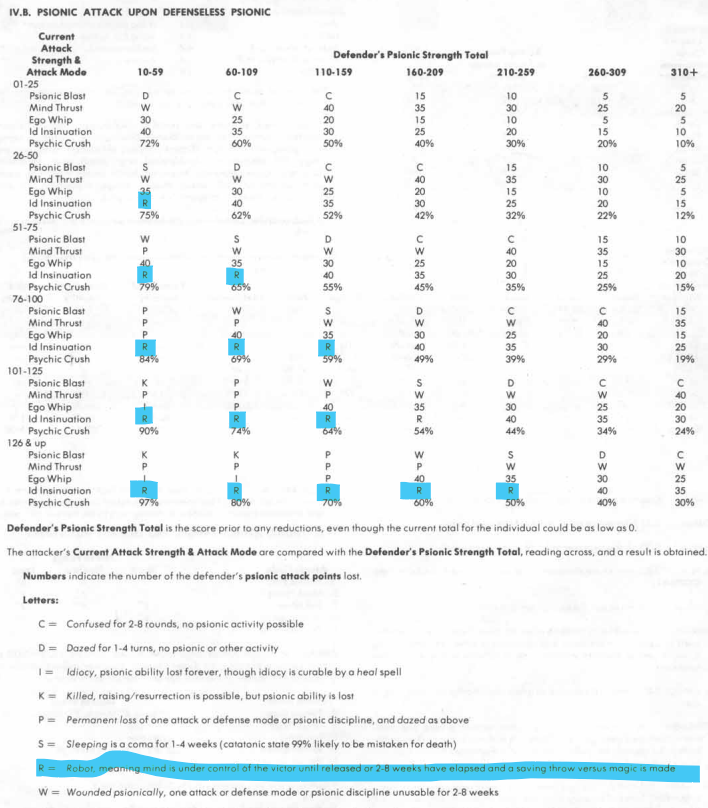
What about mentally controlling the good professor? Well, in AD&D psionics, the attacker picks an attack mode, the defender picks a defense mode which then determines how many psionic points are lost. Psionic points act both as psionic hit points but also as what fuels the attacks, the defenses, and the various other powers. Once an enemy runs out of psionic points, they are defenseless, and various effects can happen depending on the attack mode. For example, Psionic Blast can confuse or even kill an opponent, while Ego Whip can disable defense modes or even destroy another’s psionic ability. The most relevant Attack Mode for the Yithians is Mode E, Id Insinuation. By looking at the table (p. 82 DMG) one can see that only Id Insinuation has effect R. R stands for robot – the loser is mind controlled for 2-8 weeks. Weeks! And, of course, once the effect wears off, the attacker could attack again. A weakly psionic character could be controlled for long periods of time, especially when faced with such a powerfully psionic creature as a Yithian.
Additionally, Astral Projection is one of the major psionic magic-like powers. And, time passes differently in astral space. Note, here that I do not include the 1987 Manual of the Planes as canonical in regard to astral space – this book is a post-Gygax addition. A DM can choose how time passes during Astral Projection.
To make my point clear, the key abilities of the Great Race of Yith that are present in the story all are already baked into the existing psionic rules. There is no need to discuss them in the creature listing because they are already there and available. We really have to thank E. Gary Gygax, James Ward, and J. Eric Holmes for their deep understanding of the Appendix N works and how all the parts of AD&D fit together to replicate the Appendix N works.
Are the abilities perfectly modeled in AD&D? Well, no. The mind swap is not implicit in the mind control aspect of the Robot effect from psionic combat. However, surely, for practical purposes most things are there right out of the box. And, any DM worth their salt has read the Appendix N works including The Shadow Out of Time, and can include that effect at will. You have read it, haven’t you? No? Well, get on it!
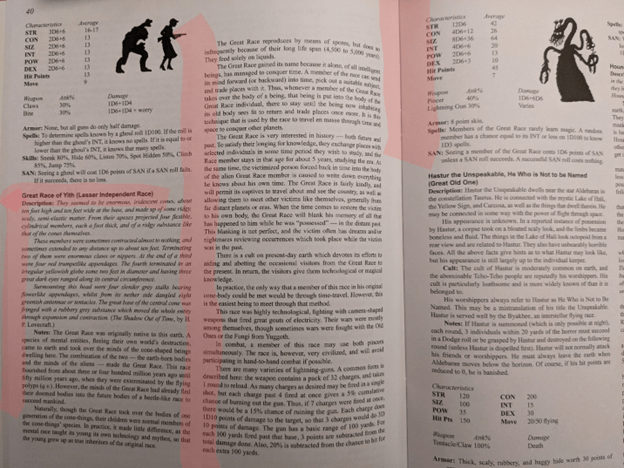
In contrast, the RPG The Call of Cthulhu listing for the Great Race spends a fair amount of time describing the mind swapping aspect of the Great Race but includes no game method for performing it. In the Call of Cthulhu RPG, the mind control/swap is just carried out by fiat. While in AD&D 1e, the ability is there, there is a game mechanism not just for the mind control but also for sending one’s mind through time (astrally) to find the necessary sensitive target. When one puts the pieces together, AD&D clearly beats Call of Cthulhu at its own game. In fact, one might even argue that Call of Cthulhu isn’t a game at all in comparison.
PS. Just for fun, check out the inspired The Darkest of the Hillside Thickets Shadow Out of Tim concept album, loosely based on the Lovecraft story. It’s great.
PSS. Trollopulous has Great Race controlled Earthquake Beetles building a vast non-Euclidian city. What are they up to? We haven’t heard much from them lately. But, maybe we should?


 Fluid -- Druid
Leave a comment