
Note: there may be errors and approximations in the math presented here. Feel free to check it and let me know if you find an error.
With that out of the way, let’s discuss random Outdoor Encounters and DMG Appendix B random terrain generation. When traveling outdoors in AD&D, encounters are generated by the relative population density and the frequency of checking for encounters based on terrain types. See page 47 of the DMG.
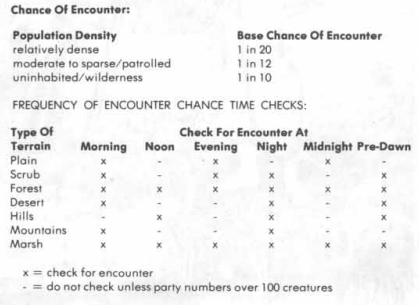
While the DMG does not define it, the interpretation I have taken is that population density refers to population density of people. People meaning humans and demi-humans. Given that humans predominate in numbers over the other demi-humans some might choose just the human population density. So, the odds of an encounter for a terrain are the number of checks per day multiplied by the base chance determined by population density. For example in a wilderness marsh the daily odds of an encounter are 6 x 0.1 = 0.6 or 60 percent. One can extrapolate this further to conclude an encounter is most likely to occur every 1.66 days in a wilderness marsh.
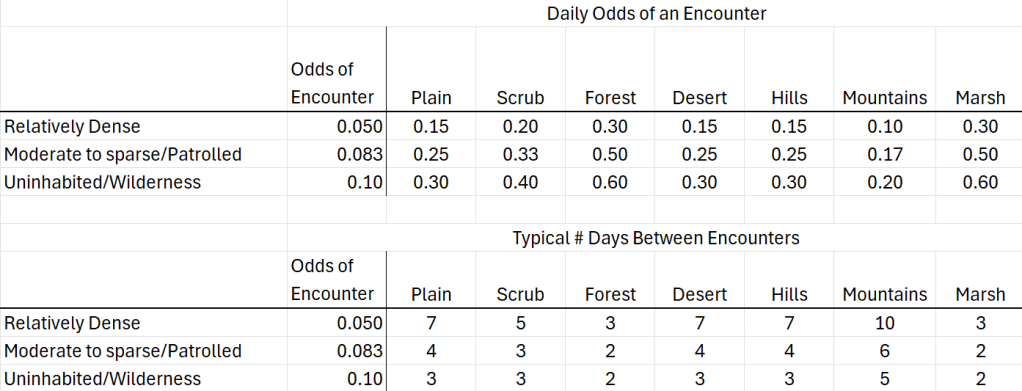
One thing that sticks our here is that the more densely populated an area is, the less likely there is to be an encounter. Huh? Shouldn’t encounters be more frequent in populated areas? Well, no. Look at it this way, these odds are not the odds of meeting people, but the odds of a potentially hostile and/or beneficial encounter. In densely populated areas, one isn’t likely to get devoured by wolves or find a dragon’s hoard. In populated lands, people are just going about their business. So, it looks like the best places to have an encounter are a Forest or Marsh.
Arguably, the areas defined as “relatively dense” and “moderate to sparse/patrolled” would be considered inhabited areas. In fact, when you look at the Appendix C random encounter tables (starting p. 174 but most importantly p. 184 & p. 186.) the temperate and subtropical tables are divided into Uninhabited/Wilderness and Inhabited/patrolled areas. Only the temperate and subtropical area has an inhabited/patrolled table so, presumably all the other climatic tables are wilderness.
The directions on p. 182 of Appendix C note, for inhabited areas twenty-five percent of encounters are patrols. And for uninhabited areas five percent of encounters are strongholds. Strongholds may be of different sizes and those are broken into four categories: totally deserted, deserted but containing a monster, occupied by humans (bandits, berserkers, etc), and occupied by character class types (fighters, clerics, magic-users, etc).
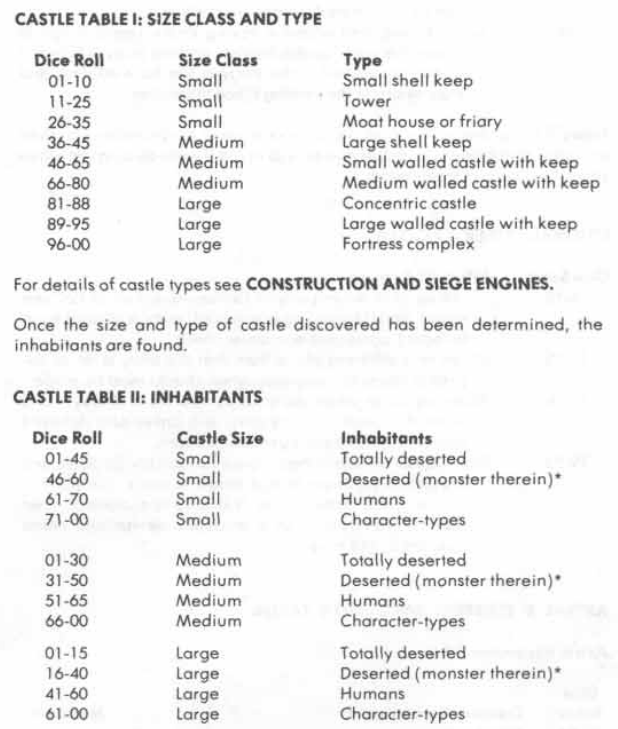
How likely is it to encounter a castle? Well, it’s 1 in 20 right? Of encounters. If an encounter on a wilderness plain happens every 3.33 days then a castle would be 3.33/0.05 = 66.6. Or, one castle every 66.6 days of travel. But, will that castle be occupied? If I did the math right something like thirty-two percent of castles encountered will be deserted with the rest some combination of monsters, hostile humans, or possibly friendly (or hostile) powerful humans. Below, shows the typical days of travel by terrain type one might have to expect to travel before encountering the various castle types. Similarly, the days travel expected before encountering the inhabited area encounter types is shown.

It should be no surprise that encountering castles is pretty rare (1 in 20 duh). Over the course of a year of travel, a character might encounter a deserted castle or two, maybe one or two castles with monsters, maybe a castle occupied by bandits, and two to four with powerful character types. Maybe a castle every month and half of travel time or so. During which there may be dozens or even hundreds of monster encounters. In any case, those castles with monsters are all potential dungeons, and the other castles are opportunities with varying levels of danger associated with them.
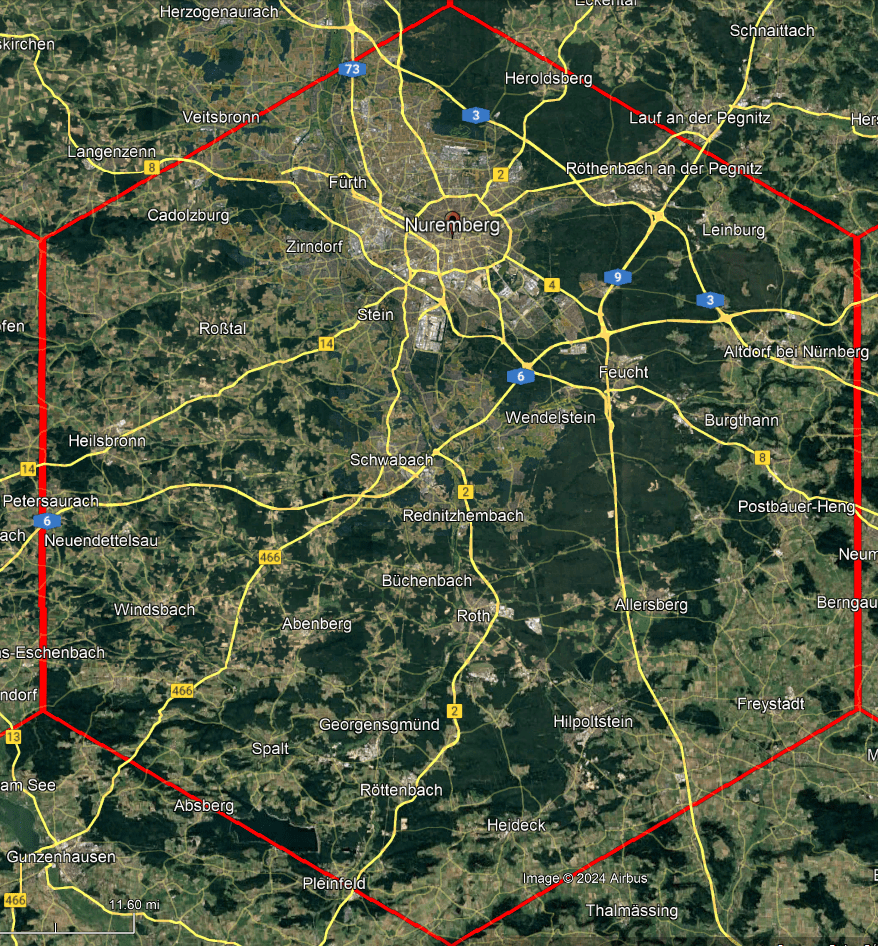
But what about those inhabited areas? No castles at all? Only patrols and monsters? That’s odd. Well, again no. Where do those patrols come from? The castles! Or the settlements in general. Appendix B of the DMG (on p. 173) gives details how to generate terrain. The exact language in the section says the DM must use common sense in determining overall terrain but does suggest using “1 space = 1 mile, or larger”. Given that a lightly loaded character can travel roughly 30 miles a day through plain terrain, one common large area denominator is the 30-mile hex. The picture below shows a 30-mile hex containing the area around the city of Nuremberg. Clearly, a 30-mile hex can contain a lot.
Appendix B has you check each hex for the possibility of a settlement. There is an eleven percent chance of a settlement, a three percent chance of a castle, and a two percent chance of ruins of various types. The rest, eighty-three percent is uninhabited.
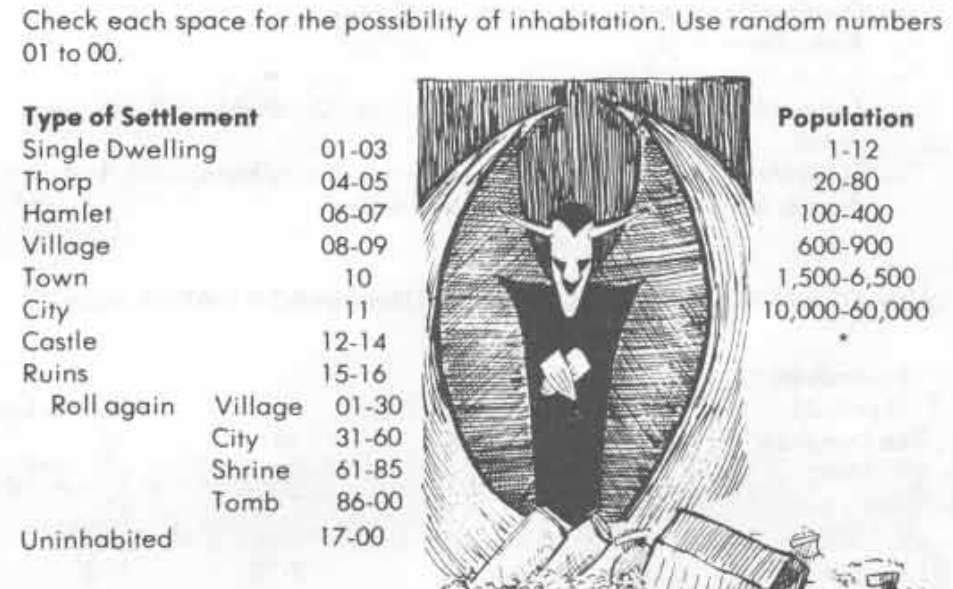
Using the 30-mile hex broken into the suggested 1-mile subhexes, is likely to contain five ruins, seven castles, and twenty-five settlements. That’s actually pretty similar to the labeled number of settlements in the Nuremberg example. Though actually, the Nuremberg area is much denser as the smaller settlements were not labeled at the resolution shown. Nonetheless, it seems to make common sense that the Appendix B method using the suggested 1-mile hexes generates what would be considered an inhabited area for the purposes of random encounter generation despite the title of the Appendix being “Random Wilderness Terrain”. Though, those ruins still may be dungeon locations.

What about true wilderness areas? Appendix B gives no guidance on how to generate true wilderness or where to place it. This is up to DM desire for the overall setting/world. It’s all up to how hairy do you want it to be. One could generate a 30-mile hex broken into 1-mile hexes and set some radius around the settlements that is considered inhabited and the places between towns/castles to be wilderness. Or, one could generate a large area of 30-mile hexes, check those for settlements, and only treat those settlement hexes as inhabited and the rest of the map howling wilderness. These decisions will have consequences on how safe and how far one can travel easily about the world. But, they will also govern how often riches can be found, where the dungeons lay and how many there are, and how often players get eaten by bears in the vast woods.
Addendum 11-13-24
Some additional thoughts based on today’s discussions.
Here’s how Appendix B works to me.
- Blank Paper.
- Roll the terrain. This is wilderness.
- Roll the habitations. Except for the smallest settlements, this is inhabited area.

 Fluid -- Druid
Leave a comment