
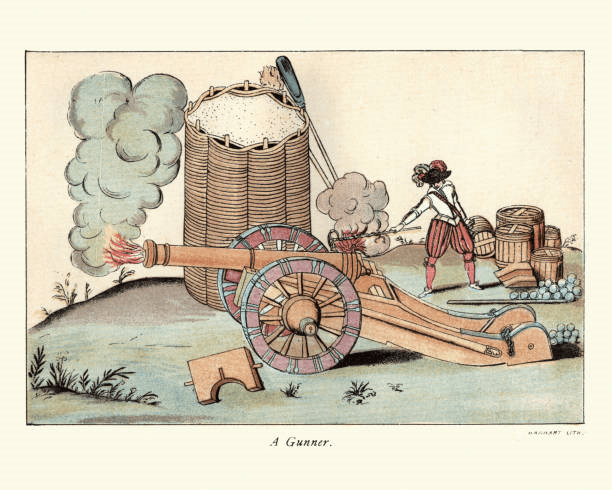
This is a follow-up on my piece about firearms for AD&D. Presented are my approach to Renaissance artillery for AD&D 1e. The rules here use the War Machine rules on page 108 & 109 of the AD&D 1e DMG but add to them for the purpose of black powder artillery.
Artillery comes in a range of sizes from small galloper guns to huge pieces of siege artillery. Artillery may be single guns or grouped into batteries of defined numbers of guns. The damages listed in the table are for single guns.
- Siege artillery may not move. Limbered galloper guns move at 9”. Limbered field guns move at 6”.
- To limber or unlimber a gun takes 5 rounds, during which time the gun may not fire.
- Grape shot may only be used at short range.
- Guns may not fire at targets closer than the minimum range.
- Siege guns have a firing arc of 60 degrees, field guns 90 degrees, and galloper guns 120 degrees. Firing outside of the arcs requires one round of repositioning.
- There is a 2 in 10 chance of misfiring each round. If damp conditions (e.g. fog) prevail chance of misfiring is 4 in 10. Wet conditions (rain, etc.) the chance of misfiring is 8 in 10. If a misfire occurs, then the gun may not fire that round, and a round must be spent clearing the gun.
- When firing, the officer (usually a captain) in charge of the gun or battery uses their to-hit number for their level.
- When being charged, a gun or battery that is capable of firing (i.e. not reloading, limbered, or fired previously in the round) may fire at the charging unit prior to the charge being evaluated. If shot type has not previously declared, flip a coin whether it is solid shot or grape.
- Firing generates smoke. After the first shot, there is smoke. Smoke dissipates after a single round with no firing. Due to smoke, each consecutive round of firing pushes the range out to the next range band. Short is treated like medium on the second round, short is treated like long on the third round of firing.
- After firing forty consecutive shots, a gun must cease firing for ten rounds to allow the gun to cool. Each round spend firing past the forty round limit adds a 1in 10 chance of premature detonation of powder. If detonation occurs all members of the gun crew within 1” must save versus breath weapon or take damage equal to the damage of the gun divided by ten. The gun itself must also save versus crushing blow or be destroyed.
- Siege guns may not fire at individuals. Field guns may fire at stationary individuals. Galloper guns may target individuals per the DMG rules.
- If firing at massed formations, the unit size target modifiers are used. Though for damage, it is the size of the individuals that count (i.e. humans are medium sized).
| Unit Size | Artillery Target Unit Size Modifier | Unit Type | No. | Officer |
| Battery | +2 | Artillery | 10 (guns) | Captain |
| Troop | +2 | Cavalry | 60 | Captain |
| Squadron | +3 | Cavalry | 400 | Major |
| Company | +3 | Infantry | 100 | Captain |
| Battalion | +4 | Infantry | 500 | Major |
| Regiment | +5 | Infantry | 1000 | Colonel |
Attacking with artillery is performed in the following manner:
- Choose shot type (solid or grapeshot).
- Roll for misfire.
- If no misfire, roll to hit.
- If hit is successful roll for damage. If a battery, roll for a single gun and multiply by the number of guns. Or roll each gun separately if the opposing side agrees.
- Apply Damage as described below.
- Perform a morale check on the targeted unit. Successful morale check will close ranks.
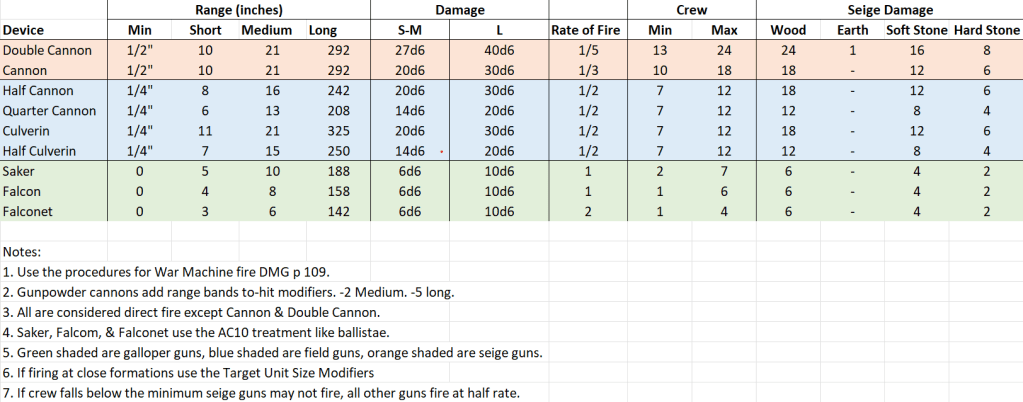
Damage to units from artillery is applied differently depending on the type of shot used and whether the unit is represented by a single figure or multiple figures.
Damage for Multiple Figures Units
For a unit composed of multiple figures, damage is assessed by the following manner:
Solid shot
- Roll randomly to determine which rank and file was hit. Cross referencing these two will determine the figure hit.
- Project a line from the battery through the identified figure. This may be imaginary but if disagreements occur a string may be used.
- From the hit figure apply damage to the hit figure and to all figures in the unit along the projected line in the direction of fire.
- If a figure does not sustain the full amount of damage necessary to remove it, the figure remains on the board.
- After damage has been applied to the identified figures then all remaining damage points are lost. Exception, damage may be projected into any directly adjacent unit.
Grape shot
- Divide the damage rolled by two.
- Roll randomly along the rank or file nearest the gun to identify the target figure.
- Apply damage to the target figure. Then apply damage to the figures adjacent to the target figure. Start in the rank or file the figure occupied then move to the ranks or files behind. With each successive rank add the adjacent figures by two. That is first rank is three figures, second rank five, third rank seven, etc.
- If a figure does not sustain the full amount of damage necessary to remove it, the figure remains on the board.
- After damage has been applied to the identified figures then all remaining damage points are lost.
Damage for Single Figure Units
When treating large units as a single figure (i.e. regiments), damage is assessed by the following manner:
Solid shot
- Use common sense to determine if the shot is to the front or the flank. Disagreements resolved through Rochambeau.
- Roll 3d10 and divide the result by 30. Multiply the rolled damage by this number to determine preliminary damage.
- Multiply preliminary damage by the aspect value (see table below) to determine final damage.
- Divide the final damage by the unit hit point value to determine men lost. If a unit is composed of multiple soldier types, then the attacker chooses which type to consider lost.
| Line | Column | Block | |
| Front | .25 | .75 | 0.5 |
| Flank | .75 | 0.25 | 0.5 |
Grape shot
- Divide the damage rolled by two to determine total damage.
- Divide the final damage by the unit hit point value to determine men lost. If a unit is composed of multiple soldier types, then the defender chooses which type to consider lost.
Morale
Morale for units is determined identically to the AD&D rules. During battles there are specific events that will trigger unit morale checks. Note: the fire does not need to hit to trigger the morale roll.
| Morale Triggering Events |
| First receipt of hand weapon fire (e.g., arquebus, musket, pistols) |
| First receipt of artillery fire |
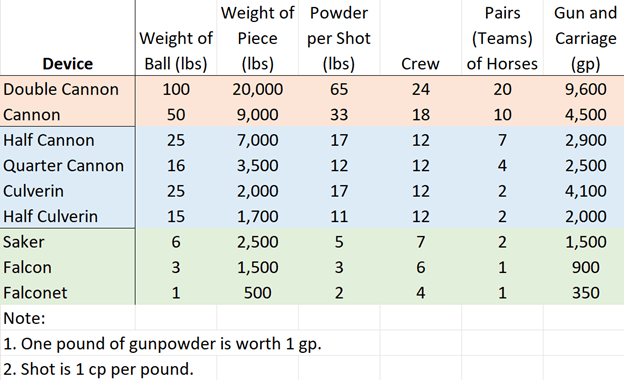
Note that prices are given in AD&D 1e coinage and are based on exchange rate of 9 gp per ducat. However, this rate does not transfer into a direct comparison of weight of ducats per AD&D gp but more tied to AD&D purchasing power.
So, there you go. This should be enough to get started with artillery in AD&D 1e.

 Fluid -- Druid
Leave a comment