
The discussion that follows is best understood with a copy of both the first edition DMG and a copy of the Boot Hill rules.
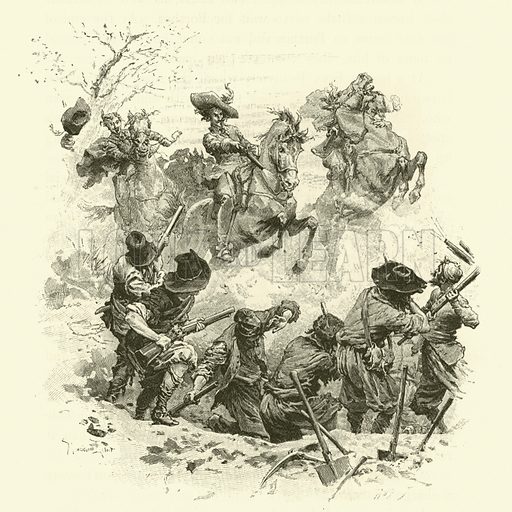
Gary Gygax was against functioning gunpowder in AD&D. For him, gunpowder should just not work in the AD&D fantasy setting. This is akin to the Appendix N Amber books (by Roger Zelazny) where gunpowder would not function in Amber. Even in Amber there was jewelers rouge which did act like an explosive. Plus, despite Gygax’s opinion that the introduction of firearms into the AD&D fantasy world would change that world too drastically, Gygax did include in the Dungeon Masters Guide (DMG) that AD&D characters might (through use of magic) travel into the western Boot Hill setting and back. And vice-versa, a Boot Hill character might end up in AD&D land as well. Because of this, conversions of the Boot Hill characters and firearms to AD&D was included in the DMG. So, what are those firearms rules and how do they work? They are on page 113 of the DMG.

First, a distinction is made between situations where both sides in a conflict are both armed with firearms, in which case it says use the Boot Hill Turn Sequence. But, if it’s mixed firearms and AD&D weapons (and I suppose magic) the AD&D Turn Sequence is used in which case unarmored characters using firearms get a +1-initiative bonus. That’s interesting, apparently firearms are quicker than say a magic user causing a wand or staff magic to function.
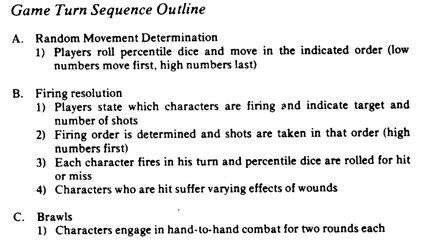
Boot Hill Turn Sequence
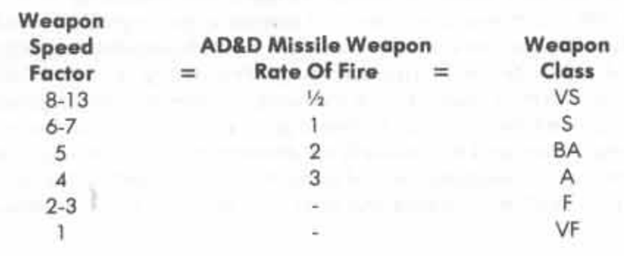
Note step B.2 which states “firing order is determined”. In Boot Hill this is called “First Shot Determination”. Without going into the fine details of how Boot Hill does this (get a copy of the rules), in general, a Boot Hill character has First Shot Determination value (based on a number of parameters) which is then modified by a number of situational considerations. For AD&D, what’s relevant is that the DMG includes a table that allows the determination of Boot Hill speed classifications for AD&D weaponry.
In addition, AD&D armor class also affects First Shot Determination.
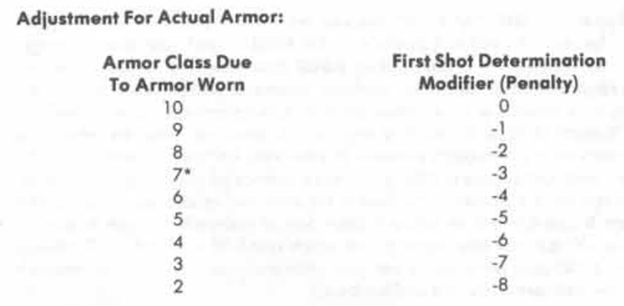
There is also a Hit Determination Modifier.
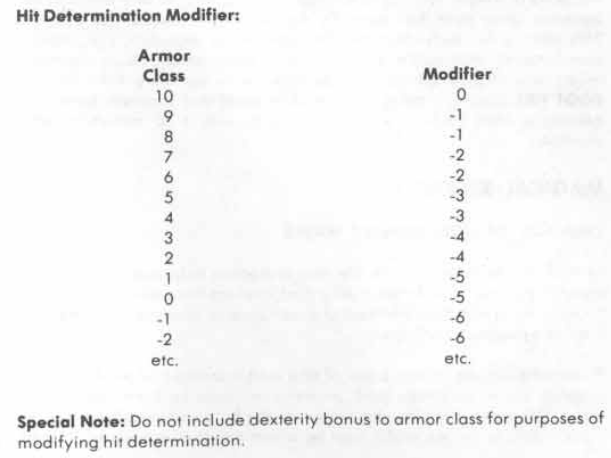
While the text in the DMG in how to use these modifiers is sparse, my reading is that the Hit Determination Modifier is to be used when using the Boot Hill to-hit procedure and not the AD&D to-hit procedure. In fact, my reading is that the intention with using Boot Hill firearms is to always use the Boot Hill to-hit procedure. Which means figuring for your AD&D character the appropriate Boot Hill Characteristics necessary to use firearms (see pages 112-113 DMG).
But, what about wounds? The Boot Hill damage sequence is totally different than the AD&D damage sequence. What happens when an AD&D character is shot? DMG p 113 has got you covered.
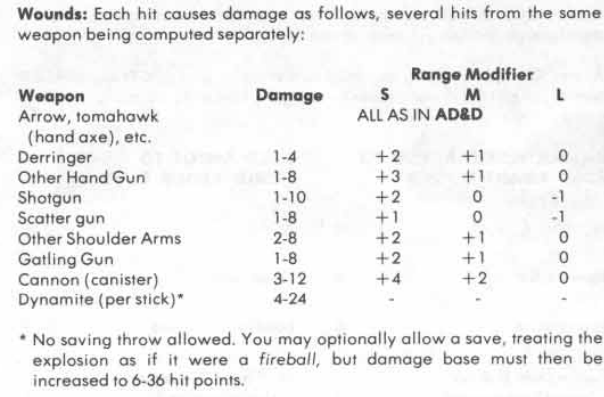
For years I was confused by this table. I thought the range modifier shown was a to-hit modifier as it resembled such from AD&D. This is not the case. The range modifier is to damage. The clue to this is this table exists in the “wounds” section. So, for example, a shotgun does 1-10 damage and at short range two points of damage are added to the roll and at long range a point is subtracted form the roll. One thing to note here is that while Boot Hill and AD&D ranges are all given in the same inches, AD&D does not have the Extreme range category that Boot Hill has. So, my take is to consider that long range category in the table above to include extreme.
All the above cover an AD&D character transferred to Boot Hill. But what about the other way? Gygax has this to say.
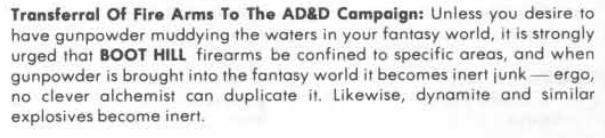
But I do want gunpowder muddying the waters. And, frankly, why not? It’s not like gunpowder was not present in the Middle Ages – gunpowder was present in the late Middle Ages. Gygax is right, that the introduction of gunpowder will fundamentally change the nature of one’s fantasy world. Why can’t one enjoy a pike and shot world with added magic? Why shouldn’t the occasional six-gun make it into AD&D? Heck, at Expedition to the Barrier Peaks Gygax introduced laser guns. If that’s not a step too far, I don’t see how a musket breaks the game.
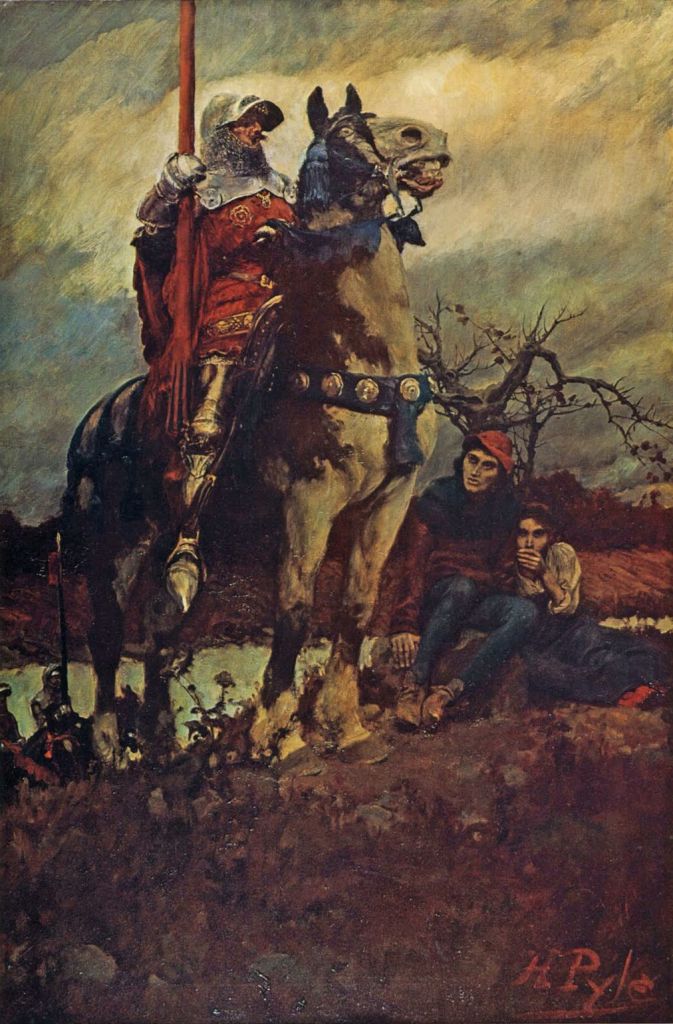
Nonetheless Gygax, does not provide rules beyond the statement, “Any circumstances not covered here can be extrapolated from this work and/or BOOT HILL…” Well, here I go, boys.
Below are rules and table for use of both Boot Hill firearms and Renaissance Firearms in AD&D without the need to reference Boot Hill.
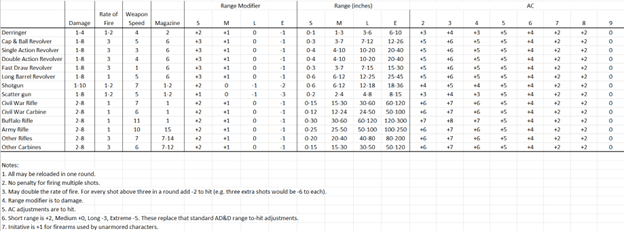
Boot Hill Firearms
Note the footnotes to the table which outline some modifiers and procedures specific to the that set of weapons.
For the Boot Hill firearms, I have included a Weapon Speed, which is nonstandard for AD&D Missile Weapons. Normally, in AD&D, missile fire occurs prior to melee with the missile fire occurring first for whomever won initiative. There may be circumstances (like in Boot Hill) firearms may be used on both sides and/or firearms and spells may be simultaneously in use. For the situation tied initiative and firearms versus firearms use the same weapon speed procedure as with melee weapons. Similarly, if the firearm is being used as a melee weapon, use the same melee weapon speed procedure.
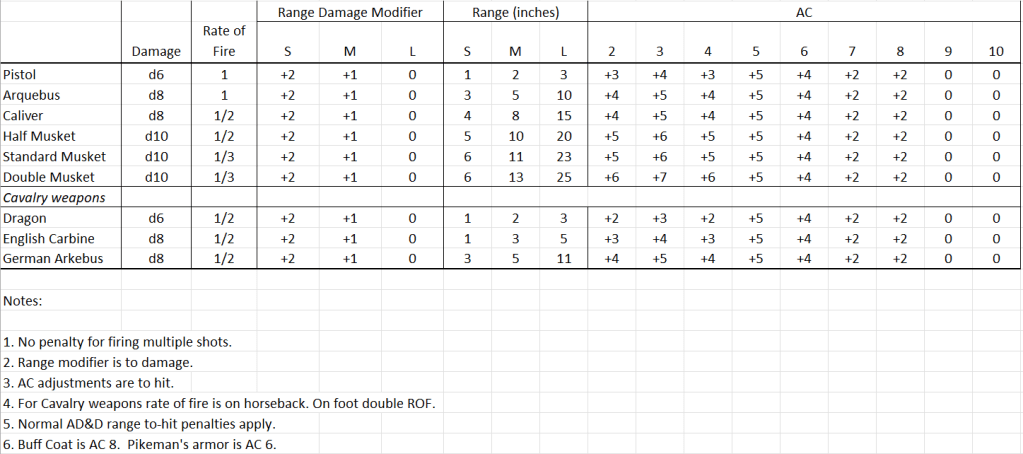
Renaissance Firearms
For renaissance firearms, note the footnotes. And be aware that no weapon speed information has been provided. Just use the AD&D standard missile weapon procedures. This is because the renaissance firearms are significantly more unwieldy than the 19th century firearms listed for Boot Hill. If Boot Hill firearms have tied initiative with renaissance firearms, any of the Boot Hill firearms will shoot first.
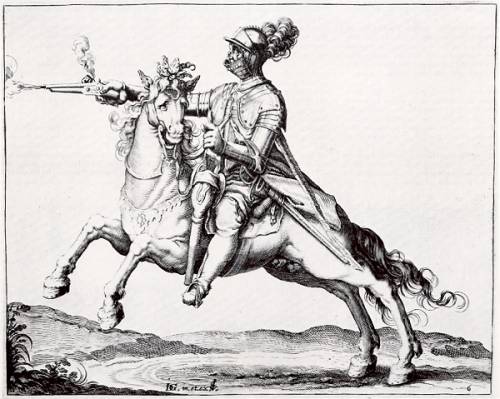
Optional rule, firing generates smoke. After the first shot, there is smoke. Smoke dissipates after a single turn with no firing. Due to smoke, each consecutive turn of firing pushes the range out to the next range band. Short is treated like medium on the second turn, short is treated like long on the third turn of firing.
So there you go. If you try it, let me know how it works for you. A few comments. In other treatments of adding gunpowder weapons to AD&D, people have added things like exploding dice for damage, because it seems unreasonable that any firearm doesn’t have a chance of a one-shot kill, and AD&D characters can have many more hit points than any single dice roll. I have not included such here. Why? Because Gygax did not. But, here’s my reasoning.
The common zero level soldier in AD&D has 4-7 hit points. For those guys, any firearm hit is a potential kill. For characters above first level, firearms are much more survivable; but even there given the armor class adjustments, it is likely that a character may well take several hits and still be killed or severely wounded in a single round. Even then, high-level characters may well survive many hits from a firearm – no single shot will take them down.
And, in AD&D character 10th level and higher are common as NPCs – most castles will have such a character running the place. One must remember, AD&D is a world of extraordinary people. And, hit points are not mere wounds but includes fatigue, dodging, near misses, cover, etc. High level characters represent people of extreme luck and ability who will come to the fore and be important centers in any battle. Exploding dice would dilute the potency and heroic nature from the AD&D fantasy campaign, and that in my opinion is what Gygax was most afraid the introduction of gunpowder would remove from the AD&D setting. In the versions presented, firearms, like any of the weapons in AD&D present a real hazard to the common man but, the extraordinary heroes still have an edge.
Addendum:
New rule for reloading firearms. Firearms may not be reloaded while engaged in melee. This applies to all firearms. Previously loaded firearms can, of course, be fired while engaged in melee. Muzzle-loading firearms with a rate of fire of 1 may not be fired while engaged in melee, except for the first shot.


 Fluid -- Druid
Leave a reply to Pancho Villa Weapons for RPGs – Fluid — Druid Cancel reply