
Jeffro Johnson has a new post (Tunnels & Trolls is the First Rpg) where he presents a thesis that Tunnels and Trolls is the true first RPG. Go read his post and then come back.
Without going on at length, Johnson’s thesis is that the field of role playing games came about through people misunderstanding what was being done when they watched people play D&D (or were instructed to play D&D), yet, nonetheless, being inspired by the experience. These people, at a time either before D&D was published (or when obtaining the actual booklets was difficult), then went and wrote their own games based on what they thought was happening when D&D was played.
The result of this inspiration was a new genre of game that jettisons a lot of important rules that existed in D&D. That is, rules the neophytes did not understand, did not enjoy, or did not even know existed. Johnson writes:
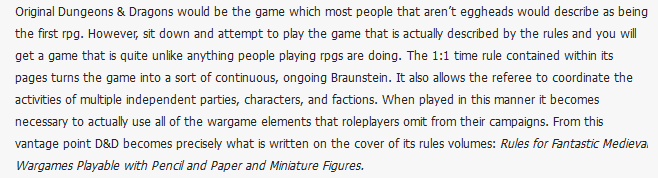
In essence, Tunnels and Trolls took the D&D competitive Braunstein plus 1:1 Time formula and boiled it down to one aspect — the dungeon exploration experience. There is nothing wrong with this. But it is an entirely different game. Many people followed with this approach.
But what about other people? Many others who initially experienced D&D went and created games too. Did any of them duplicate the D&D experience of mating individual characters to large scale faction-oriented Braunstein play? Many people will answer this with Traveller. Traveller was in the first wave of games that followed the publication of D&D. In its complete form, Traveller contains factions with which a Braunstein can be played. Traveller, while not explicit, has something akin to 1:1 time when you take the one-week jump times into account. And, with the board game 5th Frontier War, one has a war game that can be mapped explicitly to the role playing elements of Traveller. But 5th Frontier War did not come out until 1981, along with the revised second edition of Traveller that much more explicitly added factions. I think there is an earlier candidate.
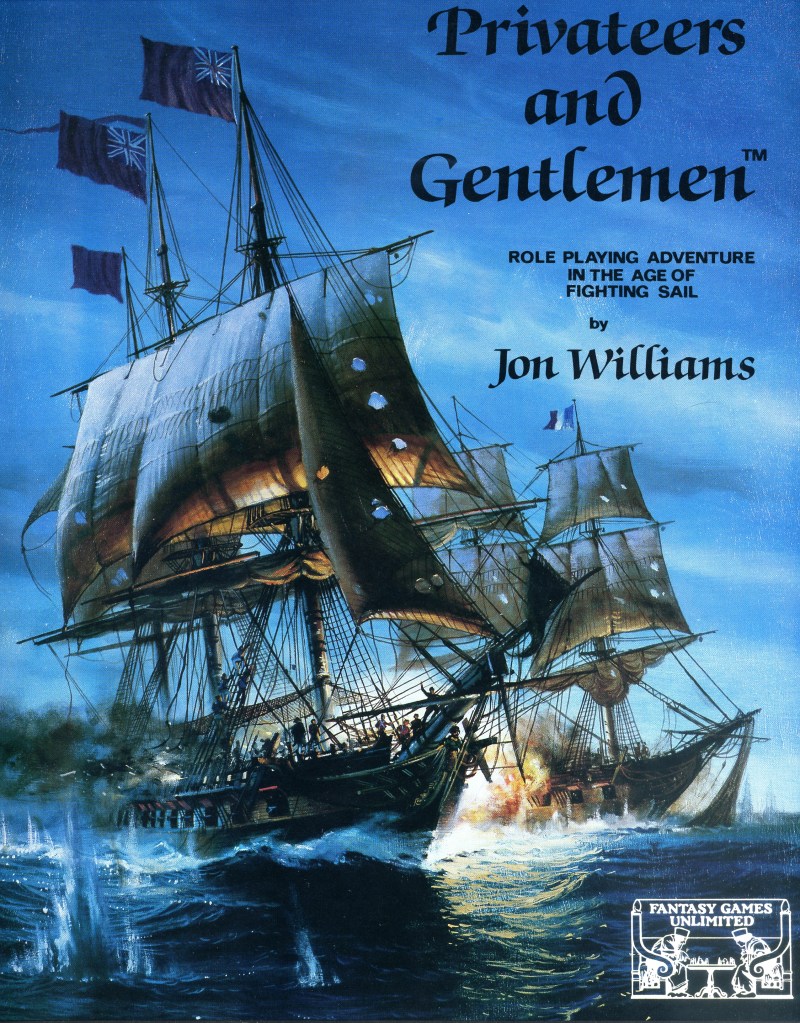
That game is Privateers and Gentlemen. I wrote about the game in 2017 here (Privateers and Gentlemen). Privateers and Gentlemen is a game of Napoleonic nautical sail. The game was published in 1978, the year after Traveller. But it has a feature that Traveller lacked in 1978. Its author, the writer Walter Jon Williams, was strategically located to make just this sort of game. He was from the upper Midwest (Minnesota) and was a war gamer who, anecdotally, was exposed to the early years of D&D within the war game community of that time. And, what did he do? He went out and wrote a game inspired by his experiences with D&D. But, unlike Ken St. Andre, he was a war gamer. When Privateers and Gentlemen was published in 1977 it was in exactly the same form as OD&D. OD&D was the miniature war game rules Chainmail with the Dungeons and Dragons rules published as a means of creating detailed characters with which to interact within a Braunsteined world. Privateers and Gentlemen, according to Walter Jon Williams, as published in 1978, was the Heart of Oak miniature rules plus the Promotions and Prizes supplement detailing how to create individual characters and run battles with them. Note the naming convention used in the original game title plus the “role playing” part mirrors the “blank and blank” format of Dungeons and Dragons. In 1981 a second edition was published that included an additional booklet Tradition of Victory which detailed constructing vessels and encounters on land plus a bunch of historical details.
While Tradition of Victory really adds to the game, the basic game format and approach matches that which was used in OD&D. And, unlike OD&D, was included together as a single unit. Now, it also lacks 1:1 time. And, it doesn’t explicitly spell out Braunsteins. But, OD&D didn’t explicitly spell out Braunstein’s either, people within the world of upper Midwest war gaming were familiar with the concept and couldn’t imagine that others needed it spelled out. But what is clear about Privateers and Gentlemen is that it was expected that numerous independent actors would be creating vessels and fleets (i.e. factions), then be moving them about the oceans, using fog-of-war and strict time-keeping, to then come into conflict in unexpected ways.
What does this add up to? Privateers and Gentlemen is not a role playing game in the same sense as Tunnels and Trolls is. But, it is a second D&D. Maybe the first second D&D. Someone would have to do a more complete historical review to be sure, but Privateers and Gentlemen, might well be the only true successor of Dungeons and Dragons.

 Fluid -- Druid
Leave a comment