

Disclaimer: this analysis uses solely the 1977 Traveller rules.
One of the tropes of Classic Traveller, and SF of that time, is the idea of refueling a starship by skimming hydrogen from the atmosphere of a gas giant.
See a example of a skimmng run here (https://youtu.be/ah-RvVUTX7U?si=Wh3h00KPnN8zsy8D).
While gas giant fuel skimming suffers a number of challenging issues on whether it will ever become a reality, for the purpose of the game it bears some looking at. Specifically, how star ports obtain the fuel that they sell to ships. In the rules refined fuel is found at A & B type star ports, while unrefined fuel is found at C & D type star ports.
So how do these star ports obtain the fuel they sell? They could be a wide variety of scenarios, but one scenario is that specialized ships are routinely travelling to a system gas giant, skimming fuel and hauling it back to the port for sale. Presumably the A & B type star ports have the specialized machinery available to refine the skimmed fuel for value-added sale.
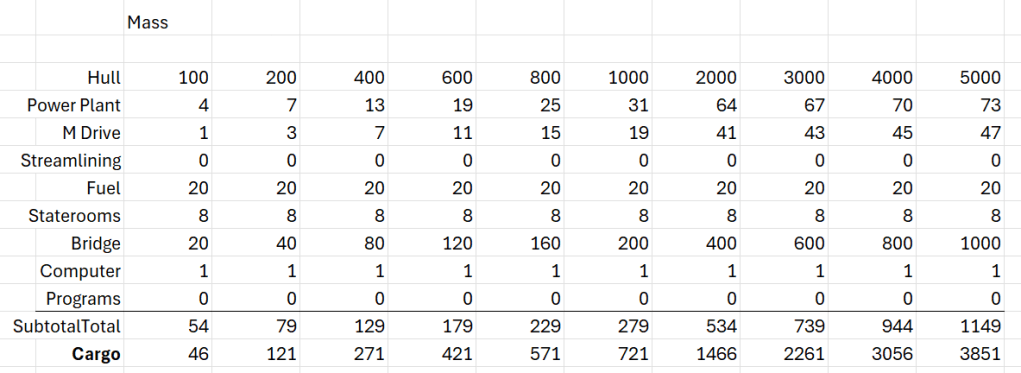
What are the in-game economics of such ships? Here’s a first cut analysis. Assumptions:
- Thrust requirement is 2g for safety during skimming
- Crew is a pilot and engineer
- No jump drive
- Minimal computer and programs limited to Maneuver.
- Streamlined Hull (required for skimming)
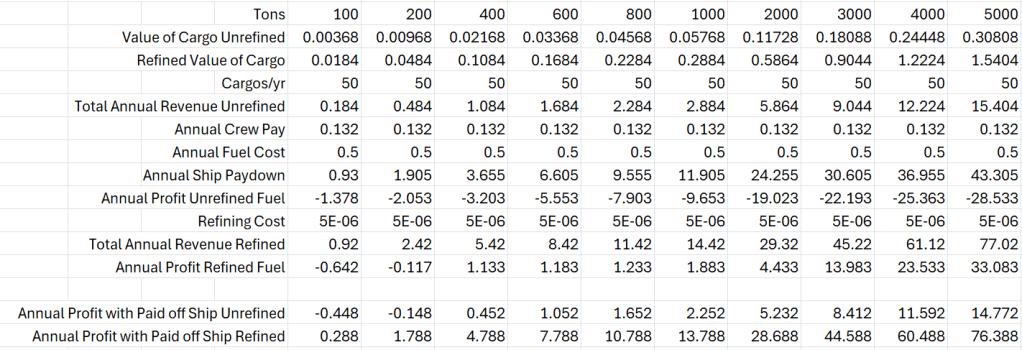
- Wholesale price of unrefined fuel is eighty percent of the retail price (thus 80 credits/ton)
- Cost to refine fuel is 5 credits per ton.
- Mass lost in refining in twenty percent (100 ton unrefined fuel produces 80 tons refined fuel).
- One delivered cargo per week (50 shipments per year)
- Tonnages reviewed:100, 200, 400, 600, 800, 1,000, 2,000, 3,000, 4,000, 5,000
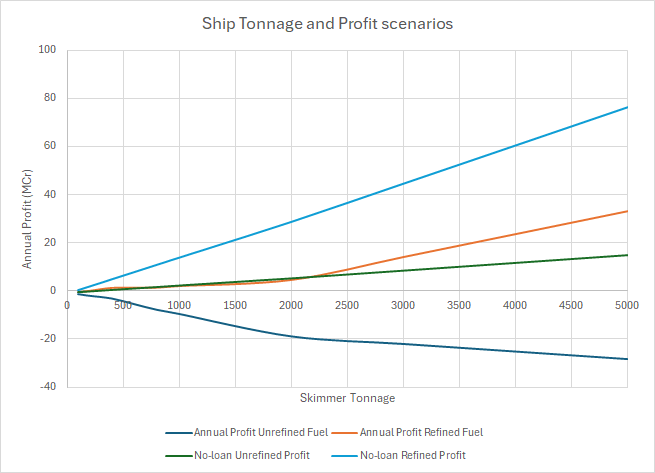
Detailed calculation results are shown below, but it mostly boils down to this chart showing the potential annual profits per ship size and sold product. Conclusions:
- Selling unrefined fuel is a money loser for any size of skimmer. The key then is to own your refining equipment and sell refined fuel.
- Even with selling refined fuel, the smaller ships (200 tons and less) remain money losers.
- The bigger the skimmer, the better in terms of profitability. Though this could bear further analysis for what level of future sales is expected within a system.
- Once a skimmer is paid off, for obvious reasons, profits are much improved. But, even with no loan payment, the 200 ton and smaller skimmers are money losers when selling unrefined fuel.
- To get your foot in the door of this profitable business, a man needs a down payment of 15 MCr for a 400 ton skimmer.
These conclusions could change with more detailed analysis, including:
- Better definition of system specific cycle times and maximum annual deliveries.
- Greater detail on costs of refining fuel and the capital equipment costs of refining. This will likely skew profitability toward even larger ships and the greater needed down payments.
- This analysis raises whether C & D class star ports actually obtain unrefined fuel from gas giants. Such ports have neither the capacity to build skimmers, nor if they could, would such skimmers be able to economically justify a loan. Likely, these rough ports obtain unrefined fuel from other processes.
- If C&D class star ports obtain fuel from other processes, then class A&B star ports could do the same. The costs of whatever the alternative process is would then need to be compared to the costs of operating skimmers.


 Fluid -- Druid
Leave a comment